Focal Point
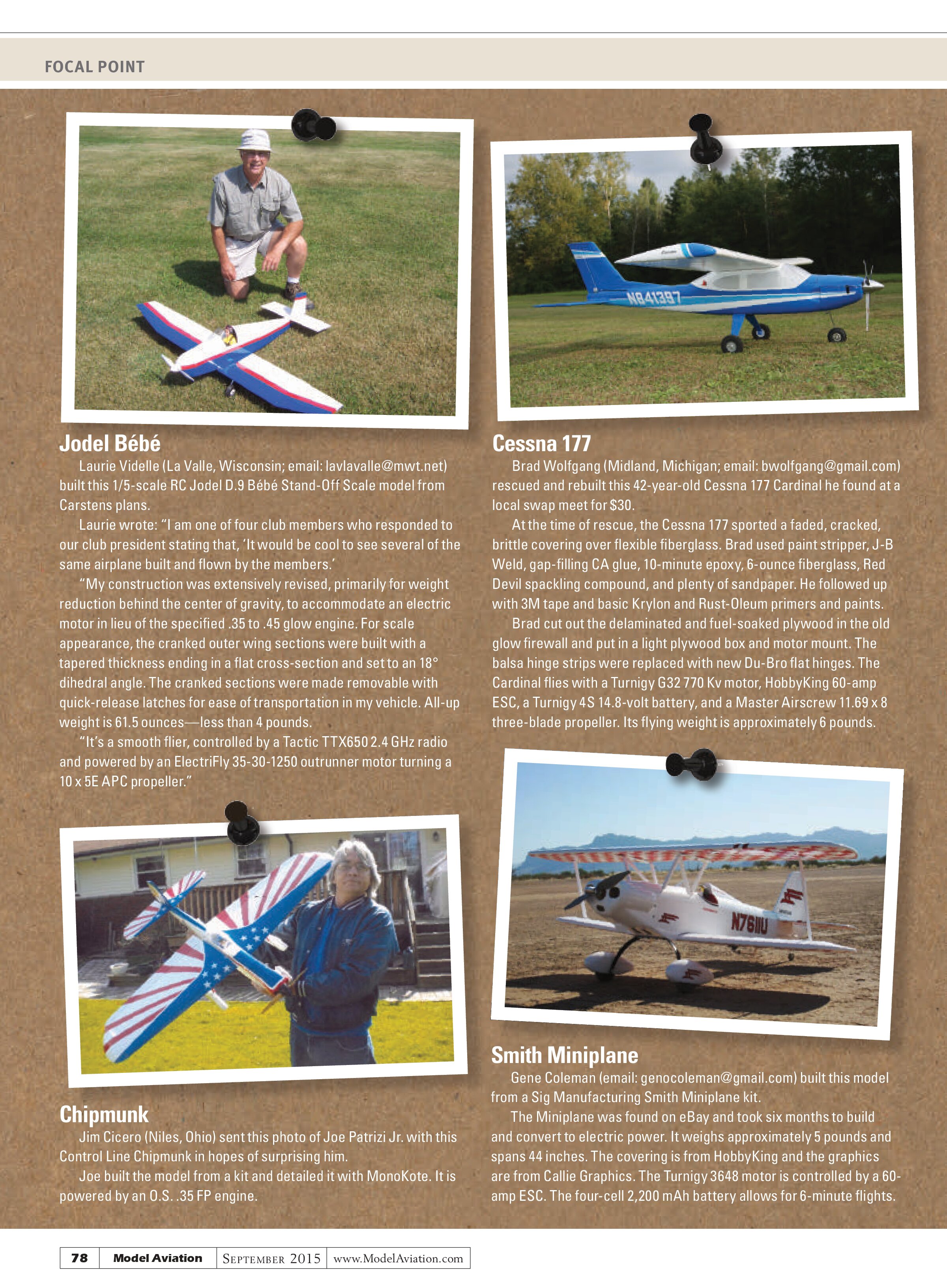
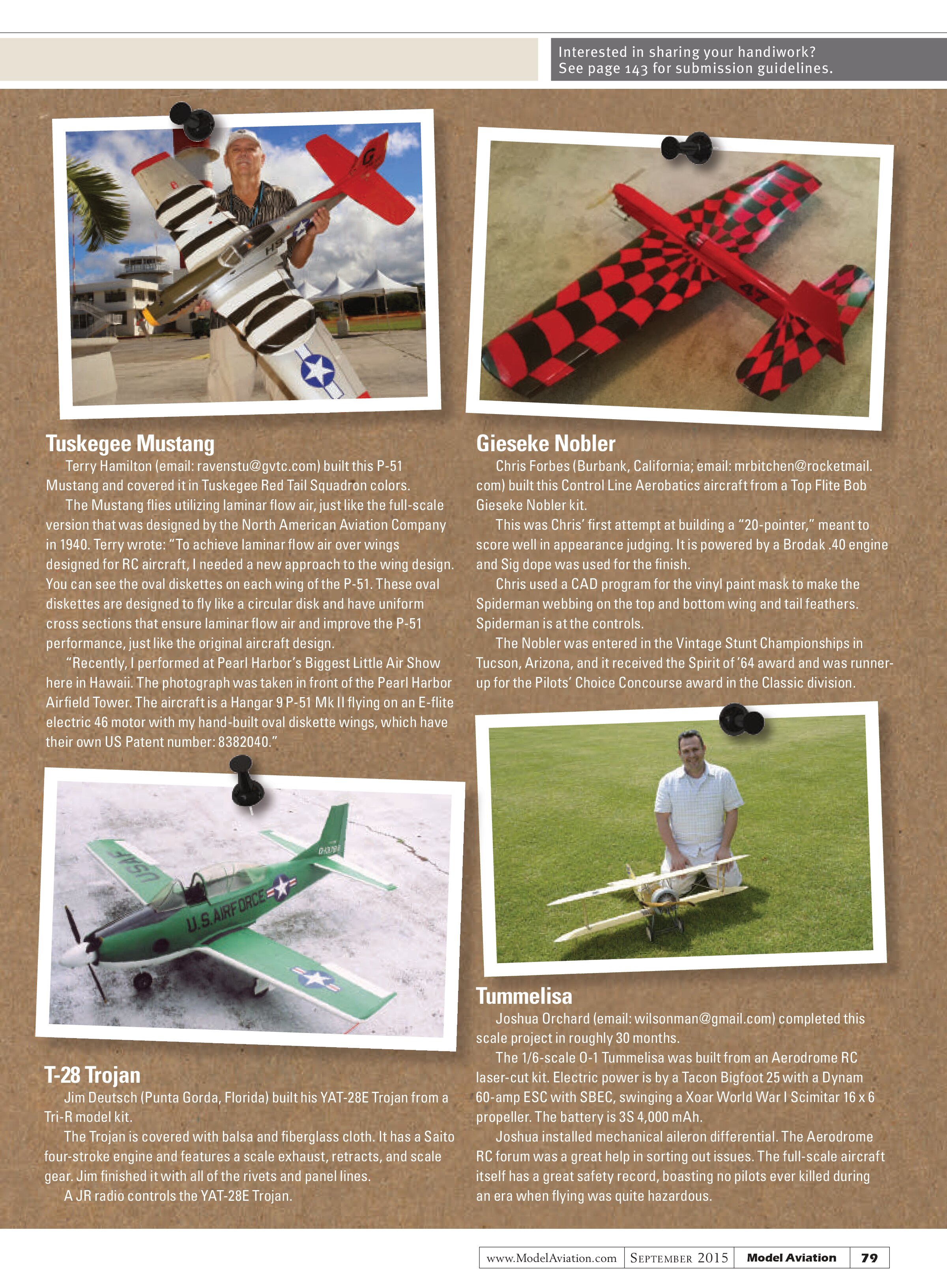
Jodel Bébé
Laurie Videlle (La Valle, Wisconsin; email: lavlavalle@mwt.net) built this 1/5-scale RC Jodel D.9 Bébé Stand-Off Scale model from Carstens plans.
Laurie wrote: “I am one of four club members who responded to our club president stating that, ‘It would be cool to see several of the same airplane built and flown by the members.’
“My construction was extensively revised, primarily for weight reduction behind the center of gravity, to accommodate an electric motor in lieu of the specified .35 to .45 glow engine. For scale appearance, the cranked outer wing sections were built with a tapered thickness ending in a flat cross-section and set to an 18° dihedral angle. The cranked sections were made removable with quick-release latches for ease of transportation in my vehicle. All-up weight is 61.5 ounces—less than 4 pounds.
“It’s a smooth flier, controlled by a Tactic TTX650 2.4 GHz radio and powered by an ElectriFly 35-30-1250 outrunner motor turning a 10 x 5E APC propeller.”

Chipmunk
Jim Cicero (Niles, Ohio) sent this photo of Joe Patrizi Jr. with this Control Line Chipmunk in hopes of surprising him.
Joe built the model from a kit and detailed it with MonoKote. It is powered by an O.S. .35 FP engine.

Cessna 177
Brad Wolfgang (Midland, Michigan; email: bwolfgang@gmail.com) rescued and rebuilt this 42-year-old Cessna 177 Cardinal he found at a local swap meet for $30.
At the time of rescue, the Cessna 177 sported a faded, cracked, brittle covering over flexible fiberglass. Brad used paint stripper, J-B Weld, gap-filling CA glue, 10-minute epoxy, 6-ounce fiberglass, Red Devil spackling compound, and plenty of sandpaper. He followed up with 3M tape and basic Krylon and Rust-Oleum primers and paints.
Brad cut out the delaminated and fuel-soaked plywood in the old glow firewall and put in a light plywood box and motor mount. The balsa hinge strips were replaced with new Du-Bro flat hinges. The Cardinal flies with a Turnigy G32 770 Kv motor, HobbyKing 60-amp ESC, a Turnigy 4S 14.8-volt battery, and a Master Airscrew 11.69 x 8 three-blade propeller. Its flying weight is approximately 6 pounds.

Smith Miniplane
Gene Coleman (email: genocoleman@gmail.com) built this model from a Sig Manufacturing Smith Miniplane kit.
The Miniplane was found on eBay and took six months to build and convert to electric power. It weighs approximately 5 pounds and spans 44 inches. The covering is from HobbyKing and the graphics are from Callie Graphics. The Turnigy 3648 motor is controlled by a 60-amp ESC. The four-cell 2,200 mAh battery allows for 6-minute flights.

Tuskegee Mustang
Terry Hamilton (email: ravenstu@gvtc.com) built this P-51 Mustang and covered it in Tuskegee Red Tail Squadron colors.
The Mustang flies utilizing laminar flow air, just like the full-scale version that was designed by the North American Aviation Company in 1940. Terry wrote: “To achieve laminar flow air over wings designed for RC aircraft, I needed a new approach to the wing design. You can see the oval diskettes on each wing of the P-51. These oval diskettes are designed to fly like a circular disk and have uniform cross sections that ensure laminar flow air and improve the P-51 performance, just like the original aircraft design.
“Recently, I performed at Pearl Harbor’s Biggest Little Air Show here in Hawaii. The photograph was taken in front of the Pearl Harbor Airfield Tower. The aircraft is a Hangar 9 P-51 Mk II flying on an E-flite electric 46 motor with my hand-built oval diskette wings, which have their own US Patent number: 8382040.”

T-28 Trojan
Jim Deutsch (Punta Gorda, Florida) built his YAT-28E Trojan from a Tri-R model kit.
The Trojan is covered with balsa and fiberglass cloth. It has a Saito four-stroke engine and features a scale exhaust, retracts, and scale gear. Jim finished it with all of the rivets and panel lines.
A JR radio controls the YAT-28E Trojan.

Gieseke Nobler
Chris Forbes (Burbank, California; email: mrbitchen@rocketmail.com) built this Control Line Aerobatics aircraft from a Top Flite Bob Gieseke Nobler kit.
This was Chris’ first attempt at building a “20-pointer,” meant to score well in appearance judging. It is powered by a Brodak .40 engine and Sig dope was used for the finish.
Chris used a CAD program for the vinyl paint mask to make the Spiderman webbing on the top and bottom wing and tail feathers. Spiderman is at the controls.
The Nobler was entered in the Vintage Stunt Championships in Tucson, Arizona, and it received the Spirit of ’64 award and was runner-up for the Pilots’ Choice Concourse award in the Classic division.

Tummelisa
Joshua Orchard (email: wilsonman@gmail.com) completed this scale project in roughly 30 months.
The 1/6-scale O-1 Tummelisa was built from an Aerodrome RC laser-cut kit. Electric power is by a Tacon Bigfoot 25 with a Dynam 60-amp ESC with SBEC, swinging a Xoar World War I Scimitar 16 x 6 propeller. The battery is 3S 4,000 mAh.
Joshua installed mechanical aileron differential. The Aerodrome RC forum was a great help in sorting out issues. The full-scale aircraft itself has a great safety record, boasting no pilots ever killed during an era when flying was quite hazardous.