F2D World Cup competitions
by Mark Rudner
rudner@mit.edu

The 2015 Combat season is now in full swing. At the time of this writing, all of my friends back home in the US are eagerly preparing for the Kansas City F2D contest. Although I haven’t had a chance to attend it, I have heard many great things about this annual competition hosted by Andy and Cary Minor.
It’s always good to see new big contests popping up on the calendar, and I know that those people are sure to put on a top-notch event. Assuming that it will be held again next year, I encourage as many of you as possible to go and support the effort.
Dreilander Pokal
Meanwhile, back in Europe, the Dreilander Pokal just wrapped up with its final stage in Aalborg, Denmark. The Dreilander (three lands) Cup is an annual series of three World Cup competitions in Germany, Sweden, and Denmark in the month of May. Three major F2D competitions in one month makes for an intense time, especially with the final two in Sweden and Denmark, which are typically held on consecutive weekends.
This year, the first leg was held in Bitterfeld, Germany, May 2-3. The US had great representation with Alex Prokofiev, Andrey Nadein, and Radik Magzianov flying in from New Jersey, Pennsylvania, and Florida. Alex flew to Copenhagen, and the two of us drove together to the competition.
This was my first time in Bitterfeld. Overall, I thought it was a good contest. The Combat area was rather tight, with not much space to set up a pit area. At first it looked as though it would be a problem, but it wasn’t an issue after the contest got underway.
A more unfortunate aspect of the site is the lack of a practice circle. When we arrived Friday evening, the fight for air time to test models was so great that pilots were flying two and even three at a time in the circle.
There were 40 entries, which is a good-sized meet. With only one flying circle available, pilots were forced to land as soon as each match was completed.
Although this rule has been in effect for a couple of years now, many still elect to crash-land their models rather than use an on-demand shutoff system. It’s hard on equipment, but for some I suppose it outweighs the risk of a “false fire” shutdown during a match. With this time-saving measure in place, however, the contest wrapped up in good time.
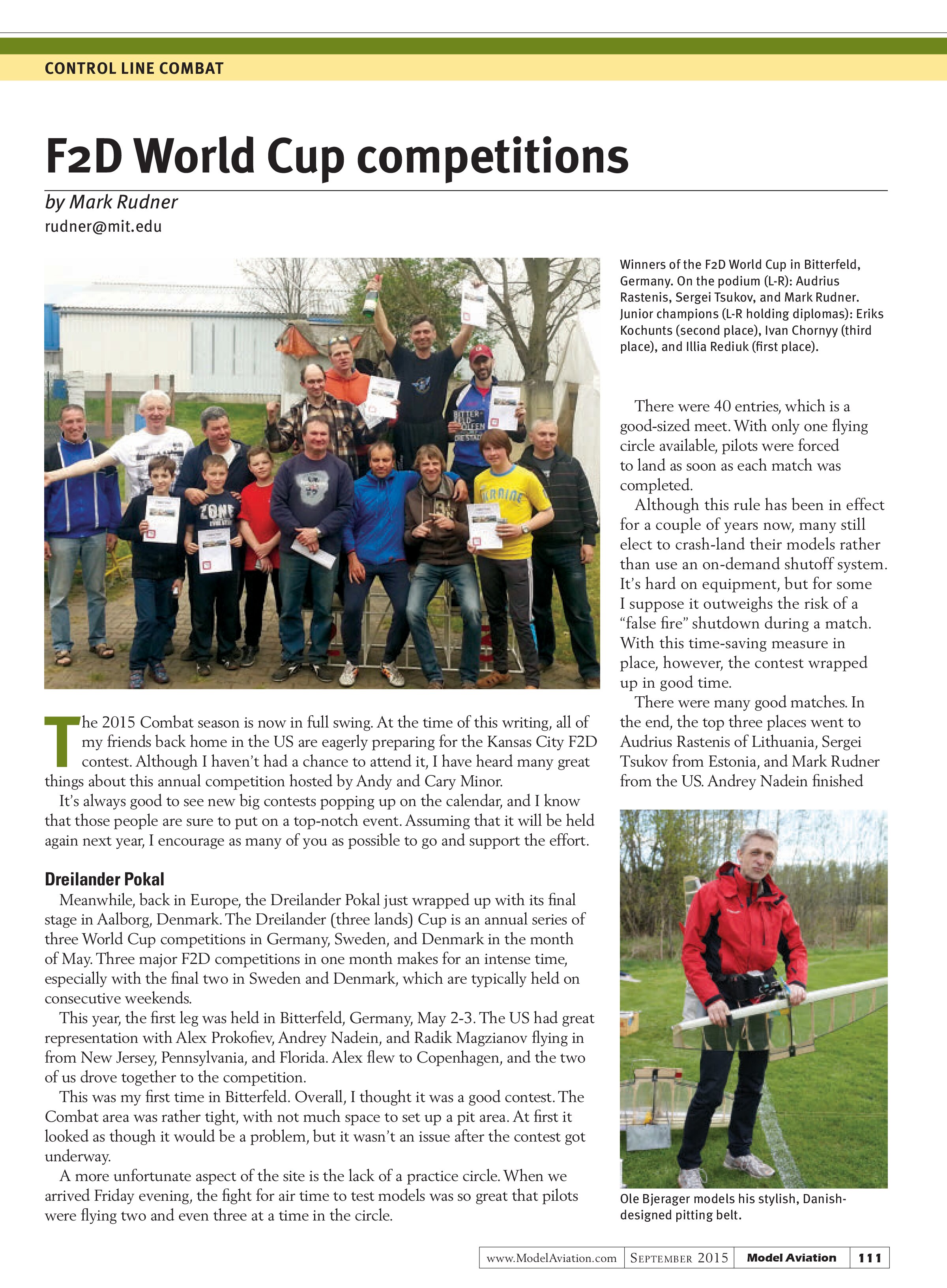
There were many good matches. In the end, the top three places went to Audrius Rastenis of Lithuania, Sergei Tsukov from Estonia, and Mark Rudner from the US. Andrey Nadein finished

in a tie with Boris Jalunins, Latvia, for fourth place.
It was great to see several Juniors in the mix as well. Illia Rediuk from Ukraine, took first in the Junior age division, followed by Eriks Kochunts from Latvia, and Ivan Chornyy of Ukraine. Illia is a top-notch pilot who can compete on strong footing against senior pilots.
Eriks’ flying has been rapidly improving, and I look forward to seeing him continue to advance in the coming years. Ivan and his brother, Dmytro, are also flying very well. These latter three pilots are still quite young, and show a lot of promise.
Two weeks after Bitterfeld, we met again for the Karlskoga World Cup in Karlskoga, Sweden, the home of Alfred Nobel. Alex and Andrey were back in the mix. Radik couldn’t make it back, but Chuck Rudner came from California to round out the US contingent.
The site in Karlskoga is beautiful. In addition to soft, plentiful green grass, there is a nice clubhouse, including lofts and a few cabins where people can stay at the site. I drove there with one of my flying partners from Copenhagen, André Bertelsen, on the Thursday before the competition. That first night I stayed in the uninsulated loft and it dropped below freezing. Enough roughing it for the weekend!

Many of the pilots who flew in Bitterfeld were on hand for the fight in Karlskoga. We had a field of 22. Andrey Nadein was back in his groove, and this time made his way to the top and grabbed first place. Alex Prokofiev was also in good form, taking third place, with Dima Varfolomejeев from Estonia in between.
The following week, 19 pilots were in Aalborg for the last stage of the Dreilander Pokal. Henning Forbech and André Bertelsen put in a huge number of hours to build a special F2D timing clock for the field. The seven-segment mechanical display has large, Day-Glo green numbers that can easily be seen from anywhere on the field. That was a nice addition to the competition.
Getting down to business, the top three places went to Gegzna Rimvydas of Lithuania, Boris Jalunins from Latvia, and Andrii Lutsyk of Ukraine. Because this competition signaled the end of the Dreilander Pokal, an overall prize was awarded for the best cumulative results among pilots who attended all three stages of the cup. Boris Jalunins took home the Dreilander Champion’s Cup, followed by Rudi Köigshofer from Austria, and Mark Rudner.
Unfortunately, next year the Control Line World Championships will conflict with the traditional dates of the Dreilander Pokal, so it is not clear yet what will happen to this trio of high-level F2D competitions. Keep your eye on the FAI contest calendar to find out the plans.
Technology
There are a few pieces of Combat technology to report on this month. Recently in the US (and on Facebook), there has been an escalating race to see who can build the “blingiest” Combat pit box.
The Danish team has brought some of its own design to the pit box concept. In the photo, you see Ole Bjerager modeling his Danish-style pitting belt. It’s a hybrid tool belt/fanny pack, with two syringe holsters on his right hip, and a starting battery with a panel ammeter built right in the front.
There’s an old saying that there’s no such thing as bad weather, only poor preparation. Well, I’ve lived in Denmark long enough to tell you that there actually is such a thing as bad weather. However, having grown up in it, the locals have some of their own solutions.
Combat pilots are tough, and we fly rain or shine. Nonetheless, sometimes it’s nice to have a dry place to stash your gear between rainy contest matches. In Karlskoga, the Danes set up small tents to shield their airplanes and other gear from the rain (see photo). I thought it was pretty cool!
That’s all for now. Next time I hope to have some new developments in electric-powered Combat technology to share. Until then, happy flying.
SOURCES:
Miniature Aircraft Combat Association (MACA)
www.macasite.org
Karlskoga World Cup
www.f2d.n.nu