Not for the faint of heart

by Bob Hunt
robinhunt@rcn.com
By now, regular readers of this column are aware that old Bob missed a deadline for the last “Control Line Aerobatics” column. Trust me: I have a pretty good excuse! I was down for nearly a month with severe back pain. Those who know me well are aware of my long battle with back pain. It started when I broke my back in the Army in 1968, and I’ve had severe sciatica on and off since then.
On Easter morning I did “something” that triggered the worst back and leg pain I’ve ever endured. I spent more than two weeks flat on my back, and then was treated to a wonderful ambulance ride to the hospital when the pain became unbearable. Writing—and just about everything else—was impossible for me during this siege.
The good news is that I’m on the mend. There is a lot of therapy ahead, and also a good bit of neurosurgery I’m told. Hey, getting old is not for the faint of heart!
I want to thank the many who called and/or emailed me with their wishes and prayers for a speedy and complete recovery. Trust me; it really helped (especially the prayers!).
New Venue
For the first time in 27 years, the United States FAI F2B (CL Aerobatics) Team Trials will not be conducted in Indiana. The Indiana run of team trials started in 1987, when they were conducted at the beautiful Mount Comfort Airport facility (now known as the Indianapolis Regional Airport) east of Indianapolis. That venue was home for four consecutive team trial cycles (1987, 1989, 1991, and 1993). They were moved to AMA’s Muncie facility in 1995, where they were contested through the 2014 FAI cycle.
I received the following information from the US FAI F2B Team Selection Committee chairperson, Randy Smith. The 2015 US F2B Team Trials will be held at Scobee Field, in Houston. The dates are October 10-11, 2015, with October 12 as a contingency day. Processing will be on Friday, October 9, at a building in the park.
The field will be open for practice the entire week before the team trials. The time for the pilots’ meeting will be announced on the field during the practice days.
Qualifying flights will be flown on Saturday, October 10. The finals will be flown on Sunday, October 11. Frank Williams will be the contest director. His contact information can be found in “Sources.” Frank has a listing of the motels in the area and will be happy to send that to you if you are interested in attending.
In speaking with Frank to get the particulars about this meet, the subject of the field came up. It will have two seamless concrete circles of 78-foot radii each available, and two 70-foot radius grass circles that will be open for practice flights during the contest. Frank told me that there is little turbulence at this site, no matter from which direction the wind blows. Sounds like a great place to hold this contest!
I’m happy to see the team selections move to other locations. I’m certain that there will be many new faces at this Team Trials.
Getting Loopy
No, this has nothing to do with any painkillers that I may or may not have taken for my aforementioned back pain. I had started discussing the Inside Loop maneuver in my May 2015 column. If you’ve been practicing this maneuver since reading that column, then you
This is difficult to achieve when the wind is blowing hard while you are flying. A strong wind will tend to “push” the model down from the 45° elevation at the top of the loop, and some piloting will be required to keep the shape round.
I’ve found that focusing on the center of the maneuver and not on the airplane, and using my peripheral vision, enables me to fly a better and more consistent shape. This takes practice if you’ve never tried it before.
I have one more tip about loops and consecutive maneuvers. When flying in dead-calm conditions, you will hit your own wake turbulence when performing the second and third loops, especially if the loops are concentric (tracking one on top of the other). This wake turbulence can, and often does, roll the model toward the pilot, causing loss of line tension and a crash!
You can avoid this problem by walking backward while flying the maneuver, causing the model to fly through relatively clean air at each bottom. It takes practice to perfect this technique, and you have to be careful that you move quickly back to the circle’s center during recovery to level flight so that you don’t hit anything during the ensuing level lap.
It’s Twins!
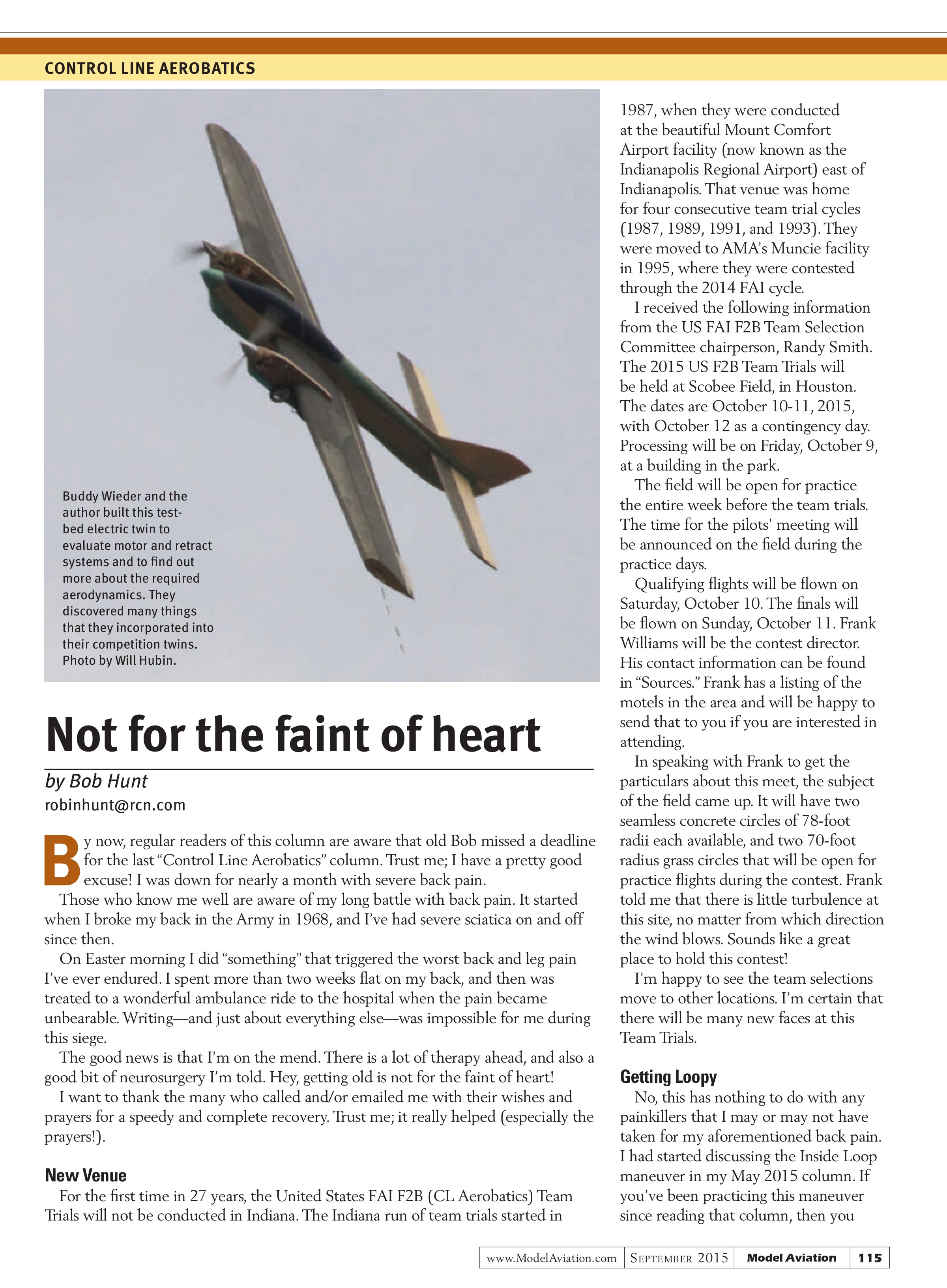
No, you don’t get a cigar. For the past couple of years, my friend and flying partner, Buddy Wieder, and I have been working on electric-powered, retractable landing gear-equipped, twin-motor Stunt models. We built a test-bed model that featured a built-up fuselage and profile nacelles. We learned a lot from the test model and have incorporated all we’ve learned into two new, full-bore contest models.
Buddy finished his twin first, and has been flying it for about a week as this is being written. It flies great, and he should be able to debut it at this year’s Nats.
In the future I’ll present information about our new twins, but I thought you might like a sneak preview. The photos show our test-bed model in flight, Buddy’s new Ryan’s “Evil” Twin design, and my new American Spirit design covered with carbon mat and awaiting finish.
SOURCES:
Frank Williams
(281) 488-1371
lonestar_77062@yahoo.com
Precision Aerobatics Model Pilots Association (PAMPA)
www.pampacl.org