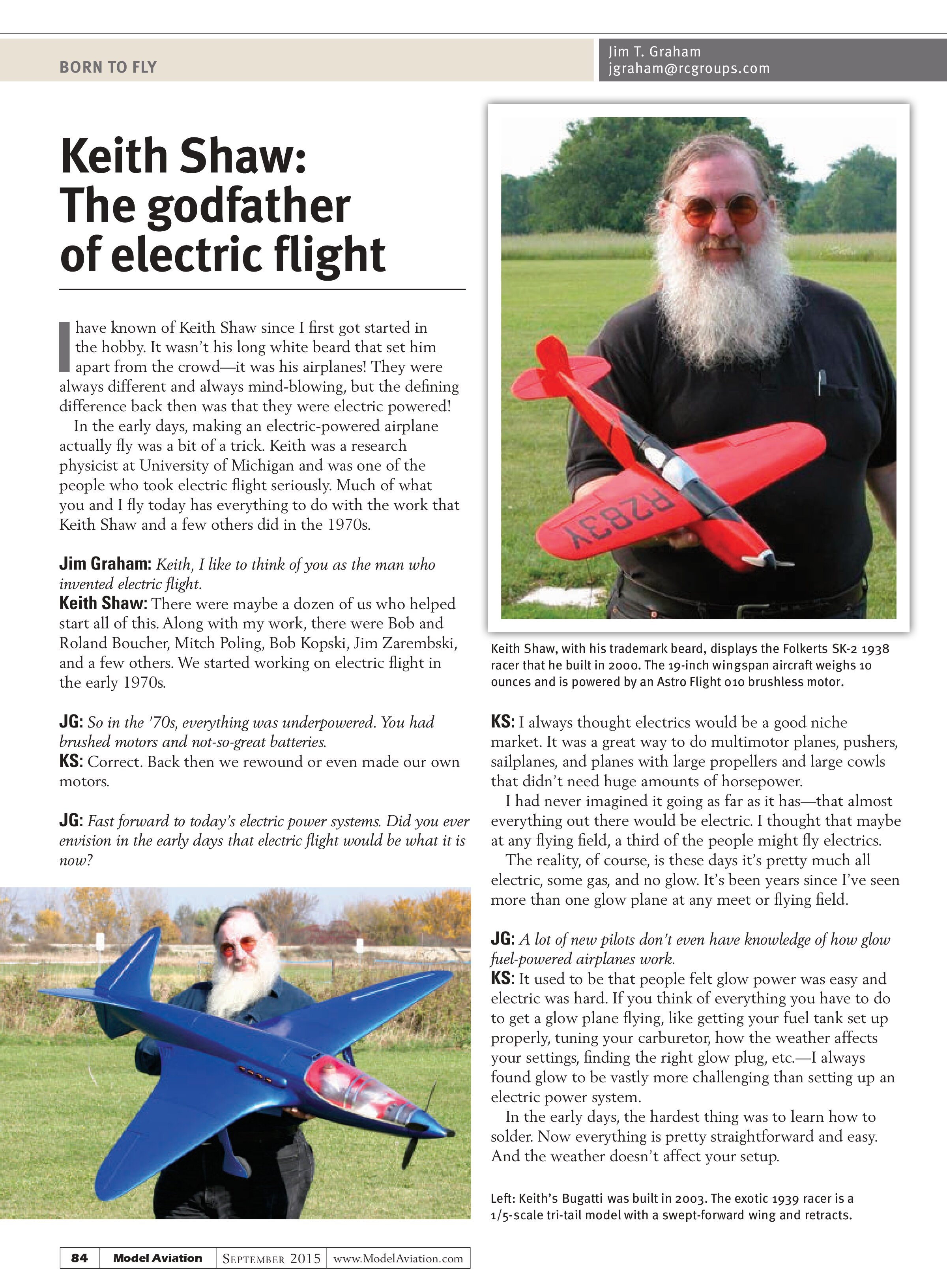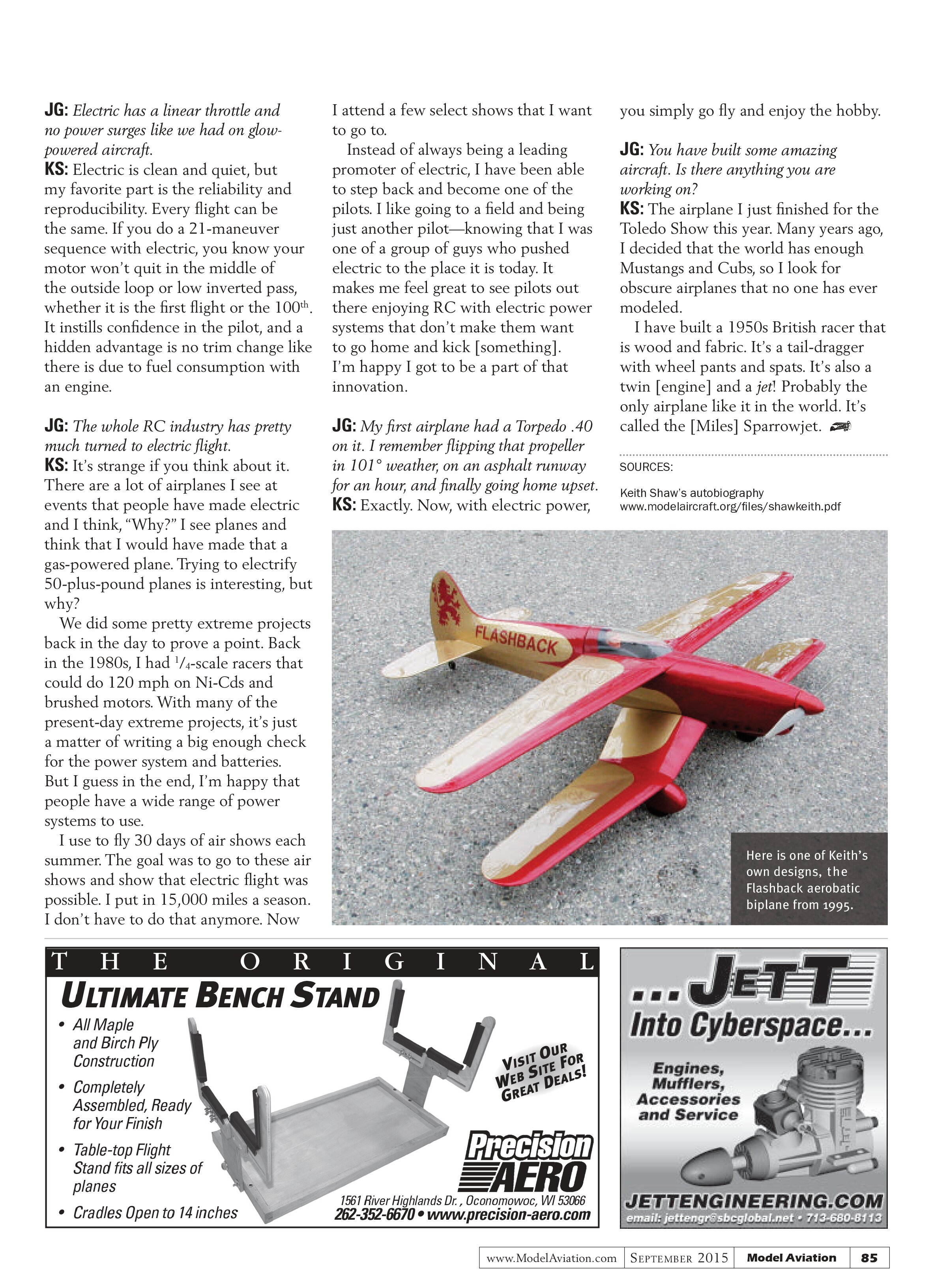
Keith Shaw: The godfather of electric flight
I have known of Keith Shaw since I first got started in the hobby. It wasn’t his long white beard that set him apart from the crowd—it was his airplanes! They were always different and always mind-blowing, but the defining difference back then was that they were electric powered!
In the early days, making an electric-powered airplane actually fly was a bit of a trick. Keith was a research physicist at University of Michigan and was one of the people who took electric flight seriously. Much of what you and I fly today has everything to do with the work that Keith Shaw and a few others did in the 1970s.
Jim Graham: Keith, I like to think of you as the man who invented electric flight.
Keith Shaw: There were maybe a dozen of us who helped start all of this. Along with my work, there were Bob and Roland Boucher, Mitch Poling, Bob Kopski, Jim Zarembski, and a few others. We started working on electric flight in the early 1970s.

JG: So in the ’70s, everything was underpowered. You had brushed motors and not-so-great batteries.
KS: Correct. Back then we rewound or even made our own motors.
JG: Fast forward to today’s electric power systems. Did you ever envision in the early days that electric flight would be what it is now?

KS: I always thought electrics would be a good niche market. It was a great way to do multimotor planes, pushers, sailplanes, and planes with large propellers and large cowls that didn’t need huge amounts of horsepower.
I had never imagined it going as far as it has—that almost everything out there would be electric. I thought that maybe at any flying field, a third of the people might fly electrics.
The reality, of course, is these days it’s pretty much all electric, some gas, and no glow. It’s been years since I’ve seen more than one glow plane at any meet or flying field.
JG: A lot of new pilots don’t even have knowledge of how glow fuel-powered airplanes work.
KS: It used to be that people felt glow power was easy and electric was hard. If you think of everything you have to do to get a glow plane flying, like getting your fuel tank set up properly, tuning your carburetor, how the weather affects your settings, finding the right glow plug, etc.—I always found glow to be vastly more challenging than setting up an electric power system.
In the early days, the hardest thing was to learn how to solder. Now everything is pretty straightforward and easy. And the weather doesn’t affect your setup.
JG: Electric has a linear throttle and no power surges like we had on glow-powered aircraft.
KS: Electric is clean and quiet, but my favorite part is the reliability and reproducibility. Every flight can be the same. If you do a 21-maneuver sequence with electric, you know your motor won’t quit in the middle of the outside loop or low inverted pass, whether it is the first flight or the 100th. It instills confidence in the pilot, and a hidden advantage is no trim change like there is due to fuel consumption with an engine.
JG: The whole RC industry has pretty much turned to electric flight.
KS: It’s strange if you think about it. There are a lot of airplanes I see at events that people have made electric and I think, “Why?” I see planes and think that I would have made that a gas-powered plane. Trying to electrify 50-plus-pound planes is interesting, but why?
We did some pretty extreme projects back in the day to prove a point. Back in the 1980s, I had 1/4-scale racers that could do 120 mph on Ni-Cds and brushed motors. With many of the present-day extreme projects, it’s just a matter of writing a big enough check for the power system and batteries. But I guess in the end, I’m happy that people have a wide range of power systems to use.
I use to fly 30 days of air shows each summer. The goal was to go to these air shows and show that electric flight was possible. I put in 15,000 miles a season. I don’t have to do that anymore. Now
I attend a few select shows that I want to go to.
Instead of always being a leading promoter of electric, I have been able to step back and become one of the pilots. I like going to a field and being just another pilot—knowing that I was one of a group of guys who pushed electric to the place it is today. It makes me feel great to see pilots out there enjoying RC with electric power systems that don’t make them want to go home and kick [something]. I’m happy I got to be a part of that innovation.
JG: My first airplane had a Torpedo .40 on it. I remember flipping that propeller in 101° weather, on an asphalt runway for an hour, and finally going home upset.
KS: Exactly. Now, with electric power,

you simply go fly and enjoy the hobby.
JG: You have built some amazing aircraft. Is there anything you are working on?
KS: The airplane I just finished for the Toledo Show this year. Many years ago, I decided that the world has enough Mustangs and Cubs, so I look for obscure airplanes that no one has ever modeled.
I have built a 1950s British racer that is wood and fabric. It’s a tail-dragger with wheel pants and spats. It’s also a twin [engine] and a jet! Probably the only airplane like it in the world. It’s called the [Miles] Sparrowjet.
SOURCES:
Keith Shaw’s autobiography
www.modelaircraft.org/files/shawkeith.pdf