Sharing the love
Thayer Syme
thayer@flying-models.com
It is always great to hear from people who read this column. I like seeing what you are up to and sharing it with other readers.
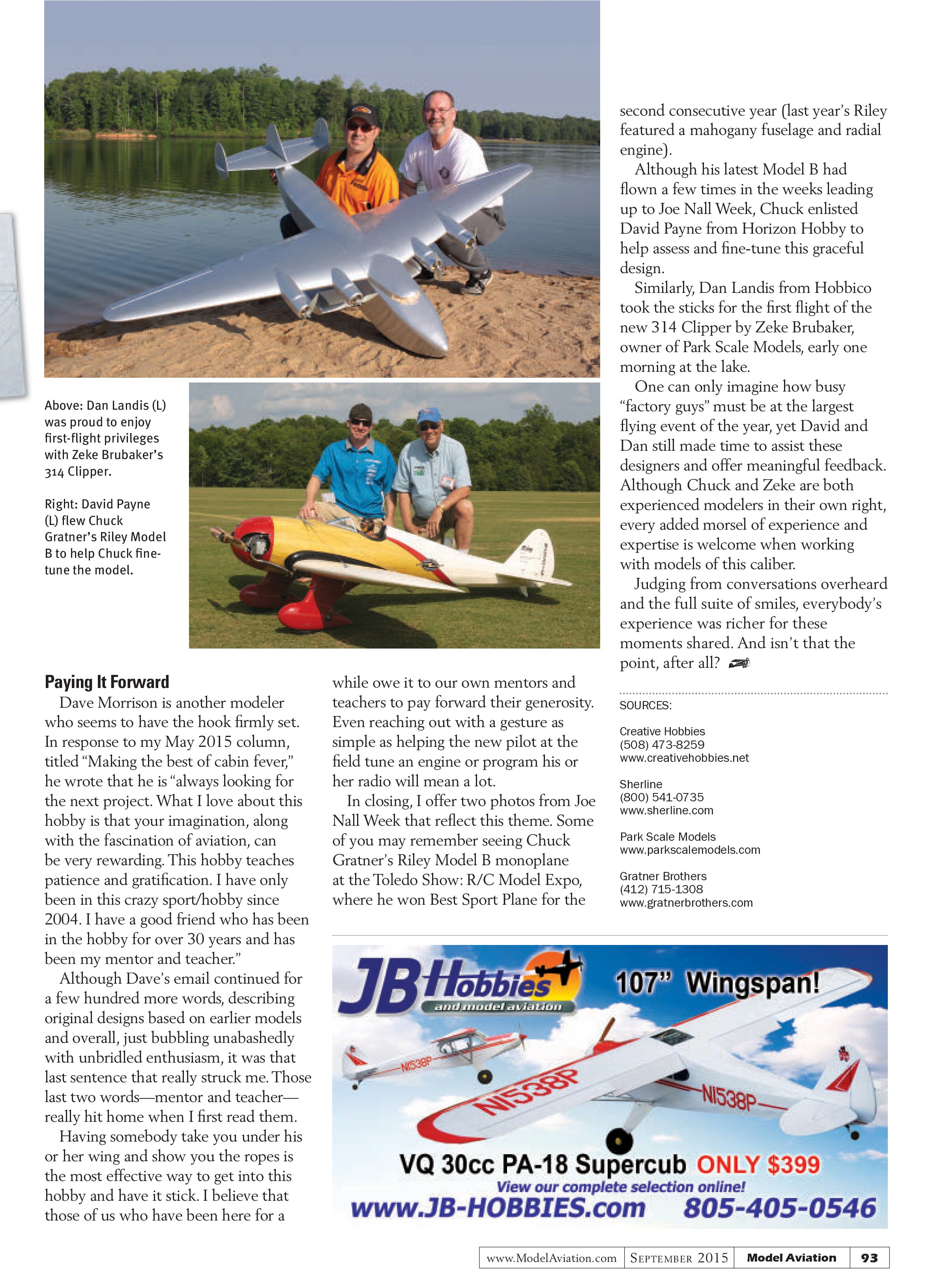
Ron Bouchard wrote to share with us his latest winter project, Fred Randall’s Golden Era 60 biplane. This beauty was originally featured in the February 2009 issue of Model Aviation, and the plans are available through the AMA Plans Service as plans number 1025. I believe Ron started with a laser-cut kit from Creative Hobbies.
“I had hoped to have it completed by the NEAT [Northeast Electric Aircraft Technology] Fair, but that is looking further and further from reality at this point. Maybe next year, unless some miracle takes place between now and then, but my honey-do list keeps getting in the way!
“My version will be electric, powered by an Atlas 4030/12 60-size motor, with a 100 [amp] ESC and power from a 5S 4,000 mAh pack. The upper wing measures 55.25 inches and the lower 49.25 inches. The weight as you see it now is 6.5 [pounds] with the motor, ESC, and battery pack all temporarily installed.
“In Fred’s article, he said his inspiration for the model was the Knight Twister, a picture of which he first saw in an Air Trails magazine back in 1938, when he was a kid. With that in mind, my pilot bust will need to be larger. I never realized how small that plane was until I searched it on Google.”
Ron, thanks so much for sharing your model with us! This is a popular design that has a lot of appeal for Golden Age fans. Your project clearly exemplifies the enjoyment garnered while building your own model and the opportunity that adding a little creativity offers.
Your electric conversion is intriguing and I look forward to seeing it at the NEAT Fair, if not this year, then next year. It looks like it is coming along nicely and as long as you’re having fun in the workshop, it doesn’t really matter when it flies.
I especially like Ron’s battery hatch. That is a nice, neat cutout, and the use of the Venturi as a handle is a nice touch! Presumably Ron is planning a magnetic catch for the cover plate, which should work out well given the lack of vibration with an electric power system. It’s the little details such as this that set a personal project apart from mass-produced models.
Jordan Segal wrote to thank me for my column in the January 2015 Model Aviation. He had been looking for a small milling vise to complement a small mill he purchased a couple of years ago, and had forgotten about checking Sherline. That’s nice to hear because I use my Sherline equipment all the time and I think it is an ideal size for most of our machining needs. Being able to easily move and store tools under the workbench if needed is a huge bonus for workshops with limited space.
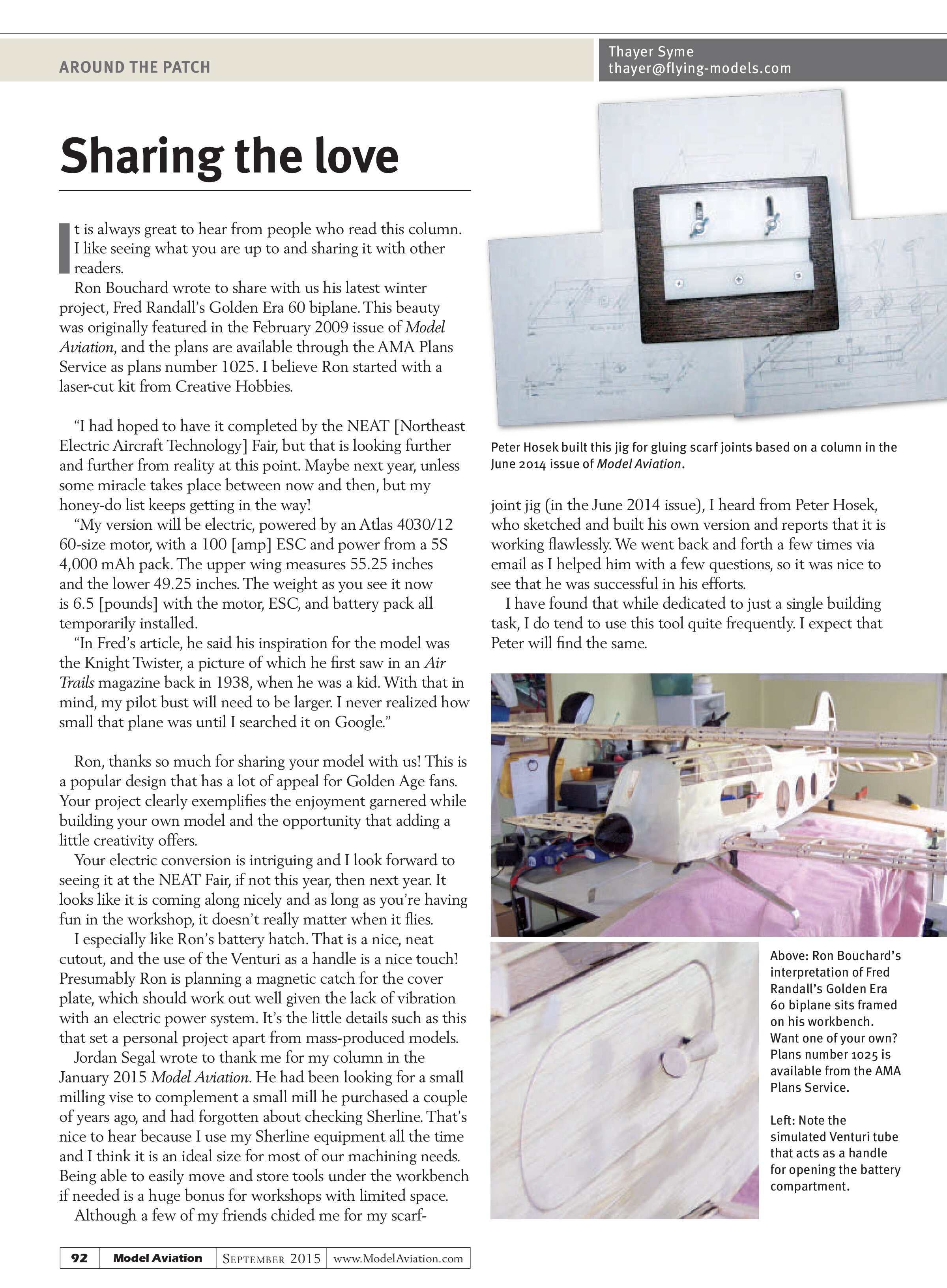
Although a few of my friends chided me for my scarf-joint jig (in the June 2014 issue), I heard from Peter Hosek, who sketched and built his own version and reports that it is working flawlessly. We went back and forth a few times via email as I helped him with a few questions, so it was nice to see that he was successful in his efforts.
I have found that while dedicated to just a single building task, I do tend to use this tool quite frequently. I expect that Peter will find the same.
Peter Hosek built this jig for gluing scarf joints based on a column in the June 2014 issue of Model Aviation.


Jordan Segal wrote to thank me for my column in the January 2015 Model Aviation. He had been looking for a small milling vise to complement a small mill he purchased a couple of years ago, and had forgotten about checking Sherline. That’s nice to hear because I use my Sherline equipment all the time and I think it is an ideal size for most of our machining needs. Being able to easily move and store tools under the workbench if needed is a huge bonus for workshops with limited space.
Although a few of my friends chided me for my scarf-joint jig (in the June 2014 issue), I heard from Peter Hosek, who sketched and built his own version and reports that it is working flawlessly. We went back and forth a few times via email as I helped him with a few questions, so it was nice to see that he was successful in his efforts.
I have found that while dedicated to just a single building task, I do tend to use this tool quite frequently. I expect that Peter will find the same.


Above: Dan Landis (L) was proud to enjoy first-flight privileges with Zeke Brubaker’s 314 Clipper.
Right: David Payne (L) flew Chuck Gratner’s Riley Model B to help Chuck fine-tune the model.
Although a few of my friends chided me for my scarf-joint jig (in the June 2014 issue), I heard from Peter Hosek, who sketched and built his own version and reports that it is working flawlessly. We went back and forth a few times via email as I helped him with a few questions, so it was nice to see that he was successful in his efforts. I have found that while dedicated to just a single building task, I do tend to use this tool quite frequently. I expect that Peter will find the same.
Although a few of my friends chided me for my scarf-joint jig (in the June 2014 issue), I heard from Peter Hosek, who sketched and built his own version and reports that it is working flawlessly.
second consecutive year (last year’s Riley featured a mahogany fuselage and radial engine).
Although his latest Model B had flown a few times in the weeks leading up to Joe Nall Week, Chuck enlisted David Payne from Horizon Hobby to help assess and fine-tune this graceful design.
Similarly, Dan Landis from Hobbico took the sticks for the first flight of the new 314 Clipper by Zeke Brubaker, owner of Park Scale Models, early one morning at the lake.
One can only imagine how busy “factory guys” must be at the largest flying event of the year, yet David and Dan still made time to assist these designers and offer meaningful feedback. Although Chuck and Zeke are both experienced modelers in their own right, every added morsel of experience and expertise is welcome when working with models of this caliber.
Judging from conversations overheard and the full suite of smiles, everybody’s experience was richer for these moments shared. And isn’t that the point, after all?
Paying It Forward
Dave Morrison is another modeler who seems to have the hook firmly set. In response to my May 2015 column, titled “Making the best of cabin fever,” he wrote that he is “always looking for the next project. What I love about this hobby is that your imagination, along with the fascination of aviation, can be very rewarding. This hobby teaches patience and gratification. I have only been in this crazy sport/hobby since 2004. I have a good friend who has been in the hobby for over 30 years and has been my mentor and teacher.”
Although Dave’s email continued for a few hundred more words, describing original designs based on earlier models and overall, just bubbling unabashedly with unbridled enthusiasm, it was that last sentence that really struck me. Those last two words—mentor and teacher—really hit home when I first read them.
Having somebody take you under his or her wing and show you the ropes is the most effective way to get into this hobby and have it stick. I believe that those of us who have been here for a while owe it to our own mentors and teachers to pay forward their generosity. Even reaching out with a gesture as simple as helping the new pilot at the field tune an engine or program his or her radio will mean a lot.
In closing, I offer two photos from Joe Nall Week that reflect this theme. Some of you may remember seeing Chuck Gratner’s Riley Model B monoplane at the Toledo Show: R/C Model Expo, where he won Best Sport Plane for the second consecutive year (last year’s Riley featured a mahogany fuselage and radial engine).
Although his latest Model B had flown a few times in the weeks leading up to Joe Nall Week, Chuck enlisted David Payne from Horizon Hobby to help assess and fine-tune this graceful design.
Similarly, Dan Landis from Hobbico took the sticks for the first flight of the new 314 Clipper by Zeke Brubaker, owner of Park Scale Models, early one morning at the lake.
One can only imagine how busy “factory guys” must be at the largest flying event of the year, yet David and Dan still made time to assist these designers and offer meaningful feedback. Although Chuck and Zeke are both experienced modelers in their own right, every added morsel of experience and expertise is welcome when working with models of this caliber.
Judging from conversations overheard and the full suite of smiles, everybody’s experience was richer for these moments shared. And isn’t that the point, after all?
SOURCES:
Creative Hobbies
(508) 473-8259
www.creativehobbies.net
Sherline
(800) 541-0735
www.sherline.com
Park Scale Models
www.parkscalemodels.com
Gratner Brothers
(412) 715-1308
www.gratnerbrothers.com