In the Air
Membership news and updates
from AMA Headquarters
Lazy Larry
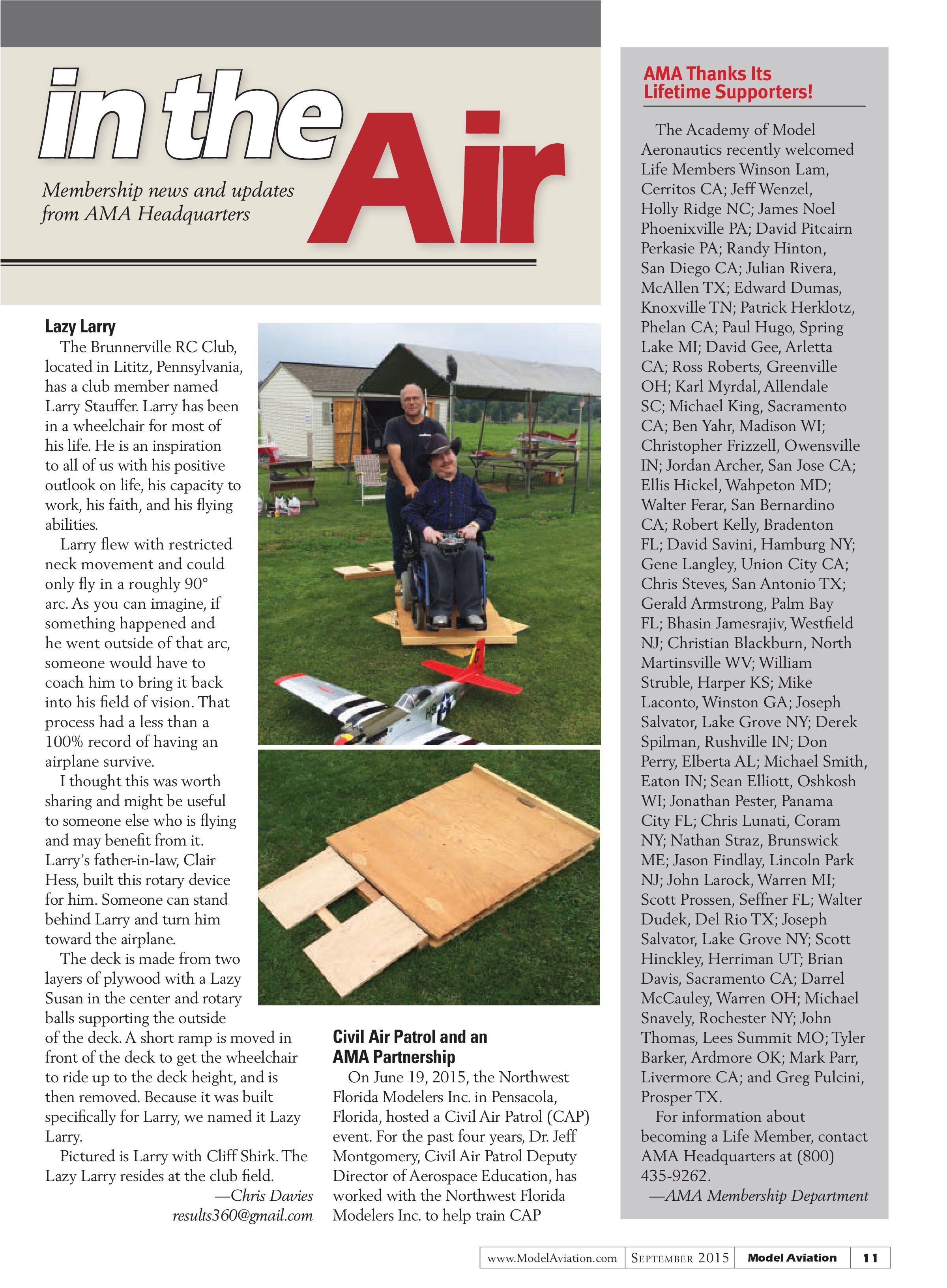
The Brunnerville RC Club, located in Lititz, Pennsylvania, has a club member named Larry Stauffer. Larry has been in a wheelchair for most of his life. He is an inspiration to all of us with his positive outlook on life, his capacity to work, his faith, and his flying abilities.
Larry flew with restricted neck movement and could only fly in a roughly 90° arc. As you can imagine, if something happened and he went outside of that arc, someone would have to coach him to bring it back into his field of vision. That process had a less than a 100% record of having an airplane survive.
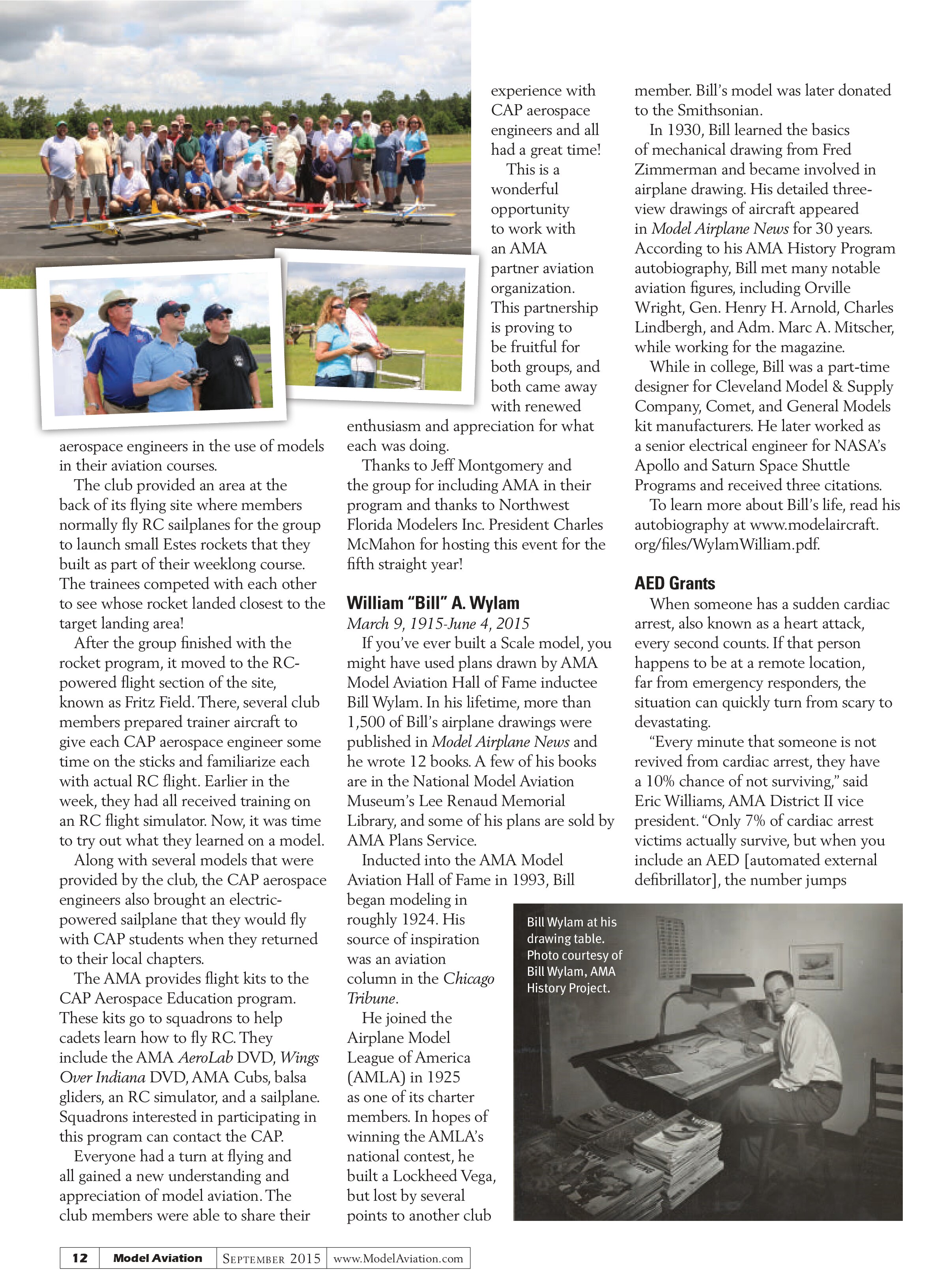
I thought this was worth sharing and might be useful to someone else who is flying and may benefit from it. Larry’s father-in-law, Clair Hess, built this rotary device for him. Someone can stand behind Larry and turn him toward the airplane.
The deck is made from two layers of plywood with a Lazy Susan in the center and rotary balls supporting the outside of the deck. A short ramp is moved in front of the deck to get the wheelchair to ride up to the deck height, and is then removed. Because it was built specifically for Larry, we named it Lazy Larry.


Civil Air Patrol and an AMA Partnership
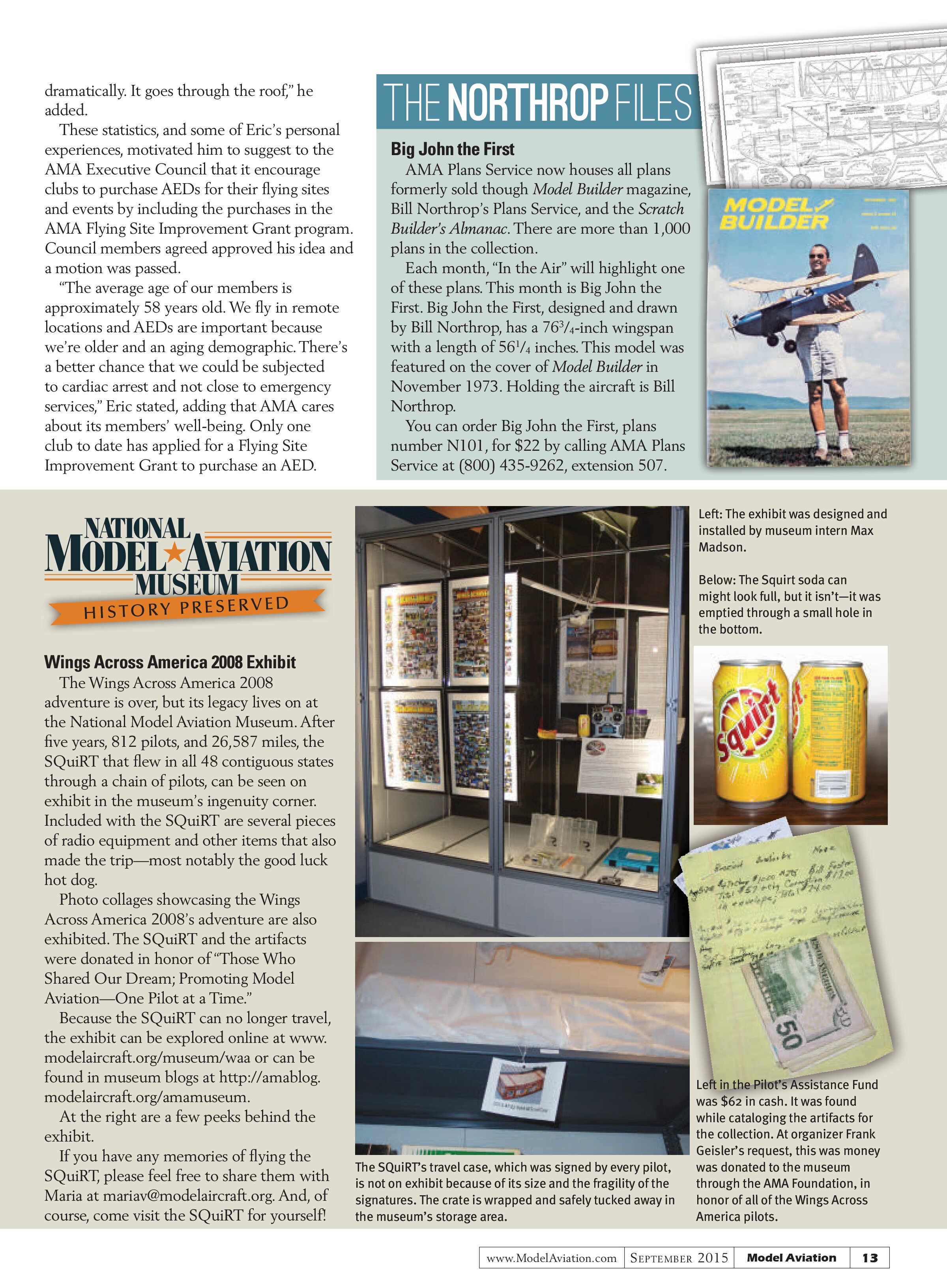
On June 19, 2015, the Northwest Florida Modelers Inc. in Pensacola, Florida, hosted a Civil Air Patrol (CAP) event. For the past four years, Dr. Jeff Montgomery, Civil Air Patrol Deputy Director of Aerospace Education, has worked with the Northwest Florida Modelers Inc. to help train CAP
experience with CAP aerospace engineers and all had a great time! This is a wonderful opportunity to work with an AMA partner aviation organization. This partnership is proving to be fruitful for both groups, and both came away with renewed enthusiasm and appreciation for what each was doing.


Thanks to Jeff Montgomery and the group for including AMA in their program and thanks to Northwest Florida Modelers Inc. President Charles McMahon for hosting this event for the fifth straight year!
William “Bill” A. Wylam
March 9, 1915-June 4, 2015
If you’ve ever built a Scale model, you might have used plans drawn by AMA Model Aviation Hall of Fame inductee Bill Wylam. In his lifetime, more than 1,500 of Bill’s airplane drawings were published in Model Airplane News and he wrote 12 books. A few of his books are in the National Model Aviation Museum’s Lee Renaud Memorial Library, and some of his plans are sold by AMA Plans Service.
Inducted into the AMA Model Aviation Hall of Fame in 1993, Bill began modeling in roughly 1924. His source of inspiration was an aviation column in the Chicago Tribune. He joined the Airplane Model League of America (AMLA) in 1925 as one of its charter members. In hopes of winning the AMLA’s national contest, he built a Lockheed Vega, but lost by several points to another club member. Bill’s model was later donated to the Smithsonian.
In 1930, Bill learned the basics of mechanical drawing from Fred Zimmerman and became involved in airplane drawing. His detailed three-view drawings of aircraft appeared in Model Airplane News for 30 years. According to his AMA History Program autobiography, Bill met many notable aviation figures, including Orville Wright, Gen. Henry H. Arnold, Charles Lindbergh, and Adm. Marc A. Mitscher, while working for the magazine.
While in college, Bill was a part-time designer for Cleveland Model & Supply Company, Comet, and General Models kit manufacturers. He later worked as a senior electrical engineer for NASA’s Apollo and Saturn Space Shuttle Programs and received three citations.
To learn more about Bill’s life, read his autobiography at www.modelaircraft.org/files/WylamWilliam.pdf.

AED Grants
When someone has a sudden cardiac arrest, also known as a heart attack, every second counts. If that person happens to be at a remote location, far from emergency responders, the situation can quickly turn from scary to devastating.
“Every minute that someone is not revived from cardiac arrest, they have a 10% chance of not surviving,” said Eric Williams, AMA District II vice president. “Only 7% of cardiac arrest victims actually survive, but when you include an AED [automated external defibrillator], the number jumps dramatically. It goes through the roof,” he added.
These statistics, and some of Eric’s personal experiences, motivated him to suggest to the AMA Executive Council that it encourage clubs to purchase AEDs for their flying sites and events by including the purchases in the AMA Flying Site Improvement Grant program. Council members agreed approved his idea and a motion was passed.
“The average age of our members is approximately 58 years old. We fly in remote locations and AEDs are important because we’re older and an aging demographic. There’s a better chance that we could be subjected to cardiac arrest and not close to emergency services,” Eric stated, adding that AMA cares about its members’ well-being. Only one club to date has applied for a Flying Site Improvement Grant to purchase an AED.