Considerations for making your own multirotor
Patrick Sherman
lucidity@roswellflighttestcrew.com

If you’re interested in flying a multirotor aircraft, you have an easy choice to make. Which of the excellent platforms that are currently available and ready to go right out of the box do you choose? The ubiquitous DJI Phantom 3 or the formidable Inspire 1? The feature-rich 3DR Solo, or my current favorite, the Yuneec Typhoon Q500+? So many choices …
However, if you’re interested in building your own multirotor—and as a reader of Model Aviation magazine, I suspect that you are more inclined than most to follow this route—you face a more complicated set of questions. What components should I use, and how can I be sure that they will come together to create a safe, reliable aircraft?
The Three Musketeers
There are many components that you’ll need to consider—from the airframe, to the battery, to the flight management system—but the three that create the most confusion among new builders are the propellers, the motors, and the ESCs. Choosing from among the options is made even more complicated by the fact that any change you make to one of them affects the other two.
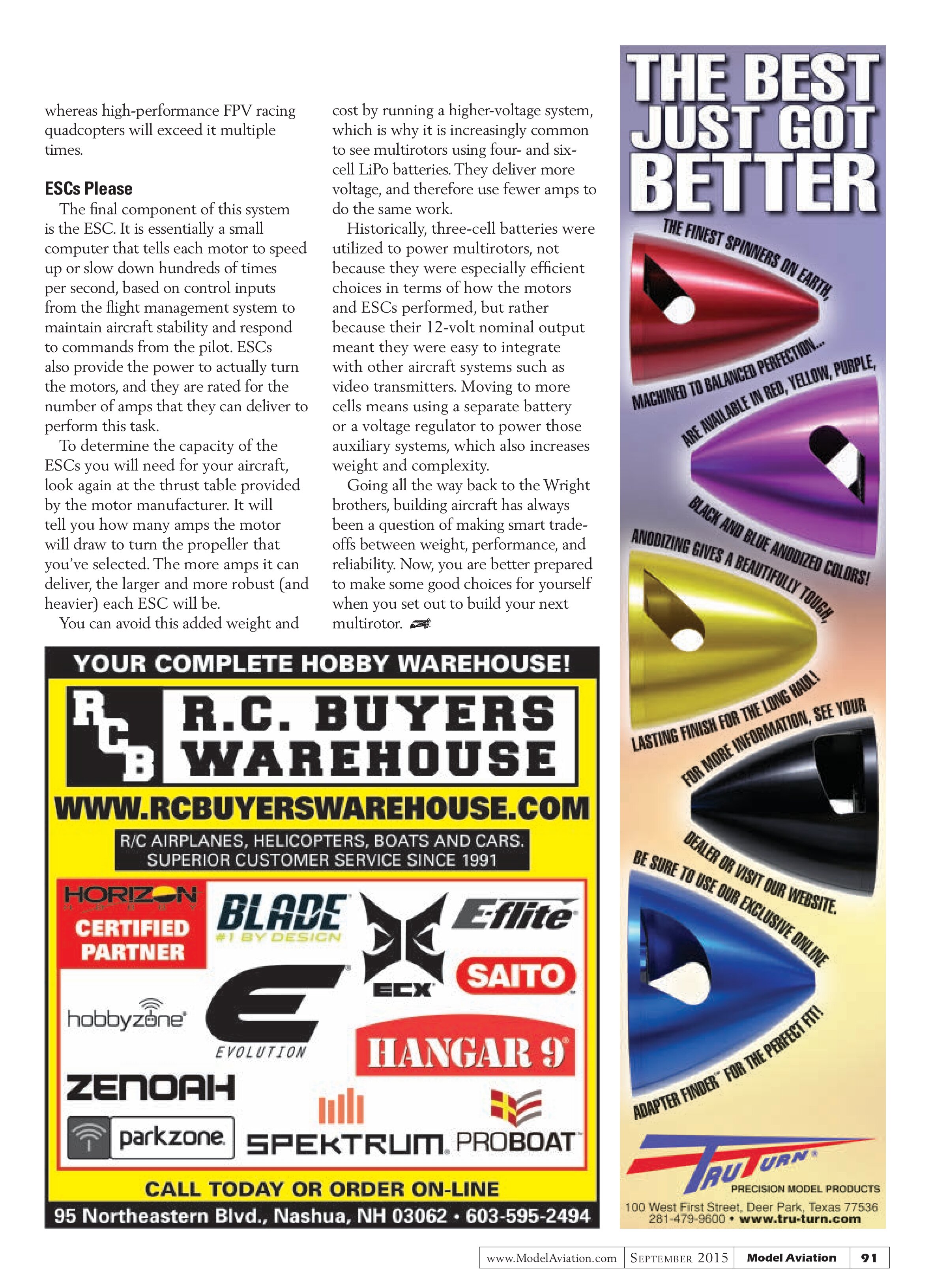
What does each of these components contribute to aircraft performance? The propeller moves the air, generating the thrust that keeps the multirotor aloft and giving it the ability to maneuver. The motor turns the propeller, and the ESC takes input from the flight management system, speeding up or slowing the motor as needed to maintain controlled, stable flight.
If any link in this chain breaks, you immediately lose all three components and your flight will likely end in an abrupt and distinctly unsatisfactory manner. To make sure that doesn’t happen, let’s start at the outside and work our way in, beginning with the propellers.
According to the fundamental principles of aerodynamics, the larger a propeller is, the more efficient it is. If you want your multirotor to fly for a long time, use the largest propellers that the airframe can physically accommodate (without hitting each other or other components of the aircraft). The weakness of propellers is that they are only able to generate so much thrust before they experience structural failure. In short, spin a propeller too fast—ask it to generate too much thrust—and it will break.
Quality manufacturers, such as Advanced Precision Composites in California, provide charts and tables that will tell you how many rpm their propellers can sustain before they are in danger of failing.
Motoring Along
Continuing our journey inboard from the propellers, the next component encountered is the motor. Motors come

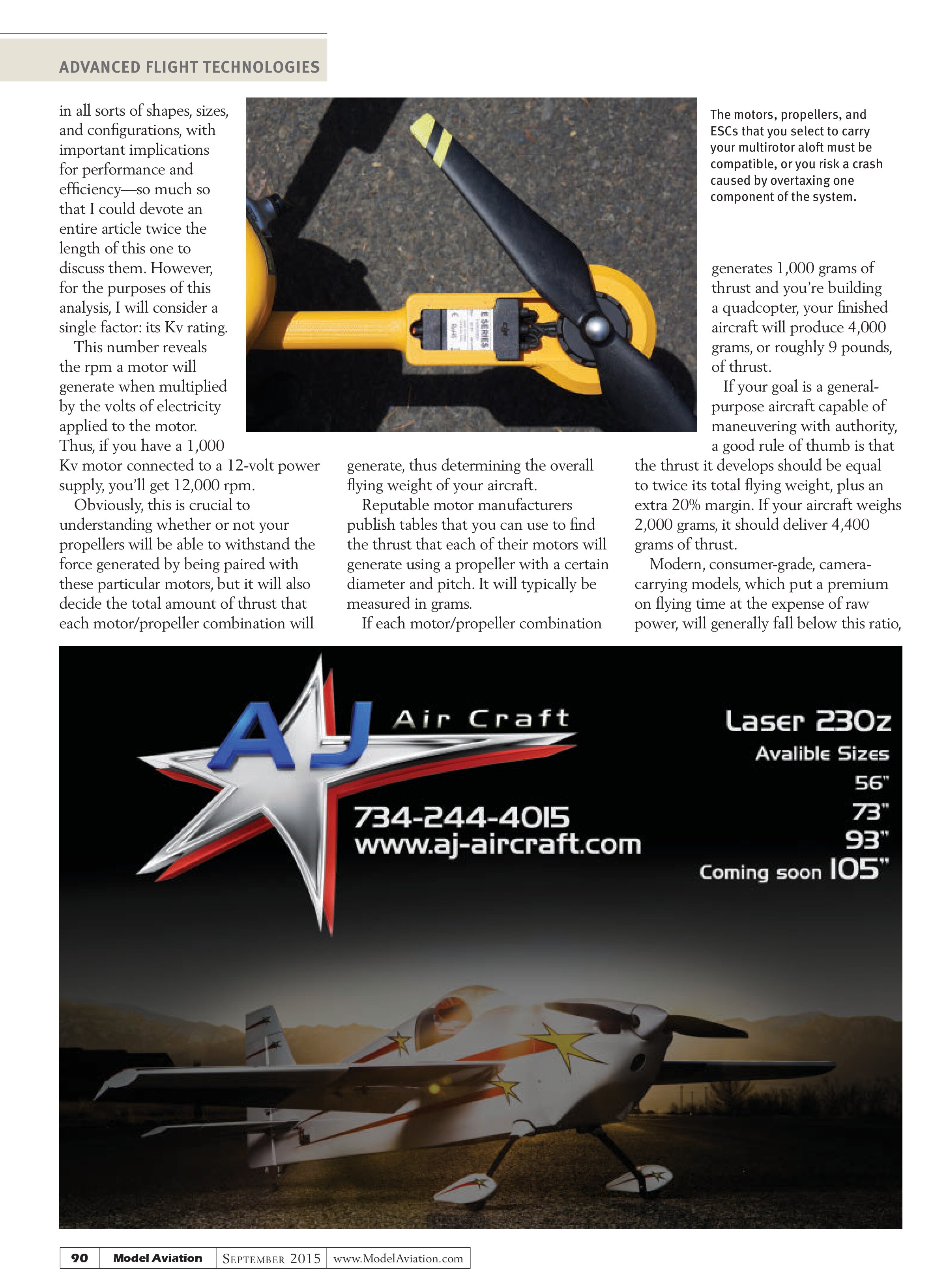
An electric motor’s Kv determines the number of rpm it will deliver per volt of power applied. These 1,180 Kv Cobra motors are mounted on the Roswell Flight Test Crew’s flagship hexacopter, RQCX-3 Raven, which runs an 11.1-volt battery providing 13,098 peak rpm.
in all sorts of shapes, sizes, and configurations, with important implications for performance and efficiency—so much so that I could devote an entire article twice the length of this one to discuss them. However, for the purposes of this analysis, I will consider a single factor: its Kv rating. This number reveals the rpm a motor will generate when multiplied by the volts of electricity applied to the motor. Thus, if you have a 1,000 Kv motor connected to a 12-volt power supply, you’ll get 12,000 rpm. Obviously, this is crucial to understanding whether or not your propellers will be able to withstand the force generated by being paired with these particular motors, but it will also decide the total amount of thrust that each motor/propeller combination will generate, thus determining the overall flying weight of your aircraft. Reputable motor manufacturers publish tables that you can use to find the thrust that each of their motors will generate using a propeller with a certain diameter and pitch. It will typically be measured in grams. If each motor/propeller combination generates 1,000 grams of thrust and you’re building a quadcopter, your finished aircraft will produce 4,000 grams, or roughly 9 pounds, of thrust. If your goal is a general-purpose aircraft capable of maneuvering with authority, a good rule of thumb is that the thrust it develops should be equal to twice its total flying weight, plus an extra 20% margin. If your aircraft weighs 2,000 grams, it should deliver 4,400 grams of thrust. Modern, consumer-grade, camera-carrying models, which put a premium on flying time at the expense of raw power, will generally fall below this ratio,

whereas high-performance FPV racing quadcopters will exceed it multiple times.
ESCs Please
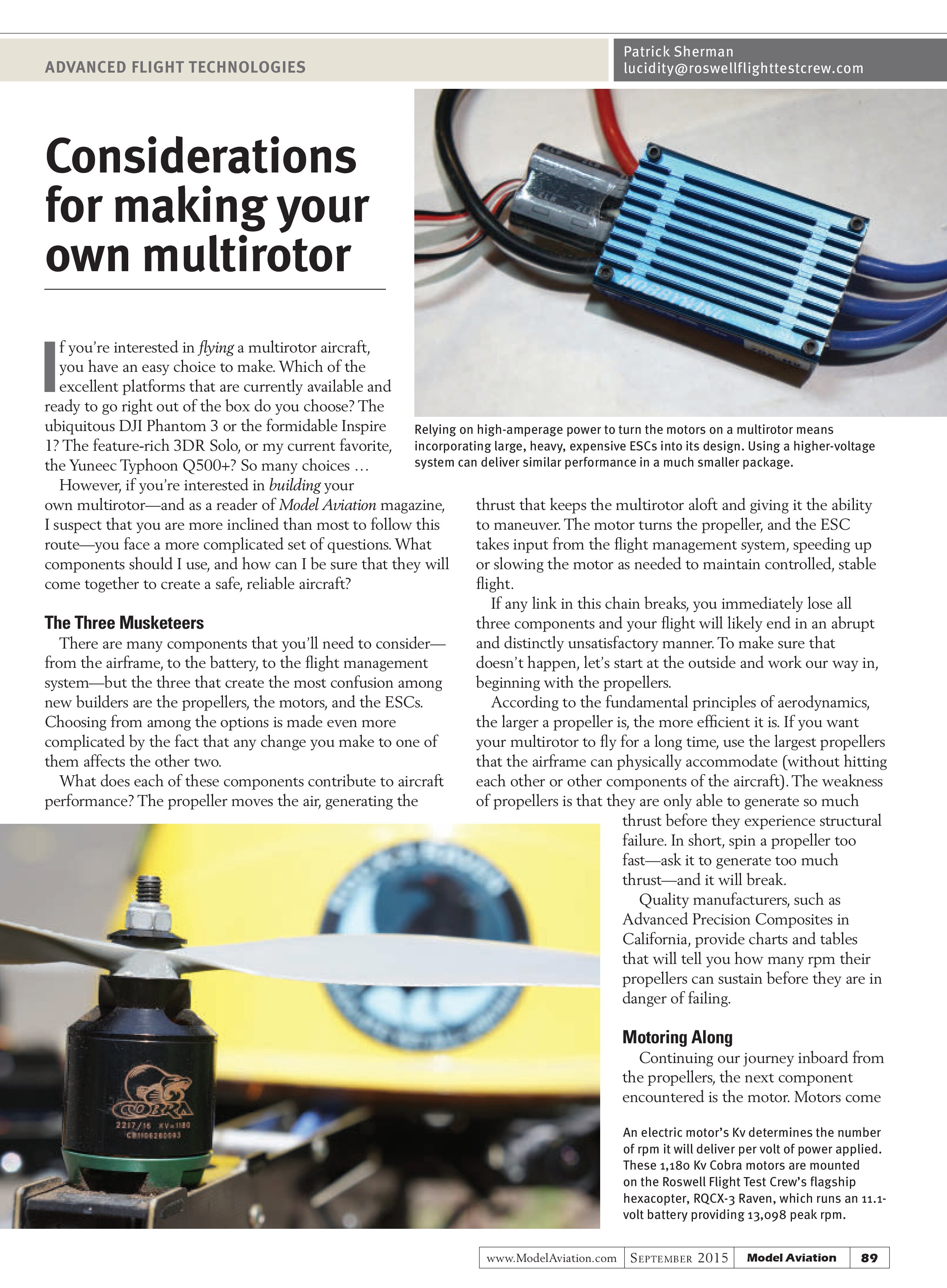
The final component of this system is the ESC. It is essentially a small computer that tells each motor to speed up or slow down hundreds of times per second, based on control inputs from the flight management system to maintain aircraft stability and respond to commands from the pilot. ESCs also provide the power to actually turn the motors, and they are rated for the number of amps that they can deliver to perform this task. To determine the capacity of the ESCs you will need for your aircraft, look again at the thrust table provided by the motor manufacturer. It will tell you how many amps the motor will draw to turn the propeller that you’ve selected. The more amps it can deliver, the larger and more robust (and heavier) each ESC will be. You can avoid this added weight and cost by running a higher-voltage system, which is why it is increasingly common to see multirotors using four- and six-cell LiPo batteries. They deliver more voltage, and therefore use fewer amps to do the same work. Historically, three-cell batteries were utilized to power multirotors, not because they were especially efficient choices in terms of how the motors and ESCs performed, but rather because their 12-volt nominal output meant they were easy to integrate with other aircraft systems such as video transmitters. Moving to more cells means using a separate battery or a voltage regulator to power those auxiliary systems, which also increases weight and complexity. Going all the way back to the Wright brothers, building aircraft has always been a question of making smart trade-offs between weight, performance, and reliability. Now, you are better prepared to make some good choices for yourself when you set out to build your next multirotor.