In a sunny mood

Walter Voyt has sincere concern for all modelers. In addition to being an experienced RC pilot, Walter is the man who first discovered that ultraviolet (UV) A radiation is carcinogenic, and helped develop the first broad-spectrum sunscreens. His email to me was filled with information about skin cancer and how UVA radiation ages our skin.
UVA rays penetrate clouds and can cause life-threatening trouble for people who enjoy outdoor activities such as our hobby. Walter wrote, “I’m afraid that many fliers and RC clubs do not take the dangers of sunlight seriously enough, and pay a dear price later in life. I’m not talking primarily about wearing sunscreens and broad-brimmed caps and hats. Shade and timing are the outdoor flier’s best friends.”
Check out the MA Digital Library and read the skin cancer article by Dr. Joseph Gadzia in the September 2012 issue of Model Aviation. It’s scary, but this stuff is not made up. The danger is real and an ounce of prevention could save your life.
I’ve become a believer in using proper UV protection because some members of my immediate family have been treated for these cancers. The cure rate is high when the victim sees a doctor promptly, but anyone who has undergone the medical procedures will tell you that prevention is much better. Getting rid of some types of skin cancer is no picnic under a shade tree.
The Crowded Sky
Like solar radiation, there is a broad spectrum of model types flying through the air. Can dissimilar models be hazardous to each other? You better believe it! Some are incompatible with others because of weight or speed, but there isn’t any reason why their pilots shouldn’t get along.
Years ago, several factors combined to create tension at a local RC field. Helicopters were becoming popular, and park flyers began to show up in squadron strength. Aircraft that fly slowly or hover
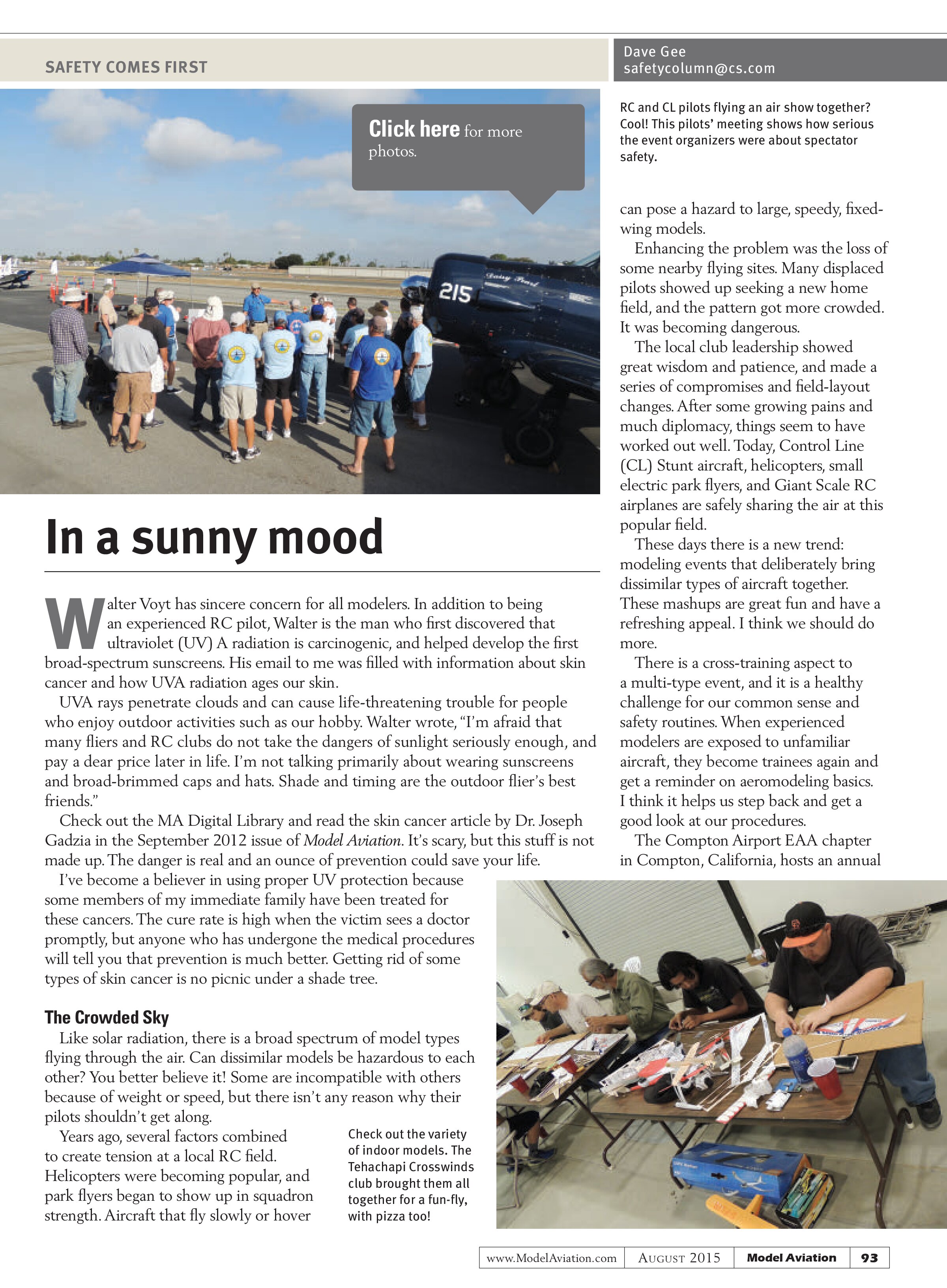
RC and CL pilots flying an air show together? Cool! This pilots’ meeting shows how serious the event organizers were about spectator safety.
can pose a hazard to large, speedy, fixed-wing models.
Enhancing the problem was the loss of some nearby flying sites. Many displaced pilots showed up seeking a new home field, and the pattern got more crowded. It was becoming dangerous.
The local club leadership showed great wisdom and patience, and made a series of compromises and field-layout changes. After some growing pains and much diplomacy, things seem to have worked out well. Today, Control Line (CL) Stunt aircraft, helicopters, small electric park flyers, and Giant Scale RC airplanes are safely sharing the air at this popular field.
These days there is a new trend: modeling events that deliberately bring dissimilar types of aircraft together. These mashups are great fun and have a refreshing appeal. I think we should do more.
There is a cross-training aspect to a multi-type event, and it is a healthy challenge for our common sense and safety routines. When experienced modelers are exposed to unfamiliar aircraft, they become trainees again and get a reminder on aeromodeling basics. I think it helps us step back and get a good look at our procedures.
The Compton Airport EAA chapter in Compton, California, hosts an annual


air show with CL and RC models flying simultaneously. The group is serious about spectator safety, but the fun is worth it. It’s hard to get used to seeing a CL aircraft flying near an RC Aerobatics airplane!
The included photo shows a preshow pilots’ meeting where safety rules were made clear to all participants. Note the CL circle next to the runway, right where visitors could get a close look.
Earlier this year, I crashed a terrific indoor event at Mojave Air and Space Port. The Tehachapi Crosswinds Radio Control Club, of Tehachapi, California, combined many types of indoor models with pizza, aviation movies, and informal competition.
A big crowd of new and seasoned fliers ate, flew, and had a ball. It was obvious that not all of the organizers were experienced indoor pilots, but their careful attention to safety and fairness was impressive. This sincerity added to the event’s charm.
My favorite part was seeing some brilliant local aeronautical engineers struggle to get their built-on-the-spot Free Flight (FF) models off the ground. “How come we can break all these aviation records and even go to outer space, but we can’t get this rubber job trimmed out?”
The Duration contest was a hoot. The crowd was impressed with a 24-second flight, not knowing that “serious” indoor FF aircraft can stay up much longer. My son, Jeff, laughed when I left my trusty A6 Endurance model in the box, rather than ruin everyone’s fun with a three-minute flight.
Balsa and Plastic at the Gipper’s
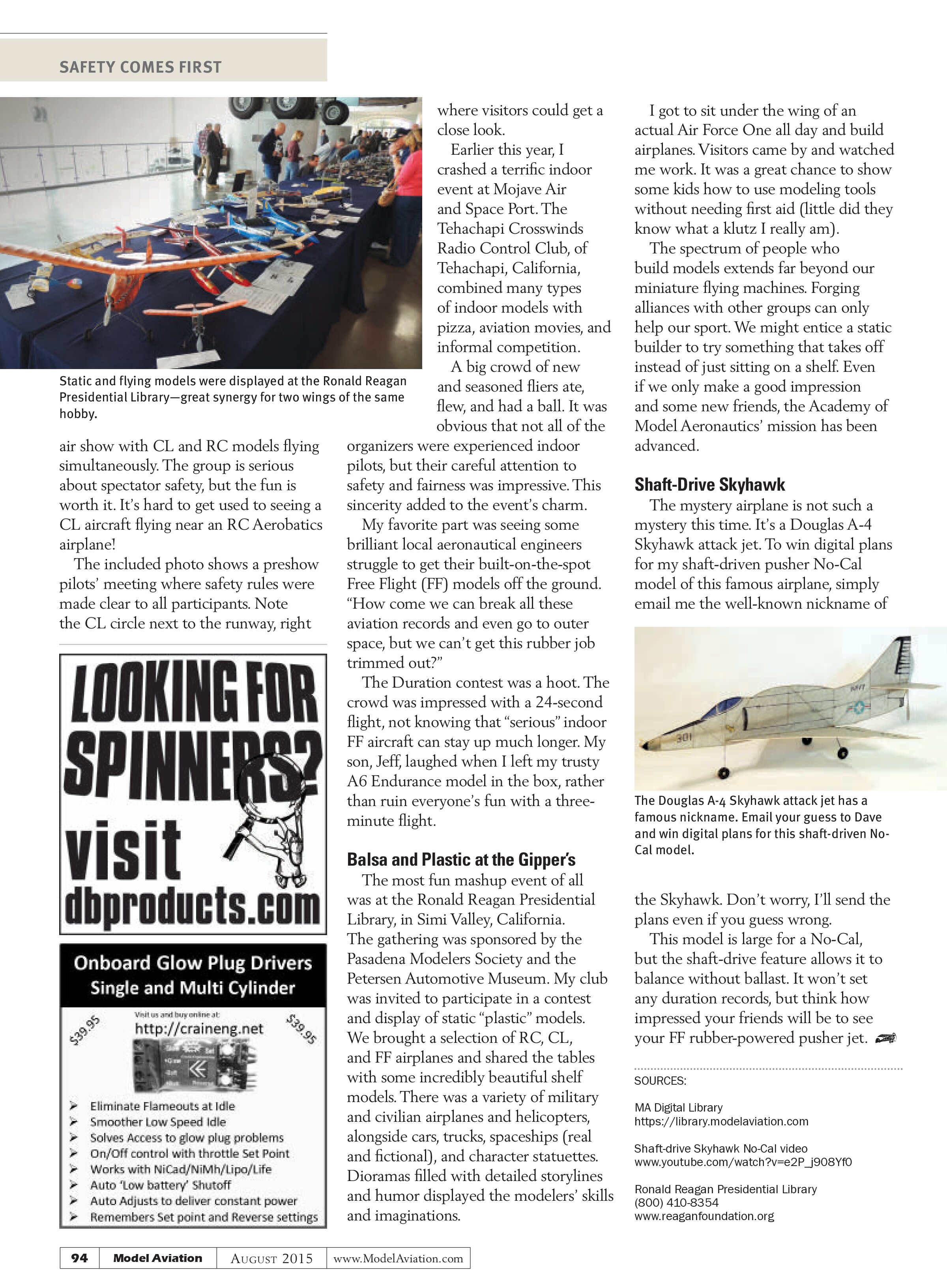
The most fun mashup event of all was at the Ronald Reagan Presidential Library, in Simi Valley, California. The gathering was sponsored by the Pasadena Modelers Society and the Petersen Automotive Museum. My club was invited to participate in a contest and display of static “plastic” models. We brought a selection of RC, CL, and FF airplanes and shared the tables with some incredibly beautiful shelf models. There was a variety of military and civilian airplanes and helicopters, alongside cars, trucks, spaceships (real and fictional), and character statuettes. Dioramas filled with detailed storylines and humor displayed the modelers’ skills and imaginations.
I got to sit under the wing of an actual Air Force One all day and build airplanes. Visitors came by and watched me work. It was a great chance to show some kids how to use modeling tools without needing first aid (little did they know what a klutz I really am).
The spectrum of people who build models extends far beyond our miniature flying machines. Forging alliances with other groups can only help our sport. We might entice a static builder to try something that takes off instead of just sitting on a shelf. Even if we only make a good impression and some new friends, the Academy of Model Aeronautics’ mission has been advanced.
Shaft-Drive Skyhawk
The mystery airplane is not such a mystery this time. It’s a Douglas A-4 Skyhawk attack jet. To win digital plans for my shaft-driven pusher No-Cal model of this famous airplane, simply email me the well-known nickname of the Skyhawk. Don’t worry, I’ll send the plans even if you guess wrong.
This model is large for a No-Cal, but the shaft-drive feature allows it to balance without ballast. It won’t set any duration records, but think how impressed your friends will be to see your FF rubber-powered pusher jet.

SOURCES:
MA Digital Library
https://library.modelaviation.com
Shaft-drive Skyhawk No-Cal video
www.youtube.com/watch?v=e2P_j908Yf0
Ronald Reagan Presidential Library
(800) 410-8354
www.reaganfoundation.org