Judging criteria and aircraft setup
by John Glezellis
jglezelllis@gmail.com
As pilots become more proficient within the International Miniature Aerobatic Club (IMAC) scene, they will realize that their success is not entirely linked to their flying ability. In addition to being capable pilots, they must also know proper aircraft setup techniques and fully understand the elements that judges use to score all competition flights.
This experience will come with time. For those just entering the competition arena, it is important to begin with the Basic class and gradually move from one level to the next, even if a modeler is considered to be a competent air show pilot. Variations of certain maneuvers are present in all sequences.
To illustrate this notion, a basic loop is found in the Basic program, whereas an Avalanche—a loop with a positive snap roll at the top—is found in the Sportsman program. A pilot must be comfortable with fundamental forms of certain maneuvers before advancing to the next class.
The focus this month revolves around the loop. Not only will I discuss the basic judging criteria for this figure, but I will examine a few flight and aircraft setup techniques to decrease a pilot’s workload. Without further delay, let’s get started!
Judging Criteria Basics
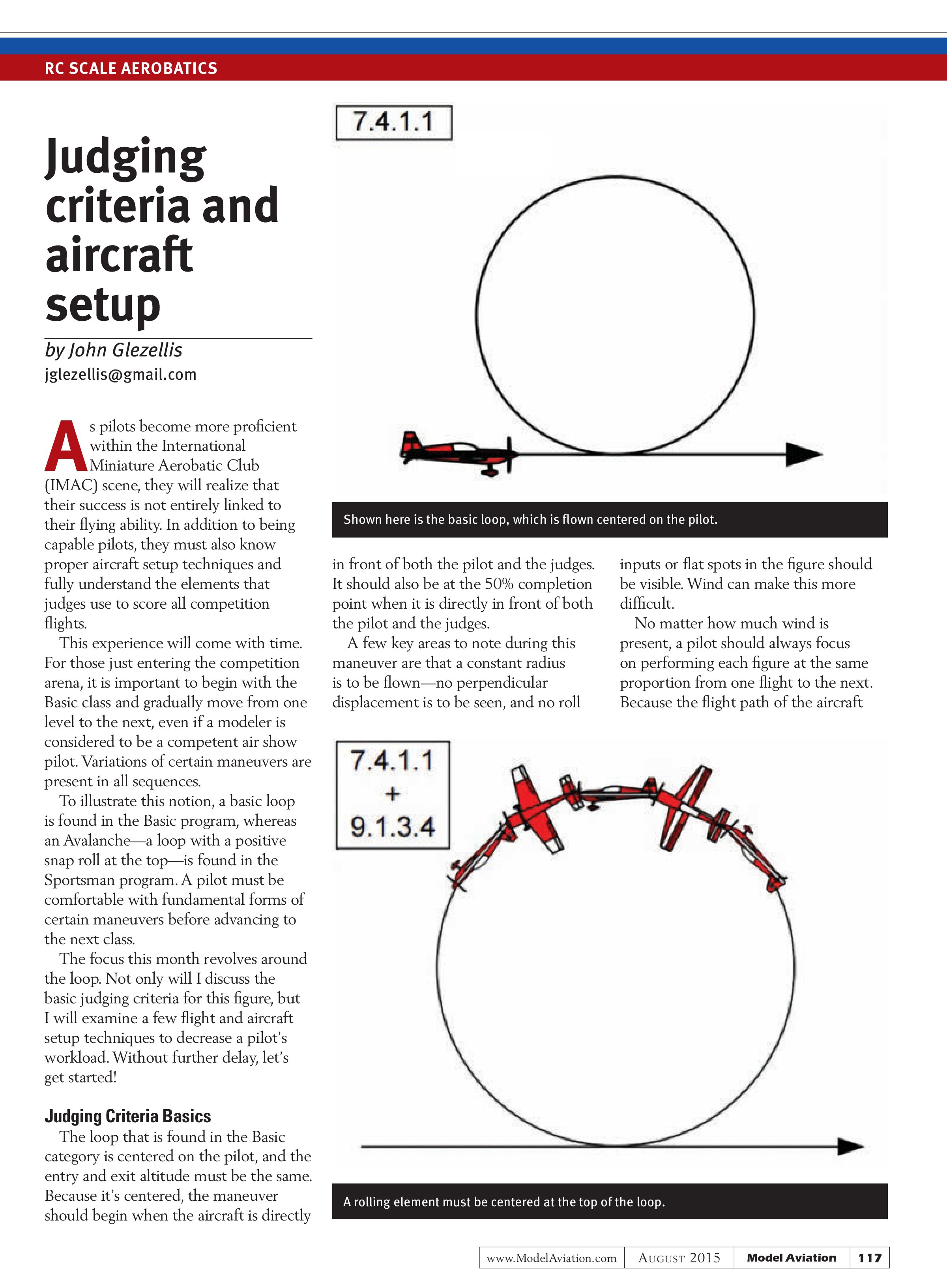
The loop that is found in the Basic category is centered on the pilot, and the entry and exit altitude must be the same. Because it’s centered, the maneuver should begin when the aircraft is directly

in front of both the pilot and the judges. It should also be at the 50% completion point when it is directly in front of both the pilot and the judges.
A few key areas to note during this maneuver are that a constant radius is to be flown—no perpendicular displacement is to be seen, and no roll

inputs or flat spots in the figure should be visible. Wind can make this more difficult.
No matter how much wind is present, a pilot should always focus on performing each figure at the same proportion from one flight to the next. Because the flight path of the aircraft
is what is judged, it should appear perfectly round. Any drift because of wind and any roll movement results in a half-point deduction per 5° error. If a noticeable line is shown throughout the figure, a one-point deduction will also be applied for every line shown. Don’t give away the easy points!
Flying in a strong headwind requires different elevator deflection amounts compared with flying in calm conditions. In the perfect scenario, a nearly constant amount of elevator is needed to perform the loop. If this is done with a strong headwind, the aircraft will drift downwind throughout the figure and the completion point of the loop will be downwind instead of centered on the pilot. The modeler must adjust the amount of elevator and throttle needed to hit the figure’s cardinal points.
The pilot will gradually apply elevator

input during the first quadrant and allow the wind to “carry” the aircraft throughout the arc. As the airplane hits the 90° point, the pilot needs to apply more elevator input to “pull” the aircraft around so that it is perfectly inverted at the 50% completion point and centered on the modeler.
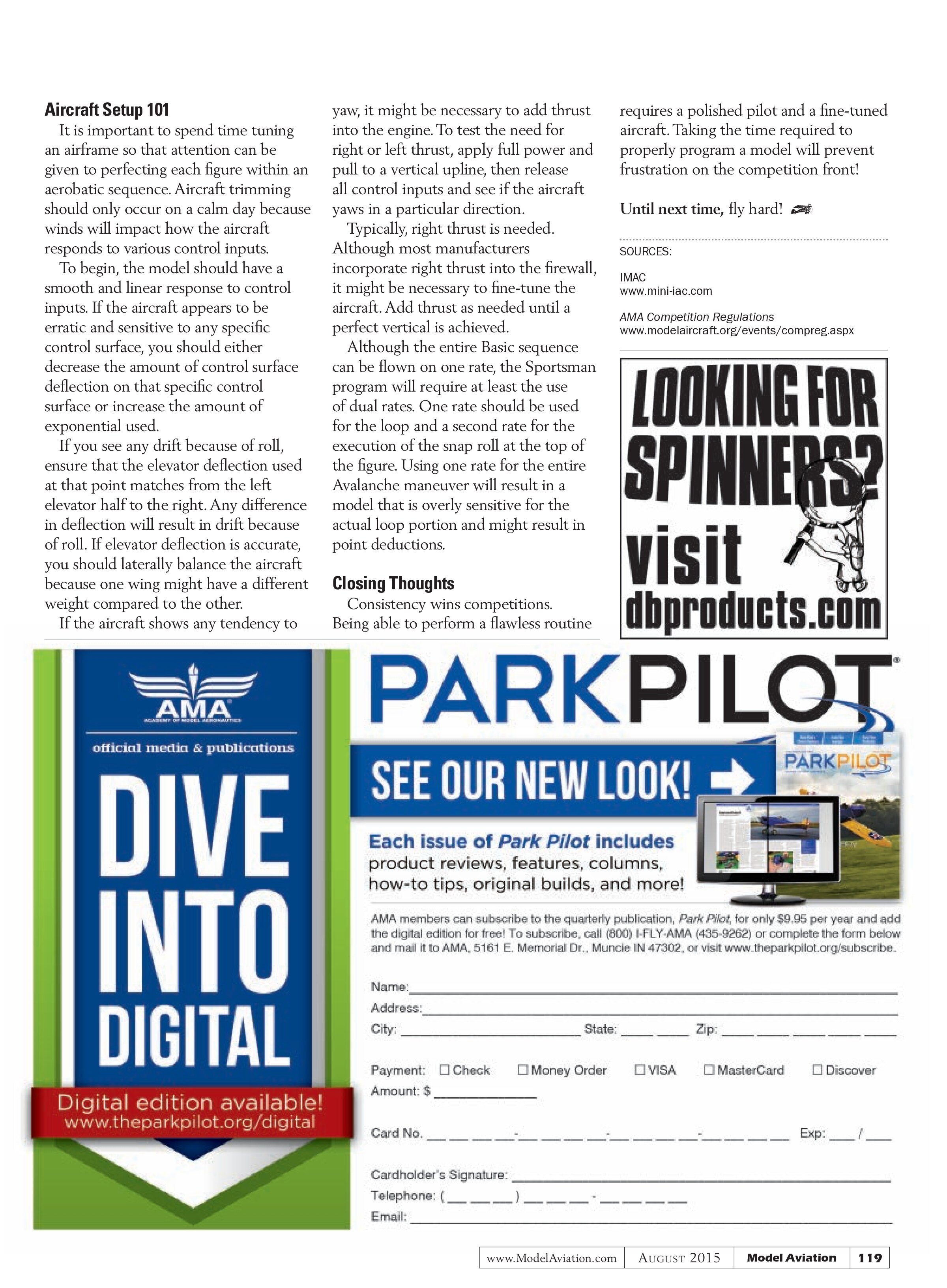
Similarly, in a heavy crosswind, a loop might be flown with visible crabbing. No deduction should be applied in this case because the flight path of the aircraft is being judged. When leaning the aircraft into the wind in yaw, otherwise known as crabbing, using the rudder surface is mandatory and will take time to master.
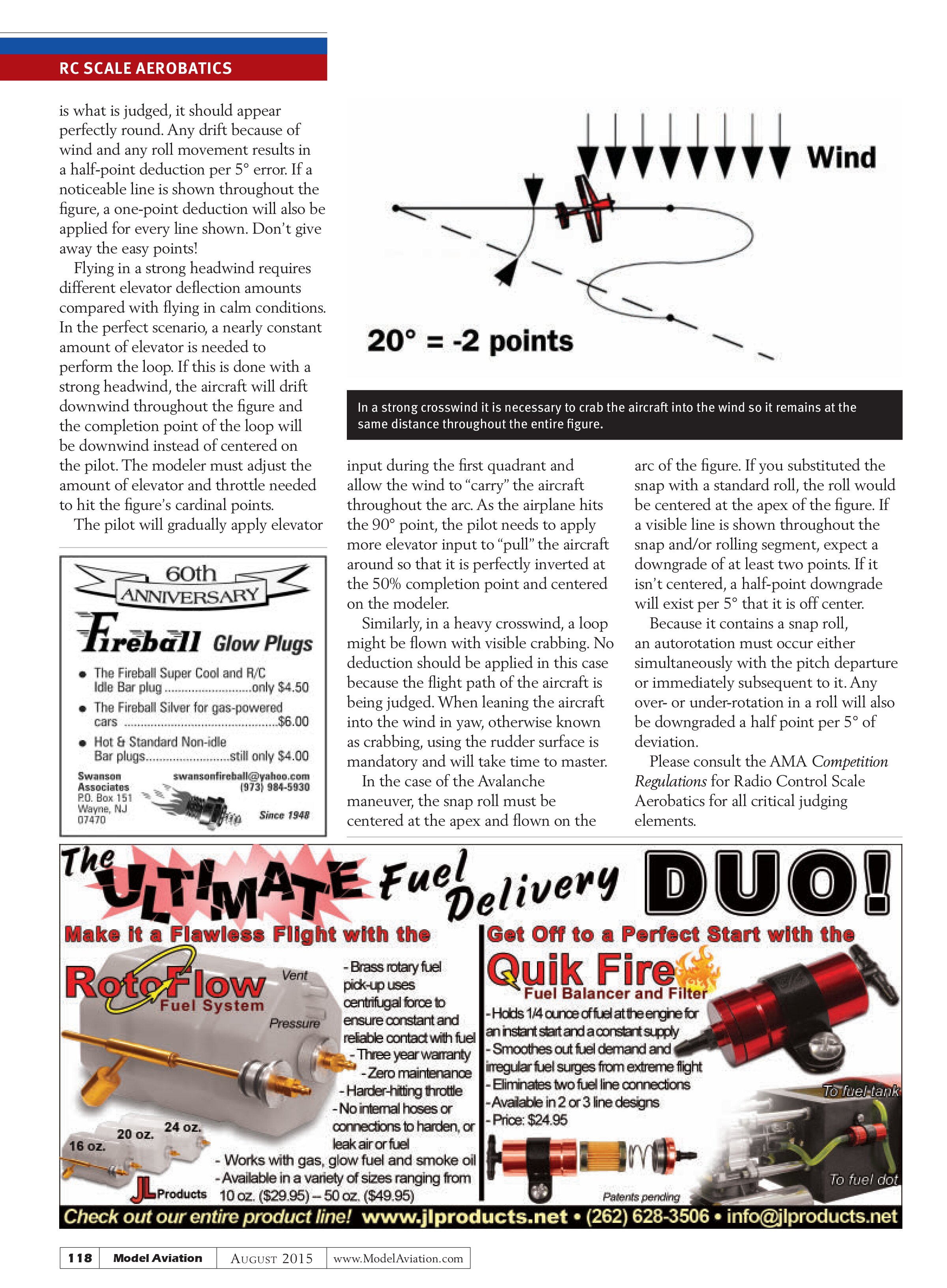
In the case of the Avalanche maneuver, the snap roll must be centered at the apex and flown on the arc of the figure. If you substituted the snap with a standard roll, the roll would be centered at the apex of the figure. If a visible line is shown throughout the snap and/or rolling segment, expect a downgrade of at least two points. If it isn’t centered, a half-point downgrade will exist per 5° that it is off center. Because it contains a snap roll, an autorotation must occur either simultaneously with the pitch departure or immediately subsequent to it. Any over- or under-rotation in a roll will also be downgraded a half point per 5° of deviation.
Please consult the AMA Competition Regulations for Radio Control Scale Aerobatics for all critical judging elements.
Aircraft Setup 101
It is important to spend time tuning an airframe so that attention can be given to perfecting each figure within an aerobatic sequence. Aircraft trimming should only occur on a calm day because winds will impact how the aircraft responds to various control inputs.
To begin, the model should have a smooth and linear response to control inputs. If the aircraft appears to be erratic and sensitive to any specific control surface, you should either decrease the amount of control surface deflection on that specific control surface or increase the amount of exponential used.
If you see any drift because of roll, ensure that the elevator deflection used at that point matches from the left elevator half to the right. Any difference in deflection will result in drift because of roll. If elevator deflection is accurate, you should laterally balance the aircraft because one wing might have a different weight compared to the other.
If the aircraft shows any tendency to yaw, it might be necessary to add thrust into the engine. To test the need for right or left thrust, apply full power and pull to a vertical upline, then release all control inputs and see if the aircraft yaws in a particular direction.
Typically, right thrust is needed. Although most manufacturers incorporate right thrust into the firewall, it might be necessary to fine-tune the aircraft. Add thrust as needed until a perfect vertical is achieved.
Although the entire Basic sequence can be flown on one rate, the Sportsman program will require at least the use of dual rates. One rate should be used for the loop and a second rate for the execution of the snap roll at the top of the figure. Using one rate for the entire Avalanche maneuver will result in a model that is overly sensitive for the actual loop portion and might result in point deductions.
Closing Thoughts
Consistency wins competitions. Being able to perform a flawless routine requires a polished pilot and a fine-tuned aircraft. Taking the time required to properly program a model will prevent frustration on the competition front!
Until next time, fly hard!
SOURCES:
IMAC
www.mini-iac.com
AMA Competition Regulations
www.modelaircraft.org/events/compreg.aspx