Compact 1/2A CL semiscale model boasts eye appeal
The Fokker Dr.1 is one of the best-known aircraft of the World War I fighter airplanes because of Baron von Richthofen, who was known as the Red Baron. The aircraft entered service at the end of August 1917 and was used for nine months, retiring from combat in May 1918.

Bill Michaels’ eye-catching model, according to him, “looks better than a profile model, but is still easy to build,” and featured bright red MonoKote and simple-to-make markings.
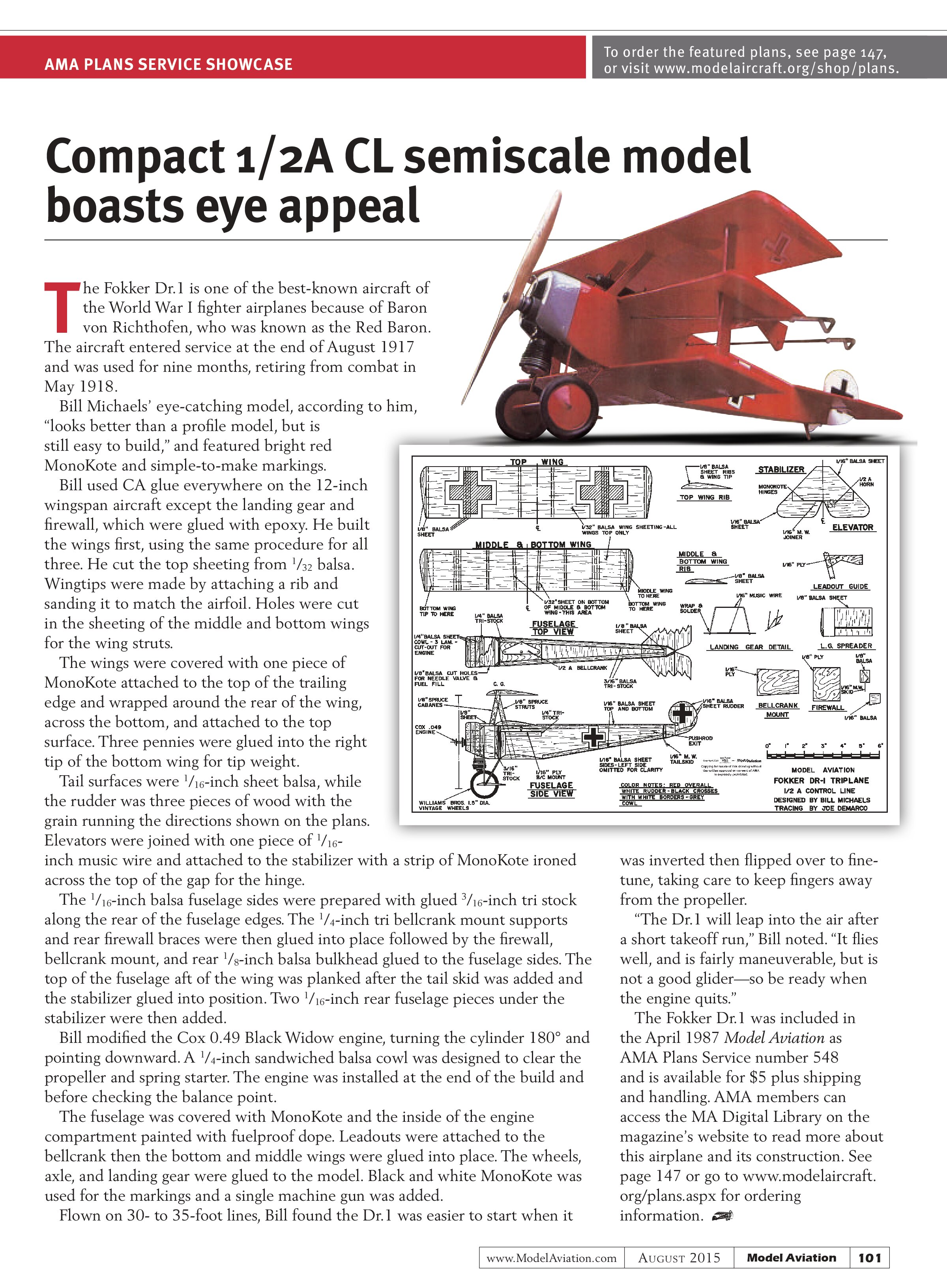
Bill used CA glue everywhere on the 12-inch wingspan aircraft except the landing gear and firewall, which were glued with epoxy. He built the wings first, using the same procedure for all three. He cut the top sheeting from 1/32 balsa. Wingtips were made by attaching a rib and sanding it to match the airfoil. Holes were cut in the sheeting of the middle and bottom wings for the wing struts.

The wings were covered with one piece of MonoKote attached to the top of the trailing edge and wrapped around the rear of the wing, across the bottom, and attached to the top surface. Three pennies were glued into the right tip of the bottom wing for tip weight.
Tail surfaces were 1/16-inch sheet balsa, while the rudder was three pieces of wood with the grain running the directions shown on the plans. Elevators were joined with one piece of 1/16-inch music wire and attached to the stabilizer with a strip of MonoKote ironed across the top of the gap for the hinge.
The 1/16-inch balsa fuselage sides were prepared with glued 3/16-inch tri stock along the rear of the fuselage edges. The 1/4-inch tri bellcrank mount supports and rear firewall braces were then glued into place followed by the firewall, bellcrank mount, and rear 1/8-inch balsa bulkhead glued to the fuselage sides. The top of the fuselage aft of the wing was planked after the tail skid was added and the stabilizer glued into position. Two 1/16-inch rear fuselage pieces under the stabilizer were then added.
Bill modified the Cox 0.49 Black Widow engine, turning the cylinder 180° and pointing downward. A 1/4-inch sandwiched balsa cowl was designed to clear the propeller and spring starter. The engine was installed at the end of the build and before checking the balance point.
The fuselage was covered with MonoKote and the inside of the engine compartment painted with fuelproof dope. Leadouts were attached to the bellcrank then the bottom and middle wings were glued into place. The wheels, axle, and landing gear were glued to the model. Black and white MonoKote was used for the markings and a single machine gun was added.
Flown on 30- to 35-foot lines, Bill found the Dr.1 was easier to start when it was inverted then flipped over to fine-tune, taking care to keep fingers away from the propeller.
“The Dr.1 will leap into the air after a short takeoff run,” Bill noted. “It flies well, and is fairly maneuverable, but is not a good glider—so be ready when the engine quits.”
The Fokker Dr.1 was included in the April 1987 Model Aviation as AMA Plans Service number 548 and is available for $5 plus shipping and handling. AMA members can access the MA Digital Library on the magazine’s website to read more about this airplane and its construction. See page 147 or go to www.modelaircraft.org/plans.aspx for ordering information.