The great works of Henry Struck
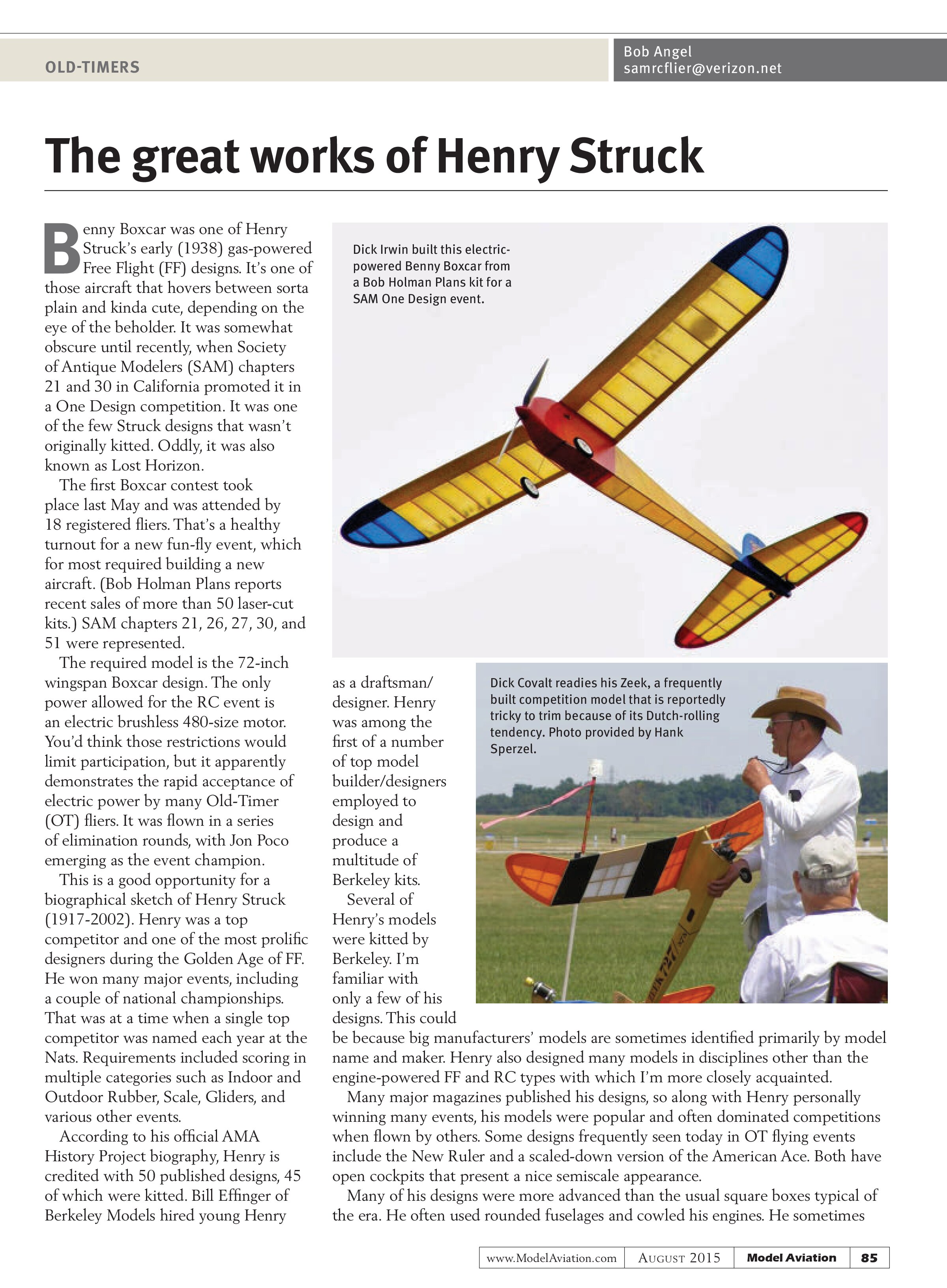
Benny Boxcar was one of Henry Struck’s early (1938) gas-powered Free Flight (FF) designs. It’s one of those aircraft that hovers between sorta plain and kinda cute, depending on the eye of the beholder. It was somewhat obscure until recently, when Society of Antique Modelers (SAM) chapters 21 and 30 in California promoted it in a One Design competition. It was one of the few Struck designs that wasn’t originally kitted. Oddly, it was also known as Lost Horizon.

The first Boxcar contest took place last May and was attended by 18 registered fliers. That’s a healthy turnout for a new fun-fly event, which for most required building a new aircraft. (Bob Holman Plans reports recent sales of more than 50 laser-cut kits.) SAM chapters 21, 26, 27, 30, and 51 were represented.
The required model is the 72-inch wingspan Boxcar design. The only power allowed for the RC event is an electric brushless 480-size motor. You’d think those restrictions would limit participation, but it apparently demonstrates the rapid acceptance of electric power by many Old-Timer (OT) fliers. It was flown in a series of elimination rounds, with Jon Poco emerging as the event champion.
This is a good opportunity for a biographical sketch of Henry Struck (1917-2002). Henry was a top competitor and one of the most prolific designers during the Golden Age of FF. He won many major events, including a couple of national championships. That was at a time when a single top competitor was named each year at the Nats. Requirements included scoring in multiple categories such as Indoor and Outdoor Rubber, Scale, Gliders, and various other events.
According to his official AMA History Project biography, Henry is credited with 50 published designs, 45 of which were kitted. Bill Effinger of Berkeley Models hired young Henry as a draftsman/designer. Henry was among the first of a number of top model builder/designers employed to design and produce a multitude of Berkeley kits. Several of Henry’s models were kitted by Berkeley. I’m familiar with only a few of his designs. This could be because big manufacturers’ models are sometimes identified primarily by model name and maker.

Henry also designed many models in disciplines other than the engine-powered FF and RC types with which I’m more closely acquainted.
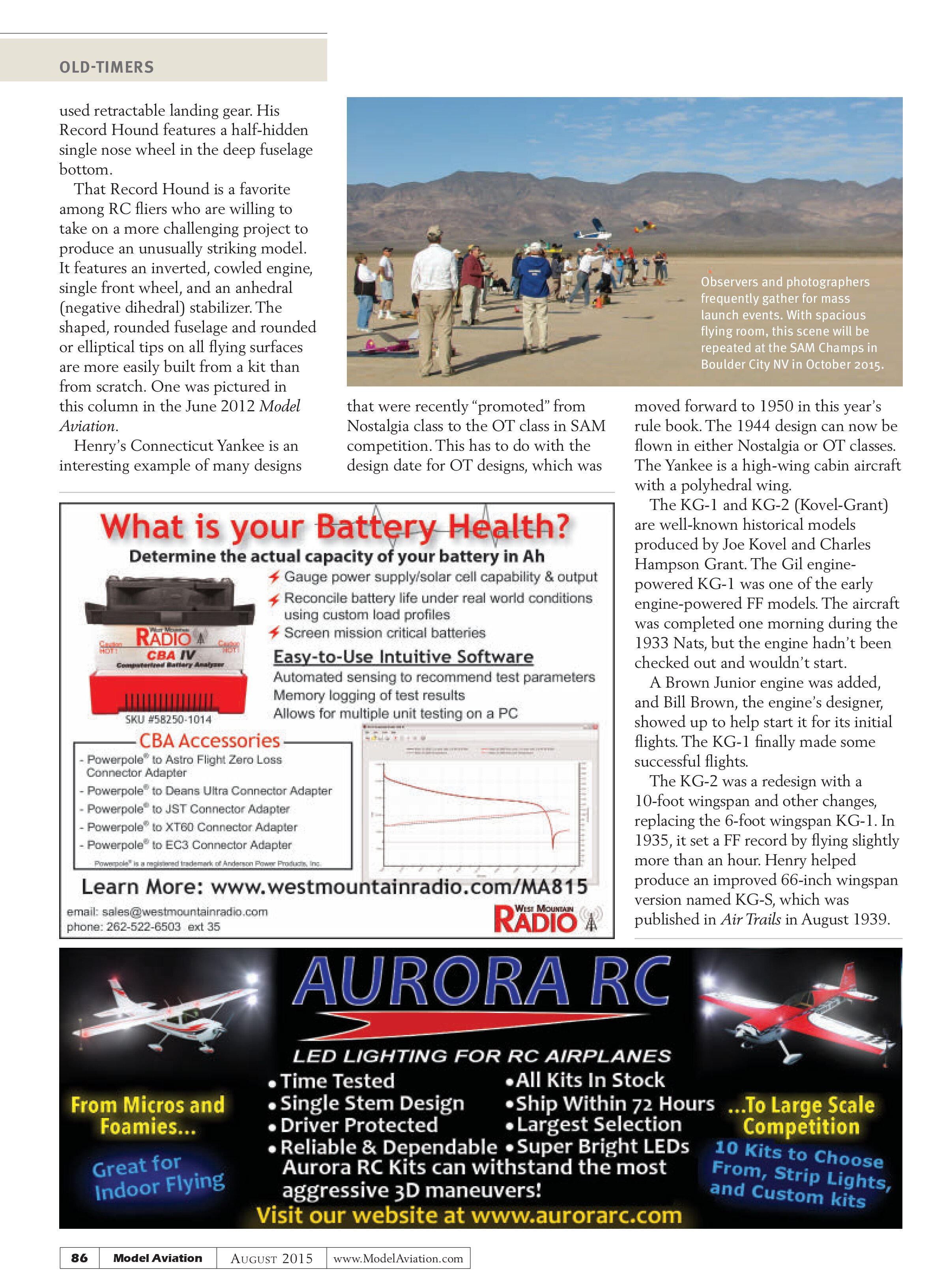
Many major magazines published his designs, so along with Henry personally winning many events, his models were popular and often dominated competitions when flown by others. Some designs frequently seen today in OT flying events include the New Ruler and a scaled-down version of the American Ace. Both have open cockpits that present a nice semiscale appearance.
Many of his designs were more advanced than the usual square boxes typical of the era. He often used rounded fuselages and cowled his engines. He sometimes
used retractable landing gear. His Record Hound features a half-hidden single nose wheel in the deep fuselage bottom.
That Record Hound is a favorite among RC fliers who are willing to take on a more challenging project to produce an unusually striking model. It features an inverted, cowled engine, single front wheel, and an anhedral (negative dihedral) stabilizer. The shaped, rounded fuselage and rounded or elliptical tips on all flying surfaces are more easily built from a kit than from scratch. One was pictured in this column in the June 2012 Model Aviation.
Henry’s Connecticut Yankee is an interesting example of many designs

that were recently “promoted” from Nostalgia class to the OT class in SAM competition. This has to do with the design date for OT designs, which was
moved forward to 1950 in this year’s rule book. The 1944 design can now be flown in either Nostalgia or OT classes. The Yankee is a high-wing cabin aircraft with a polyhedral wing.
As modeling advanced technically, Henry progressed with it and flew Control Line and RC. The Bootstraps was one of his RC designs.
As with many successful modelers, Henry excelled in several other endeavors. He held a private pilot’s license and was involved in technical projects, many helping in the World War II war effort. He was active in AMA and in promotion of the organization.
Calculating Balsa Density
Gary Sherman sent me a note regarding the simple formula for calculating balsa density that was in my April 2015 column. He correctly pointed out that the formula merely determines the average density of the stack. You may recall the idea was to stack 3 x 36-inch sheets to a height of 1 inch and weigh them. The weight in ounces is also the weight in pounds per cubic foot.
If the sheets came from a reasonably uniform batch, the result is good enough for most of us. Meticulous contest builders such as Gary, however, will still want to weigh each sheet separately and identify it for immediate or future use. After weighing each sheet, Gary refers to a balsa-density chart and marks the density on each sheet before cutting out parts or storing the sheet.
You can still use that formula for individual sheets. Weigh a single 3 x 36-inch sheet and multiply the weight in ounces by the number of sheets needed to make a 1-inch stack. For example, you’d multiply the weight of a ⅛-inch sheet by 8, or a ¹⁄₁₆-inch sheet by 16 to get pounds per cubic foot. With such light weights, it’s usually advantageous to weigh in grams and convert to ounces at the end. (Divide grams by 28.35 to convert to ounces.)
Balsa-density charts are often published, and with the revival of people actually building models, maybe it would be timely to make one available. There isn’t room here, but I can forward one in PDF format through my email address, or you can send me a self-addressed stamped envelope. One useful chart covers some other sheet widths and lengths in addition to 3 x 36 inches.
None of the charts cover odd sizes, blocks, or sticks, so here is another simple little formula. First, find the balsa volume in cubic inches (width x thickness x length, all in inches). Weight in grams multiplied by 3.8, divided by cubic inches, equals pounds per cubic foot.
To be honest, most of us simply pick up a piece of balsa, heft it, maybe compare it to any others we have in stock, and assign it a use.
SOURCES:
Henry Struck biography
www.modelaircraft.org/files/StruckHenry.pdf
Bob Holman Plans
(909) 885-3959
www.bhplans.com
Klarich Custom Kits
(916) 635-4588
www.klarichkits.com
Bob Angel
1001 Patterson Rd.
Santa Maria CA 93455
samrcflier@verizon.net