JR NINJA 400MR RTF
Your 3-D flight experience awaits
By Chris Mulcahy

Multirotor is definitely a buzzword these days and most of the time it’s used in reference to high-tech, self-stabilizing, GPS-guided camera platforms. A small percentage of multirotors, however, are used for something slightly different. These aircraft do not have GPS guidance, they don’t carry a camera, and did I mention that they can hover upside down?
3-D quadcopters are incredibly fun and challenging to fly. Although some use variable-pitch propellers similar to a helicopter tail rotor, this quadcopter uses a fixed-pitch propeller and can reverse the motor direction almost instantly when flipping upside down.
JR Americas is known for its quality transmitters and helicopters, and has now brought something different into the mix in the form of its new Ninja 400MR. The Ninja is a 400mm aerobatic quadcopter, and is available in two flavors. The RTF Ninja comes with a transmitter, or you can purchase the kit, which requires you to build it and add your own DMSS-compatible transmitter. Both versions require a flight battery. In this case, it’s a three-cell 2,200 mAh pack.
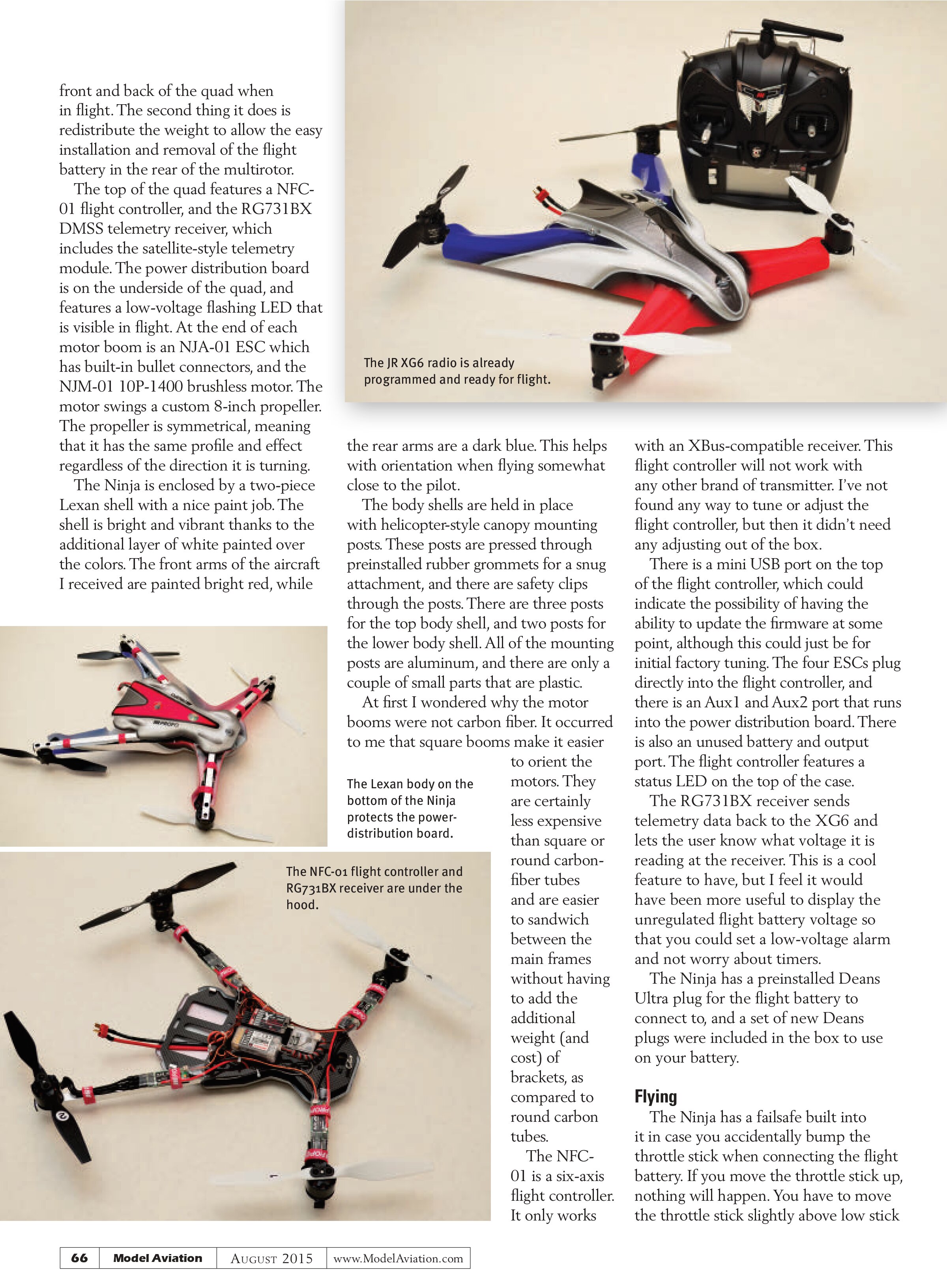
The RTF Ninja comes with a JR XG6 transmitter. All of the programming is done for you, and you simply have to add four AA batteries to the transmitter, charge a flight battery, and go fly. The preassembled kit comes with a separate decal sheet.
The quadcopter’s main frames are two stacked carbon-fiber frames with short vertical carbon ribs, with square aluminum motor booms sandwiched between them. It features a cool carbon-fiber quick-release battery tray that slides into the back of the quad. The multirotor’s two front booms are shorter than the rear booms because of the unique way in which the center main frames are arranged.
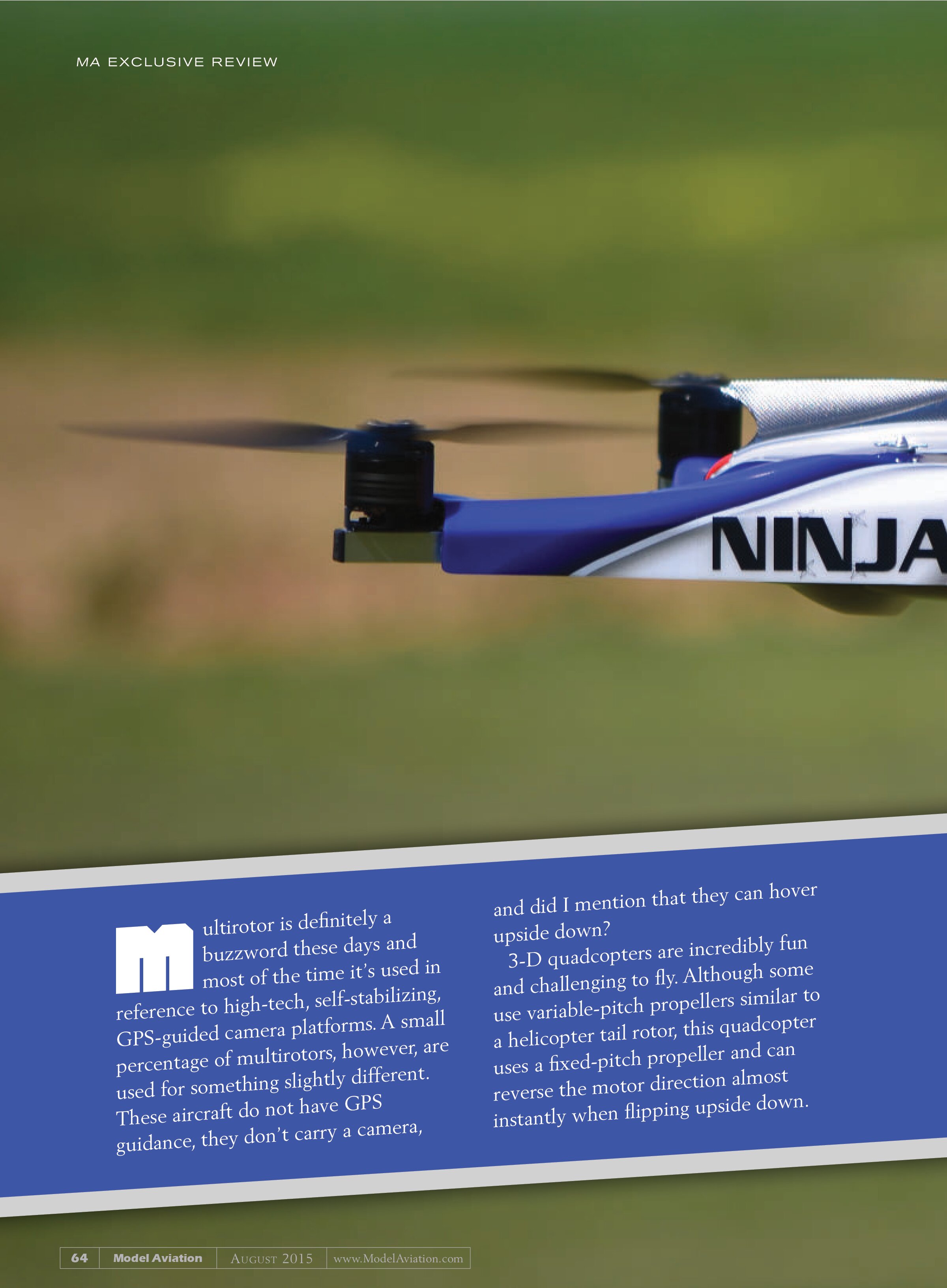
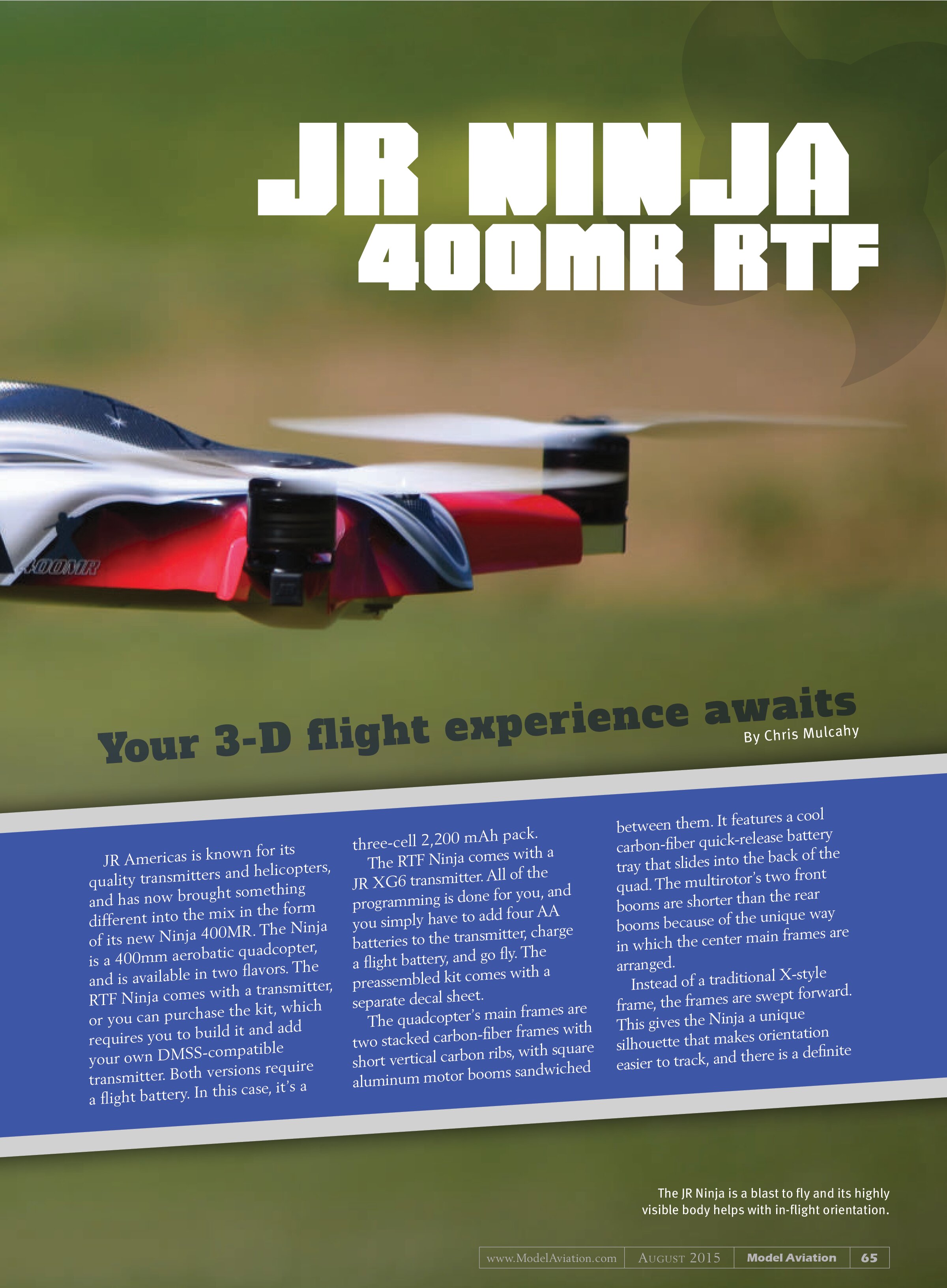
Instead of a traditional X-style frame, the frames are swept forward. This gives the Ninja a unique silhouette that makes orientation easier to track, and there a definite
front and back of the quad when in flight. The second thing it does is redistribute the weight to allow the easy installation and removal of the flight battery in the rear of the multirotor.
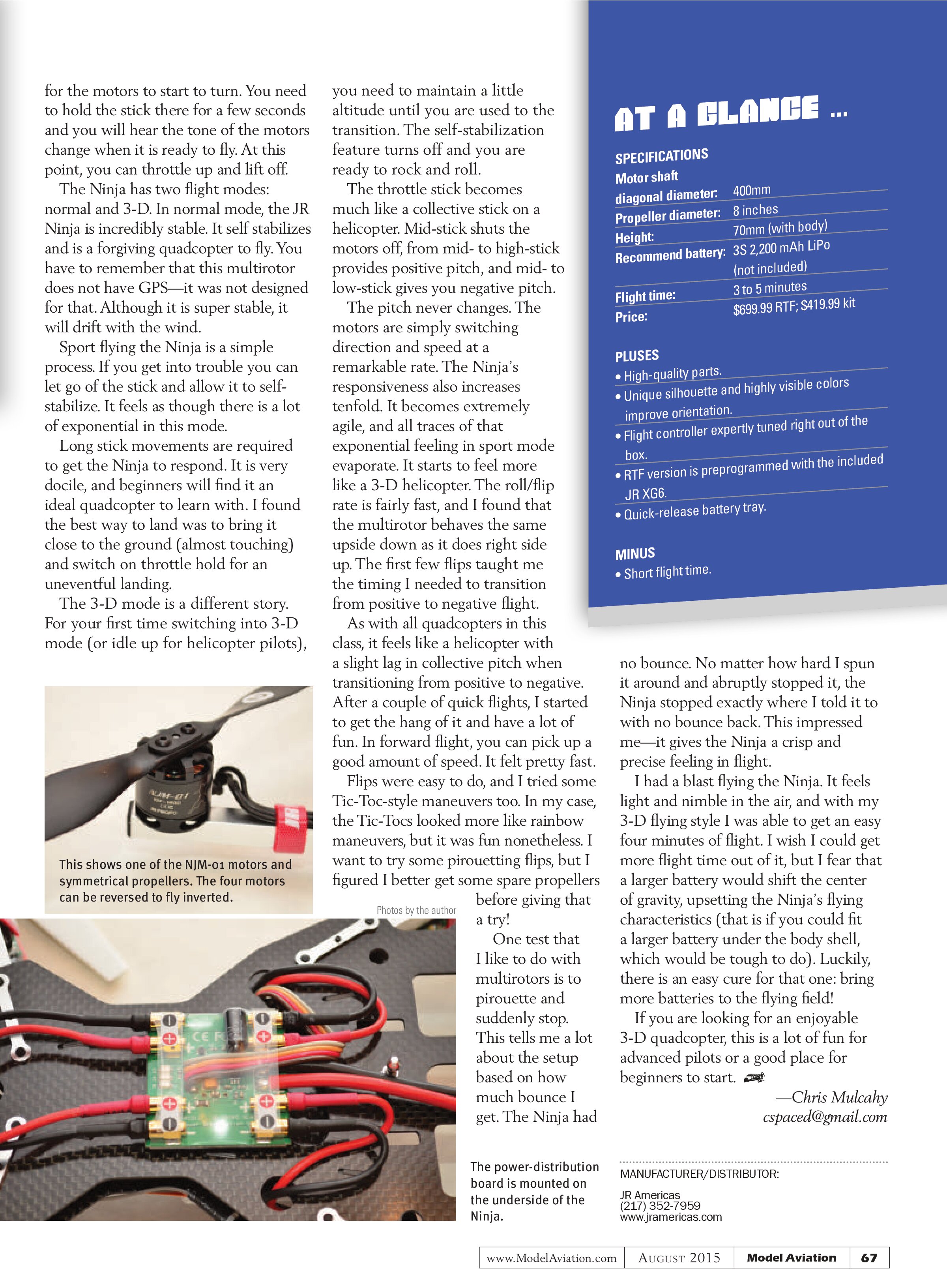
The top of the quad features a NFC-01 flight controller, and the RG731BX DMSS telemetry receiver, which includes the satellite-style telemetry module. The power distribution board is on the underside of the quad, and features a low-voltage flashing LED that is visible in flight. At the end of each motor boom is an NJA-01 ESC which has built-in bullet connectors, and the NJM-01 10P-1400 brushless motor. The motor swings a custom 8-inch propeller. The propeller is symmetrical, meaning that it has the same profile and effect regardless of the direction it is turning.
The Ninja is enclosed by a two-piece Lexan shell with a nice paint job. The shell is bright and vibrant thanks to the additional layer of white painted over the colors. The front arms of the aircraft I received are painted bright red, while
the rear arms are a dark blue. This helps with orientation when flying somewhat close to the pilot.
The body shells are held in place with helicopter-style canopy mounting posts. These posts are pressed through preinstalled rubber grommets for a snug attachment, and there are safety clips through the posts. There are three posts for the top body shell, and two posts for the lower body shell. All of the mounting posts are aluminum, and there are only a couple of small parts that are plastic.
At first I wondered why the motor booms were not carbon fiber. It occurred to me that square booms make it easier to orient the motors. They are certainly less expensive than square or round carbon-fiber tubes and are easier to sandwich between the main frames without having to add the additional weight (and cost) of brackets, as compared to round carbon tubes.
The NFC-01 is a six-axis flight controller. It only works with an XBus-compatible receiver. This flight controller will not work with any other brand of transmitter. I’ve not found any way to tune or adjust the flight controller, but then it didn’t need any adjusting out of the box.
There is a mini USB port on the top of the flight controller, which could indicate the possibility of having the ability to update the firmware at some point, although this could just be for initial factory tuning. The four ESCs plug directly into the flight controller, and there is an Aux1 and Aux2 port that runs into the power distribution board. There is also an unused battery and output port. The flight controller features a status LED on the top of the case.
The RG731BX receiver sends telemetry data back to the XG6 and lets the user know what voltage it is reading at the receiver. This is a cool feature to have, but I feel it would have been more useful to display the unregulated flight battery voltage so that you could set a low-voltage alarm and not worry about timers.
The Ninja has a preinstalled Deans Ultra plug for the flight battery to connect to, and a set of new Deans plugs were included in the box to use on your battery.
Flying
The Ninja has a failsafe built into it in case you accidentally bump the throttle stick when connecting the flight battery. If you move the throttle stick up, nothing will happen. You have to move the throttle stick slightly above low stick for the motors to start to turn. You need to hold the stick there for a few seconds and you will hear the tone of the motors change when it is ready to fly. At this point, you can throttle up and lift off.
The Ninja has two flight modes: normal and 3-D. In normal mode, the JR Ninja is incredibly stable. It self stabilizes and is a forgiving quadcopter to fly. You have to remember that this multirotor does not have GPS—it was not designed for that. Although it is super stable, it will drift with the wind.
Sport flying the Ninja is a simple process. If you get into trouble you can let go of the stick and allow it to self-stabilize. It feels as though there is a lot of exponential in this mode.
Long stick movements are required to get the Ninja to respond. It is very docile, and beginners will find it an ideal quadcopter to learn with. I found the best way to land was to bring it close to the ground (almost touching) and switch on throttle hold for an uneventful landing.
The 3-D mode is a different story. For your first time switching into 3-D mode (or idle up for helicopter pilots), you need to maintain a little altitude until you are used to the transition. The self-stabilization feature turns off and you are ready to rock and roll.
The throttle stick becomes much like a collective stick on a helicopter. Mid-stick shuts the motors off, from mid- to high-stick provides positive pitch, and mid- to low-stick gives you negative pitch. The pitch never changes. The motors are simply switching direction and speed at a remarkable rate. The Ninja’s responsiveness also increases tenfold. It becomes extremely agile, and all traces of that exponential feeling in sport mode evaporate. It starts to feel more like a 3-D helicopter. The roll/flip rate is fairly fast, and I found that the multirotor behaves the same upside down as it does right side up. The first few flips taught me the timing I needed to transition from positive to negative flight.
As with all quadcopters in this class, it feels like a helicopter with a slight lag in collective pitch when transitioning from positive to negative. After a couple of quick flights, I started to get the hang of it and have a lot of fun. In forward flight, you can pick up a good amount of speed. It felt pretty fast.
Flips were easy to do, and I tried some Tic-Toc-style maneuvers too. In my case, the Tic-Tocs looked more like rainbow maneuvers, but it was fun nonetheless. I want to try some pirouetting flips, but I figured I better get some spare propellers before giving that a try!
One test that I like to do with multirotors is to pirouette and suddenly stop. This tells me a lot about the setup based on how much bounce I get. The Ninja had no bounce. No matter how hard I spun it around and abruptly stopped it, the Ninja stopped exactly where I told it to with no bounce back. This impressed me—it gives the Ninja a crisp and precise feeling in flight.
I had a blast flying the Ninja. It feels light and nimble in the air, and with my 3-D flying style I was able to get an easy four minutes of flight. I wish I could get more flight time out of it, but I fear that a larger battery would shift the center of gravity, upsetting the Ninja’s flying characteristics (that is if you could fit a larger battery under the body shell, which would be tough to do). Luckily, there is an easy cure for that one: bring more batteries to the flying field!
If you are looking for an enjoyable 3-D quadcopter, this is a lot of fun for advanced pilots or a good place for beginners to start.
—Chris Mulcahy
cspaced@gmail.com
MANUFACTURER/DISTRIBUTOR:
JR Americas
(217) 352-7959
www.jramericas.com
AT A GLANCE ...
SPECIFICATIONS
Motor shaft
diagonal diameter: 400mm
Propeller diameter: 8 inches
Height: 70mm (with body)
Recommend battery: 3S 2,200 mAh LiPo (not included)
Flight time: 3 to 5 minutes
Price: $699.99 RTF; $419.99 kit
PLUSES
- High-quality parts.
- Unique silhouette and highly visible colors improve orientation.
- Flight controller expertly tuned right out of the box.
- RTF version is preprogrammed with the included JR XG6.
- Quick-release battery tray.
MINUS
- Short flight time.