F1Q: One event, several approaches
by Louis Joyner
joyner28@comcast.net

The rules for the Fédération Aéronautique Internationale (FAI) Electric Power Free Flight (FF) class, known as F1Q, limit the motor run to a fixed amount of power based on model weight. The limit is 4 joules per gram of model weight, with a 500-gram cap for calculation purposes. (One joule equals one watt-second.) There are no restrictions on wing area and a maximum 550-gram model weight.
A quick example: A 500-gram model is allowed 2,000 joules. This could be used for a short motor run (5 seconds at 800 watts) or for a longer run (20 seconds at 200 watts). This is much like Rubber events, where the amount of energy (rubber weight) is limited, but the contestant can use that energy for a short, fast climb (many strands of rubber) or for a longer, slower climb (fewer strands, more turns).
For fliers familiar with the fixed motor runs used for Power events and other Electric events, the F1Q rules offer the challenge of figuring out the correct motor run to meet the rules. This can be done in two ways. The first is by using a wattmeter to measure current in watts during the midpoint of a test run on the ground. The contestant can then determine the maximum motor run by dividing the current in watts into the maximum allowed.
For example, say the current was 400 watts and the model weight was 500 grams. The maximum motor run would be 10 seconds (2,000 ÷ 400 = 10). The contestant would then fly with the motor run measured in the traditional way by a stopwatch.

The second method uses an electronic device, called an energy limiter, to shut off the motor after a preset amount of energy is used. This approach is similar to the Altitude Limited Electric Sailplane (ALES) RC event, where an electronic altimeter shuts off the model’s electric motor after a preset altitude is reached.
With no limit on model size or minimum weight, design options for F1Q are broader than in most other events. “One of the unique benefits of this particular class is the design freedom,” said Paul Masterman. “I’m flying two cells, others having chosen three cells,” he added, referring to the LiPo batteries used.
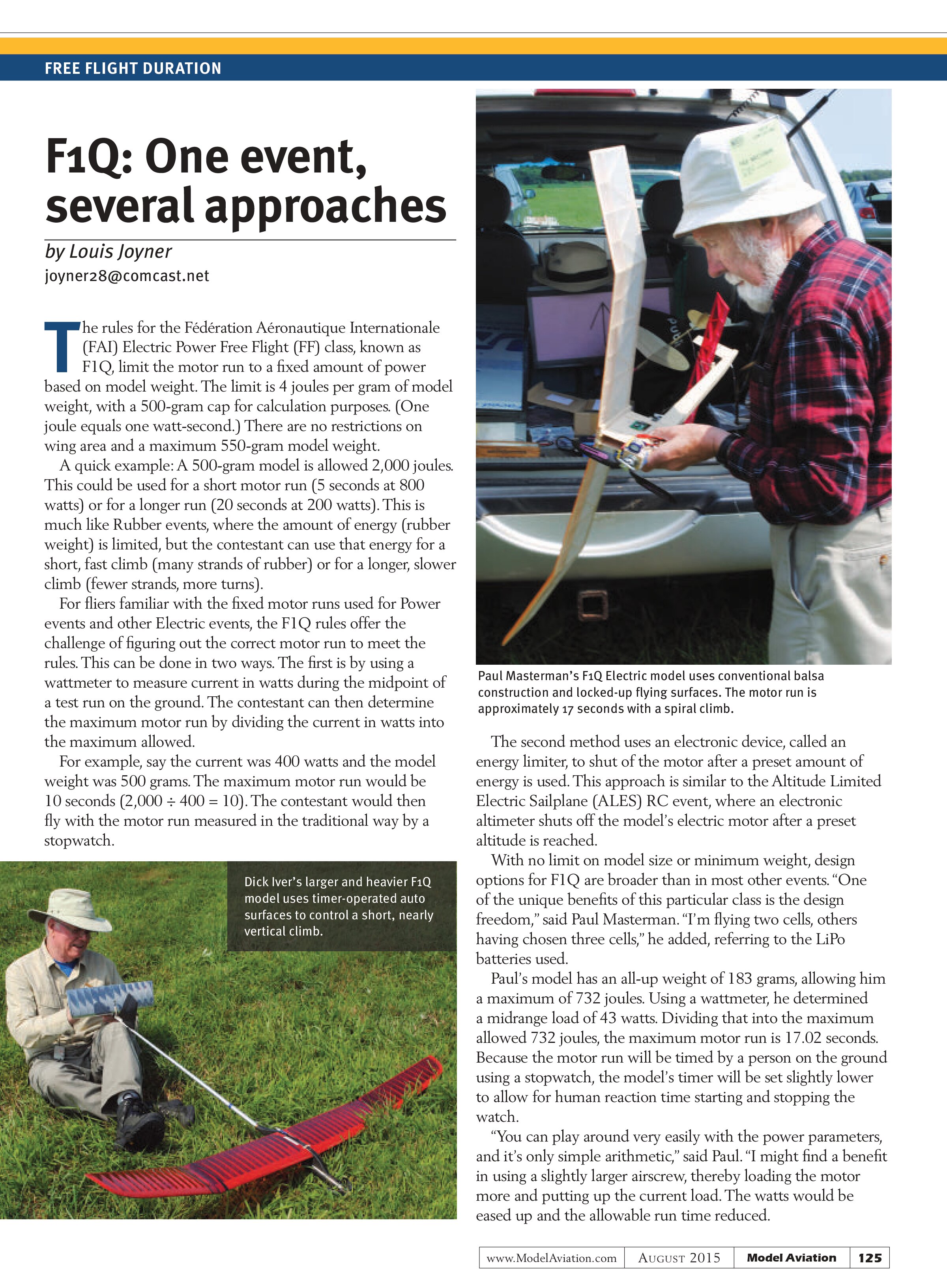
Paul’s model has an all-up weight of 183 grams, allowing him a maximum of 732 joules. Using a wattmeter, he determined a midrange load of 43 watts. Dividing that into the maximum allowed 732 joules, the maximum motor run is 17.02 seconds. Because the motor run will be timed by a person on the ground using a stopwatch, the model’s timer will be set slightly lower to allow for human reaction time starting and stopping the watch.
“You can play around very easily with the power parameters, and it’s only simple arithmetic,” said Paul. “I might find a benefit in using a slightly larger aircrew, thereby loading the motor more and putting up the current load. The watts would be eased up and the allowable run time reduced.
“The F1Q is my own design,” he noted. “It is a stretched version of my original E36, which is heavily influenced by John Oldenkamp’s Joule Box models.”
The major changes included substituting a built-up balsa fuselage for the carbon-fiber tube boom used on John’s E36 and thinning the flat-bottom wing airfoil down from 10% to 8%. How did he make it better? Paul replied, “Changing to an undercambered wing airfoil, cleaning up the front, and probably moving the battery inside.”
Paul’s model uses no auto surfaces and climbs in a spiral like a locked-up gas-powered model.
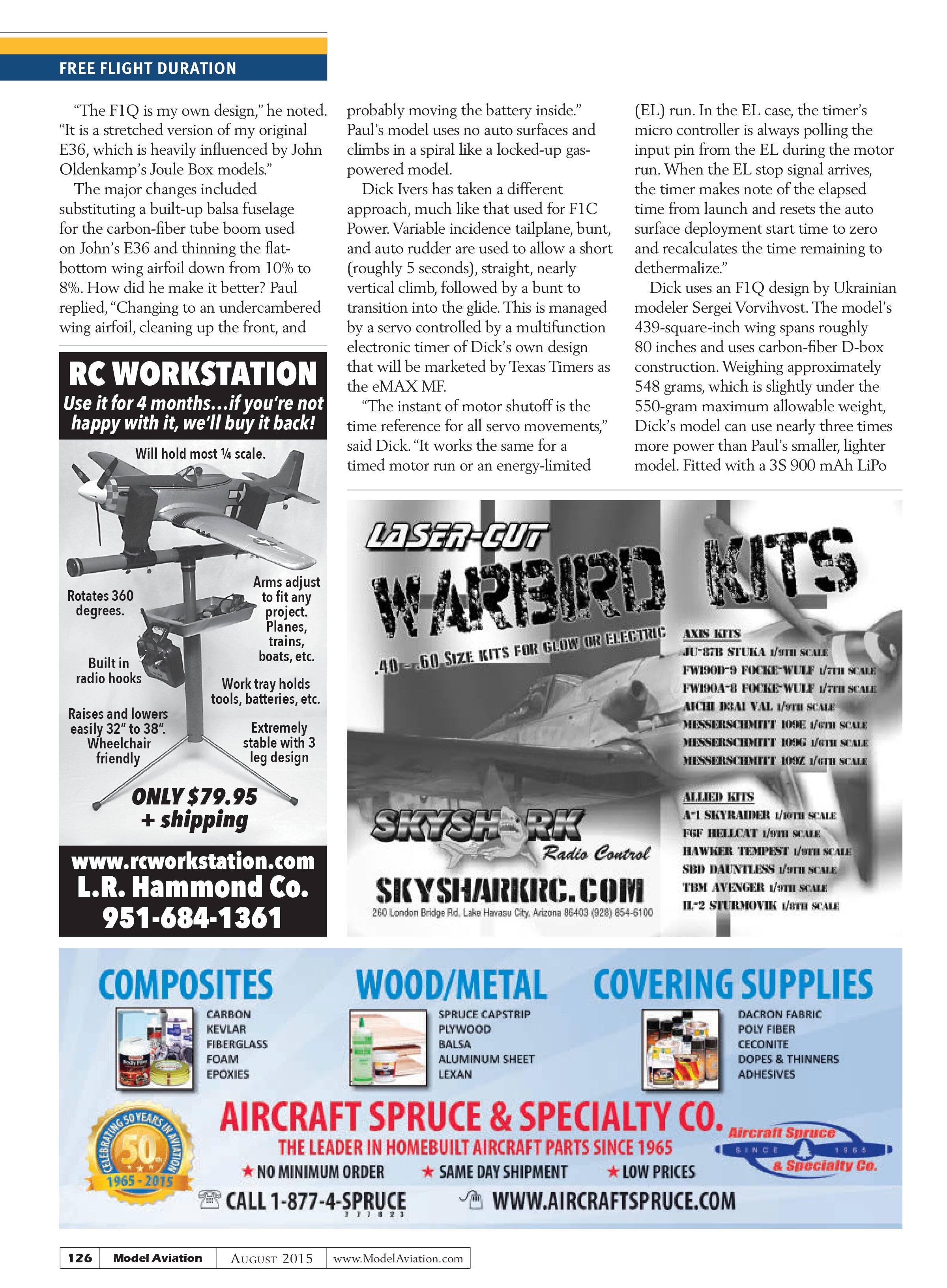
Dick Ivers has taken a different approach, much like that used for F1C Power. Variable incidence tailplane, bunt, and auto rudder are used to allow a short (roughly 5 seconds), straight, nearly vertical climb, followed by a bunt to transition into the glide. This is managed by a servo controlled by a multifunction electronic timer of Dick’s own design that will be marketed by Texas Timers as the eMAX MF.
“The instant of motor shutoff is the time reference for all servo movements,” said Dick. “It works the same for a timed motor run or an energy-limited (EL) run. In the EL case, the timer’s micro controller is always polling the input pin from the EL during the motor run. When the EL stop signal arrives, the timer makes note of the elapsed time from launch and resets the auto surface deployment start time to zero and recalculates the time remaining to dethermalize.”
Dick uses an F1Q design by Ukrainian modeler Sergei Vorvihvost. The model’s 439-square-inch wing spans roughly 80 inches and uses carbon-fiber D-box construction. Weighing approximately 548 grams, which is slightly under the 550-gram maximum allowable weight, Dick’s model can use nearly three times more power than Paul’s smaller, lighter model. Fitted with a 3S 900 mAh LiPo battery and a Turnigy SK2836 1,500 Kv motor driving an Aeronaut 9 x 7 folding propeller, the model focuses that power into a short, fast climb.
These two approaches are not the only ways to fly F1Q. Another is to use a converted F1B Wakefield rubber model. There are a few kits available for F1Q, including Bernie Crowe’s Noah’s Quark from BMJR Models and the Big Dog from Top Notch Product Company.
Note that models that fit the AMA rules for Electric A, Electric B, and E36 can also be flown in F1Q by either using the wattmeter method of determining motor run, or by adding an energy limiter. Conversely, F1Q models can also be flown in some of the AMA Electric events.
For example, an F1Q model with auto surfaces can be flown in Electric B as long as its motor run is below the 10-second maximum. Electric A does not allow auto surfaces, so a locked-up F1Q could be used. With the elimination of the Builder of the Model rule effective this year, models such as the one produced by Sergei Vorvihvost can be flown in AMA events.
“I like this new rule change; it is long overdue,” said Dick. “I can now use this same model in AMA Electric B and get double duty from one model. Some fellow Skyscrapers are doing the same thing, so there will be more competitors, and the performance level will be higher.”
BMFA Free Flight Forum 2015
The 31st edition of the British Model Flying Association’s (BMFA) Free Flight Forum publication offers a variety of articles on FF topics ranging from Indoor to Scale. A sampling includes Trevor Grey’s piece on F1Q Electric, John Thompson’s suggestions for selecting and trimming models for Classic power, and Alan Jack explores the problem of F1C models going flat toward the end of the climb.
In separate papers, Roy Vaughn and Mike Woodhouse discuss electronic timers, and in another paper, Mike suggests new ideas for the F1 outdoor events. Tony Hebb offers detailed information on building and flying F1D Indoor models. On the Scale front, Andy Hewitt focuses on Kit Scale, while Ivan Taylor details his approach to Rubber Scale.
Also included are three-views of interesting and successful models for 2014, including Andy Hewitt’s Fokker D.VIII Kit Scale model; Ed Bennett’s 1950’s Thin Man Classic Rubber model; the Mini Creep by Frank Rushby, which is a scaled-down ½A flier based on a 1950s design; Chris Redrup’s BMFA Rubber model; Andy Crisp’s Blue Note, which is a low-tech, straight-tow, all-wood version of a modern composite circle-tow glider; and Trevor Grey’s Kaon F1Q design.
Copies of Free Flight Forum 2015 can be ordered by email from Martin Dilly in England or through the National Free Flight Society (NFFS) Publications. If ordered through NFFS, the price is $25 plus shipping. Be sure to check out the 2015 NFFS Symposium Report, also available from NFFS Publications.
SOURCES:
Sergei Vorvihvost
sergf1@yahoo.com
www.f1j pq.com
BMJR Models
(321) 537-1159
www.bjmrmodels.com
Top Notch Product Company
(615) 866-4327
www.topnotchkits.com/index_files/slide0001.htm
Texas Timers
(423) 282-6423
www.texastimers.com
BMFA
www.bmfa.org
Martin Dilly
martindilly20@compuserve.com