FLYZONE L-39 BRUSHLESS EDF Rx-R
Terry Dunn

Get into the air quickly with this enjoyable jet
The Aero Vodochody L-39 Albatros is one of those airplanes that looks “right.” It has great proportions and all of its shapes seem to meld together.
The full-scale Czech trainer and light attack aircraft has been around since the 1960s. Thousands of L-39s are still flying in the hands of air forces and private owners around the world, and modern variants of the L-39 are being developed and produced today.
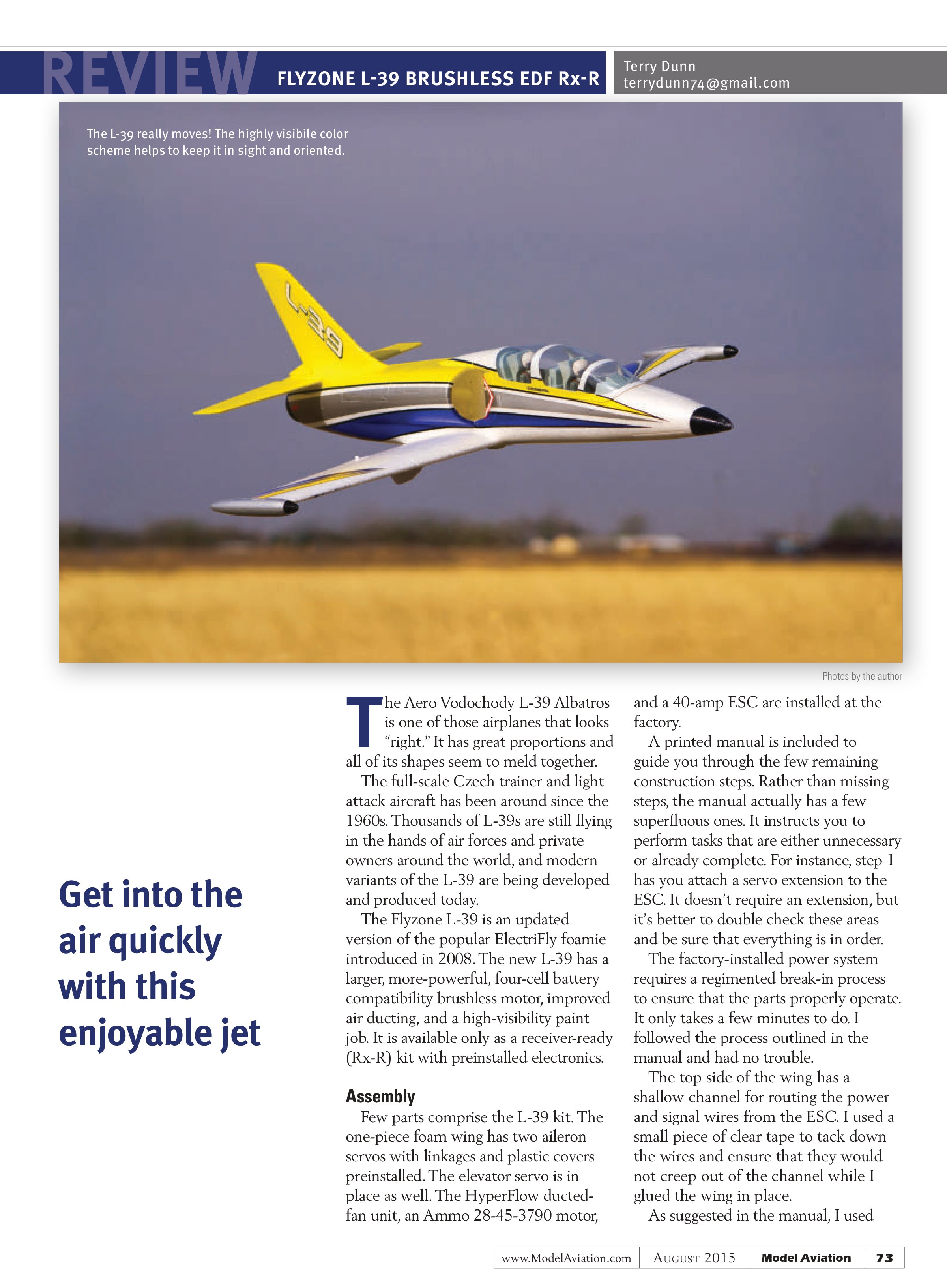
The Flyzone L-39 is an updated version of the popular ElectriFly foamie introduced in 2008. The new L-39 has a larger, more-powerful, four-cell battery compatibility brushless motor, improved air ducting, and a high-visibility paint job. It is available only as a receiver-ready (Rx-R) kit with preinstalled electronics.
Assembly
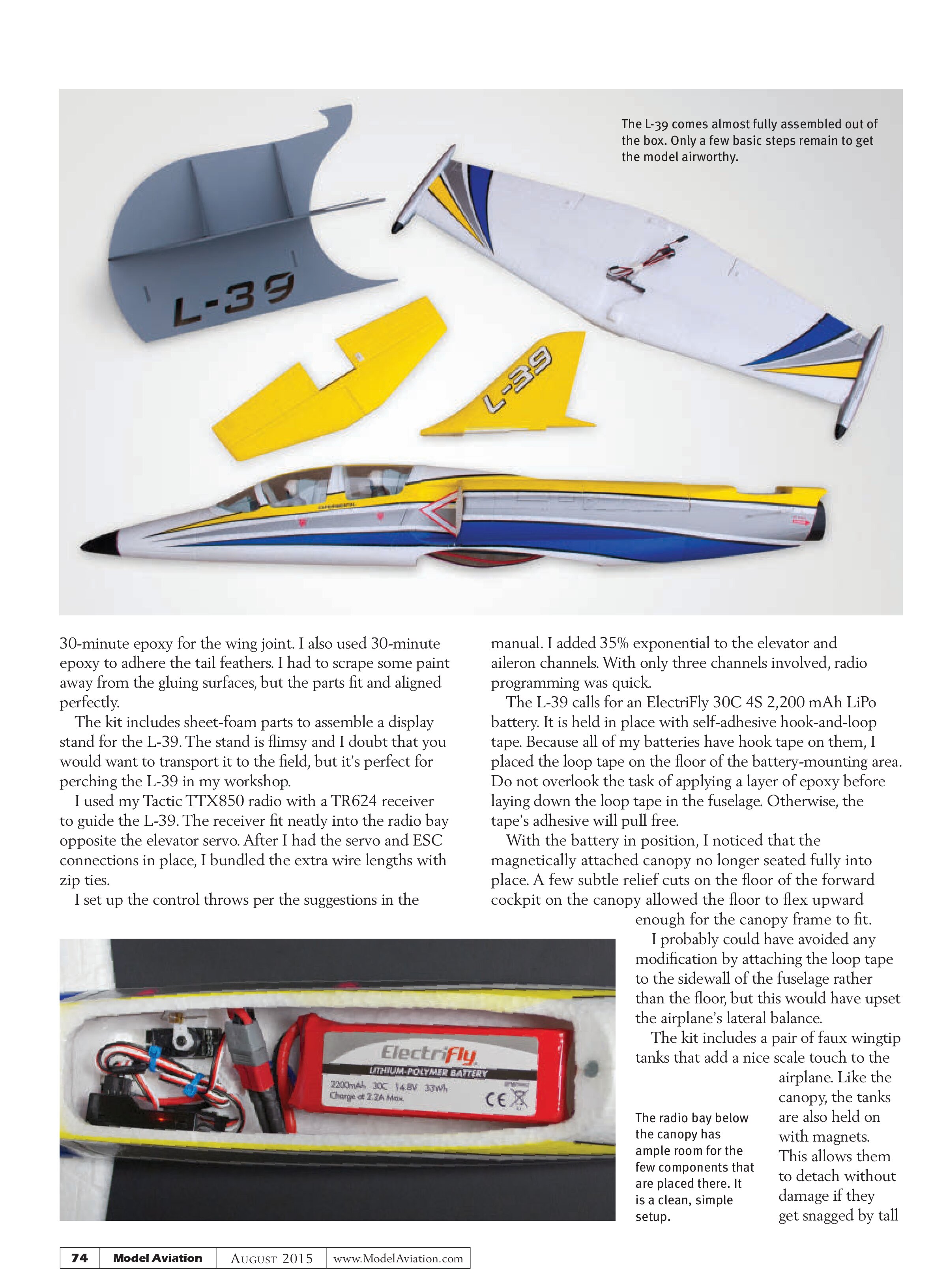
Few parts comprise the L-39 kit. The one-piece foam wing has two aileron servos with linkages and plastic covers preinstalled. The elevator servo is in place as well. The HyperFlow ducted-fan unit, an Ammo 28-45-3790 motor, and a 40-amp ESC are installed at the factory.
A printed manual is included to guide you through the few remaining construction steps. Rather than missing steps, the manual actually has a few superfluous ones. It instructs you to perform tasks that are either unnecessary or already complete. For instance, step 1 has you attach a servo extension to the ESC. It doesn’t require an extension, but it’s better to double check these areas and be sure that everything is in order.
The factory-installed power system requires a regimented break-in process to ensure that the parts properly operate. It only takes a few minutes to do. I followed the process outlined in the manual and had no trouble.
The top side of the wing has a shallow channel for routing the power and signal wires from the ESC. I used a small piece of clear tape to tack down the wires and ensure that they would not creep out of the channel while I glued the wing in place.
As suggested in the manual, I used

30-minute epoxy for the wing joint. I also used 30-minute epoxy to adhere the tail feathers. I had to scrape some paint away from the gluing surfaces, but the parts fit and aligned perfectly.
The kit includes sheet-foam parts to assemble a display stand for the L-39. The stand is flimsy and I doubt that you would want to transport it to the field, but it’s perfect for perching the L-39 in my workshop.
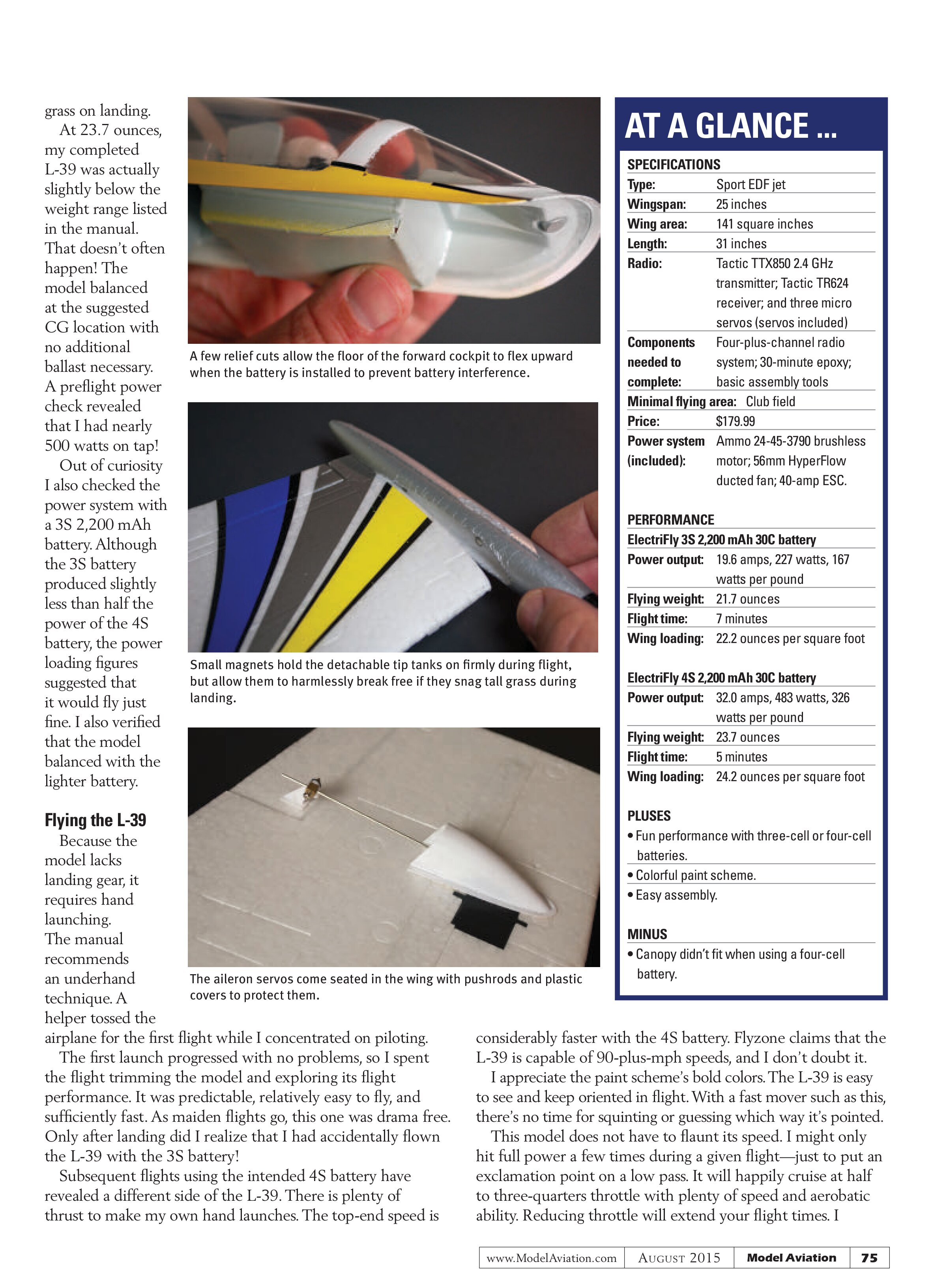
I used my Tactic TTX850 radio with a TR624 receiver to guide the L-39. The receiver fit neatly into the radio bay opposite the elevator servo. After I had the servo and ESC connections in place, I bundled the extra wire lengths with zip ties.
I set up the control throws per the suggestions in the manual. I added 35% exponential to the elevator and aileron channels. With only three channels involved, radio programming was quick.
The L-39 calls for an ElectriFly 30C 4S 2,200 mAh LiPo battery. It is held in place with self-adhesive hook-and-loop tape. Because all of my batteries have hook tape on them, I placed the loop tape on the floor of the battery-mounting area. Do not overlook the task of applying a layer of epoxy before laying down the loop tape in the fuselage. Otherwise, the tape’s adhesive will pull free.
With the battery in position, I noticed that the magnetically attached canopy no longer seated fully into place. A few subtle relief cuts on the floor of the forward cockpit on the canopy allowed the floor to flex upward enough for the canopy frame to fit.
I probably could have avoided any modification by attaching the loop tape to the sidewall of the fuselage rather than the floor, but this would have upset the airplane’s lateral balance.
The kit includes a pair of faux wingtip tanks that add a nice scale touch to the airplane. Like the canopy, the tanks are also held on with magnets. This allows them to detach without damage if they get snagged by tall grass on landing.
At 23.7 ounces, my completed L-39 was actually slightly below the weight range listed in the manual. That doesn’t often happen! The model balanced at the suggested CG location with no additional ballast necessary. A preflight power check revealed that I had nearly 500 watts on tap!
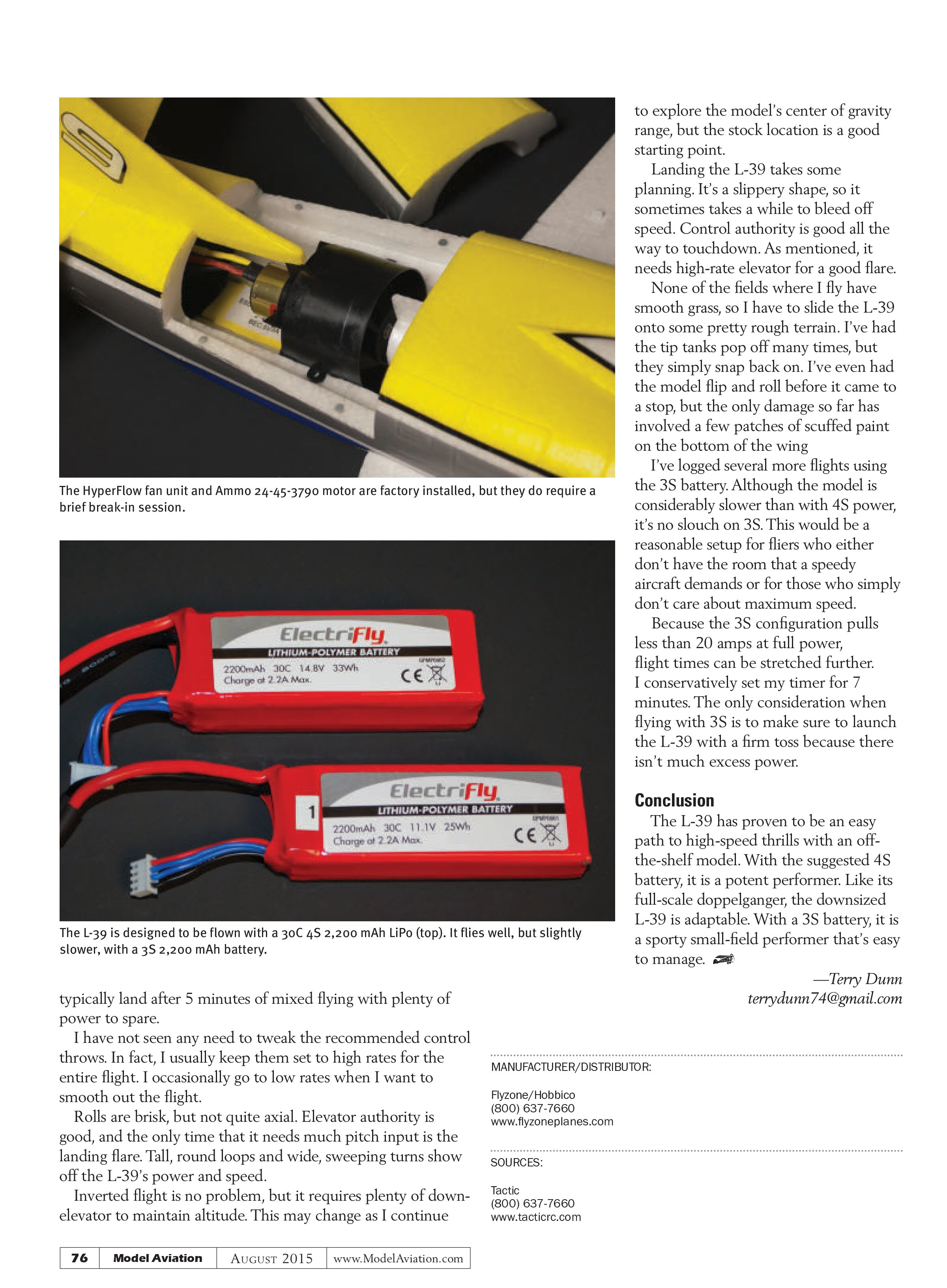
Out of curiosity I also checked the power system with a 3S 2,200 mAh battery. Although the 3S battery produced slightly less than half the power of the 4S battery, the power loading figures suggested that it would fly just fine. I also verified that the model balanced with the lighter battery.
Flying the L-39
Because the model lacks landing gear, it requires hand launching. The manual recommends an underhand technique. A helper tossed the airplane for the first flight while I concentrated on piloting.
The first launch progressed with no problems, so I spent the flight trimming the model and exploring its flight performance. It was predictable, relatively easy to fly, and sufficiently fast. As maiden flights go, this one was drama free. Only after landing did I realize that I had accidentally flown the L-39 with the 3S battery!
Subsequent flights using the intended 4S battery have revealed a different side of the L-39. There is plenty of thrust to make my own hand launches. The top-end speed is considerably faster with the 4S battery. Flyzone claims that the L-39 is capable of 90-plus-mph speeds, and I don’t doubt it.
I appreciate the paint scheme’s bold colors. The L-39 is easy to see and keep oriented in flight. With a fast mover such as this, there’s no time for squinting or guessing which way it’s pointed.
This model does not have to flaunt its speed. I might only hit full power a few times during a given flight—just to put an exclamation point on a low pass. It will happily cruise at half to three-quarters throttle with plenty of speed and aerobatic ability. Reducing throttle will extend your flight times.


AT A GLANCE …
SPECIFICATIONS
Type: Sport EDF jet
Wingspan: 25 inches
Wing area: 141 square inches
Length: 31 inches
Radio: Tactic TTX850 2.4 GHz transmitter; Tactic TR624 receiver; and three micro servos (servos included)
Components needed to complete: Four-plus-channel radio system; 30-minute epoxy; basic assembly tools
Minimal flying area: Club field
Price: $179.99
Power system (included): Ammo 24-45-3790 brushless motor; 56mm HyperFlow ducted fan; 40-amp ESC.
PERFORMANCE
ElectriFly 3S 2,200 mAh 30C battery
Power output: 19.6 amps, 227 watts, 167 watts per pound
Flying weight: 21.7 ounces
Flight time: 7 minutes
Wing loading: 22.2 ounces per square foot
ElectriFly 4S 2,200 mAh 30C battery
Power output: 32.0 amps, 483 watts, 326 watts per pound
Flying weight: 23.7 ounces
Flight time: 5 minutes
Wing loading: 24.2 ounces per square foot
PLUSES
- Fun performance with three-cell or four-cell batteries.
- Colorful paint scheme.
- Easy assembly.
MINUS
- Canopy didn’t fit when using a four-cell battery.


typically land after 5 minutes of mixed flying with plenty of power to spare.
I have not seen any need to tweak the recommended control throws. In fact, I usually keep them set to high rates for the entire flight. I occasionally go to low rates when I want to smooth out the flight.
Rolls are brisk, but not quite axial. Elevator authority is good, and the only time that it needs much pitch input is the landing flare. Tall, round loops and wide, sweeping turns show off the L-39’s power and speed.
Inverted flight is no problem, but it requires plenty of down-elevator to maintain altitude. This may change as I continue to explore the model’s center of gravity range, but the stock location is a good starting point.
Landing the L-39 takes some planning. It’s a slippery shape, so it sometimes takes a while to bleed off speed. Control authority is good all the way to touchdown. As mentioned, it needs high-rate elevator for a good flare.
None of the fields where I fly have smooth grass, so I have to slide the L-39 onto some pretty rough terrain. I’ve had the tip tanks pop off many times, but they simply snap back on. I’ve even had the model flip and roll before it came to a stop, but the only damage so far has involved a few patches of scuffed paint on the bottom of the wing.
I’ve logged several more flights using the 3S battery. Although the model is considerably slower than with 4S power, it’s no slouch on 3S. This would be a reasonable setup for fliers who either don’t have the room that a speedy aircraft demands or for those who simply don’t care about maximum speed.
Because the 3S configuration pulls less than 20 amps at full power, flight times can be stretched further. I conservatively set my timer for 7 minutes. The only consideration when flying with 3S is to make sure to launch the L-39 with a firm toss because there isn’t much excess power.
Conclusion
The L-39 has proven to be an easy path to high-speed thrills with an off-the-shelf model. With the suggested 4S battery, it is a potent performer. Like its full-scale doppelganger, the downsized L-39 is adaptable. With a 3S battery, it is a sporty small-field performer that’s easy to manage.
—Terry Dunn
terrydunn74@gmail.com
MANUFACTURER/DISTRIBUTOR:
Flyzone/Hobbico
(800) 637-7660
www.flyzoneplanes.com
SOURCES:
Tactic
(800) 637-7660
www.tacticrc.com