in the Air
Membership news and updates
from AMA Headquarters
Howard Kelem
January 30, 1925-December 1, 2014
An AMA Model Aviation Hall of Fame inductee who was an inventor, a World War II pilot, and an educator who taught thousands of students how to fly model and full-scale aircraft, won’t soon be forgotten.
Howard Kelem left his mark in history as one of the inventors of cruise control for automobiles. He also invented a four-wire U-Reely-type control line handle, and a machine that automatically ties meat products with an aluminum staple. There are eight patents in the US and the United Kingdom in Howard’s name.
In the autobiography he submitted in 2003 for the AMA History Project, Howard explained why he decided to invent cruise control. “I would get many speeding tickets unintentionally, especially in the summertime when driving to work at 4 a.m. [or] a beautiful evening, the top down on my convertible Cadillac, listening to the Glen Miller Orchestra, just cruising along the Belt Parkway, I would end up doing 60 to 65 mph in a 50 mph zone.”
Howard seemed to cruise along in life—moving from one adventure to the next. Between his birth on January 30, 1925, on the east side of New York City, to his death on December 1, 2014, in Florida, Howard accomplished more than most.
His interest in aviation was sparked at an early age, and he idolized Charles Lindbergh. He became friends with a boy named Franky, whose father started a company called Mercury Models in his basement. Franky’s father, Tony Cocaro, often gave Howard balsawood and other materials—fueling his passion for building.
Because he wanted a career in aviation, Howard attended Haaran High
School of Aviation Trades in New York. Unfortunately, he had to leave high school five months short of graduation to help support his family.
After working at a fur coat factory and a watch factory, he took a job at American Airlines, where he was an aircraft and engine mechanic. By that time, World War II had begun and he decided to join the military. He was assigned to the U.S. Army Air Force and was eventually trained to serve as a B-24 crew chief. He wanted to pilot the aircraft, but learned that he was required to have a high school diploma.
“Well, I was desperate and I lied,” Howard wrote. “Lucky for me that nobody ever checked my records in high school.
“I took the entrance exam and I was among the 10 highest scores out of 2,000 applicants. I made it! I was a cadet and on my way.”
He was appointed the cadet captain in charge of 2,000 cadets at the San
Antonio Cadet Center in Texas, and later attended the military’s B-29 flight engineering school in Hondo, Texas. He graduated August 6, 1945—the same day that the atomic bomb was dropped on Japan. Within 10 days, the war ended. Howard’s discharge was approved in November 1945.
Howard returned home to his wife and took a job at Eagle Brand Products, a wholesale meat packing company. While working there, he invented the machine to tie meat products.
When he wasn’t working, Howard continued to fly Free Flight and Control Line models and full-scale aircraft. He invented the four-wire control handle, which never proved successful.
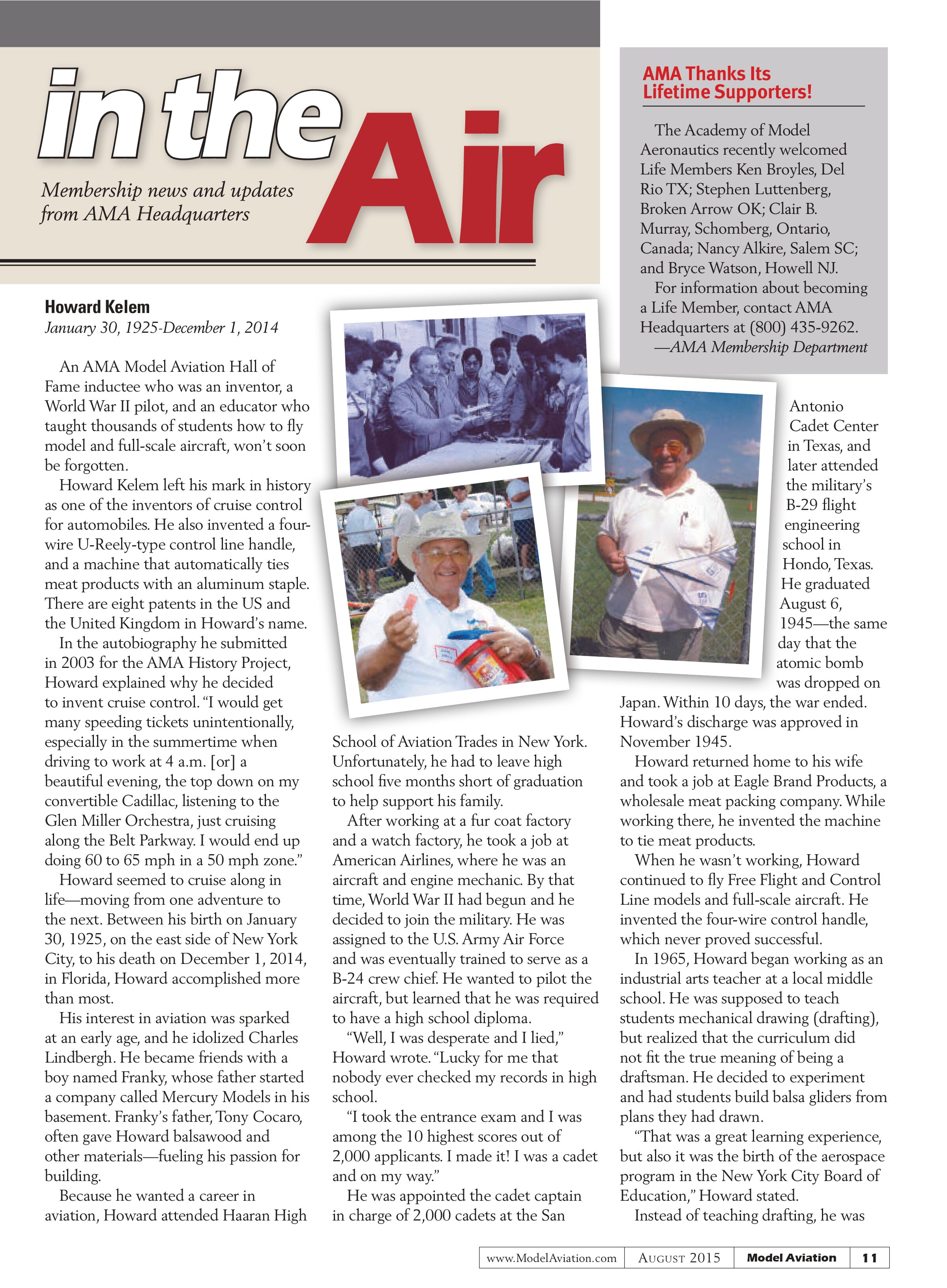
In 1965, Howard began working as an industrial arts teacher at a local middle school. He was supposed to teach students mechanical drawing (drafting), but realized that the curriculum did not fit the true meaning of being a draftsman. He decided to experiment and had students build balsa gliders from plans they had drawn.
“That was a great learning experience, but also it was the birth of the aerospace program in the New York City Board of Education,” Howard stated.
Instead of teaching drafting, he was


now an aerospace teacher, and designed a flight simulator for his classroom. The education board purchased eight of the simulators for other city schools.
The Hobby Industry Association of America heard about what Howard was teaching in his classroom and helped him set up a program to introduce Delta Darts to his students. In March of 1971, officials from magazines such as Model Airplane News, board of education supervisors, the Civil Air Patrol (CAP), the FAA, and Aero Products Research Inc. came to see the Delta Darts in action.
“That really started aerospace education throughout the country. I was asked to join the Civil Air Patrol and within a year, I was made director of aerospace education,” Howard wrote in his biography.
The CAP distributed Howard’s curriculum to numerous teachers. He began designing model airplanes and developing programs for schools in New York and across the country. Much of his material was printed in magazines and newspapers.
In addition to being inducted into the AMA Model Aviation Hall of Fame in 2013, Howard received several awards and 53 trophies related to model aviation throughout his lifetime. He was also asked to build a replica of the Wright Flyer, which was displayed at the International Arrivals Building at Kennedy Airport in New York. That aircraft is now on display at the Old Rhinebeck Aerodrome, in Red Hook, New York.
Horace Hagen’s Cobra
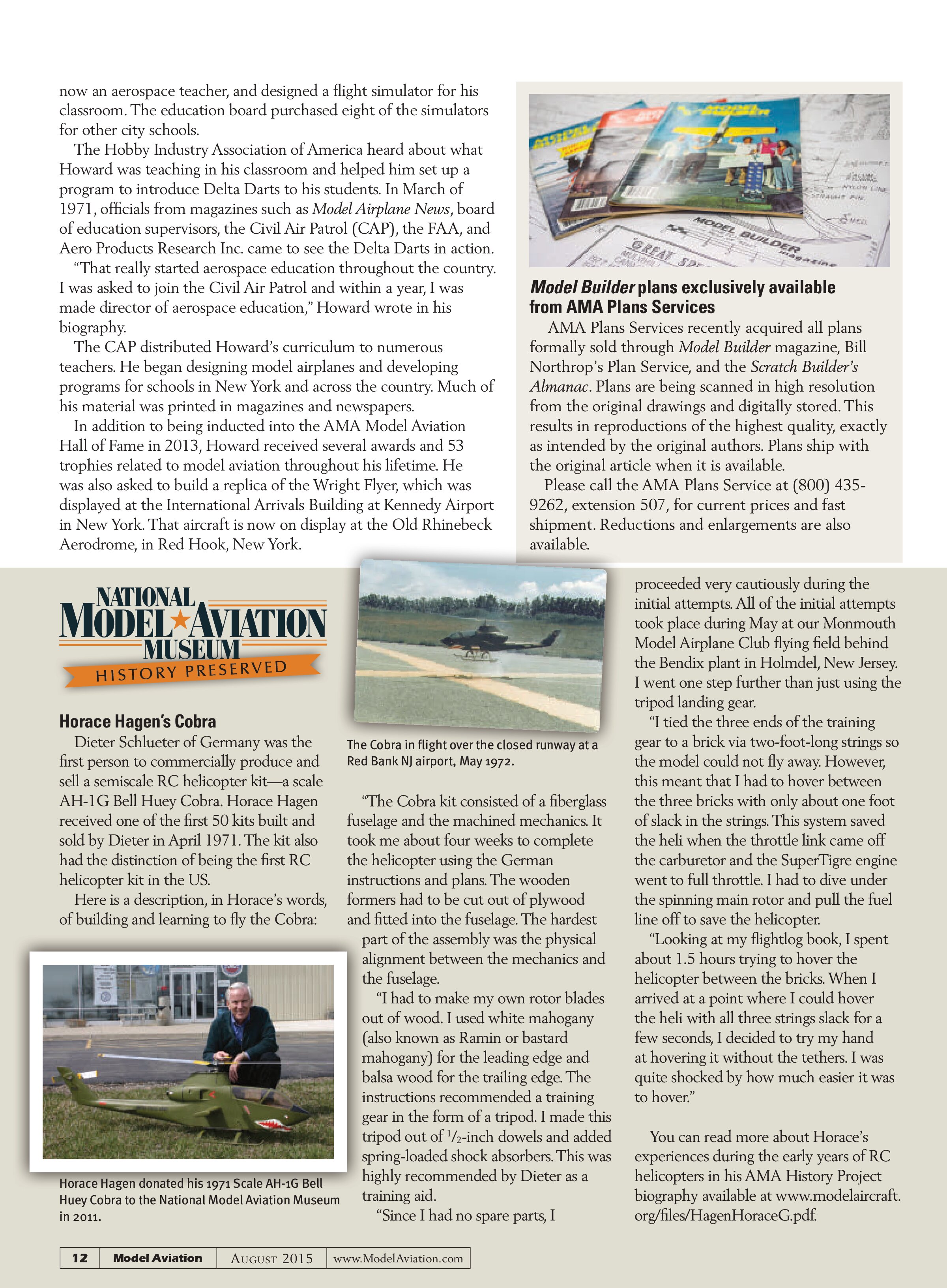
Dieter Schlueter of Germany was the first person to commercially produce and sell a semiscale RC helicopter kit—a scale AH-1G Bell Huey Cobra. Horace Hagen received one of the first 50 kits built and sold by Dieter in April 1971. The kit also had the distinction of being the first RC helicopter kit in the US.
Here is a description, in Horace’s words, of building and learning to fly the Cobra:

“The Cobra kit consisted of a fiberglass fuselage and the machined mechanics. It took me about four weeks to complete the helicopter using the German instructions and plans. The wooden formers had to be cut out of plywood and fitted into the fuselage. The hardest part of the assembly was the physical alignment between the mechanics and the fuselage.
“I had to make my own rotor blades out of wood. I used white mahogany (also known as Ramin or bastard mahogany) for the leading edge and balsa wood for the trailing edge. The instructions recommended a training gear in the form of a tripod. I made this tripod out of 1/2-inch dowels and added spring-loaded shock absorbers. This was highly recommended by Dieter as a training aid.
“Since I had no spare parts, I proceeded very cautiously during the initial attempts. All of the initial attempts took place during May at our Monmouth Model Airplane Club flying field behind the Bendix plant in Holmdel, New Jersey. I went one step further than just using the tripod landing gear.
“I tied the three ends of the training gear to a brick via two-foot-long strings so the model could not fly away. However, this meant that I had to hover between the three bricks with only about one foot of slack in the strings. This system saved the heli when the throttle link came off the carburetor and the SuperTigre engine went to full throttle. I had to dive under the spinning main rotor and pull the fuel line off to save the helicopter.
“Looking at my flightlog book, I spent about 1.5 hours trying to hover the helicopter between the bricks. When I arrived at a point where I could hover the heli with all three strings slack for a few seconds, I decided to try my hand at hovering it without the tethers. I was quite shocked by how much easier it was to hover.”
You can read more about Horace’s experiences during the early years of RC helicopters in his AMA History Project biography available at www.modelaircraft.org/files/HagenHoraceG.pdf.