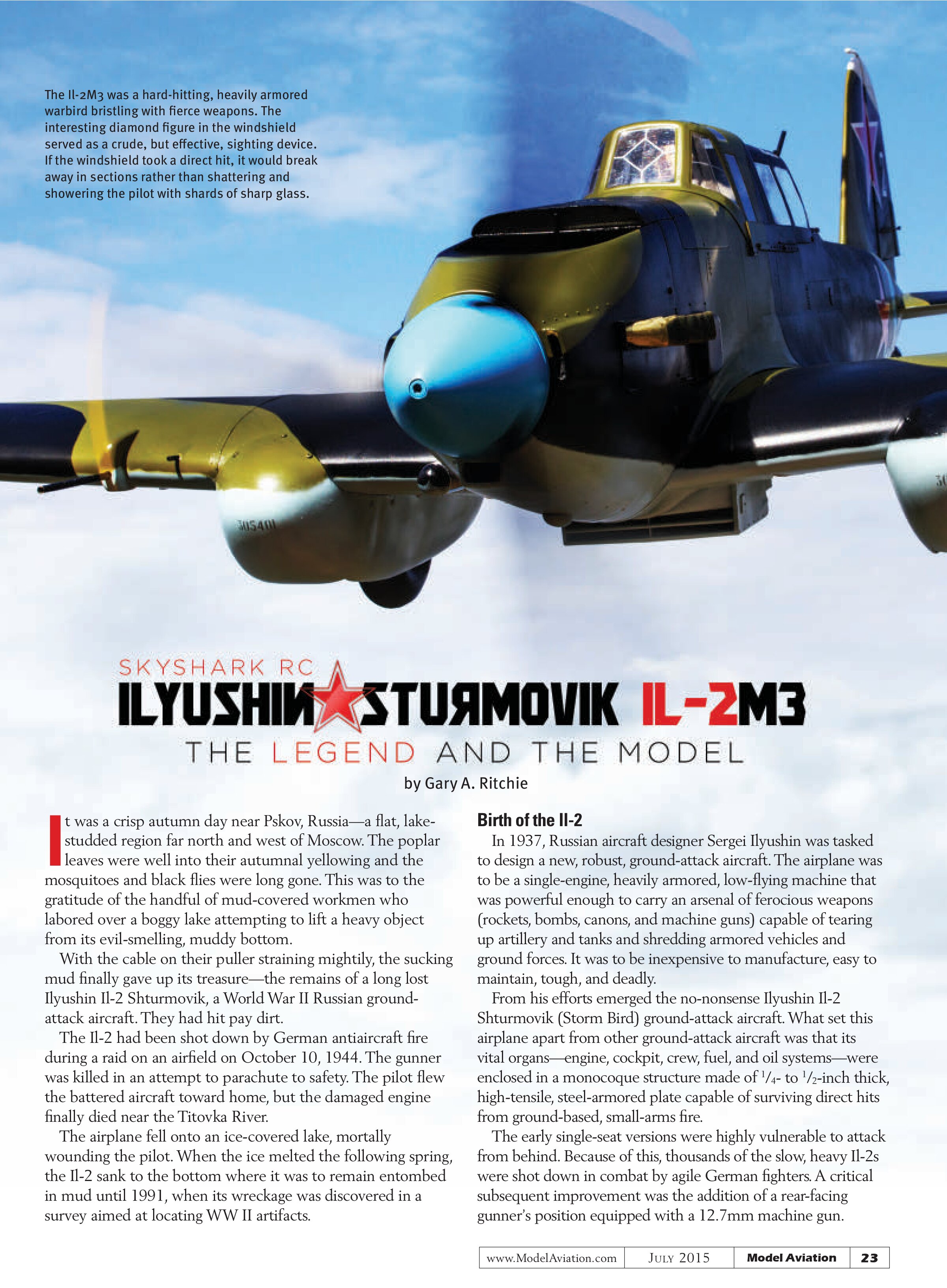
SKYSHARK RC ILYUSHIN STURMOVIK IL-2M3
THE LEGEND AND THE MODEL
by Gary A. Ritchie

It was a crisp autumn day near Pskov, Russia—a flat, lake-studded region far north and west of Moscow. The poplar leaves were well into their autumnal yellowing and the mosquitoes and black flies were long gone. This was to the gratitude of the handful of mud-covered workmen who labored over a boggy lake attempting to lift a heavy object from its evil-smelling, muddy bottom.
With the cable on their puller straining mightily, the sucking mud finally gave up its treasure—the remains of a long lost Ilyushin Il-2 Shturmovik, a World War II Russian ground-attack aircraft. They had hit pay dirt.
The Il-2 had been shot down by German antiaircraft fire during a raid on an airfield on October 10, 1944. The gunner was killed in an attempt to parachute to safety. The pilot flew the battered aircraft toward home, but the damaged engine finally died near the Titovka River.
The airplane fell onto an ice-covered lake, mortally wounding the pilot. When the ice melted the following spring, the Il-2 sank to the bottom where it was to remain entombed in mud until 1991, when its wreckage was discovered in a survey aimed at locating WW II artifacts.
Birth of the Il-2
In 1937, Russian aircraft designer Sergei Ilyushin was tasked to design a new, robust, ground-attack aircraft. The airplane was to be a single-engine, heavily armored, low-flying machine that was powerful enough to carry an arsenal of ferocious weapons (rockets, bombs, canons, and machine guns) capable of tearing up artillery and tanks and shredding armored vehicles and ground forces. It was to be inexpensive to manufacture, easy to maintain, tough, and deadly.
From his efforts emerged the no-nonsense Ilyushin Il-2 Shturmovik (Storm Bird) ground-attack aircraft. What set this airplane apart from other ground-attack aircraft was that its vital organs—engine, cockpit, crew, fuel, and oil systems—were enclosed in a monocoque structure made of ¼- to ½-inch thick, high-tensile, steel-armored plate capable of surviving direct hits from ground-based, small-arms fire.
The early single-seat versions were highly vulnerable to attack from behind. Because of this, thousands of the slow, heavy Il-2s were shot down in combat by agile German fighters. A critical subsequent improvement was the addition of a rear-facing gunner’s position equipped with a 12.7mm machine gun.
This modification greatly improved the survivability of the Il-2 in combat, but it also added considerable weight to the rear of the airplane, causing stability problems and making it difficult to fly. This was resolved by adding a 15° sweepback to the outer wings.
During WW II, more than 42,000 Il-2s and their variants were manufactured—more than any other warplane in history. This aircraft was so critical to Russia’s defense during The Great Patriotic War that Joseph Stalin deemed it as important to the Red army as “... the air it breathes and the bread it eats,” admonishing manufacturers to increase their Il-2 production under the threat of death.
Russian pilots fondly called the airplane “Ilyuska.” Russian infantrymen called it “The Flying Tank,” and Nazi ground forces, whom it terrorized, christened it “The Black Death.” Whatever it was called, the Shturmovik was pivotal to Russia’s defense and the defeat of the Nazis on the Eastern front. It stands beside the Spitfire and the Mustang as among the great warplanes of all time.
Back to Pskov
The wreckage retrieved from the unnamed lake was determined to be that of an Il-2M3, Serial Number 305401. It was manufactured in 1943 in Kuybyshev, Russia (today known as Samara), and assigned to the 828th Attack Aviation Regiment on the lower Karelian Front. A nearly complete nose section, cockpit, engine, and propeller, as well as the pilot’s body and many of his personal effects, were recovered. A link to a Russian video of the recovery can be found in the “Sources.”
The wings and wooden aft fuselage section were irretrievably damaged, so a search was undertaken to find suitable replacements to fully restore the aircraft. In all, four separate Il-2s donated parts to the restoration project. Restoration was done by Retro Avia Tech in Novosibirsk, Russia, under contract from the Flying Heritage Collection (FHC) and its owner, Microsoft cofounder, philanthropist, and Seattle Seahawks owner, Paul Allen.
Because the original Mikulin AM-38 engines were unavailable, the restorers re-engineered the aircraft’s nose to hold a left-turning Allison 1,475 hp V-1710-113 engine retrieved from a P-38. The restored Il-2M3 was painted in the exact color scheme of the Il-2 flown in combat by Air Marshal Aleksandr Yefimov, twice decorated Hero of the Soviet Union. He inspected the airplane before his death in 2012, and verified the authenticity of the colors and markings.
After a ceremonial November 7, 2011, flight over Samara, the restored Il-2M3 was disassembled, crated, and shipped to Bremerton, Washington, on a container ship, from where it was delivered to the FHC museum at Paine Field in Everett, Washington. It was first flown in the US on August 9, 2012, by pilot Steve Hinton, and has since been a popular attraction at the museum. A link to a video of the Il-2M3 in flight at Paine Field can be found in “Sources.”
The Skyshark RC Kit
I was so impressed with this huge, charismatic warbird that I immediately began an online search for kits, plans, or anything I could find that would help me build one for myself. I first located an exquisitely detailed ¹⁄₄₈-scale Tamiya scale plastic Il-2M3 kit, which I purchased and built to get a feel for the airplane and its complexities.
Then I located several sets of online plans, but none of these suited me because they were designed for a glow engine and I was determined to use electric power for my model. Finally, one day I was surfing www.RCScaleBuilder.com where I learned that Skyshark RC had just introduced its new, electric-powered, ¹⁄₆-scale, 72-inch wingspan Il-2M3 Sturmovik. A week later the kit was on my doorstep.
The Build
I intended to compete with my Il-2M3 at a U.S. Scale Masters event, so I needed to accurately document it and build it as true to the documentation as possible. My prototype airplane was the Il-2M3 at the FHC, requiring several trips to Paine Field for on-site photo sessions, along with email conversations with the museum curator, Cory Graff.
I was familiar with the many fine scale kits produced throughout the years by Skyshark RC and its owner, Mike Grey, but this was my first opportunity to build one. The kit comes with detailed, rolled plans, an instruction manual, many sheets of laser-cut, high-quality balsa and plywood, ABS plastic parts, a fiberglass cowling, and a clear canopy. Wheels, landing gear, and decals are left to the builder, offering opportunities for customization.
A link to an excellent build thread can be found on www.RCScaleBuilder.com. A link is included in the “Sources” list. I will confine my remarks to only the aspects of my build that went beyond the build thread.
SPECIFICATIONS
Wingspan: 72 inches
Wing area: 972 square inches
Flying weight: 11.5 pounds
Wing loading: 27 ounces per square foot
Cube loading: 10.4
Motor: Lightning 75 brushless electric outrunner
Controller: O.S. 70-amp ESC
Propeller: Three-blade Master Airscrew 16 x 8
Batteries: 6S 4,000 mAh LiPo Turnigy nano-tech
Static amps at full throttle: 50
Static watts at full throttle: 1,400
Power loading: 122 watts per pound
Wing servos: Hitec HS-5245MG
Rudder, elevator servos: Hitec HS-5425BB
Radio transmitter: Spektrum DX8
Radio receiver: Spektrum AR7000

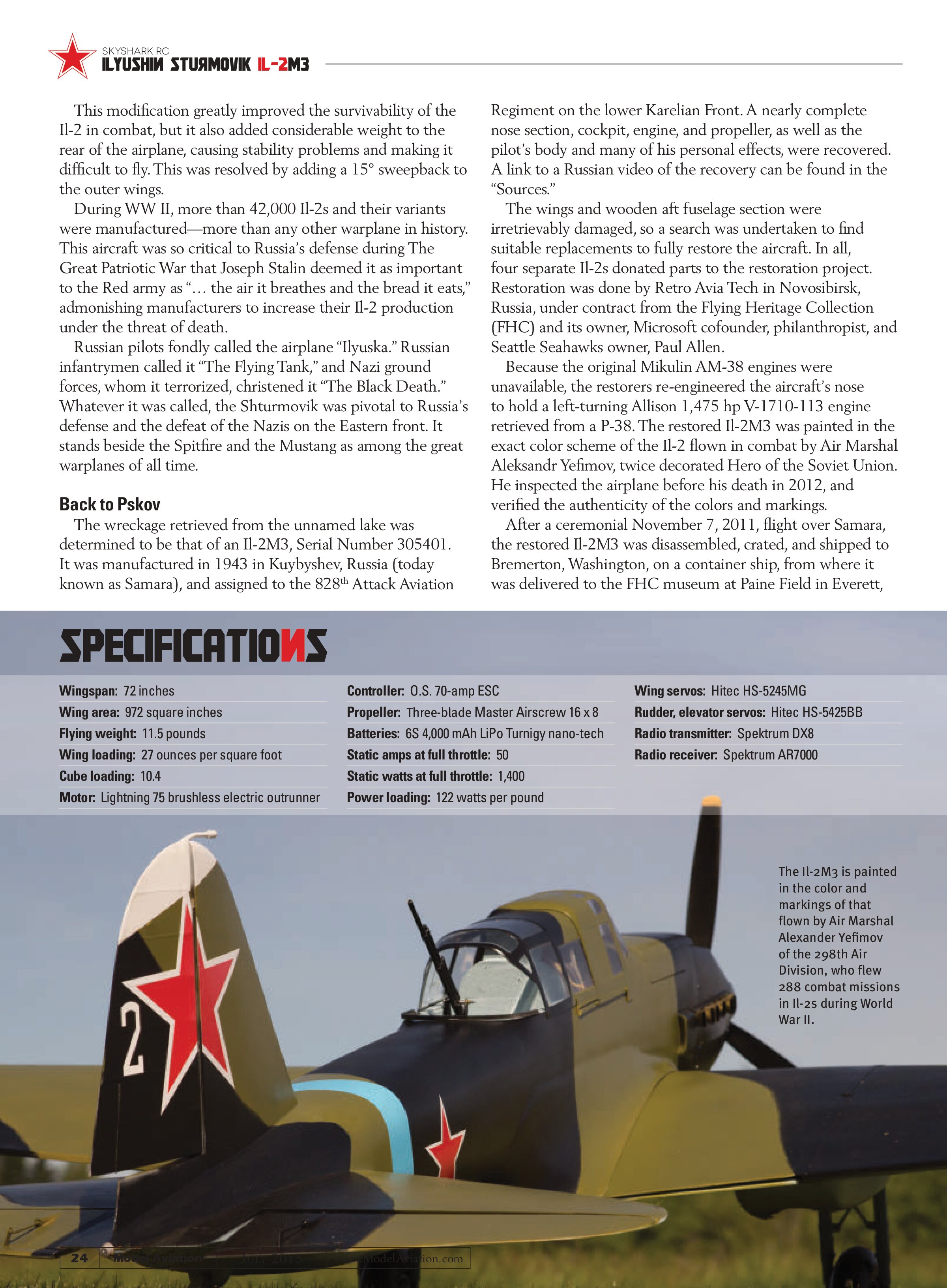
This shows final work on the wings and flaps. The flap and aileron servos are mounted in hatches beneath the wing. The pencil lines on the wing mark the location of the future panel lines. Note also that the internal flap details are also scale.
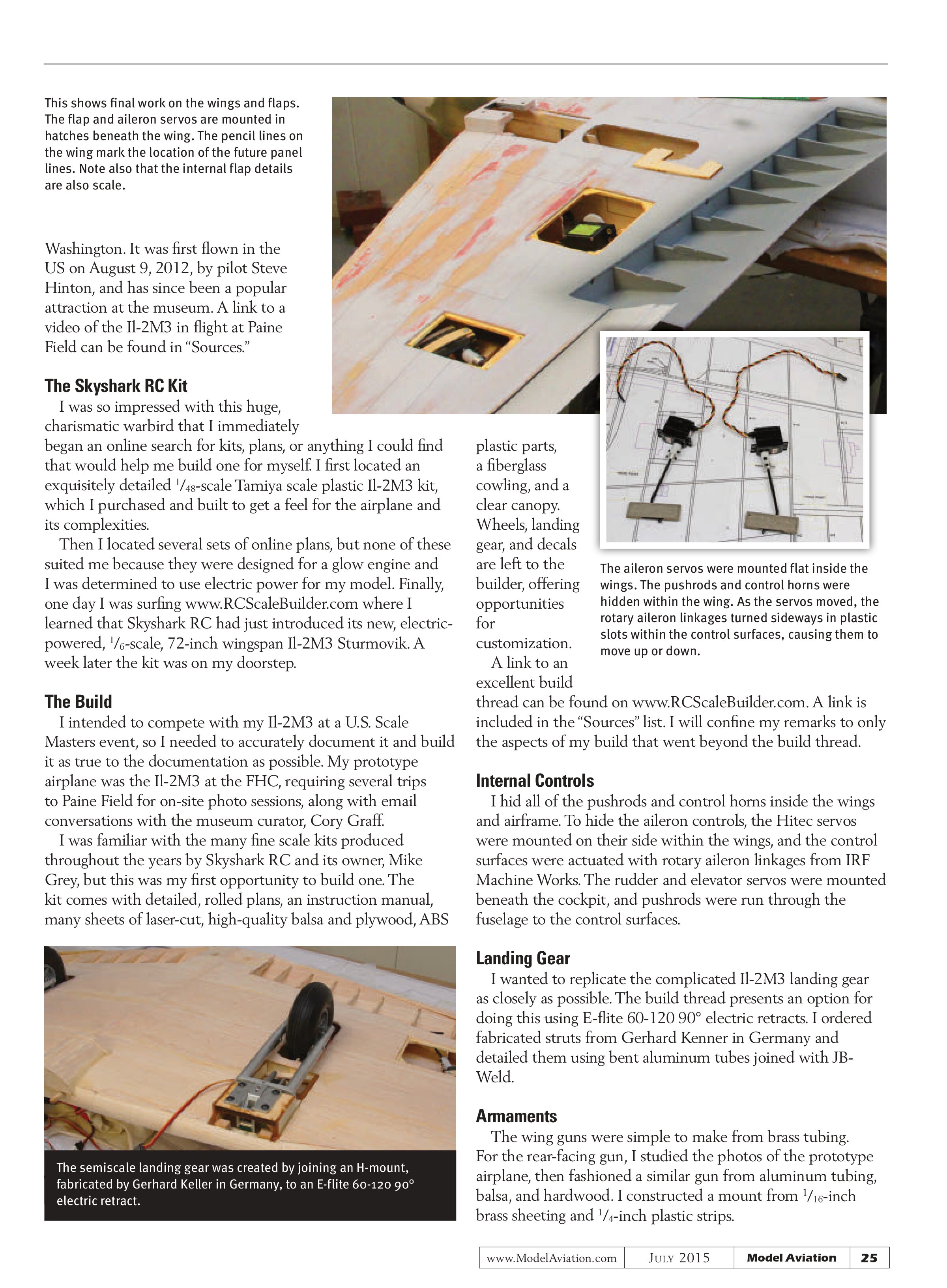
The aileron servos were mounted flat inside the wings. The pushrods and control horns were hidden within the wing. As the servos moved, the rotary aileron linkages turned sideways in plastic slots within the control surfaces, causing them to move up or down.
Internal Controls
I hid all of the pushrods and control horns inside the wings and airframe. To hide the aileron controls, the Hitec servos were mounted on their side within the wings, and the control surfaces were actuated with rotary aileron linkages from IRF Machine Works. The rudder and elevator servos were mounted beneath the cockpit, and pushrods were run through the fuselage to the control surfaces.
Landing Gear
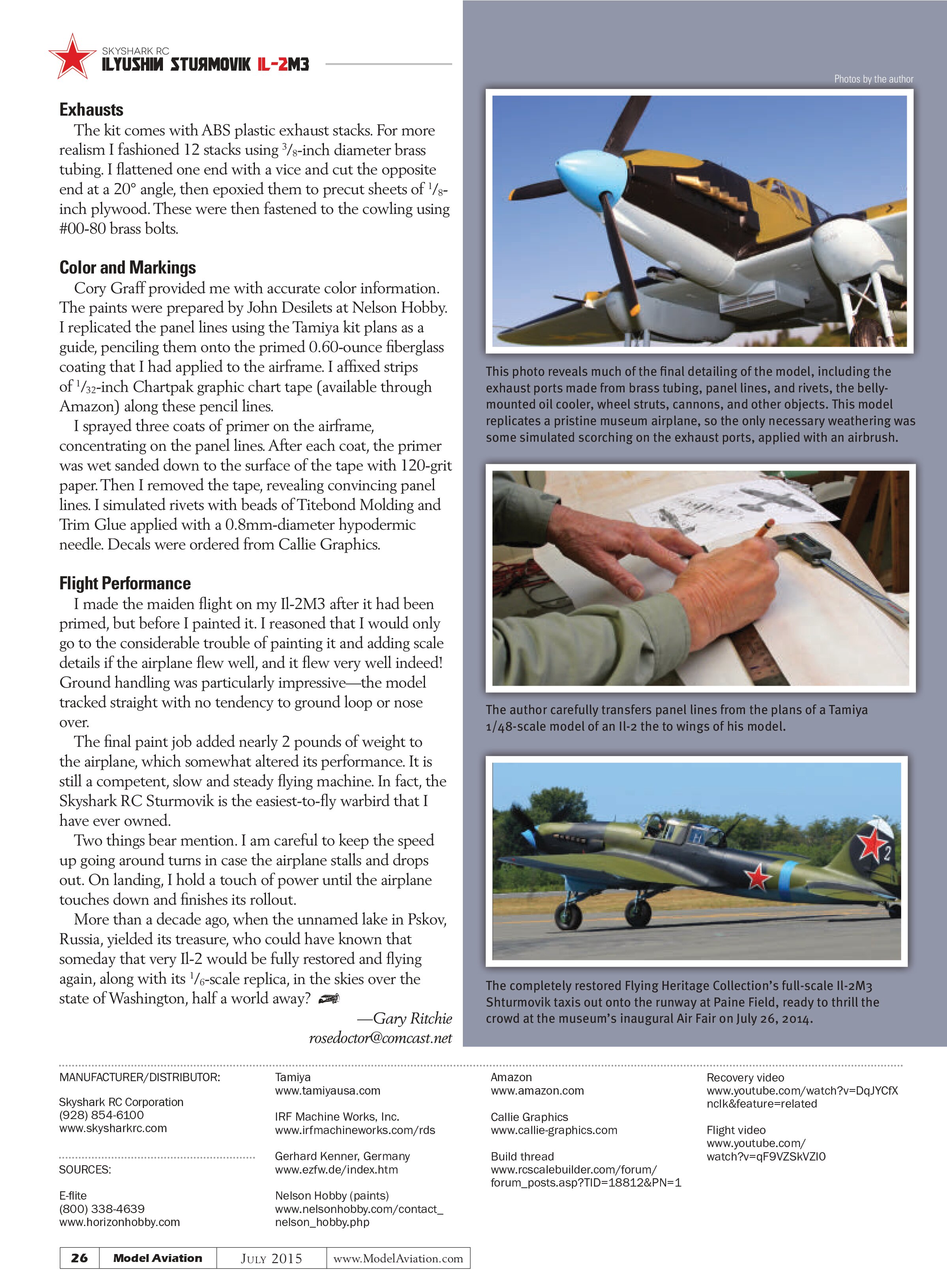
I wanted to replicate the complicated Il-2M3 landing gear as closely as possible. The build thread presents an option for doing this using E-flite 60-120 90° electric retracts. I ordered fabricated struts from Gerhard Kenner in Germany and detailed them using bent aluminum tubes joined with JB-Weld.

Armaments
The wing guns were simple to make from brass tubing. For the rear-facing gun, I studied the photos of the prototype airplane, then fashioned a similar gun from aluminum tubing, balsa, and hardwood. I constructed a mount from ¹⁄₁₆-inch brass sheeting and ¹⁄₄-inch plastic strips.
Exhausts
The kit comes with ABS plastic exhaust stacks. For more realism I fashioned 12 stacks using ³⁄₈-inch diameter brass tubing. I flattened one end with a vice and cut the opposite end at a 20° angle, then epoxied them to precut sheets of ¹⁄₈-inch plywood. These were then fastened to the cowling using #00-80 brass bolts.
Color and Markings
Cory Graff provided me with accurate color information. The paints were prepared by John Desilets at Nelson Hobby. I replicated the panel lines using the Tamiya kit plans as a guide, penciling them onto the primed 0.60-ounce fiberglass coating that I had applied to the airframe. I affixed strips of ¹⁄₃₂-inch Chartpak graphic chart tape (available through Amazon) along these pencil lines.
I sprayed three coats of primer on the airframe, concentrating on the panel lines. After each coat, the primer was wet sanded down to the surface of the tape with 120-grit paper. Then I removed the tape, revealing convincing panel lines. I simulated rivets with beads of Titebond Molding and Trim Glue applied with a 0.8mm-diameter hypodermic needle. Decals were ordered from Callie Graphics.
Flight Performance
I made the maiden flight on my Il-2M3 after it had been primed, but before I painted it. I reasoned that I would only go to the considerable trouble of painting it and adding scale details if the airplane flew well, and it flew very well indeed! Ground handling was particularly impressive—the model tracked straight with no tendency to ground loop or nose over.
The final paint job added nearly 2 pounds of weight to the airplane, which somewhat altered its performance. It is still a competent, slow and steady flying machine. In fact, the Skyshark RC Sturmovik is the easiest-to-fly warbird that I have ever owned.
Two things bear mention. I am careful to keep the speed up going around turns in case the airplane stalls and drops out. On landing, I hold a touch of power until the airplane touches down and finishes its rollout.
More than a decade ago, when the unnamed lake in Pskov, Russia, yielded its treasure, who could have known that someday that very Il-2 would be fully restored and flying again, along with its ¹⁄₆-scale replica, in the skies over the state of Washington, half a world away?
—Gary Ritchie
rosedoctor@comcast.net


MANUFACTURER/DISTRIBUTOR:
Skyshark RC Corporation
(928) 854-6100
www.skysharkrc.com
Tamiya
www.tamiyausa.com
IRF Machine Works, Inc.
www.irfmachineworks.com/rds
Gerhard Kenner, Germany
www.ezfw.de/index.htm
Nelson Hobby (paints)
www.nelsonhobby.com/contact_nelson_hobby.php
Amazon
www.amazon.com
Callie Graphics
www.callie-graphics.com
Build thread
www.rcscalebuilder.com/forum/forum_posts.asp?TID=18812&PN=1
Recovery video
www.youtube.com/watch?v=DqJYCfXnclK&feature=related
Flight video
www.youtube.com/watch?v=qF9VZSkVZI0
SOURCES:
E-flite
(800) 338-4639
www.horizonhobby.com