An unsung hero of RC Soaring: Terry Edmonds
by Gordon Buckland
gordon@gatorf3b.com

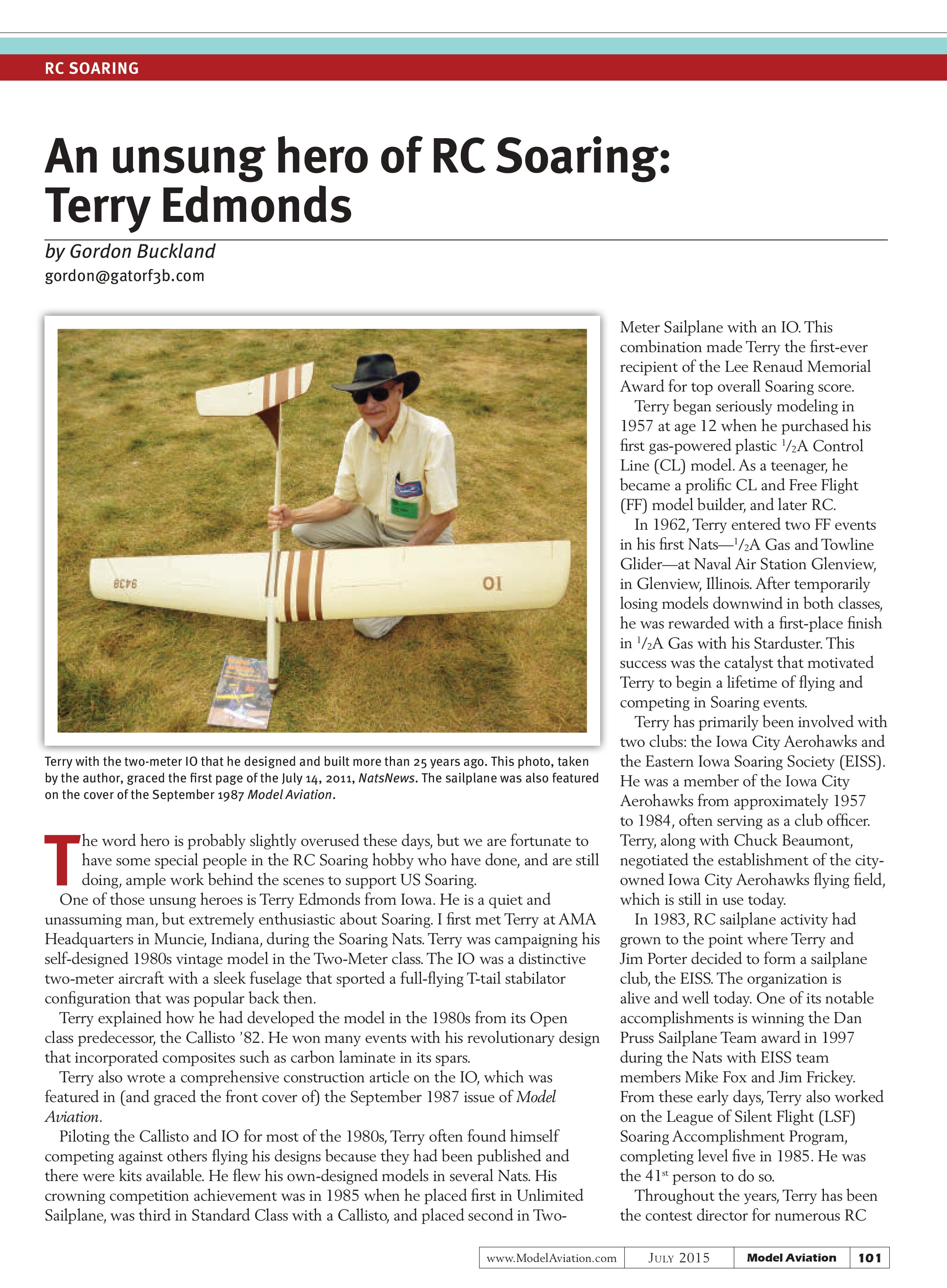
The word hero is probably slightly overused these days, but we are fortunate to have some special people in the RC Soaring hobby who have done, and are still doing, ample work behind the scenes to support US Soaring. One of those unsung heroes is Terry Edmonds from Iowa. He is a quiet and unassuming man, but extremely enthusiastic about Soaring. I first met Terry at AMA Headquarters in Muncie, Indiana, during the Soaring Nats. Terry was campaigning his self-designed 1980s vintage model in the Two-Meter class. The IO was a distinctive two-meter aircraft with a sleek fuselage that sported a full-flying T-tail stabilator configuration that was popular back then.
Terry explained how he had developed the model in the 1980s from its Open class predecessor, the Callisto ’82. He won many events with his revolutionary design that incorporated composites such as carbon laminate in its spars.
Terry also wrote a comprehensive construction article on the IO, which was featured in (and graced the front cover of) the September 1987 issue of Model Aviation.
Piloting the Callisto and IO for most of the 1980s, Terry often found himself competing against others flying his designs because they had been published and there were kits available. He flew his own-designed models in several Nats. His crowning competition achievement was in 1985 when he placed first in Unlimited Sailplane, was third in Standard Class with a Callisto, and placed second in Two-Meter Sailplane with an IO. This combination made Terry the first-ever recipient of the Lee Renaud Memorial Award for top overall Soaring score.
Terry began seriously modeling in 1957 at age 12 when he purchased his first gas-powered plastic ½A Control Line (CL) model. As a teenager, he became a prolific CL and Free Flight (FF) model builder, and later RC.
In 1962, Terry entered two FF events in his first Nats—½A Gas and Towline Glider—at Naval Air Station Glenview, in Glenview, Illinois. After temporarily losing models downwind in both classes, he was rewarded with a first-place finish in ½A Gas with his Starduster. This success was the catalyst that motivated Terry to begin a lifetime of flying and competing in Soaring events.
Terry has primarily been involved with two clubs: the Iowa City Aerohawks and the Eastern Iowa Soaring Society (EISS). He was a member of the Iowa City Aerohawks from approximately 1957 to 1984, often serving as a club officer. Terry, along with Chuck Beaumont, negotiated the establishment of the city-owned Iowa City Aerohawks flying field, which is still in use today.
In 1983, RC sailplane activity had grown to the point where Terry and Jim Porter decided to form a sailplane club, the EISS. The organization is alive and well today. One of its notable accomplishments is winning the Dan Pruss Sailplane Team award in 1997 during the Nats with EISS team members Mike Fox and Jim Frickey. From these early days, Terry also worked on the League of Silent Flight (LSF) Soaring Accomplishment Program, completing level five in 1985. He was the 41st person to do so.
Throughout the years, Terry has been the contest director for numerous RC
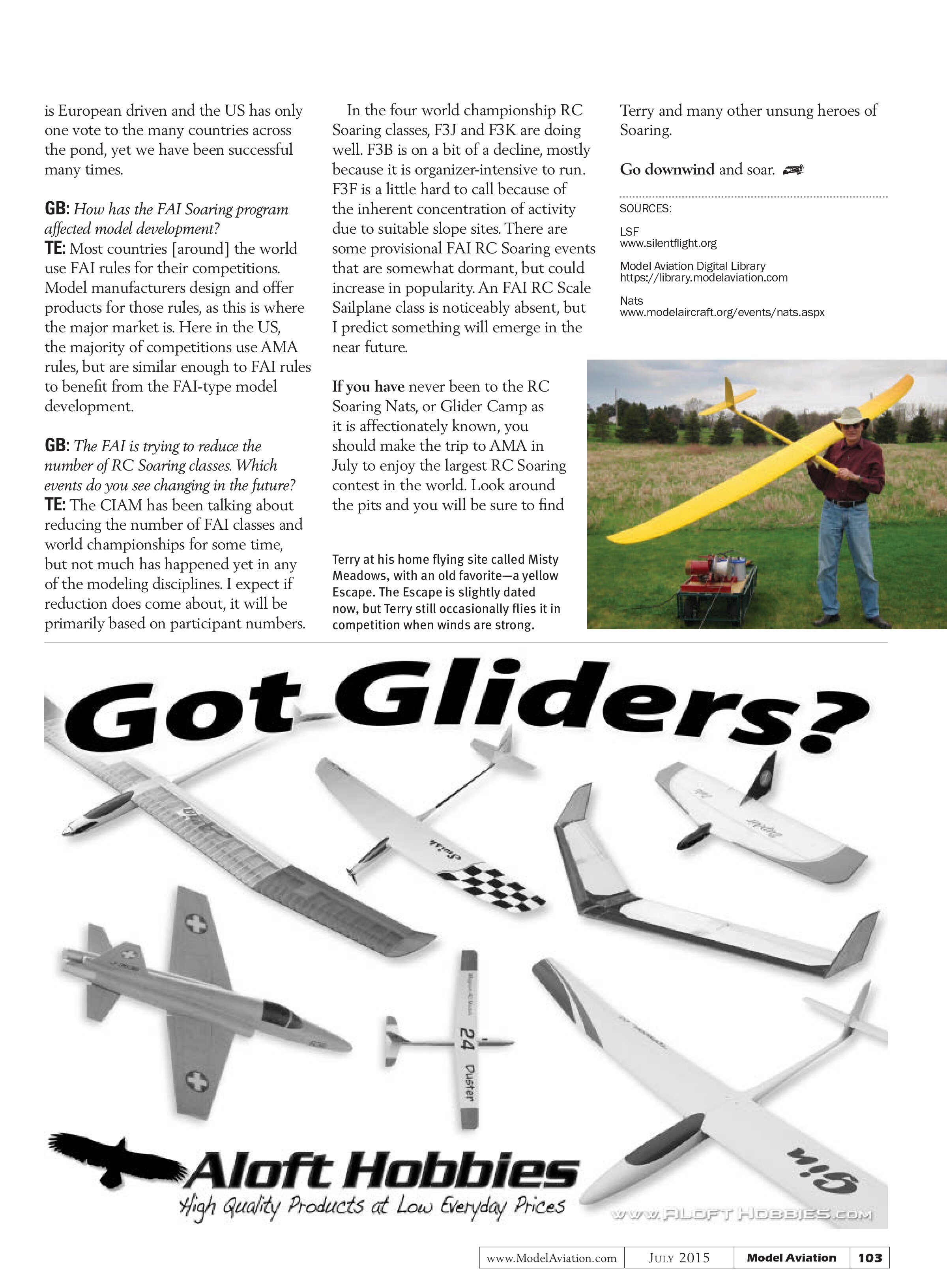
sailplane contests for both the Iowa City Aerohawks and EISS. In recent years, he has lived on his own flying site and hosted an annual contest in May called the Misty Meadows Soaring Classic.
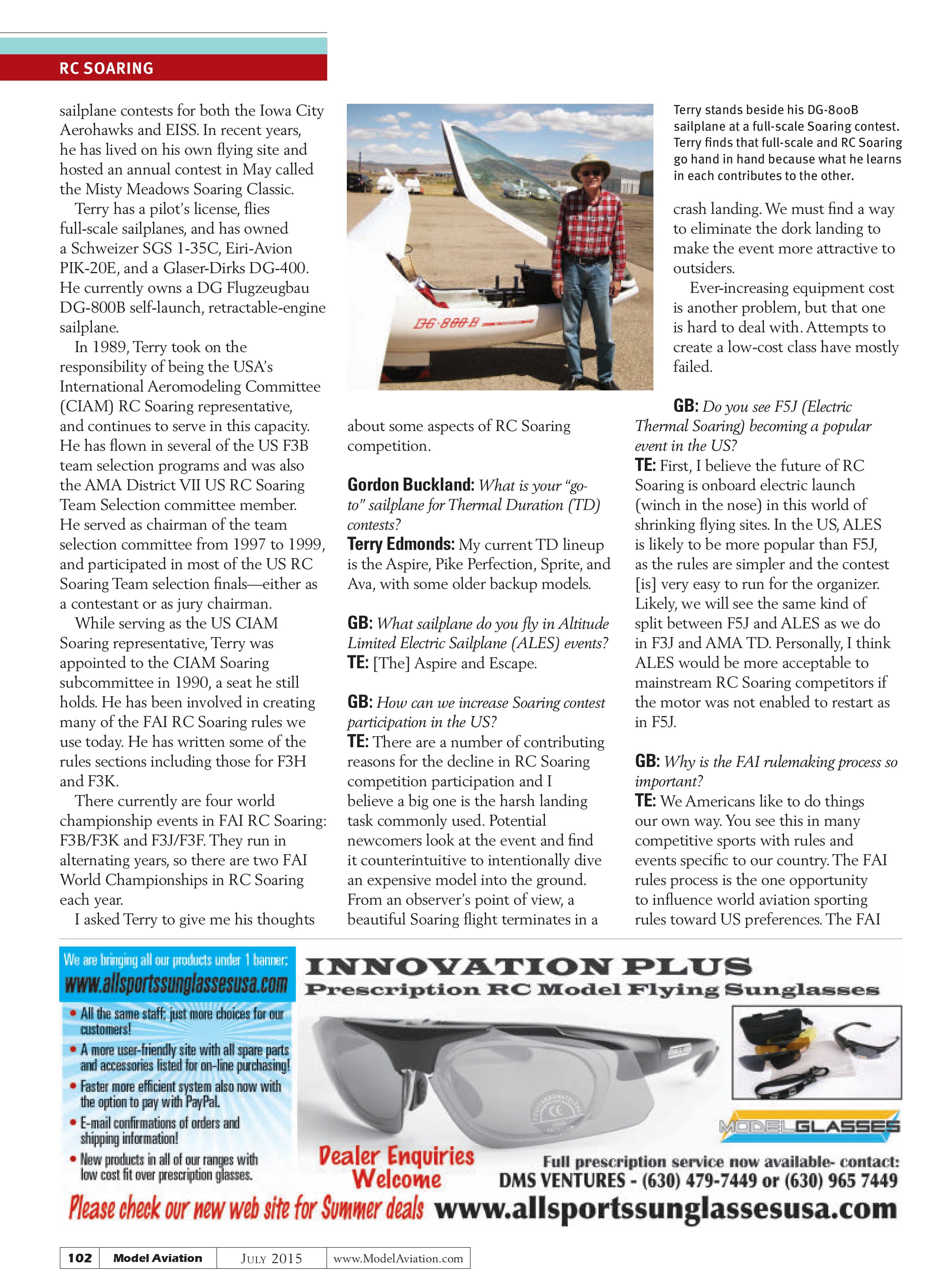
Terry has a pilot’s license, flies full-scale sailplanes, and has owned a Schweizer SGS 1-35C, Eiri-Avion PIK-20E, and a Glaser-Dirks DG-400. He currently owns a DG Flugzeugbau DG-800B self-launch, retractable-engine sailplane.
In 1989, Terry took on the responsibility of being the USA’s International Aeromodeling Committee (CIAM) RC Soaring representative, and continues to serve in this capacity. He has flown in several of the US F3B team selection programs and was also the AMA District VII US RC Soaring Team Selection committee member. He served as chairman of the team selection committee from 1997 to 1999, and participated in most of the US RC Soaring Team selection finals—either as a contestant or as jury chairman.
While serving as the US CIAM Soaring representative, Terry was appointed to the CIAM Soaring subcommittee in 1990, a seat he still holds. He has been involved in creating many of the FAI RC Soaring rules we use today. He has written some of the rules sections including those for F3H and F3K.
There currently are four world championship events in FAI RC Soaring: F3B/F3K and F3J/F3F. They run in alternating years, so there are two FAI World Championships in RC Soaring each year.
I asked Terry to give me his thoughts

about some aspects of RC Soaring competition.
Gordon Buckland: What is your “go-to” sailplane for Thermal Duration (TD) contests?
Terry Edmunds: My current TD lineup is the Aspire, Pike Perfection, Sprite, and Ava, with some older backup models.
GB: What sailplane do you fly in Altitude Limited Electric Sailplane (ALES) events?
TE: [The] Aspire and Escape.
GB: How can we increase Soaring contest participation in the US?
TE: There are a number of contributing reasons for the decline in RC Soaring competition participation and I believe a big one is the harsh landing task commonly used. Potential newcomers look at the event and find it counterintuitive to intentionally dive an expensive model into the ground. From an observer’s point of view, a beautiful Soaring flight terminates in a crash landing. We must find a way to eliminate the dork landing to make the event more attractive to outsiders.
Ever-increasing equipment cost is another problem, but that one is hard to deal with. Attempts to create a low-cost class have mostly failed.
GB: Do you see F5J (Electric Thermal Soaring) becoming a popular event in the US?
TE: First, I believe the future of RC Soaring is onboard electric launch (winch in the nose) in this world of shrinking flying sites. In the US, ALES is likely to be more popular than F5J, as the rules are simpler and the contest [is] very easy to run for the organizer. Likely, we will see the same kind of split between F5J and ALES as we do in F3J and AMA TD. Personally, I think ALES would be more acceptable to mainstream RC Soaring competitors if the motor was not enabled to restart as in F5J.
GB: Why is the FAI rulemaking process so important?
TE: We Americans like to do things our own way. You see this in many competitive sports with rules and events specific to our country. The FAI rules process is the one opportunity to influence world aviation sporting rules toward US preferences. The FAI is European driven and the US has only one vote to the many countries across the pond, yet we have been successful many times.
GB: How has the FAI Soaring program affected model development?
TE: Most countries [around] the world use FAI rules for their competitions. Model manufacturers design and offer products for those rules, as this is where the major market is. Here in the US, the majority of competitions use AMA rules, but are similar enough to FAI rules to benefit from the FAI-type model development.
GB: The FAI is trying to reduce the number of RC Soaring classes. Which events do you see changing in the future?
TE: The CIAM has been talking about reducing the number of FAI classes and world championships for some time, but not much has happened yet in any of the modeling disciplines. I expect if reduction does come about, it will be primarily based on participant numbers.
In the four world championship RC Soaring classes, F3J and F3K are doing well. F3B is on a bit of a decline, mostly because it is organizer-intensive to run. F3F is a little hard to call because of the inherent concentration of activity due to suitable slope sites. There are some provisional FAI RC Soaring events that are somewhat dormant, but could increase in popularity. An FAI RC Scale Sailplane class is noticeably absent, but I predict something will emerge in the near future.
If you have never been to the RC Soaring Nats, or Glider Camp as it is affectionately known, you should make the trip to AMA in July to enjoy the largest RC Soaring contest in the world. Look around the pits and you will be sure to find Terry and many other unsung heroes of Soaring.
Go downwind and soar.

SOURCES:
LSF
www.silentflight.org
Model Aviation Digital Library
https://library.modelaviation.com
Nats
www.modelaircraft.org/events/nats.aspx