Flying season spruce up
Chris Mulcahy
cspaced@gmail.com
It’s been a busy few weeks for me. With spring well underway and summer just around the corner (well, it was when I wrote this), I’ve been preparing my fleet for the season. I’m finally getting to play outside a little more and try out all of the projects I’ve been working on for the past few months.
I’ve also come across several cool products and want to share some of them with you.
Transmitter Face Lift
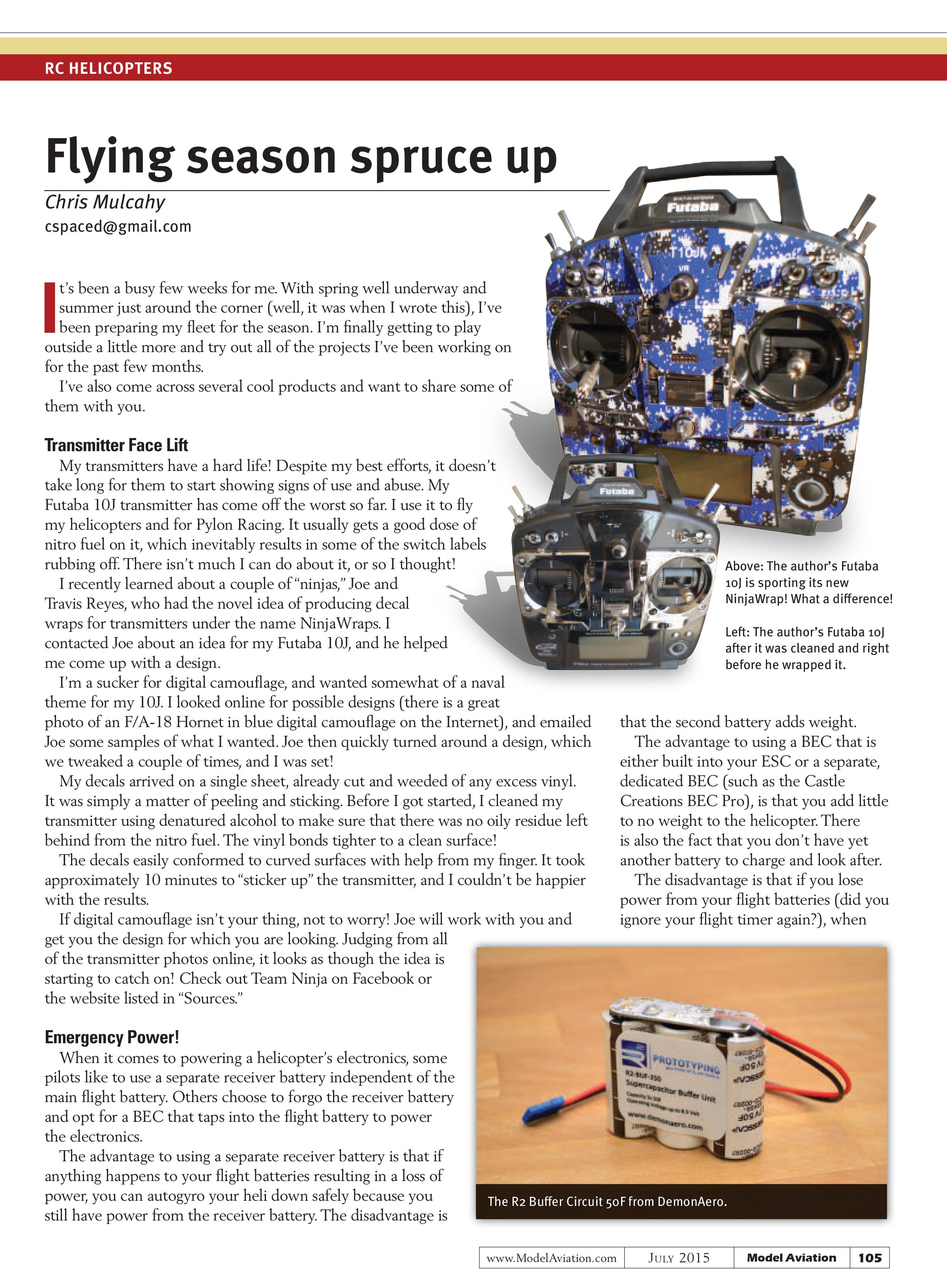
My transmitters have a hard life! Despite my best efforts, it doesn’t take long for them to start showing signs of use and abuse. My Futaba 10J transmitter has come off the worst so far. I use it to fly my helicopters and for Pylon Racing. It usually gets a good dose of nitro fuel on it, which inevitably results in some of the switch labels rubbing off. There isn’t much I can do about it, or so I thought!


I recently learned about a couple of “ninjas,” Joe and Travis Reyes, who had the novel idea of producing decal wraps for transmitters under the name NinjaWraps. I contacted Joe about an idea for my Futaba 10J, and he helped me come up with a design.
I’m a sucker for digital camouflage, and wanted somewhat of a naval theme for my 10J. I looked online for possible designs (there is a great photo of an F/A-18 Hornet in blue digital camouflage on the Internet), and emailed Joe some samples of what I wanted. Joe then quickly turned around a design, which we tweaked a couple of times, and I was set!
My decals arrived on a single sheet, already cut and weeded of any excess vinyl. It was simply a matter of peeling and sticking. Before I got started, I cleaned my transmitter using denatured alcohol to make sure that there was no oily residue left behind from the nitro fuel. The vinyl bonds tighter to a clean surface!
The decals easily conformed to curved surfaces with help from my finger. It took approximately 10 minutes to “sticker up” the transmitter, and I couldn’t be happier with the results.
If digital camouflage isn’t your thing, not to worry! Joe will work with you and get you the design for which you are looking. Judging from all of the transmitter photos online, it looks as though the idea is starting to catch on! Check out Team Ninja on Facebook or the website listed in “Sources.”
Emergency Power!
When it comes to powering a helicopter’s electronics, some pilots like to use a separate receiver battery independent of the main flight battery. Others choose to forgo the receiver battery and opt for a BEC that taps into the flight battery to power the electronics.
The advantage to using a separate receiver battery is that if anything happens to your flight batteries resulting in a loss of power, you can autogyro your heli down safely because you still have power from the receiver battery. The disadvantage is
that the second battery adds weight.
The advantage to using a BEC that is either built into your ESC or a separate, dedicated BEC (such as the Castle Creations BEC Pro), is that you add little to no weight to the helicopter. There is also the fact that you don’t have yet another battery to charge and look after.
The disadvantage is that if you lose power from your flight batteries (did you ignore your flight timer again?), when

the power is gone, it’s gone! There’s no autogyroing safely in. It’s just going to come down, usually hard, and probably on the only patch of concrete on the entire field. If you use a BEC, what can you do?

There are a growing number of backup guards that you can put on your helicopter. They consist of a number of large capacitors that charge while you are flying. Given a sudden loss of power, they store enough energy so that you can safely autogyro your helicopter to the ground in one piece. They are lightweight and self-sustaining, so you don’t have to remember to charge them.

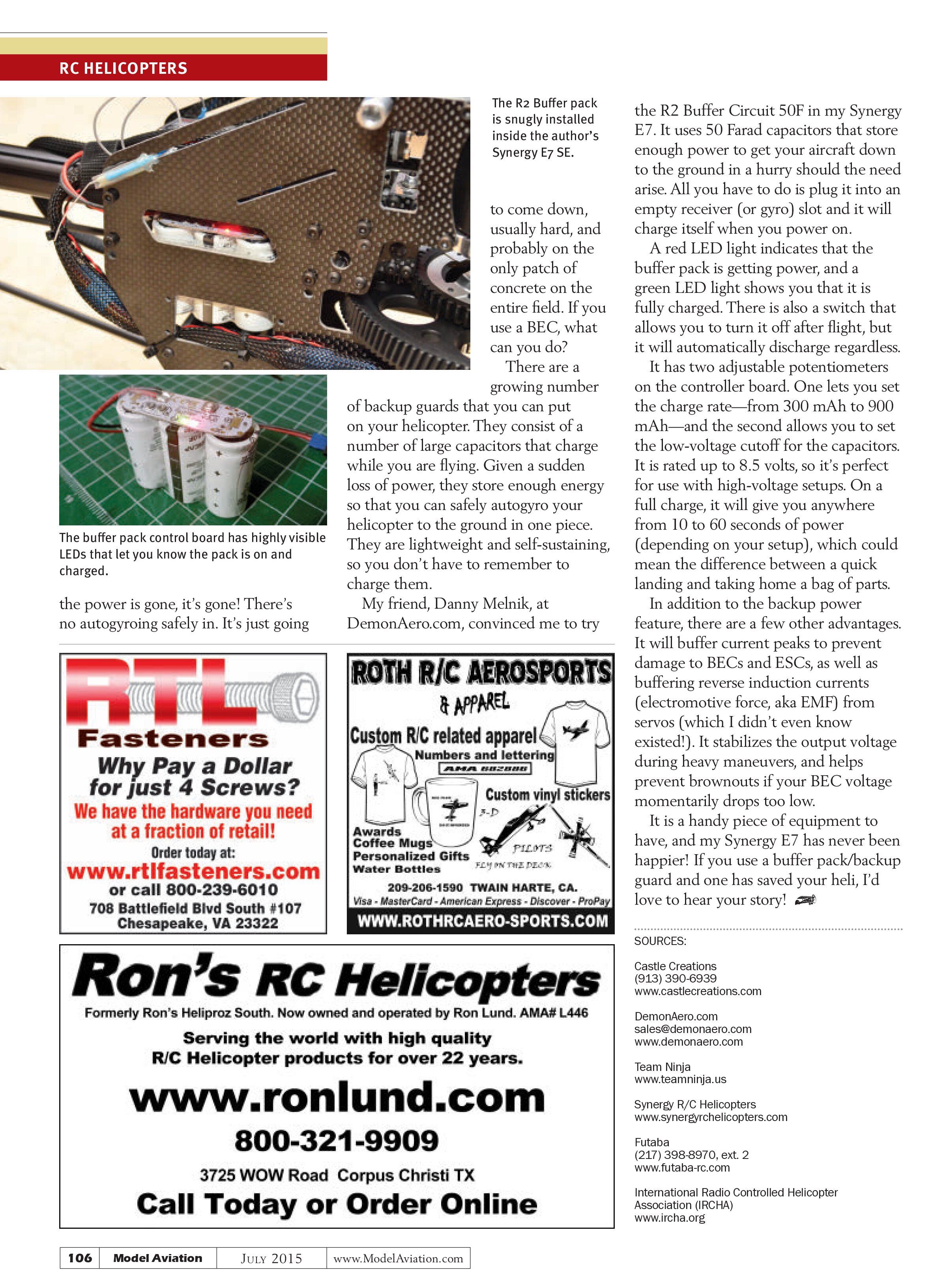
My friend, Danny Melnik, at DemonAero.com, convinced me to try the R2 Buffer Circuit 50F in my Synergy E7. It uses 50 Farad capacitors that store enough power to get your aircraft down to the ground in a hurry should the need arise. All you have to do is plug it into an empty receiver (or gyro) slot and it will charge itself when you power on.
A red LED light indicates that the buffer pack is getting power, and a green LED light shows you that it is fully charged. There is also a switch that allows you to turn it off after flight, but it will automatically discharge regardless.
It has two adjustable potentiometers on the controller board. One lets you set the charge rate—from 300 mAh to 900 mAh—and the second allows you to set the low-voltage cutoff for the capacitors. It is rated up to 8.5 volts, so it’s perfect for use with high-voltage setups. On a full charge, it will give you anywhere from 10 to 60 seconds of power (depending on your setup), which could mean the difference between a quick landing and taking home a bag of parts.
In addition to the backup power feature, there are a few other advantages. It will buffer current peaks to prevent damage to BECs and ESCs, as well as buffering reverse induction currents (electromotive force, aka EMF) from servos (which I didn’t even know existed!). It stabilizes the output voltage during heavy maneuvers, and helps prevent brownouts if your BEC voltage momentarily drops too low.
It is a handy piece of equipment to have, and my Synergy E7 has never been happier! If you use a buffer pack/backup guard and one has saved your heli, I’d love to hear your story!
SOURCES:
Castle Creations
(913) 390-6939
www.castlecreations.com
DemonAero.com
sales@demonaero.com
www.demonaero.com
Team Ninja
www.teamninja.us
Synergy R/C Helicopters
www.synergyhelicopters.com
Futaba
(217) 398-8970, ext. 2
www.futaba-rc.com
International Radio Controlled Helicopter Association (IRCHA)
www.ircha.org