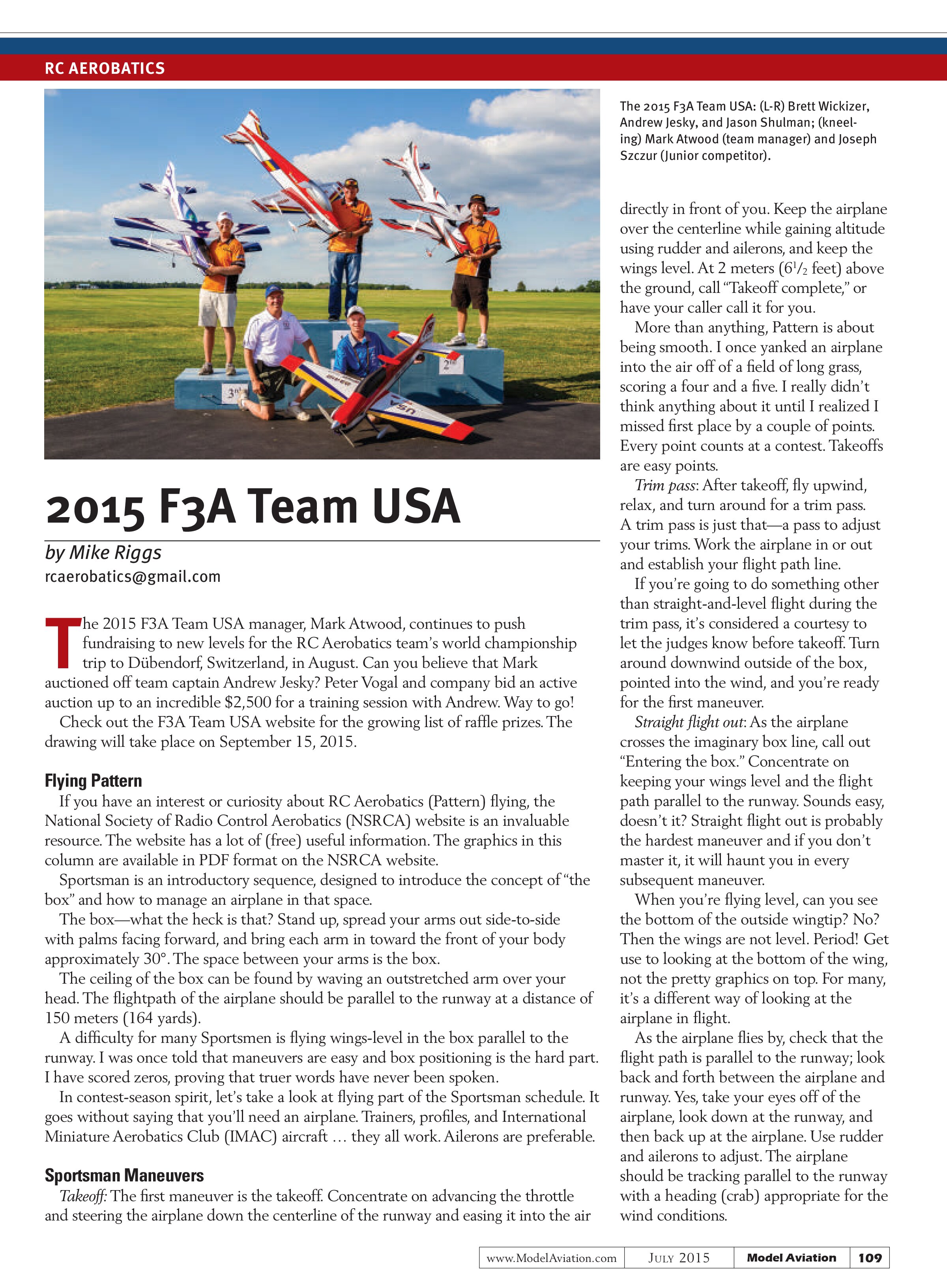
2015 F3A Team USA
by Mike Riggs
rcaerobatics@gmail.com
The 2015 F3A Team USA manager, Mark Atwood, continues to push fundraising to new levels for the RC Aerobatics team’s world championship trip to Dübendorf, Switzerland, in August. Can you believe that Mark auctioned off team captain Andrew Jesky? Peter Vogal and company bid an active auction up to an incredible $2,500 for a training session with Andrew. Way to go!
Check out the F3A Team USA website for the growing list of raffle prizes. The drawing will take place on September 15, 2015.
Flying Pattern
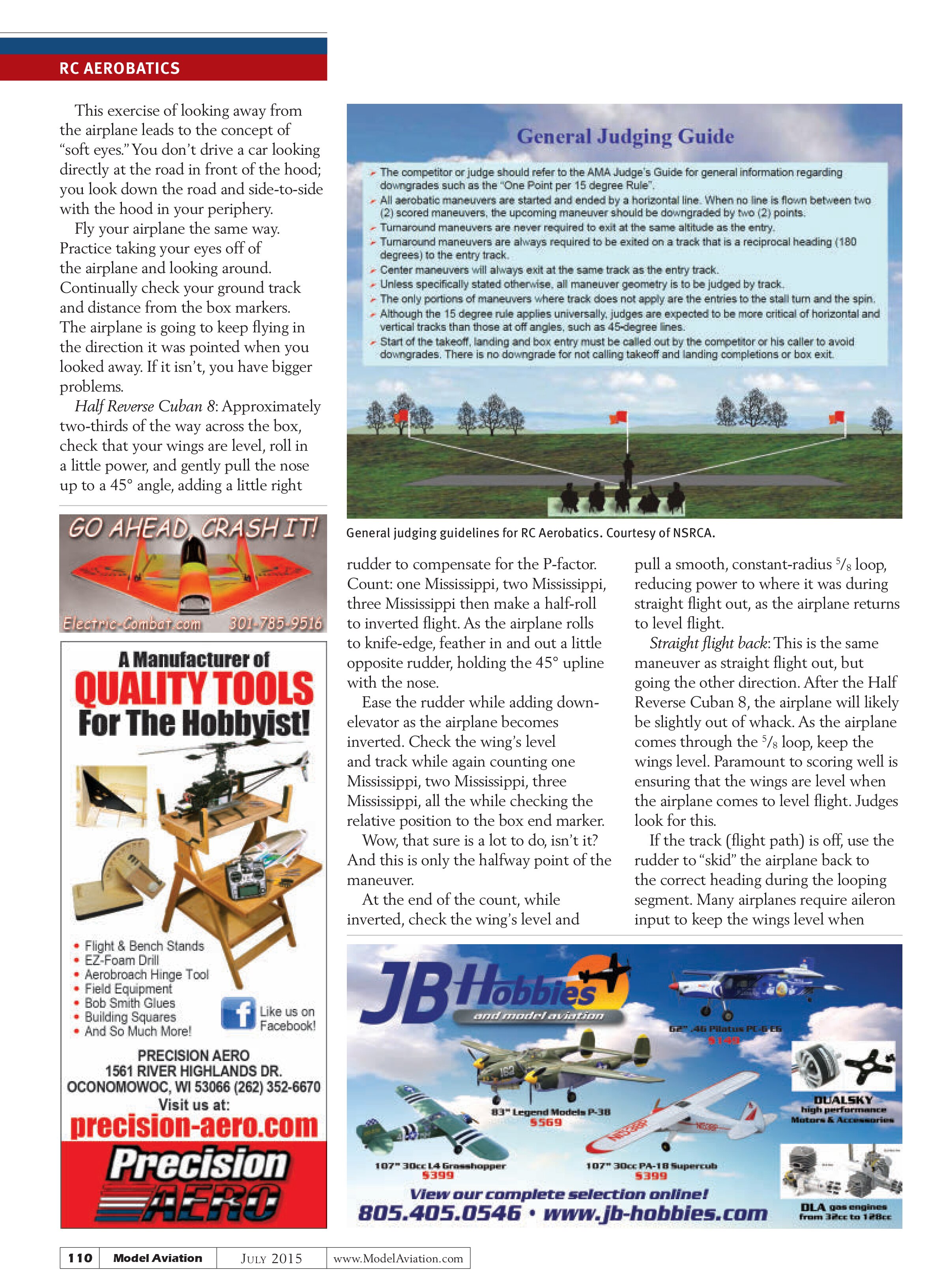
If you have an interest or curiosity about RC Aerobatics (Pattern) flying, the National Society of Radio Control Aerobatics (NSRCA) website is an invaluable resource. The website has a lot of (free) useful information. The graphics in this column are available in PDF format on the NSRCA website.
Sportsman is an introductory sequence, designed to introduce the concept of “the box” and how to manage an airplane in that space.
The box—what the heck is that? Stand up, spread your arms out side-to-side with palms facing forward, and bring each arm in toward the front of your body approximately 30°. The space between your arms is the box.
The ceiling of the box can be found by waving an outstretched arm over your head. The flightpath of the airplane should be parallel to the runway at a distance of 150 meters (164 yards).
A difficulty for many Sportsmen is flying wings-level in the box parallel to the runway. I was once told that maneuvers are easy and box positioning is the hard part. I have scored zeros, proving that truer words have never been spoken.
In contest-season spirit, let’s take a look at flying part of the Sportsman schedule. It goes without saying that you’ll need an airplane. Trainers, profiles, and International Miniature Aerobatics Club (IMAC) aircraft … they all work. Ailerons are preferable.
Sportsman Maneuvers
Takeoff: The first maneuver is the takeoff. Concentrate on advancing the throttle and steering the airplane down the centerline of the runway and easing it into the air
directly in front of you. Keep the airplane over the centerline while gaining altitude using rudder and ailerons, and keep the wings level. At 2 meters (6½ feet) above the ground, call “Takeoff complete,” or have your caller call it for you.
More than anything, Pattern is about being smooth. I once yanked an airplane into the air off of a field of long grass, scoring a four and a five. I really didn’t think anything about it until I realized I missed first place by a couple of points. Every point counts at a contest. Takeoffs are easy points.
Trim pass: After takeoff, fly upwind, relax, and turn around for a trim pass. A trim pass is just that—a pass to adjust your trims. Work the airplane in or out and establish your flight path line.
If you’re going to do something other than straight-and-level flight during the trim pass, it’s considered a courtesy to let the judges know before takeoff. Turn around downwind outside of the box, pointed into the wind, and you’re ready for the first maneuver.
Straight flight out: As the airplane crosses the imaginary box line, call out “Entering the box.” Concentrate on keeping your wings level and the flight path parallel to the runway. Sounds easy, doesn’t it? Straight flight out is probably the hardest maneuver and if you don’t master it, it will haunt you in every subsequent maneuver.
When you’re flying level, can you see the bottom of the outside wingtip? No? Then the wings are not level. Period! Get use to looking at the bottom of the wing, not the pretty graphics on top. For many, it’s a different way of looking at the airplane in flight.
As the airplane flies by, check that the flight path is parallel to the runway; look back and forth between the airplane and runway. Yes, take your eyes off of the airplane, look down at the runway, and then back up at the airplane. Use rudder and ailerons to adjust. The airplane should be tracking parallel to the runway with a heading (crab) appropriate for the wind conditions.
This exercise of looking away from the airplane leads to the concept of “soft eyes.” You don’t drive a car looking directly at the road in front of the hood; you look down the road and side-to-side with the hood in your periphery.
Fly your airplane the same way. Practice taking your eyes off of the airplane and looking around. Continually check your ground track and distance from the box markers. The airplane is going to keep flying in the direction it was pointed when you looked away. If it isn’t, you have bigger problems.
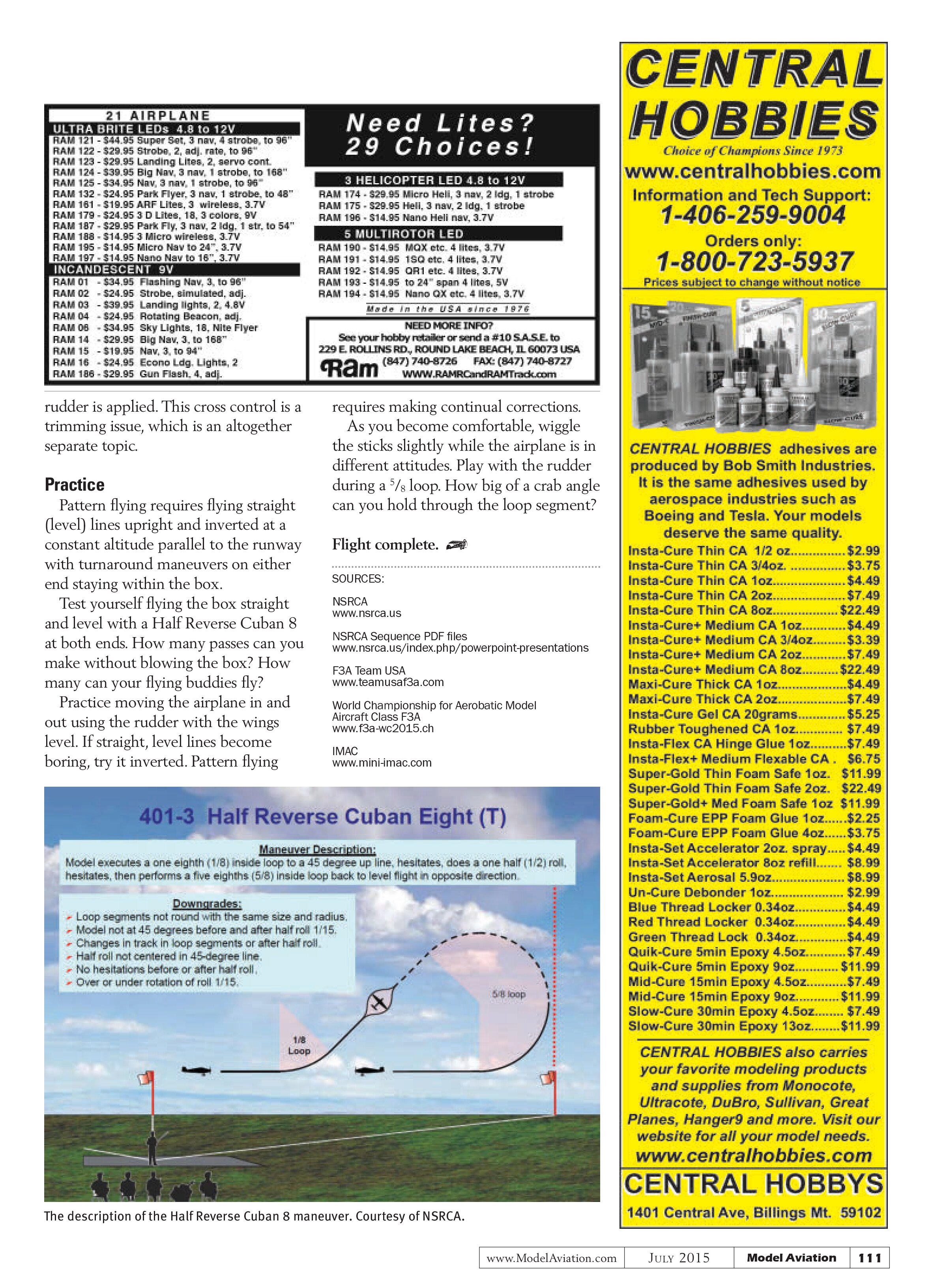
Half Reverse Cuban 8: Approximately two-thirds of the way across the box, check that your wings are level, roll in a little power, and gently pull the nose up to a 45° angle, adding a little right

rudder to compensate for the P-factor. Count: one Mississippi, two Mississippi, three Mississippi then make a half-roll to inverted flight. As the airplane rolls to knife-edge, feather in and out a little opposite rudder, holding the 45° upline with the nose.
Ease the rudder while adding down-elevator as the airplane becomes inverted. Check the wing’s level and track while again counting one Mississippi, two Mississippi, three Mississippi, all the while checking the relative position to the box end marker.
Wow, that sure is a lot to do, isn’t it? And this is only the halfway point of the maneuver.
At the end of the count, while inverted, check the wing’s level and pull a smooth, constant-radius ⅝ loop, reducing power to where it was during straight flight out, as the airplane returns to level flight.
Straight flight back: This is the same maneuver as straight flight out, but going the other direction. After the Half Reverse Cuban 8, the airplane will likely be slightly out of whack. As the airplane comes through the ⅝ loop, keep the wings level. Paramount to scoring well is ensuring that the wings are level when the airplane comes to level flight. Judges look for this.
If the track (flight path) is off, use the rudder to “skid” the airplane back to the correct heading during the looping segment. Many airplanes require aileron input to keep the wings level when rudder is applied. This cross control is a trimming issue, which is an altogether separate topic.
Practice
Pattern flying requires flying straight (level) lines upright and inverted at a constant altitude parallel to the runway with turnaround maneuvers on either end staying within the box.
Test yourself flying the box straight and level with a Half Reverse Cuban 8 at both ends. How many passes can you make without blowing the box? How many can you flying buddies fly?
Practice moving the airplane in and out using the rudder with the wings level. If straight, level lines become boring, try it inverted. Pattern flying requires making continual corrections.
As you become comfortable, wiggle the sticks slightly while the airplane is in different attitudes. Play with the rudder during a ⅝ loop. How big of a crab angle can you hold through the loop segment?
Flight complete.

SOURCES:
NSRCA
www.nsrca.us
NSRCA Sequence PDF files
www.nsrca.us/index.php/powerpoint-presentations
F3A Team USA
www.teamusa f3a.com
World Championship for Aerobatic Model Aircraft Class F3A
www.f3a-wc2015.ch