Unique FF Jumbo Scale racer
was a delight to fly

The Thomas-Morse MB-3 pursuit airplane was originally developed as part of an Army Air Service contract. Two of those aircraft, named MB7s, were modified to compete in the 1921 and 1922 Pulitzer Prize races per a request through the Army by the Marine Corps.
The lack of a reliable powerplant and the pressure of competition were only two of the shortcomings that cut this airplane’s career short. Still, Bill Noonan chose to build a Free Flight model of this unique design, modeled after the 1922 aircraft that raced as Number 7.
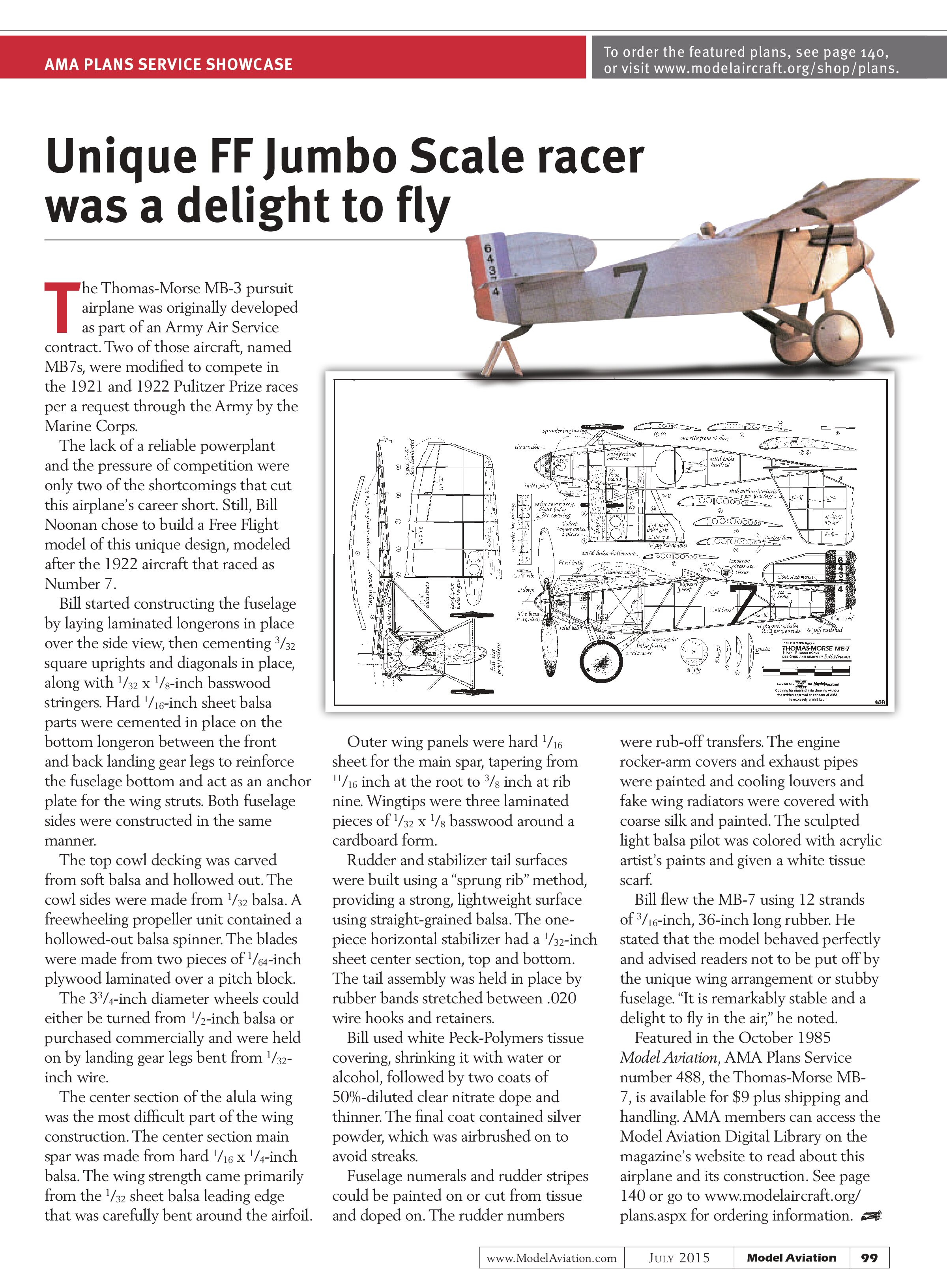
Bill started constructing the fuselage by laying laminated longerons in place over the side view, then cementing 3/32 square uprights and diagonals in place, along with 1/32 x 1/8-inch basswood stringers. Hard 1/16-inch sheet balsa parts were cemented in place on the bottom longeron between the front and back landing gear legs to reinforce the fuselage bottom and act as an anchor plate for the wing struts. Both fuselage sides were constructed in the same manner.
The top cowl decking was carved from soft balsa and hollowed out. The cowl sides were made from 1/32 balsa. A freewheeling propeller unit contained a hollowed-out balsa spinner. The blades were made from two pieces of 1/64-inch plywood laminated over a pitch block.
The 3 3/4-inch diameter wheels could either be turned from 1/2-inch balsa or purchased commercially and were held on by landing gear legs bent from 1/32-inch wire.
The center section of the alula wing was the most difficult part of the wing construction. The center section main spar was made from hard 1/16 x 1/4-inch balsa. The wing strength came primarily from the 1/32 sheet balsa leading edge that was carefully bent around the airfoil.

Outer wing panels were hard 1/16 sheet for the main spar, tapering from 11/16 inch at the root to 3/8 inch at rib nine. Wingtips were three laminated pieces of 1/32 x 1/8 basswood around a cardboard form.
Rudder and stabilizer tail surfaces were built using a “sprung rib” method, providing a strong, lightweight surface using straight-grained balsa. The one-piece horizontal stabilizer had a 1/32-inch sheet center section, top and bottom. The tail assembly was held in place by rubber bands stretched between .020 wire hooks and retainers.
Bill used white Peck-Polymers tissue covering, shrinking it with water or alcohol, followed by two coats of 50%-diluted clear nitrate dope and thinner. The final coat contained silver powder, which was airbrushed on to avoid streaks.
Fuselage numerals and rudder stripes could be painted on or cut from tissue and doped on. The rudder numbers were rub-off transfers. The engine rocker-arm covers and exhaust pipes were painted and cooling louvers and fake wing radiators were covered with coarse silk and painted. The sculpted light balsa pilot was colored with acrylic artist’s paints and given a white tissue scarf.
Bill flew the MB-7 using 12 strands of 3/16-inch, 36-inch long rubber. He stated that the model behaved perfectly and advised readers not to be put off by the unique wing arrangement or stubby fuselage. “It is remarkably stable and a delight to fly in the air,” he noted.
Featured in the October 1985 Model Aviation, AMA Plans Service number 488, the Thomas-Morse MB-7, is available for $9 plus shipping and handling. AMA members can access the Model Aviation Digital Library on the magazine’s website to read about this airplane and its construction. See page 140 or go to www.modelaircraft.org/plans.aspx for ordering information.