Kit suppliers to continue in business
by Gene Smith
grwhiskey@brightok.net
Two names in the model airplane kit industry, Peck-Polymers and Campbell’s Custom Kits, were in limbo for several months last year. Happily, both have been picked up by other kit suppliers.
The Peck-Polymers line is now being produced by Chuck Imbergamo of Wind-it-up Enterprises. Chuck is working to restock the well-known inventory of kits and the Peck accessories. He is also planning to create some new kits for Peck-Polymers. Follow Chuck’s progress on the Peck-Polymers website, listed in “Sources.”
Campbell’s Custom Kits will be produced by Mark Freeland of Retro RC. Check the Retro RC website for currently available kits. He hopes to have the ½A Gas Maverick, the Majestyk P-30, and some other short kits available by July.

Fly Boy
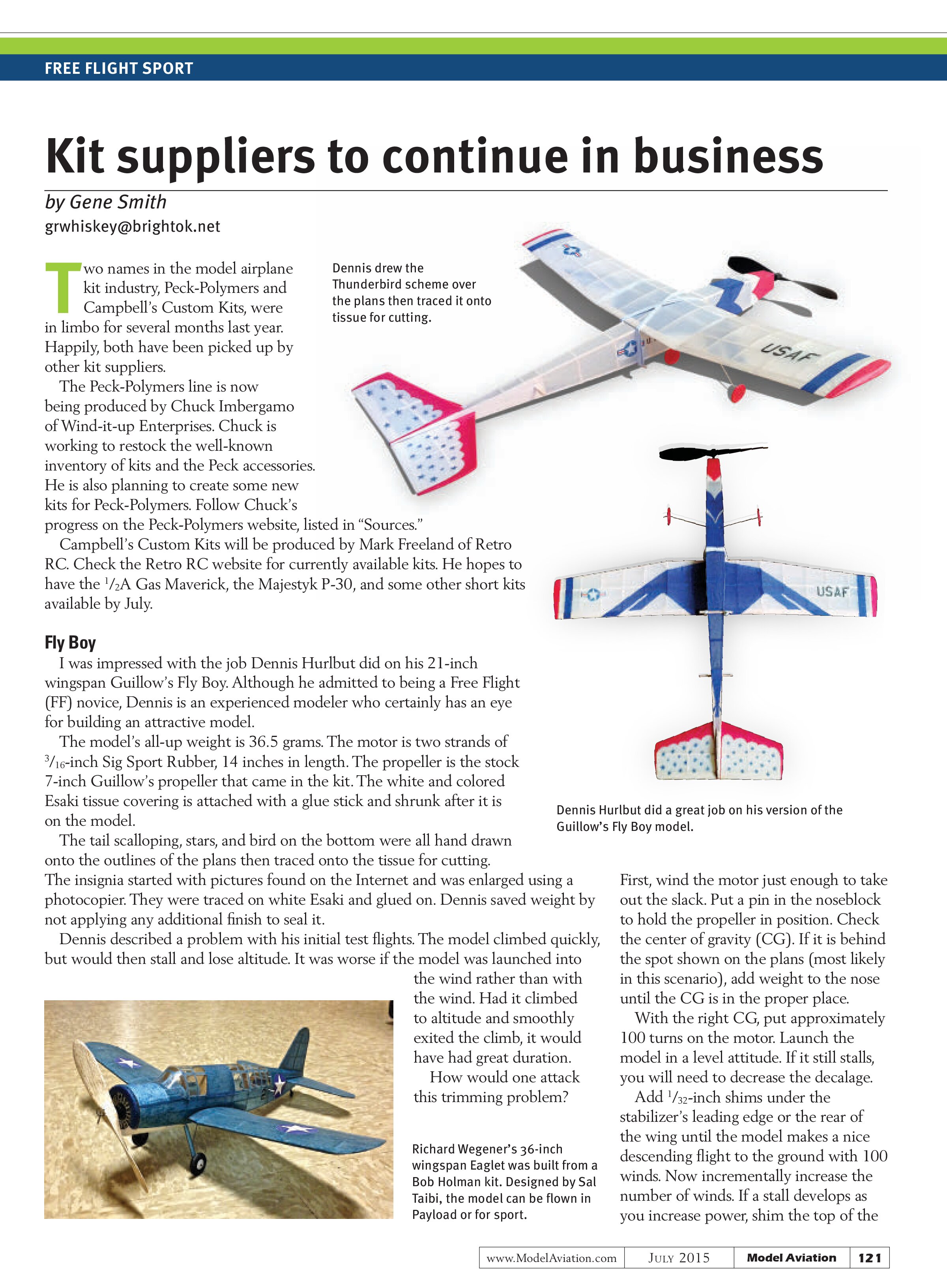
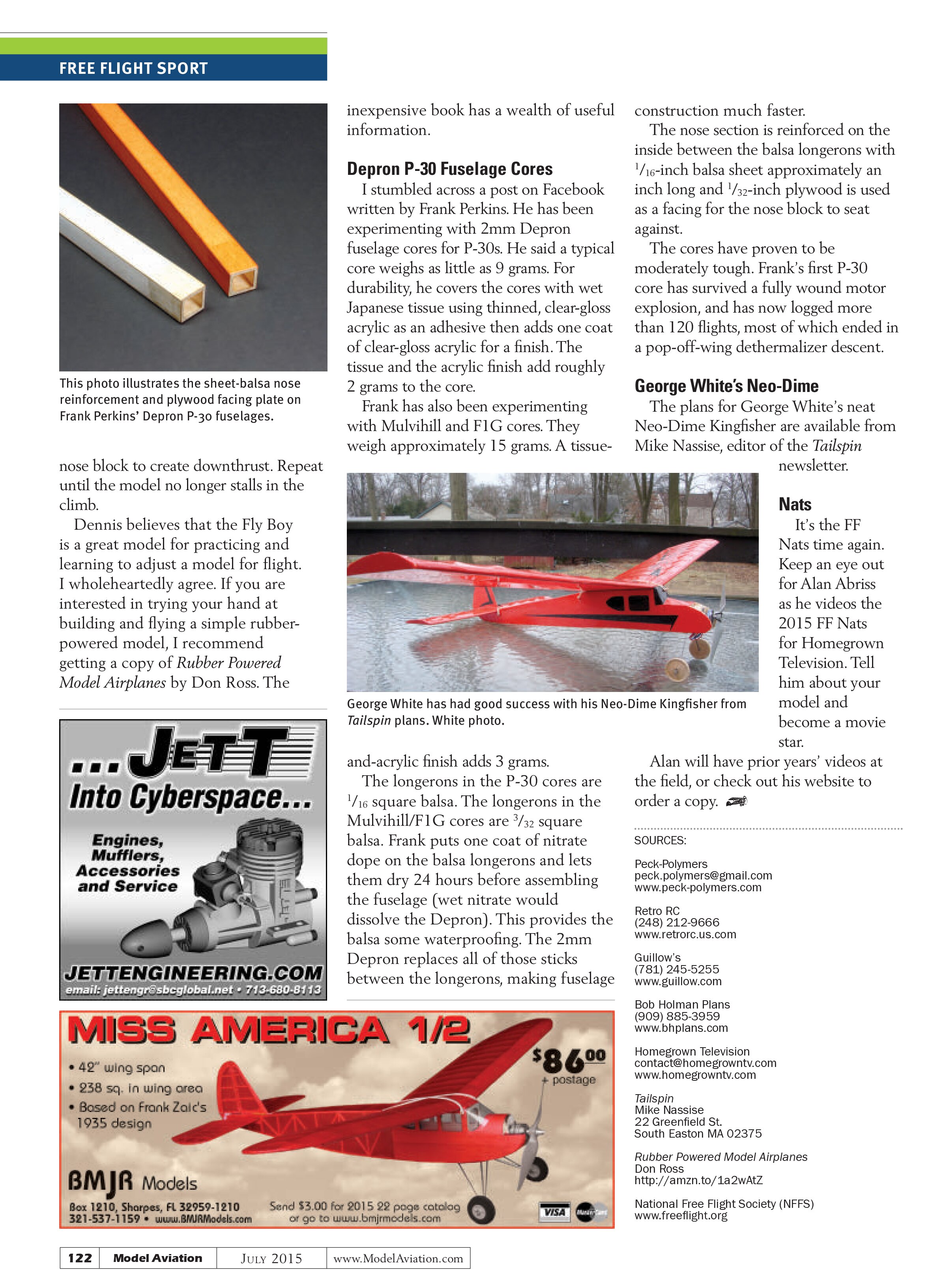
I was impressed with the job Dennis Hurlbut did on his 21-inch wingspan Guillows’s Fly Boy. Although he admitted to being a Free Flight (FF) novice, Dennis is an experienced modeler who certainly has an eye for building an attractive model.
The model’s all-up weight is 36.5 grams. The motor is two strands of ³⁄₁₆-inch Sig Sport Rubber, 14 inches in length. The propeller is the stock 7-inch Guillows’s propeller that came in the kit. The white and colored Esaki tissue covering is attached with a glue stick and shrunk after it is on the model.
The tail scalloping, stars, and bird on the bottom were all hand drawn onto the outlines of the plans then traced onto the tissue for cutting. The insignia started with pictures found on the Internet and was enlarged using a photocopier. They were traced on white Esaki and glued on. Dennis saved weight by not applying any additional finish to seal it.
Dennis described a problem with his initial test flights. The model climbed quickly, but would then stall and lose altitude. It was worse if the model was launched into the wind rather than with the wind. Had it climbed to altitude and smoothly exited the climb, it would have had great duration. How would one attack this trimming problem?

First, wind the motor just enough to take out the slack. Put a pin in the noseblock to hold the propeller in position. Check the center of gravity (CG). If it is behind the spot shown on the plans (most likely in this scenario), add weight to the nose until the CG is in the proper place.
With the right CG, put approximately 100 turns on the motor. Launch the model in a level attitude. If it still stalls, you will need to decrease the decalage.
Add ¹⁄₃₂-inch shims under the stabilizer’s leading edge or the rear of the wing until the model makes a nice descending flight to the ground with 100 winds. Now incrementally increase the number of winds. If a stall develops as you increase power, shim the top of the

nose block to create downthrust. Repeat until the model no longer stalls in the climb.
Dennis believes that the Fly Boy is a great model for practicing and learning to adjust a model for flight. I wholeheartedly agree. If you are interested in trying your hand at building and flying a simple rubber-powered model, I recommend getting a copy of Rubber Powered Model Airplanes by Don Ross. The inexpensive book has a wealth of useful information.
Depron P-30 Fuselage Cores
I stumbled across a post on Facebook written by Frank Perkins. He has been experimenting with 2mm Depron fuselage cores for P-30s. He said a typical core weighs as little as 9 grams. For durability, he covers the cores with wet Japanese tissue using thinned, clear-gloss acrylic as an adhesive then adds one coat of clear-gloss acrylic for a finish. The tissue and the acrylic finish add roughly 2 grams to the core.
Frank has also been experimenting with Mulvihill and F1G cores. They weigh approximately 15 grams. A tissue-

and-acrylic finish adds 3 grams.
The longerons in the P-30 cores are ¹⁄₁₆ square balsa. The longerons in the Mulvihill/F1G cores are ³⁄₃₂ square balsa. Frank puts one coat of nitrate dope on the balsa longerons and lets them dry 24 hours before assembling the fuselage (wet nitrate would dissolve the Depron). This provides the balsa some waterproofing. The 2mm Depron replaces all of those sticks between the longerons, making fuselage construction much faster.
The nose section is reinforced on the inside between the balsa longerons with ¹⁄₁₆-inch balsa sheet approximately an inch long and ¹⁄₃₂-inch plywood is used as a facing for the nose block to seat against.
The cores have proven to be moderately tough. Frank’s first P-30 core has survived a fully wound motor explosion, and has now logged more than 120 flights, most of which ended in a pop-off-wing dethermalizer descent.
George White’s Neo-Dime
The plans for George White’s neat Neo-Dime Kingfisher are available from Mike Nassise, editor of the Tailspin newsletter.
Nats
It’s the FF Nats time again. Keep an eye out for Alan Abriss as he videos the 2015 FF Nats for Homegrown Television. Tell him about your model and become a movie star.
Alan will have prior years’ videos at the field, or check out his website to order a copy.
SOURCES:
Peck-Polymers
peck.polymers@gmail.com
www.peck-polymers.com
Retro RC
(248) 212-9666
www.retrorc.us.com
Guillow’s
(781) 245-5255
www.guillow.com
Bob Holman Plans
(909) 885-3959
www.bhplans.com
Homegrown Television
contact@homegrowntv.com
www.homegrowntv.com
Tailspin
Mike Nassise
22 Greenfield St.
South Easton MA 02375
Rubber Powered Model Airplanes
Don Ross
http://amzn.to/1a2wAtZ
National Free Flight Society (NFFS)
www.freeflight.org