NCS on Facebook
by Dick Perry
tailhooker@comcast.net
The Navy Carrier Society (NCS) has a presence on Facebook (see the link in “Sources”). The easiest way to get there after signing into Facebook is to search for Navy Carrier Society.
I hope that by the time you read this, the group will be well established. If you are not already a group member, stop in and check out what’s going on at the site.
Bad News From Denver
Since I submitted the previous “Control Line Navy Carrier” column, I heard again from Tony Livaudais, vice president of the Rocky Mountain AeroModelers.
Much of the Carrier deck and equipment depicted in the photograph of the club’s Mapleton Field flying site was stolen. Club members are continuing to practice Carrier flying from the six remaining sections of deck, and they are looking forward to having Carrier events at their September contest.
Southwest Regionals
The Southwest Regionals has been held annually in Arizona for nearly half a century. When I was stationed at Williams Air Force Base in the early 1970s, the Control Line (CL) events in the contest were flown at the Buckeye Airport, west of Phoenix. Today, they are flown at the Christopher Columbus Park CL flying field in Tucson and are sponsored by the Cholla Choppers Model Airplane Club.
The Southwest Regionals is a great two-day Carrier contest with a relaxed atmosphere and the wonderful weather of late January in Tucson, Arizona. The event draws Carrier enthusiasts from as far away as northwest Nevada—even farther if you consider those who winter in Arizona to escape colder climates.
Visiting is as much fun as the flying! You can usually count on seeing some new Carrier models and modelers at Tucson. This year was no exception, although most of the “new” modelers were really returning after a long absence from Carrier flying.
Steve Mills showed up this year after an absence of a half century. He flew at Randolph Park in Tucson back in 1964. At that time he was flying a Class I Douglas Dauntless with a 44-inch wingspan and an Enya .35 for power. He placed second in that contest.
This year, Steve brought one of

This year, Steve brought one of


Eric Conley’s old models, which he acquired from Burt Brokaw, who had acquired it from Eric. The Profile Messerschmitt Bf 109T had a Nelson .40 with a muffler and was flown in Class I.

After all of that time, Steve still remembers how it is done. He nailed a 100-point landing on his first attempt!
Burt had a new model for Nostalgia Class II. It was a Supermarine Seafire, which was originally built by Ted Snow in 1967 and lovingly restored by Burt. Ted used a fiberglass fuselage laid up from an original mold that he made.
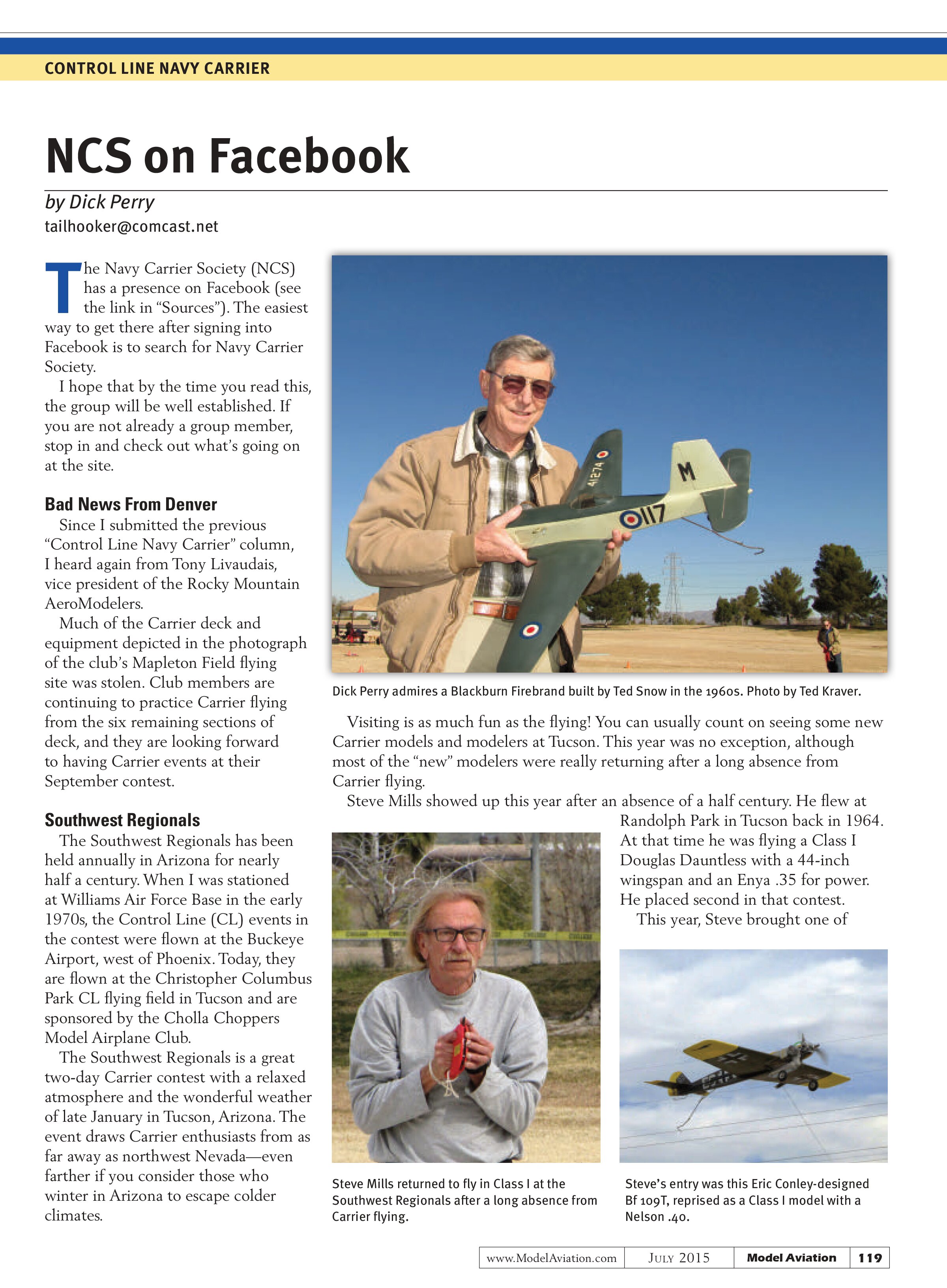
Unfortunately, Burt has so far been unsuccessful in locating that mold. The Seafire has a 37-inch wingspan, and he installed an HB .61 engine. It looked great flying again. Burt also brought out a Blackburn Firebrand, another Ted Snow design that qualifies for the Nostalgia Carrier event.
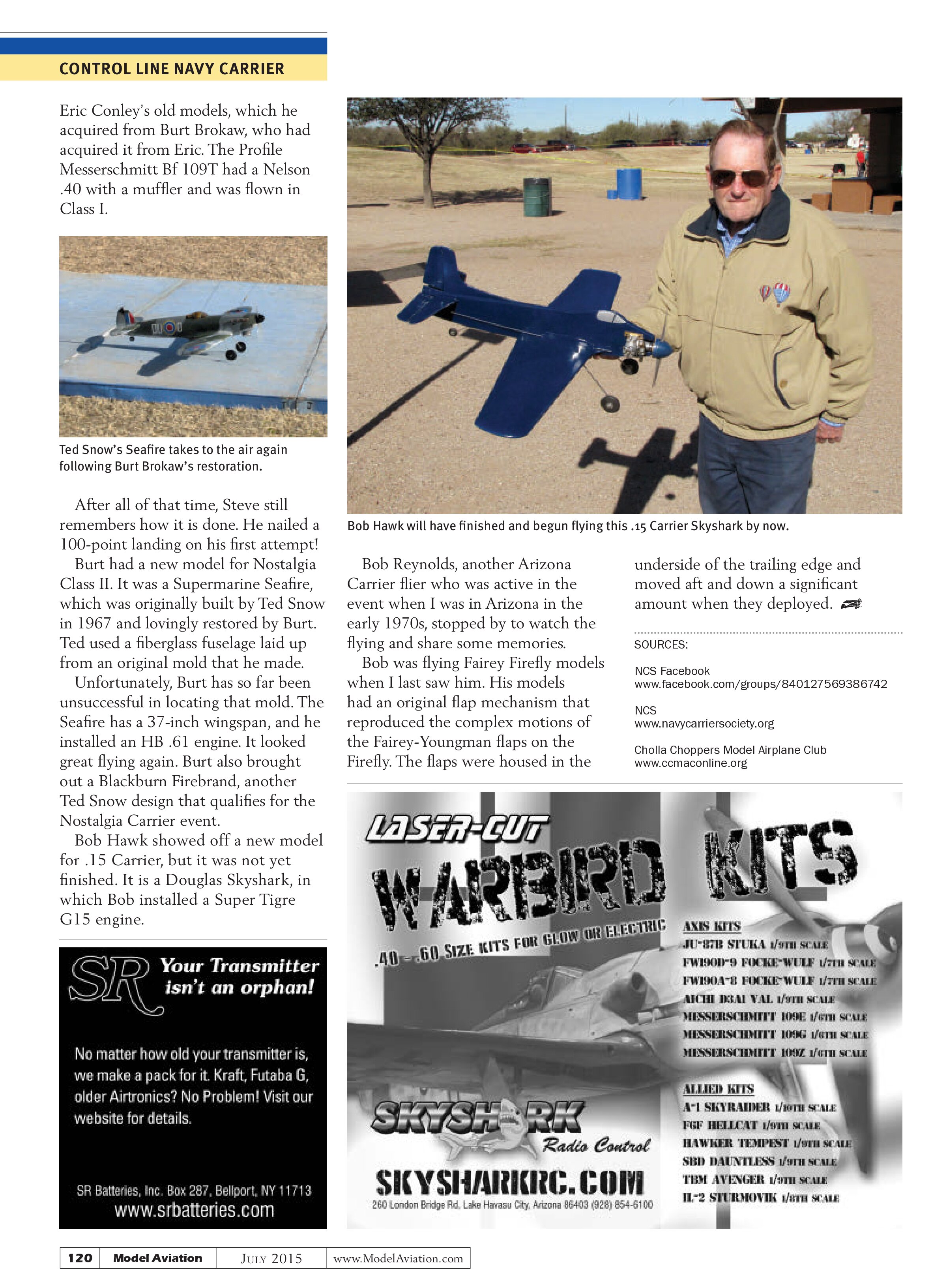
Bob Hawk showed off a new model for .15 Carrier, but it was not yet finished. It is a Douglas Skyshark, in which Bob installed a Super Tigre G15 engine.

Bob Reynolds, another Arizona Carrier flier who was active in the event when I was in Arizona in the early 1970s, stopped by to watch the flying and share some memories.
Bob was flying Fairey Firefly models when I last saw him. His models had an original flap mechanism that reproduced the complex motions of the Fairey-Youngman flaps on the Firefly. The flaps were housed in the underside of the trailing edge and moved aft and down a significant amount when they deployed.
SOURCES:
NCS Facebook
www.facebook.com/groups/840127569386742
Cholla Choppers Model Airplane Club
www.cmaconline.org