Starting your
engine safely
by Rich Lopez
richvon7@hotmail.com

Most of us have been starting model engines for decades and have our procedures down to where we almost do everything automatically. This means that we repeat the habits we have developed throughout the years without a second thought. I suggest that we examine every aspect of our engine-starting procedure and see if there is any potential for an accident.
Most Combat pilots in the US fly F2D models, either competitively or merely for sport. F2D engines are reliable and the models are a blast to fly because of their high level of performance.
There is danger in being around an F2D engine spinning a fiberglass propeller at 30,000 rpm, so there must be a healthy respect for safety. The needle valves are located less than 1¼ inches behind the propellers and adjusting the valves means you are dangerously close to a flesh-cutting, buzz saw propeller.
The first thing to look at is whether you use a mechanic to hold your model when starting the engine or whether you start it by yourself then hand the model off to a helper for the launch.
If I am holding the model for someone, I hold it by the outboard wing with my right hand and the tail area with my left hand. The starting person then gets the engine running and walks around to the back side of the model to adjust the needle valve.
If I am the starter, I start the engine, and after I have walked around to the back side of the model, use my left hand to grasp the inboard wing at the leading edge so that in case the engine surges, it won’t draw my needle-valve-adjusting fingers into the spinning propeller. The rear-adjusting position keeps the starter safely out of the propeller arc and does not allow reaching around the propeller to get to the needle valve.
There are still several who like to adjust the needle valve from in front of the model. If you start the model by yourself between your legs, then be sure to push the inboard wingtip into the ground with your legs so that the model does not jump when the engine comes to life. I use this method and achieve a close needle-valve setting before I hand the model to a helper to launch. I give the needle a final adjustment from behind the model.
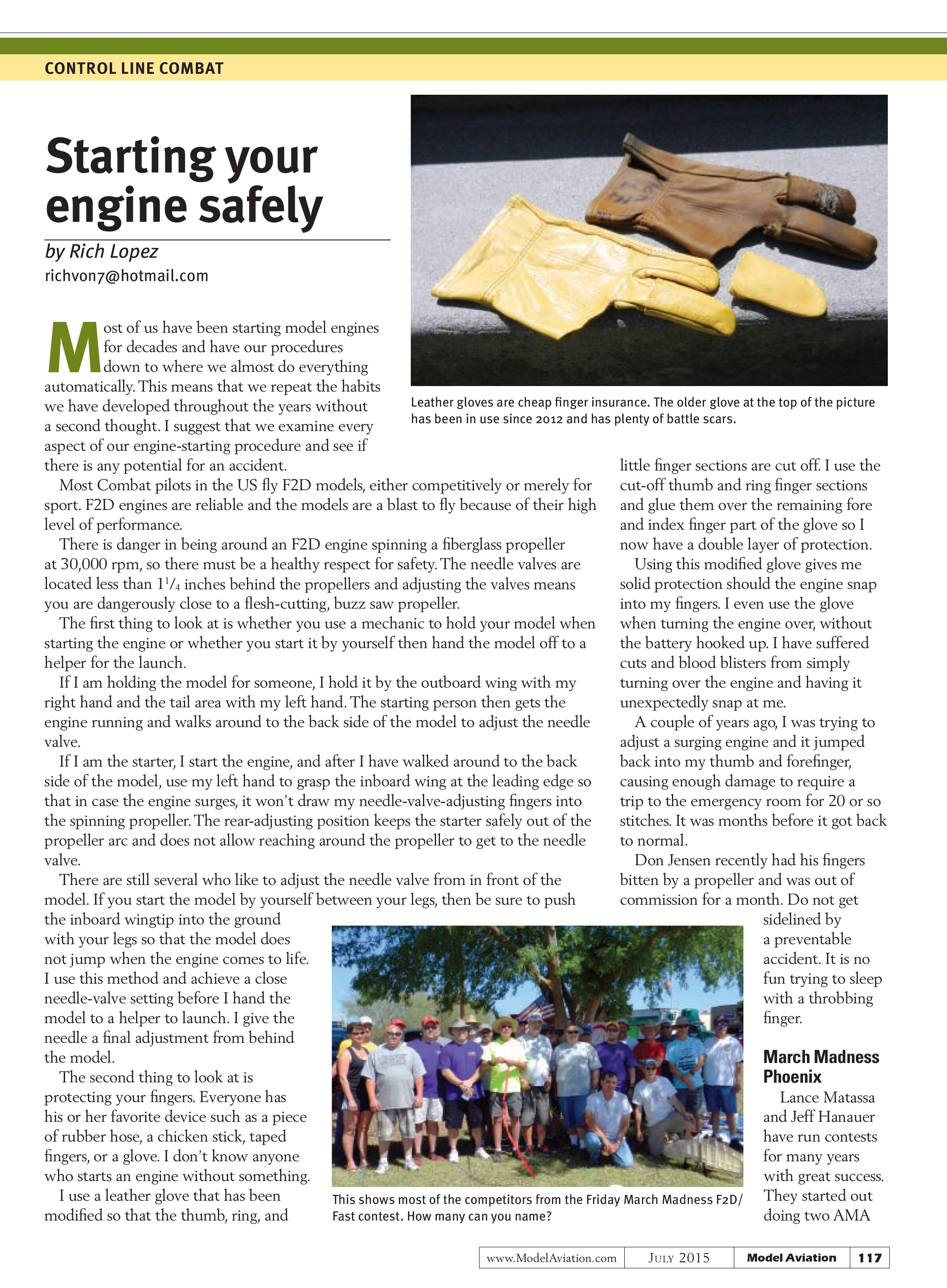
The second thing to look at is protecting your fingers. Everyone has his or her favorite device such as a piece of rubber hose, a chicken stick, taped fingers, or a glove. I don’t know anyone who starts an engine without something. I use a leather glove that has been modified so that the thumb, ring, and little finger sections are cut off. I use the cut-off thumb and ring finger sections and glue them over the remaining fore and index finger part of the glove so I now have a double layer of protection.

Using this modified glove gives me solid protection should the engine snap into my fingers. I even use the glove when turning the engine over, without the battery hooked up. I have suffered cuts and blood blisters from simply turning over the engine and having it unexpectedly snap at me.
A couple of years ago, I was trying to adjust a surging engine and it jumped back into my thumb and forefinger, causing enough damage to require a trip to the emergency room for 20 or so stitches. It was months before it got back to normal.
Don Jensen recently had his fingers bitten by a propeller and was out of commission for a month. Do not get sidelined by a preventable accident. It is no fun trying to sleep with a throbbing finger.

Fast Combat contests per year, one in the spring and the other in the fall. This seems to be the best weather to be outdoors in Arizona.
The only downside of the spring contest is that local hotels are filled with baseball players involved in spring training. The prices for hotels and motels are also higher than in the fall.
As interest in AMA Fast Combat began to decline, Lance and Jeff started to look at F2D as an alternative. They used to hold a ½A High Performance contest on the Friday before the weekend’s main event, but that faded away in favor of an F2D/Fast Combat contest where a kill ends the match. The pilots start their own engines and there is seldom a tie score because one pilot seems to get into the air first. It is an easy event to run and a competitor needs only one mechanic.
At this year’s March Madness F2D Combat Challenge in Phoenix, the Friday contest was so popular that there were 23 entries. The noon starting time pushed the finals all the way until dusk.
The Minor brothers, Andy and Cary, from Kansas, demonstrated that they were the class-of-the-field by finishing first and second, respectively. Chuck Rudner, from Southern California, was third.
The weekend’s F2D contest was even more popular with 31 entered, making it one of the largest contests ever. Two former world champions were in attendance, as well as many former US national team members and national team members from other countries. This international field lent itself to World Cup status.
The equipment has remained stable the past several years. Eastern European models dominated, although Lee Letchworth, from Northern California, used his homebuilt foam models. The most popular engine is the FORA, with only Andrey Nadein and his daughter, Sasha, using AKM engines.
There was generally a high level of flying. One match in particular was amazing. It was between the 2002 World Champion, Mike Willcox, and his former sparring partner from San Diego, Darrin Albert. These two know each other’s moves well.
Mike took the first cut, followed by a second soon after. Darrin then got a small cut back, followed by a second cut, then a third, and finally a fourth. This is amazing considering Darrin has been on hiatus raising his two kids.
When the contest was over, Bobby Mears, from Lubbock, Texas, ended up beating Stas Culachkin three consecutive times in the finals to take a hard-fought win. Stas, from the Republic of Moldova, is a former world champion and a regular on the Moldovan national team. Darrin Albert was third. The finals were flown at dusk with little light.

Thanks to all of the judges who worked well beyond an eight-hour day with no overtime pay. Jan and Arlene Mears were again very efficient in getting the rounds done and the match results posted.
Team Trials in Muncie
If you have the time, visit the AMA flying site in Muncie, Indiana, July 10-12, to watch the 2015 F2D Team Trials, which will determine who goes to the 2016 Australian Control Line World Championships.
SOURCES:
Miniature Aircraft Combat Association (MACA)
www.macasite.org