The name game
Patrick Sherman
lucidity@roswellflighttestcrew.com
Multirotors are great. They are simple, reliable flying machines with myriad beneficial applications, from precision agriculture, to aerial cinematography, to scientific research, to emergency response. They are the fastest-growing segment of the hobby today, but getting involved means mastering new skills and even a new vocabulary.
When you’re programming a new flight controller, knowing the difference between an “X” quadcopter and a “+” quadcopter can mean the difference between a smooth maiden flight and a loss of orientation followed by a crash. Knowing how to “talk the talk” won’t only boost your nerd cred on the flightline, it might actually save your aircraft.
Say My Name
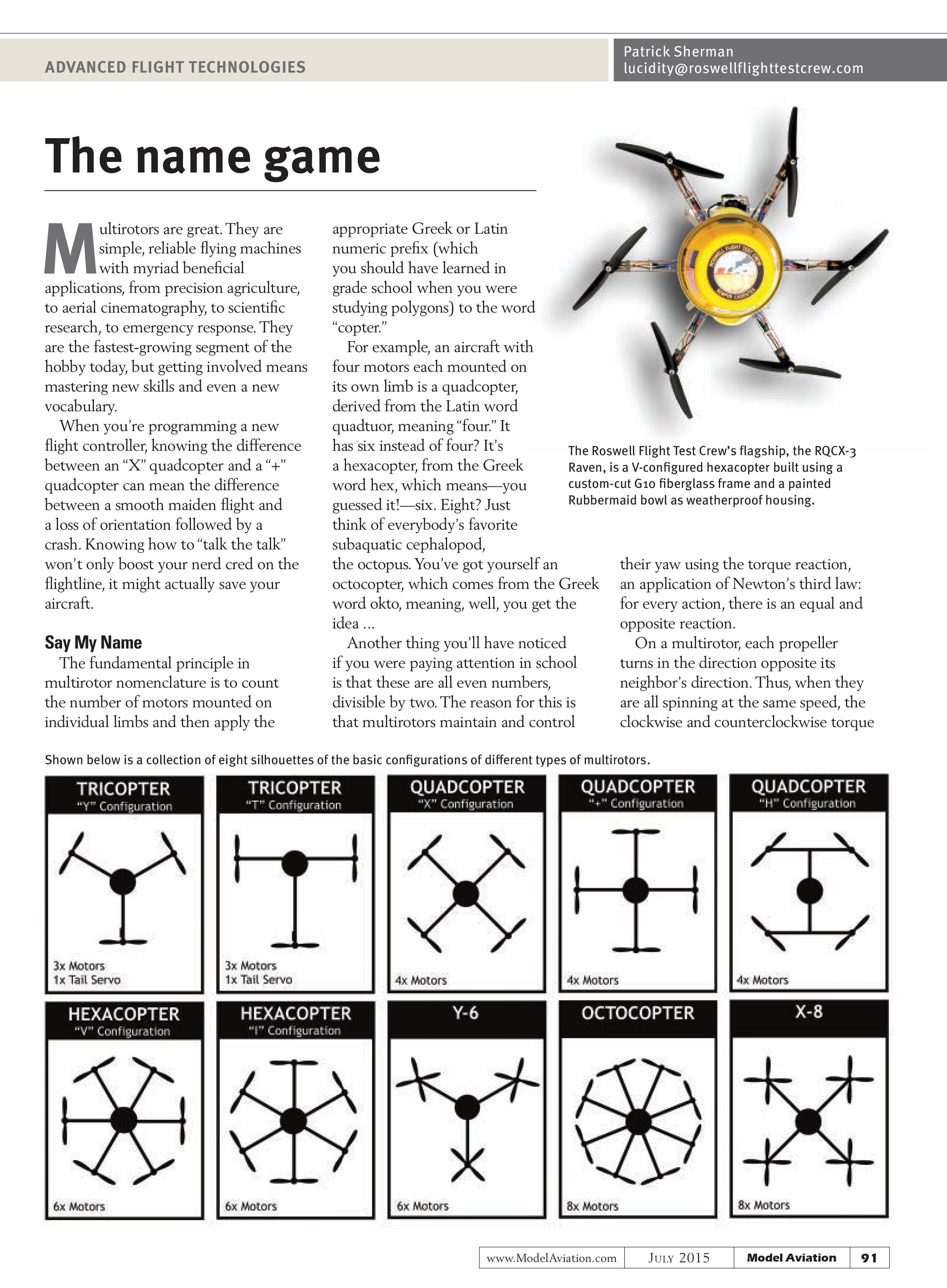
The fundamental principle in multirotor nomenclature is to count the number of motors mounted on individual limbs and then apply the appropriate Greek or Latin numeric prefix (which you should have learned in grade school when you were studying polygons) to the word “copter.”
For example, an aircraft with four motors each mounted on its own limb is a quadcopter, derived from the Latin word quattuor, meaning “four.” It has six instead of four? It’s a hexacopter, from the Greek word hex, which means—you guessed it!—six. Eight? Just think of everybody’s favorite subaquatic cephalopod, the octopus. You’ve got yourself an octocopter, which comes from the Greek word okto, meaning, well, you get the idea …
Another thing you’ll have noticed if you were paying attention in school is that these are all even numbers, divisible by two. The reason for this is that multirotors maintain and control

On a multirotor, each propeller turns in the direction opposite its neighbor’s direction. Thus, when they are all spinning at the same speed, the clockwise and counterclockwise torque
their yaw using the torque reaction, an application of Newton’s third law: for every action, there is an equal and opposite reaction.
Shown below is a collection of eight silhouettes of the basic configurations of different types of multirotors.

effects cancel each other out and the aircraft holds a constant heading.
If you want to turn the aircraft in a clockwise direction, you speed up the propellers that are turning counterclockwise. Of course, you have to simultaneously slow down the clockwise-turning propellers in order to hold constant thrust while executing a yaw turn.
If you’re pitching or rolling at the same time, tradeoffs are required between the speeds of the different propellers to maintain stable flight, which is why you need a sophisticated flight control system to make a multirotor fly—more so than its fixed-wing or single-rotor brethren.
Now you know why there aren’t any pentacopters or septacopters.
A notable exception to this even-number rule is the tricopter, which has only three motors, but four moving parts. Tricopters add a servo to one of the three limbs, typically at the rear of the aircraft, allowing the angle of the propeller to be changed in order to affect torque. As a result, tricopters typically enjoy greater
yaw authority than other multirotor configurations.
Variations
Now that you can distinguish between the different types of basic multirotors, let’s examine some of the variations within each type. Some of these are purely structural, such as the difference between a Y-frame and a T-frame tricopter. The position of the elements that compose these airframes are basically irrelevant to their flight performance, although they may affect other factors, such as the positioning of an onboard camera so that it won’t see the propellers.
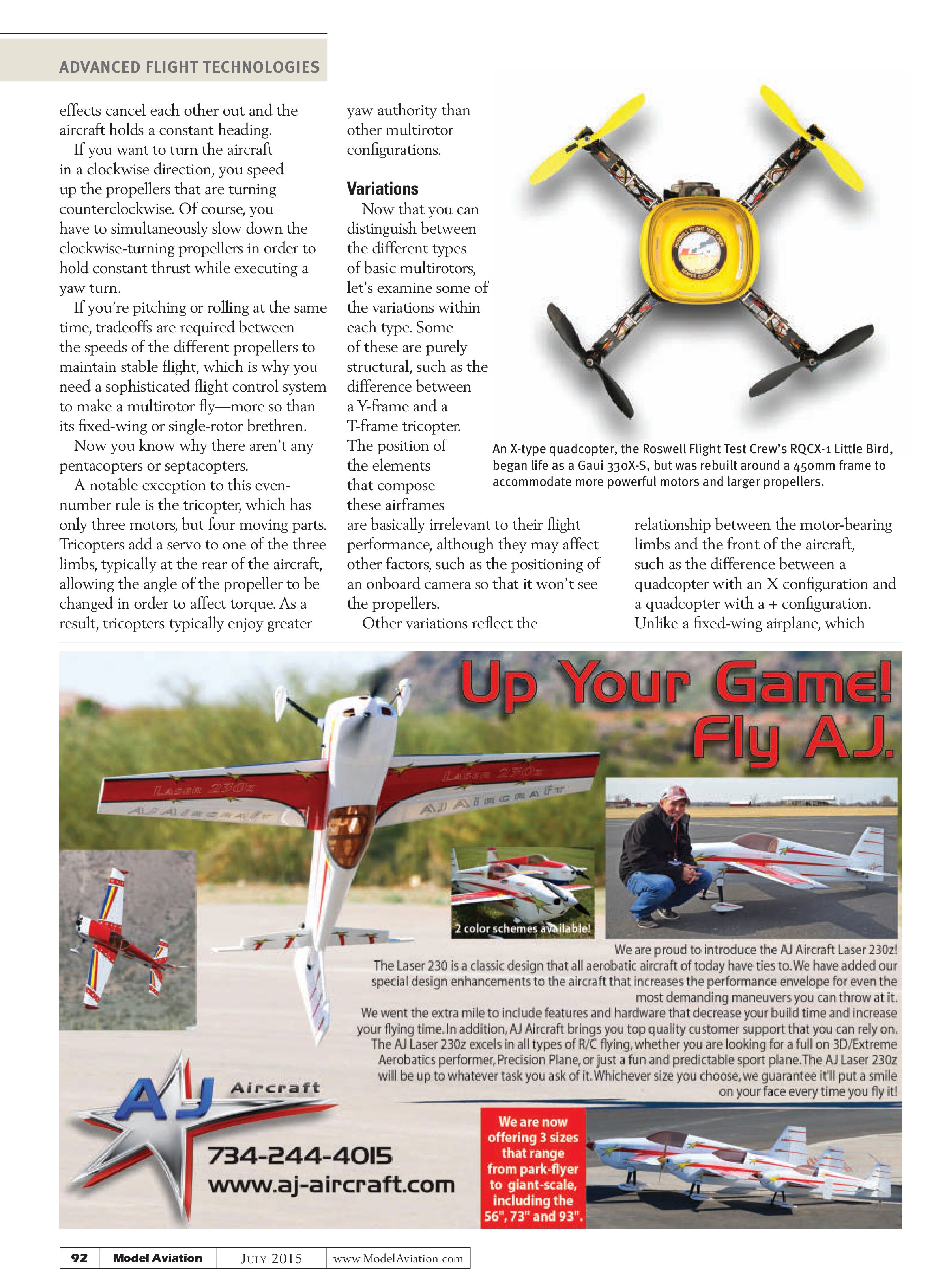
Other variations reflect the relationship between the motor-bearing limbs and the front of the aircraft, such as the difference between a quadcopter with an X configuration and a quadcopter with a + configuration. Unlike a fixed-wing airplane, which

has a definite “front” established by its aerodynamic properties, a symmetrical multirotor is comfortable flying in any direction. Front and rear exist only for the sake of helping the pilot maintain orientation; the multirotor itself couldn’t care less which direction it is flying.
Consequently, it’s possible to make changes within the software of the flight control system that will alter which direction is forward. Among quadcopters, the X configuration is by far the most common, putting the front between two of the limbs, typically to give the camera an unobstructed field of view. One such example is the ubiquitous DJI Phantom in all of its variations and permutations.
Alternatively, one of the limbs, rather than the space between two of them, can become the front of the aircraft, making it a + configuration, which is more popular with RC Acrobatics pilots.
This same fundamental difference of a gap front versus a limb front distinguishes between the “V” and “T” hexacopter variations.
Size Matters
In addition to the familiar one-motor-per-limb configurations, some multirotors mount two motors per limb in a coaxial configuration, with one motor on the top and the other on the bottom, driving their propellers in opposite directions.
These varieties are named for the basic shape of their limbs and the number of motors they carry: the Y-6 and the X-8. These are seen almost exclusively in professional, heavy-lift applications such as aerial cinematography, and are noted for their superior handling characteristics in high wind.
There are tradeoffs inherent between different types of multirotor configurations. Designs with fewer motors, such as tricopters and quadcopters, are lighter and less expensive simply because they have fewer components. However, the loss of a single motor, propeller, or ESC is immediately fatal for the aircraft.
Designs with more motors, such as hexacopters, octocopters, Y-6s, and X-8s are heavier and more expensive. They have higher payload capacities, but are less efficient because they have to lift the weight of the additional motors and ESCs.
Additionally, they incorporate a degree of redundancy and may be able to keep flying following the loss of a single motor—at least well enough to land safely. That’s good news if you’re flying a $500 GoPro HERO4 sports camera, but it could make or break your reputation if you have someone else’s $30,000 Red Epic digital cinema rig slung underneath your aircraft.
Size is another important factor that distinguishes between different types of multirotors. Multirotors are generally named for the distance between motor shafts on opposing limbs in millimeters. The groundbreaking Gaui 330X-S was 330mm across. Likewise, the famed DJI S800 is 800mm from motor to motor. Below 300mm, multirotors are generally referred to as micros.
Of course, larger aircraft can accommodate larger propellers, and as propeller size increases, so does efficiency. If your goal is to maximize flying time, you’ll want to put the largest propellers you can find on the lightest aircraft you can build.
In a field that is as young and as evolving as quickly as multirotors, new ideas frequently emerge. Keep current with reliable sources such as Model Aviation so that you’re not caught off guard when you show up at the field one day and somebody is showing off his or her dodecacopter.