RADIO CONTROL SOARING
Mike Garton, 2733 NE 15th Ave., Ankeny IA 50021; E-mail: mike@iastate.edu
THIS COLUMN starts with a quick update on the comprehensive list of Rudder-Elevator-Spoiler (RES) kits from last month. The remainder of this month's column features the new SuperGee discus-launch glider (DLG) design by Mark Drela.
Last month I published a chart of all the available RES kits I could find. One more has been announced: Whyte Wings is selling a new glider called the RESolution. It spans 117 inches and sports the SD7037 airfoil on obechi-veneered foam wings. The model has a fiberglass fuselage and sells for $360 plus shipping.
I have included the RESolution in the downloadable Excel spreadsheet on the EISS Web site: http://eiss.cnde.iastate.edu/. Future additions or corrections to the RES chart will appear there only. The address for Whyte Wings is given at the end of this column.
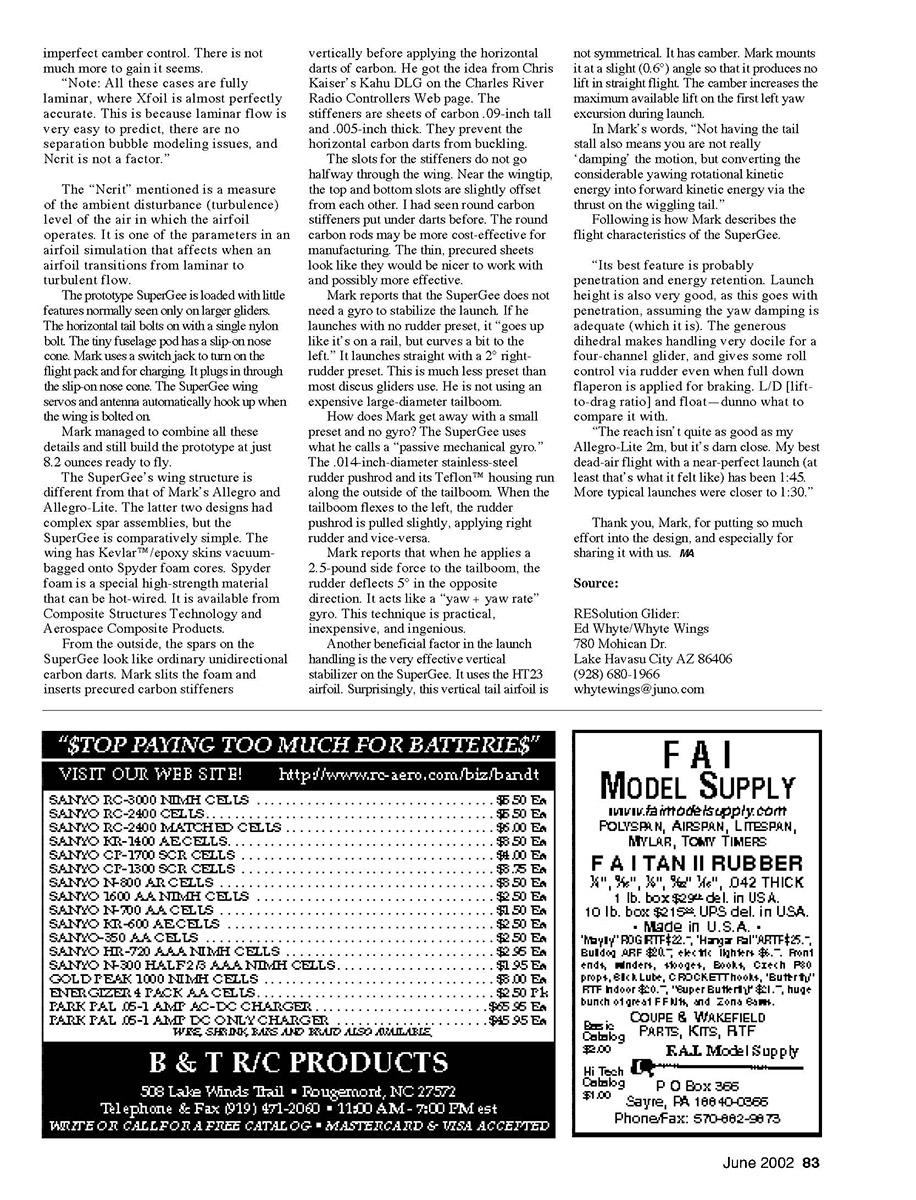
Whether you participate in discus launching or not, there is much to be learned from closely studying Mark Drela's SuperGee DLG design.
Some of the small text and light lines on the SuperGee drawing may not reproduce well in the publishing process. I recommend downloading the original Adobe® Acrobat® (pdf) file from the Internet and printing it at full 8-1/2 x 11-inch size. There are also airfoil coordinates, full-size drawings of the fuselage pod, and full-size drawings of the tail surfaces. You can find the SuperGee stuff at www.monkeytumble.com/hlg/supergee.htm. If this address goes bad, search for SuperGee.
Mark chose the name SuperGee because it is a follow-up to his Apogee Hand-Launched Glider (HLG) design. Both use the same fuselage pod. They share many design details, and they have similar airfoil philosophies (thin, low camber, and light loading).
The airfoils for the SuperGee are new. Mark designed them using his Xfoil software. There is a family of three airfoils for the wing: the AG45c, the AG46c, and the AG47c. Two more were designed for the horizontal stabilizer and vertical tail: the HT22 and the HT23 respectively. They are named with mnemonics representing the first thing for which they were designed. AG is a contraction of Apogee and Allegro (SuperGee grew from the same family). HT stands for horizontal tail.
All the airfoils are thin. The root of the wing uses the 6.9% thick AG45c. The 6.0% thick AG46c is at the panel break. The tip uses the 5.1% thick AG47c.
Following is a quote from the Apogee Web page on the Charles River Radio Controllers site at www.charlesriverrc.org/.
"Many current HLGs use 'big glider' airfoils like the SA7035, MH32, etc. On small gliders these have large draggy separation bubbles. Thinning such airfoils, or using 'fast' slope glider airfoils like the S6063, only partially alleviates this problem.
"The AGxx airfoils were designed for very low Reynolds numbers from the outset. At thermalling speeds, they have quite small separation bubbles for good minimum sink and a docile stall. At higher speeds they exhibit 100% attached laminar flow, resulting in very low launch drag and exceptional penetration. Computed polars indicate very significant overall improvements over the S6063 and other adapted airfoils."
Upon close inspection of the SuperGee wing airfoils, the bottom surfaces look like they have very slight reflex near the trailing edge, and the mean-line curvature is distributed so that the section is thin and nearly reflexed—this helps trim moments. The sections are also reflexed at the stab airfoils HT22 and HT23.
Mark reports the wing is 30 percent carbon-sandwich construction with a very light balsa core. The spar is carbon, and the wing skins are carbon cloth with foam. The wing planform is slightly tapered with washout built in.
The fuselage pod is molded fiberglass with a carbon boom. The original drawing shows R/C equipment placement with a small battery and receiver in the nose pod and another battery in the tail. The tow hook position is marked on the fuselage pod drawing.
The SuperGee has a wing span of 36 inches, a root chord of 3.25 inches, a tip chord of 1.75 inches, and an overall area of 240 square inches. The tail moment arm is relatively long for good pitch authority.
Flight reports from early test pilots suggest the SuperGee launches easily with good penetration at speed and excellent slow-flight characteristics in thermals. The thin airfoils and careful construction result in a DLG that is both responsive and efficient.
For those interested in building the SuperGee or studying the airfoil data, download the full-size drawings and airfoil coordinates from the Apogee/SuperGee Web pages. Mark Drela's analysis and files provide excellent insight into modern HLG/DLG airfoil design and construction techniques.
(End of page content)
physically attainable Cd with a thickness constraint.
"Comparing Cds to these two 'ideal' cases indicates airfoil progress, and how much farther we can possibly go. [In the accompanying table] are the relative Cds at Reynolds number 100K and Cl=0.1 (fast penetration glide).
The 'Cd/Cd(6)' column is probably more relevant as a gauge of progress, since zero thickness is not attainable, and we need some thickness with inevitably
Case | Thickness | Cd/Cd(0) | Cd/Cd(6) | Cl 1) razor blade | 0.0% | 1.000 | NA | 0 2) zero-camber | 6.0% | 1.120 | 1.000 | 0 3) AG46c(-3) | 6.0% | 1.180 | 1.060 | 0.1 4) AG04 | 6.4% | 1.230 | 1.098 | 0.1 5) S6063 | 7.0% | 1.388 | 1.239 | 0.1
imperfect camber control. There is not much more to gain it seems.
Note: All these cases are fully laminar, where Xfoil is almost perfectly accurate. This is because laminar flow is very easy to predict, there are no separation bubble modeling issues, and Ncrit is not a factor.
The "Ncrit" mentioned is a measure of the ambient disturbance (turbulence) level of the air in which the airfoil operates. It is one of the parameters in an airfoil simulation that affects when an airfoil transitions from laminar to turbulent flow.
The prototype SuperGee is loaded with little features normally seen only on larger gliders. The horizontal tail bolts on with a single nylon bolt. The tiny fuselage pod has a slip-on nose cone. Mark uses a switch jack to turn on the flight pack and for charging. It plugs in through the slip-on nose cone. The SuperGee wing servos and antenna automatically hook up when the wing is bolted on.
Mark managed to combine all these details and still build the prototype at just 8.2 ounces ready to fly.
The SuperGee's wing structure is different from that of Mark's Allegro and Allegro-Lite. The latter two designs had complex spar assemblies, but the SuperGee is comparatively simple. The wing has Kevlar/epoxy skins vacuum-bagged onto Spyder foam cores. Spyder foam is a special high-strength material that can be hot-wired. It is available from Composite Structures Technology and Aerospace Composite Products.
From the outside, the spars on the SuperGee look like ordinary unidirectional carbon darts. Mark slits the foam vertically before applying the horizontal darts of carbon. He got the idea from Chris Kaiser's Kahu DLG on the Charles River Radio Controllers Web page. The stiffeners are sheets of carbon .09-inch tall and .005-inch thick. They prevent the horizontal carbon darts from buckling.
The slots for the stiffeners do not go halfway through the wing. Near the wingtip, the top and bottom slots are slightly offset from each other. I had seen round carbon stiffeners put under darts before. The round carbon rods may be more cost-effective for manufacturing. The thin, precured sheets look like they would be nicer to work with and possibly more effective.
Mark reports that the SuperGee does not need a gyro to stabilize the launch. If he launches with no rudder preset, it "goes up like it's on a rail, but curves a bit to the left." It launches straight with a 2° right-rudder preset. This is much less preset than most discus gliders use. He is not using an expensive large-diameter tailboom.
How does Mark get away with a small preset and no gyro? The SuperGee uses what he calls a "passive mechanical gyro." The .014-inch-diameter stainless-steel rudder pushrod and its Teflon™ housing run along the outside of the tailboom. When the tailboom flexes to the left, the rudder pushrod is pulled slightly, applying right rudder and vice-versa.
Mark reports that when he applies a 2.5-pound side force to the tailboom, the rudder deflects 5° in the opposite direction. It acts like a "yaw + yaw rate" gyro. This technique is practical, inexpensive, and ingenious.
Another beneficial factor in the launch handling is the very effective vertical stabilizer on the SuperGee. It uses the HT23 airfoil. Surprisingly, this vertical tail airfoil is not symmetrical. It has camber. Mark mounts it at a slight (0.6°) angle so that it produces no lift in straight flight. The camber increases the maximum available lift on the first left yaw excursion during launch.
In Mark's words, "Not having the tail stall also means you are not really 'damping' the motion, but converting the considerable yawing rotational kinetic energy into forward kinetic energy via the thrust on the winglet tail."
Following is how Mark describes the flight characteristics of the SuperGee.
"Its best feature is probably penetration and energy retention. Launch height is also very good, as this goes with penetration, assuming the yaw damping is adequate (which it is). The generous dihedral makes handling very docile for a four-channel glider, and gives some roll control via rudder even when full down flaperon is applied for braking. L/D [lift-to-drag ratio] and float — dunno what to compare it with.
"The reach isn't quite as good as my Allegro-Lite 2m, but it's darn close. My best dead-air flight with a near-perfect launch (at least that's what it felt like) has been 1:45. More typical launches were closer to 1:30."
Thank you, Mark, for putting so much effort into the design, and especially for sharing it with us. MA
Source:
RESolution Glider: Ed Whyte/Whyte Wings 780 Mohican Dr. Lake Havasu City AZ 86406 (928) 680-1966 whytewings@juno.com
Transcribed from original scans by AI. Minor OCR errors may remain.