RC Pylon Racing
Duane Gall, 1267 S. Beeler Ct., Denver CO 80231; E-mail: stinger4@earthlink.net
RECORD: As this column was going to press, I received word that the record time in Quickie 500 (AMA event 428) had been taken down another notch. The perpetrator in this case was longtime competitor Travis Flynn. Travis's 1:03.54 slightly bettered the record previously held by another stalwart contender: Randy Bridge. Randy's father Chuck Bridge kits the Vortex design used by both.
The record was set at the Valley Flyers' Racin at the Basin Pylon Race held in Van Nuys, California on February 3, 2002. According to Contest Director George Finch, "conditions were perfect with no wind and temperatures in the 60s. The electronic timing system was the same as used to time the previous record holder last fall, on another cool, windless day."
Congratulations, Travis, but you know Randy will take this lying down. Expect more championship performances from both of these guys in the coming months.
A Shameless Plug: I was pleasantly surprised to receive a blizzard of mail (okay, a flurry) in response to the photo of the Q-40 Pole Cat prototype in the February 2002 column. For those who just joined us, Q-40 refers to Quarter 40, AMA event 422, as published in the rule book. You can get a free copy by calling (765) 287-1256, extension 234. (Each AMA member is entitled to one free rule book. Additional copies can be purchased at extension 212.)
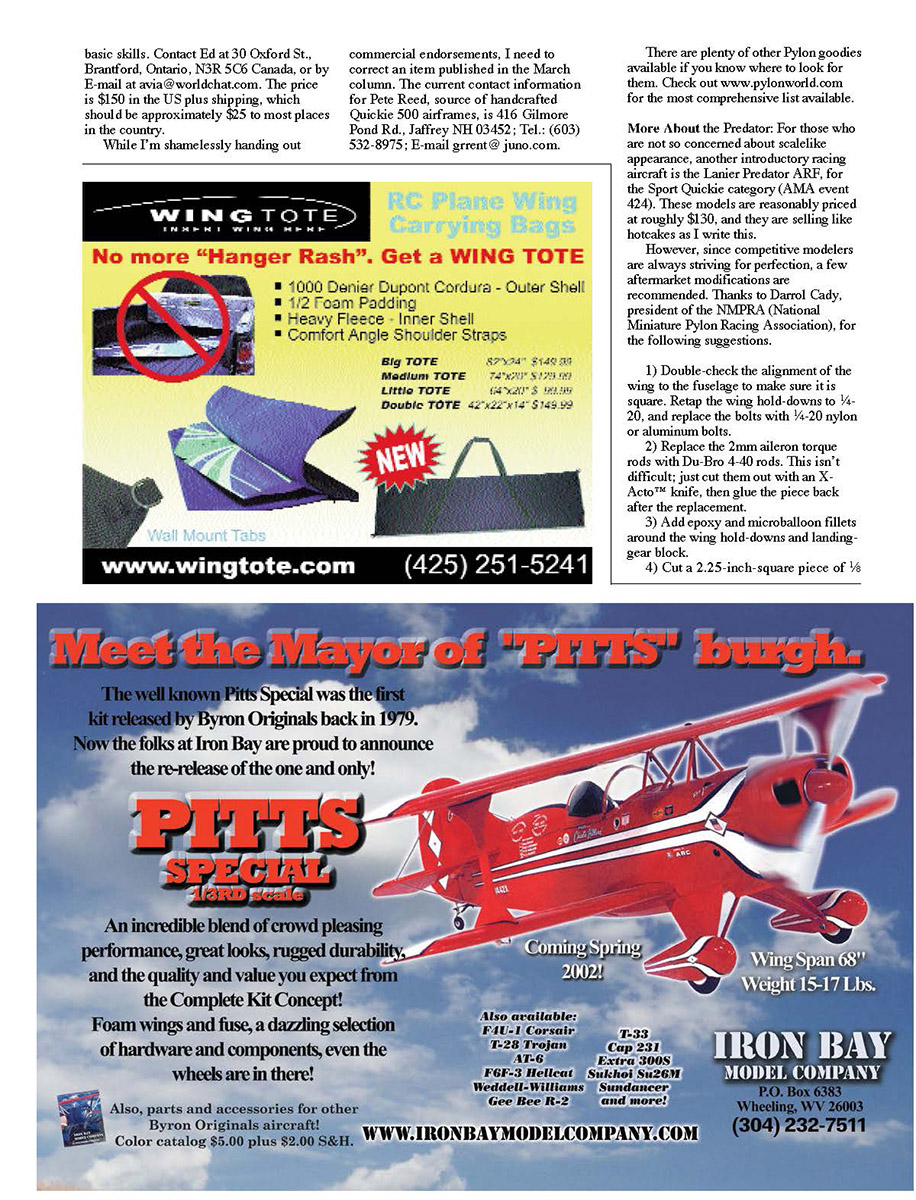
The model shown in that column is a variation on a theme; it uses the fuselage from my Stinger design, which I am happy to say is now commercially available. (This is not the same Stinger model shown in an accompanying photo this month.) No, I'm not making any money from this, but I continue to beat the drum to promote racing.
A sizable population of proficient sport fliers out there would enjoy racing if they tried it, but they are turned off by the square, trainerlike appearance of the Quickie models. They will put down serious money on a scalelike, high-performance competition model to fly for sport; just look at how many Almost Ready-to-Fly (ARF) Lasers show up at the local field on a Sunday!
First these pilots must be convinced that they can fly it and that it will last more than a few flights. Moreover, it has to be usable for normal sport-flying purposes day in and day out. Let's face it: there aren't that many contests, and the number of people who are willing to jump right into the high-buck traveling contest circuit is vanishingly small.
A full-on, 180 mph racing Q-40 with no throttle is certainly not something to play with on a casual basis. However, these models are a joy to sport-fly when they are equipped with a milder engine such as a Thunder Tiger Pro .40 or a SuperTiger GS .40.
I can attest to the Stinger's good manners because I designed it, and one of the things I insisted on from the start was good low-speed handling. Yes, low-speed handling! On a racer! If you can't land it in one piece, you won't be ready for the next heat. But at the same time, it gives up nothing at the high end; my several single-digit times were not earned by crackerjack flying skills, but were stolen through clever aerodynamics.
Ed Smith is now kitting the Stinger. It's not an ARF, but a fine-quality fiberglass-fuselage, foam-wing "semikit" that can be assembled by any enterprising modeler.
I'm shamelessly handing out commercial endorsements, I need to correct an item published in the March column. The current contact information for Pete Reed, source of handcrafted Quickie 500 airframes, is 416 Gilmore Pond Rd., Jaffrey NH 03452; Tel.: (603) 532-8975; E-mail: grrent@juno.com.
There are plenty of other Pylon goodies available if you know where to look for them. Check out www.pylonworld.com for the most comprehensive list available.
More About the Predator: For those who are not so concerned about scale-like appearance, another introductory racing aircraft is the Lanier Predator ARF, for the Sport Quickie category (AMA event 424). These models are reasonably priced at roughly $130, and they are selling like hotcakes as I write this.
However, since competitive modelers are always striving for perfection, a few aftermarket modifications are recommended. Thanks to Darrol Cady, president of the NMPRA (National Miniature Pylon Racing Association), for the following suggestions.
- Double-check the alignment of the wing to the fuselage to make sure it is square. Retape the wing hold-downs to 1/4-20, and replace the bolts with 1/4-20 nylon or aluminum bolts.
- Replace the 2mm aileron torque rods with Du-Bro 4-40 rods. This isn't difficult; just cut them out with an X-Acto knife, then glue the piece back after the replacement.
- Add epoxy and microballoon fillets around the wing hold-downs and landing-gear block.
- Cut a 2.25-inch-square piece of 1/8" plywood, and epoxy it to the front of the firewall, making sure that you get plenty of adhesion of the plate to the fuselage sides and top and bottom block. This will keep the firewall in if you drag the muffler on landing.
- Drill and pin the firewall and the wing hold-downs to the fuselage sides with toothpicks.
- Replace all the hardware, especially the pushrods, with standard hardware from your local hobby shop.
As I noted, these are suggestions. If you intend to race this or any other aircraft, you are responsible for ensuring that it is airworthy and well tested before you bring it to a contest. This goes double if you plan to use a thoroughbred racing engine such as a Nelson or a Jetex. Racing has an excellent safety record, and we should all do our part to keep it that way.
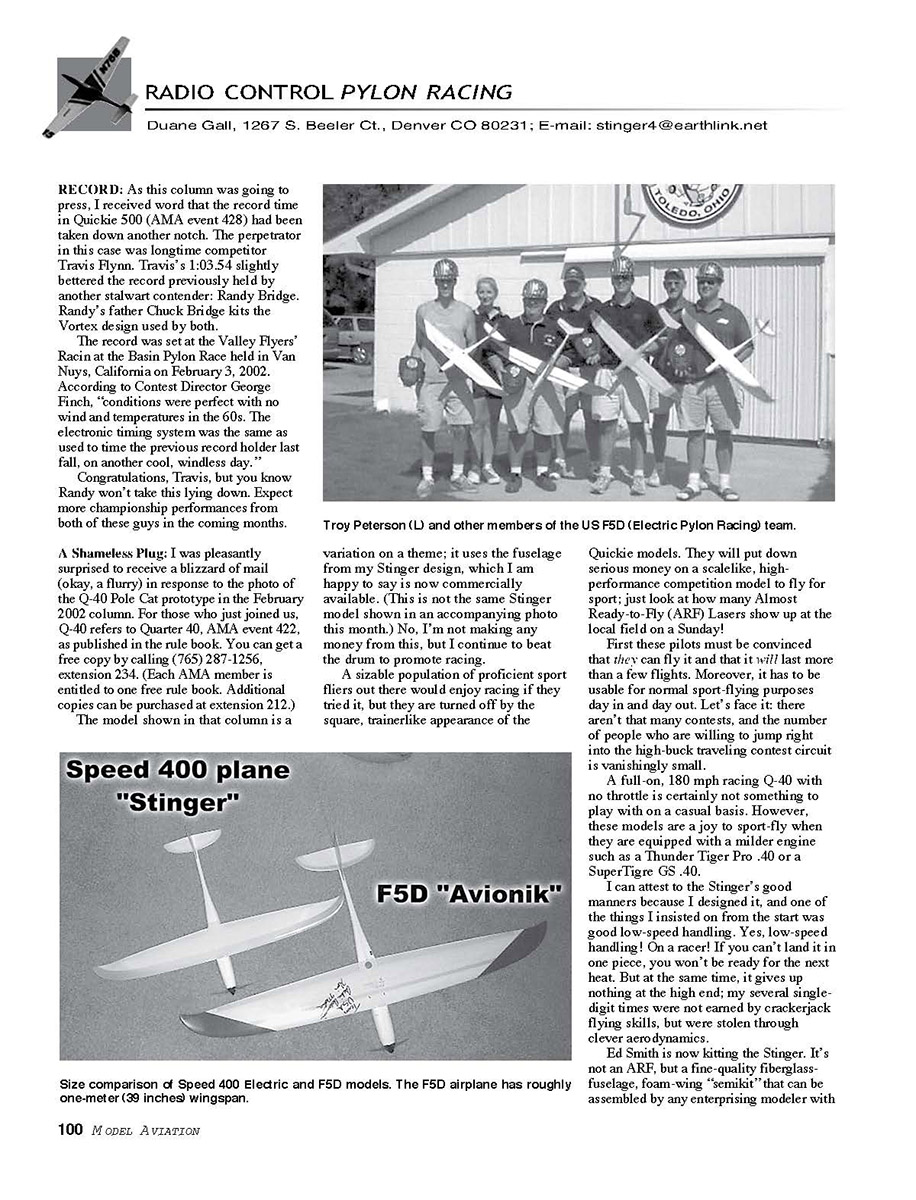
An Electrifying Prospect: I'll close this month with a few words from Troy Peterson, who is a current member (sorry, I couldn't resist) of the US team for F5D Electric Pylon.
What is F5D? F5D is the designation by the Fédération Aéronautique Internationale (FAI) for open-class, radio-controlled, electric-powered pylon races. The FAI pylon course consists of three pylons set in a triangle 180 meters long by 40 meters wide. This is slightly shorter than the AMA pylon course but is wider at turns two and three. The race lasts 10 laps and up to four airplanes are flown at a time.
The object is to complete a 10-lap heat as fast as you can without cutting inside the pylons. One outside adds 10% to your 10-lap time; two cuts disqualify you from the race. You are allowed to take out the turn for you during the race. The airplanes are hand-launched and they land on their belly.
F5D originally started out as an exhibition demo in early Electric World Championships. Due to its growing popularity in the competitive spirit, it was destined to become an integral part of future World Championships. These specially selected pilots form a team and compete against other international teams at World Championships.
The first F5D World Championship was held in 1994 in Wanganui, Australia. Since then there have been three more World Championships and another is coming up in July which will be held in Switzerland. The US has traditionally been one of the strongest F5D contenders in the world and will strive to achieve future F5D World Championship titles.
What sort of airframes do you use? F5D airplanes are what's come to be called big brother to the popular Electric Speed 400 pylon racers. They are generally about 40% bigger (about one-meter wingspan) and are capable of reaching speeds in excess of 160 mph on the course.
Popular airframes are the Russian-made Avionik, a German-made Y2K Silver, and some home-brews. The aircraft are all built using high-performance composite materials such as carbon fiber, Kevlar, and fiberglass.
There isn't much room in the airframe, so space is at a premium. Small receivers and micro servos are utilized to achieve this. The controls used in F5D airplanes are aileron, elevator, throttle control, and some flap-to-elevator mixing.
Nickel-cadmium cells provide the electric power. The battery may not exceed a maximum weight of 425 grams, and the cells may not be physically altered. Competitive battery packs under that weight limit can be seven-cell 2400 mAh, nine-cell CP1700 mAh, or 10-cell 2250 mAh packs.
The airplane ready to fly cannot exceed a total surface loading of 24.5 ounces per square foot. Most F5D airplanes ready to fly weigh 28–30 ounces. There are no restrictions on our motors, and therefore it is no surprise that brushless motors (Hacker, Kontronik, Lehner, and Axi, to name a few) are the only way to go due to their efficiency and reliability.
The speed controls are highly sophisticated and handle tremendous amounts of power in a small package. Motor system currents can approach 100 amps as the motors spin 5–6 inch props at over 33,000 rpm. Average lap times are around six to seven seconds, with the fastest laps slowing due mostly to voltage drop in the battery pack. The current world record is 68 seconds. This will surely drop by the next World Championships.
F5D airplanes have come a long way over the years. It is a challenging competition for even the seasoned pro that takes pilot skills, knowledge of electric power plants, and a great set-up.
Imagine your .40-size airplane chasing a Nelson-powered pylon racer and watching it shrink as it gets to turn 4. Don’t blink!
For more information about Electric Pylon Racing or the upcoming F5D World Championships, check out these Web sites: The EZ Zone (Pylon in the discussion forums): www.ezonemag.com
Info on the World Champs in Switzerland: www.silentwings.ch
Thanks, Troy. I have included some illustrative photos. For more information about F5D, contact Troy at <REDACTED>.
Transcribed from original scans by AI. Minor OCR errors may remain.