RC Giants
Sal Calvagna, 1335 Broadway Ave., Holbrook NY 11741; E-mail: ncalvagn@suffolk.lib.ny.us
BEFORE I GET into the business of Radio Control (RC) Giants, I must set the record straight once and for all. It is important for the truth to be told, and I take this opportunity to do so. My tormentors would have you believe differently as they spread lies and half-truths throughout the modeling community. So here it is: I have been flying those eight- to 10-ounce indoor/park flyers!
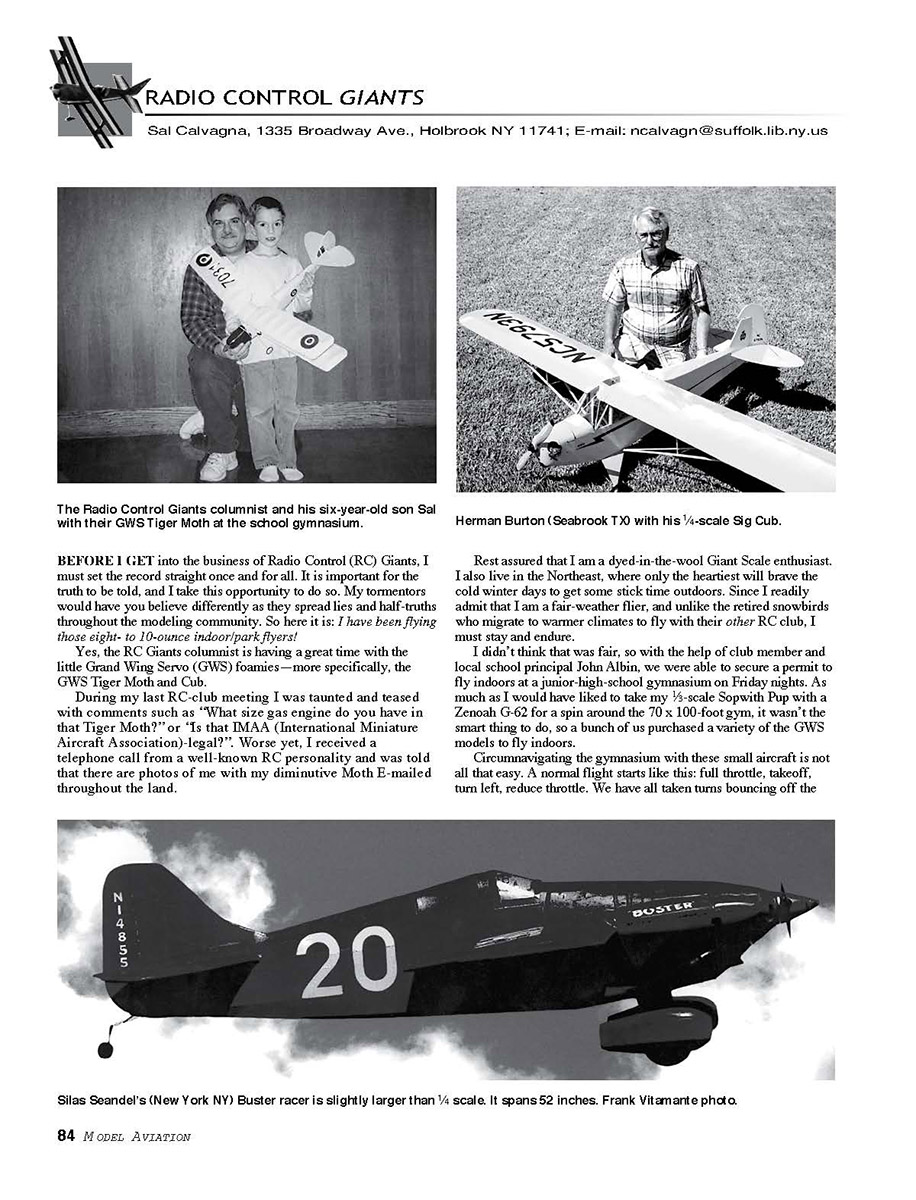
Yes, the RC Giants columnist is having a great time with the little Grand Wing Servo (GWS) foamies — more specifically, the GWS Tiger Moth and Cub.
During my last RC-club meeting I was taunted and teased with comments such as "What size gas engine do you have in that Tiger Moth?" or "Is that IMAA (International Miniature Aircraft Association)-legal?" Worse yet, I received a telephone call from a well-known RC personality and was told that there are photos of me with my diminutive Moth E-mailed throughout the land.
Rest assured that I am a dyed-in-the-wool Giant Scale enthusiast. I also live in the Northeast, where only the heartiest will brave the cold winter days to get some stick time outdoors. Since I readily admit that I am a fair-weather flier, and unlike the retired snowbirds who migrate to warmer climates to fly with their other RC club, I must stay and endure.
I didn't think that was fair, so with the help of club member and local school principal John Albin, we were able to secure a permit to fly indoors at a junior-high-school gymnasium on Friday nights. As much as I would have liked to take my 1/3-scale Sopwith Pup with a Zenoah G-62 for a spin around the 70 x 100-foot gym, it wasn't the smart thing to do, so a bunch of us purchased a variety of the GWS models to fly indoors.
Circumnavigating the gymnasium with these small aircraft is not all that easy. A normal flight starts like this: full throttle, takeoff, turn left, reduce throttle. We have all taken turns bouncing off the walls, bleachers, light fixtures, and basketball nets. Even more so, we enjoy the frequent midairs. These small, light aircraft are surprisingly robust, and they are usually back in the air in no time with a little Scotch® tape and a spare propeller.
I am working on this column in late January, and after a winter of indoor activity my flying skills will remain at their peak and my thumbs limber, ready for another Giant Scale season. As they say, "the truth shall set you free." So let my tormentors do their worst; I can handle it!
First 1/4-Scale Project:
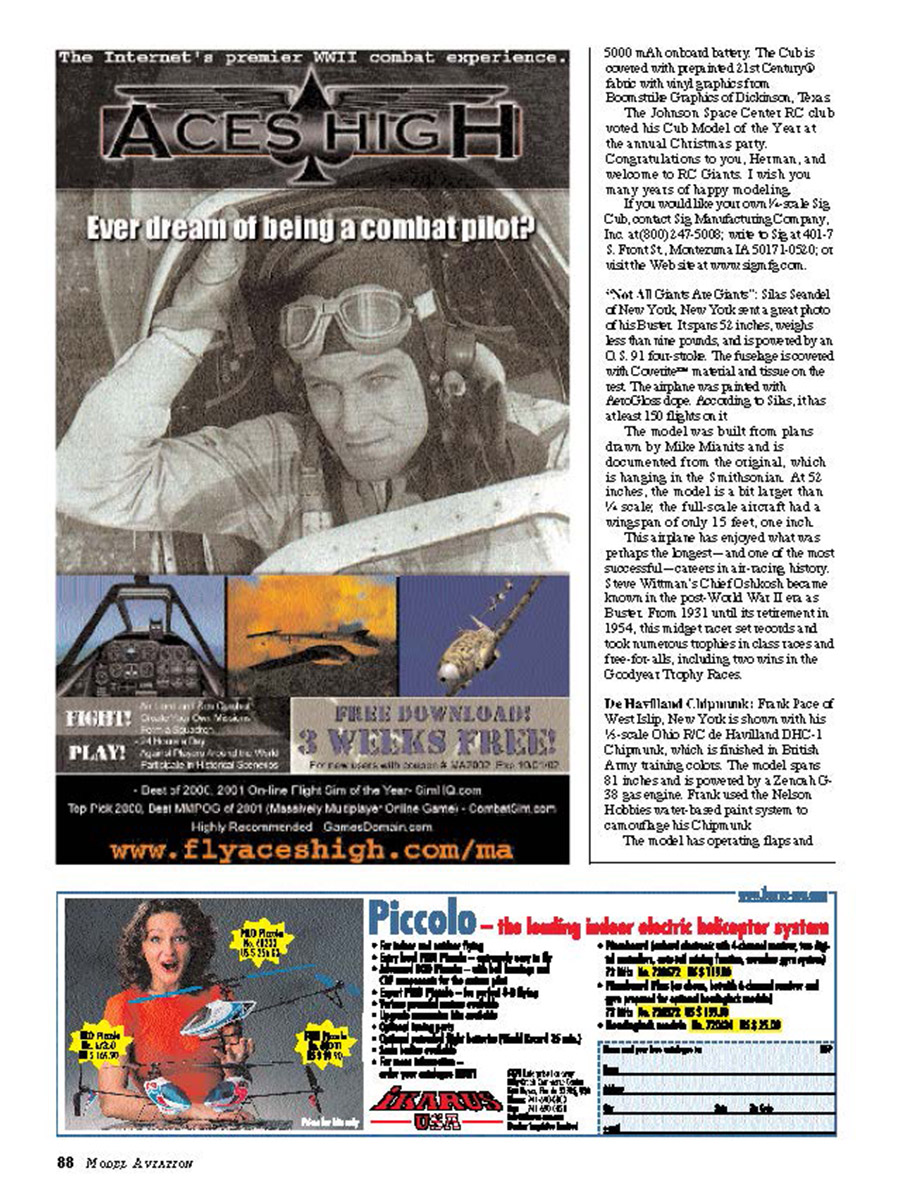
Herman Burton of Seabrook, Texas sent a very nice letter and photos of his first RC Giant project: a Sig Manufacturing 1/4-scale Cub. Herman started in this hobby approximately five years ago, shortly after retiring, and has found RC building and flying most enjoyable. He started with the 40-size models and moved up with experience.
Herman really likes the way all of his Sig kits have gone together and has high praise for their instruction booklets and accurate parts.
His Sig Cub has an O.S. 1.60 twin for power, Hitec servos and receiver, and a 1100 mAh battery power source. He installed a JHM Aero Engineering DGS-2 onboard glow-driver package powered by a 5000 mAh onboard battery. The Cub is covered with preprinted 21st Century® fabric with vinyl graphics from Boomstile Graphics of Dickinson, Texas.
The Johnson Space Center RC Club voted his Cub Model of the Year at the annual Christmas party. Congratulations to you, Herman, and welcome to RC Giants. I wish you many years of happy modeling.
If you would like your own 1/4-scale Sig Cub, contact Sig Manufacturing Company, Inc. at (800) 247-5008; write to Sig at 4017 S. Front St., Montezuma, IA 50171-0582; or visit the Web site at www.sigmfg.com.
"Not All Giants Are Giants":
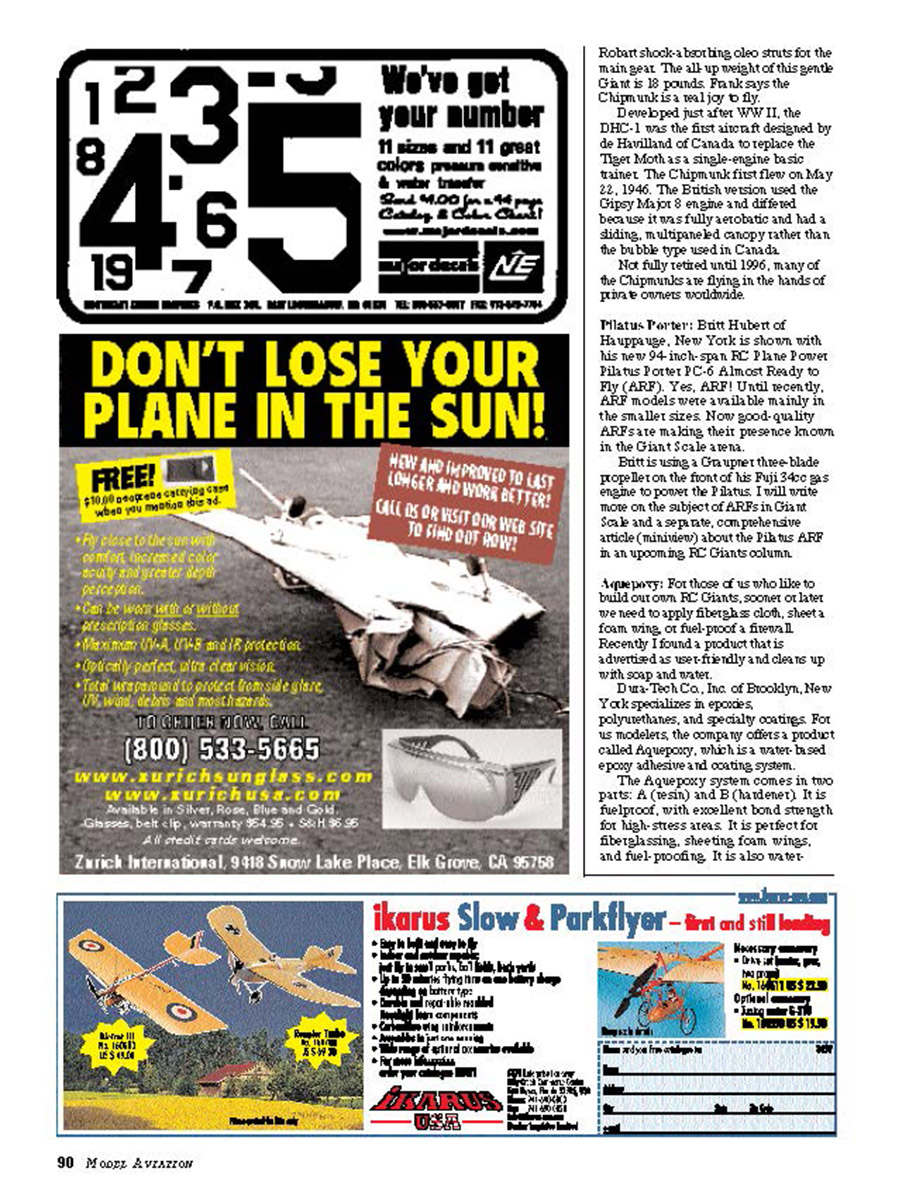
Silas Scandell of New York, New York sent a great photo of his Buster Ispats. It spans 52 inches, weighs less than nine pounds, and is powered by an O.S. 91 four-stroke. The fuselage is covered with Coverite® material and tissue on the rest. The airplane was painted with Aerocote® dope. According to Silas, it has about 150 flights on it.
The model was built from plans drawn by Mike Minatus and is documented from the original, which is hanging in the Smithsonian. At 52 inches, the model is a bit larger than 1/4 scale; the full-scale aircraft had a wingspan of only 15 feet, one inch.
This airplane has enjoyed what was perhaps the longest—and one of the most successful—careers in air-racing history. Steve Wittman's Chief Oshkosh became known in the post–World War II era as Buster. From 1931 until its retirement in 1954, this midget racer set records and took numerous trophies in classic races and free-for-alls, including two wins in the Goodyear Trophy Races.
The De Havilland Chipmunk:
Frank Pace of West Islip, New York is shown with his 1/4-scale DHC-1 Chipmunk, which is finished in British Army training colors. The model spans 81 inches and is powered by a Zenoah G-38 gas engine. Frank used the Nelson Hobbies water-based paint system to camouflage this Chipmunk.
The model has operating flaps and Robart shock-absorbing oleo struts for the main gear. The all-up weight of this gentle Giant is 18 pounds. Frank says the Chipmunk is a real joy to fly.
Developed just after WWII, the DHC-1 was the first aircraft designed by the de Havilland of Canada to replace the Tiger Moth as a single-engine basic trainer. The Chipmunk first flew on May 22, 1946. The British version used the Gipsy Major 8 engine and differed because it was fully aerobatic and had a sliding, multi-paneled canopy rather than the bubble type used in Canada.
Not fully retired until 1996, many of the Chipmunks are flying in the hands of private owners worldwide.
Pilatus Porter:
Britt Hubert of Hauppauge, New York is shown with his new 94-inch span RC Plane Power Pilatus Porter PC-6 Almost Ready to Fly (ARF). Yes, ARF! Until recently, ARF models were available mainly in the smaller sizes. Now good-quality ARFs are making their presence known in the Giant-Scale arena.
Britt is using a Graupner three-blade propeller on the front of his Fuji 34cc gas engine to power the Pilatus. I will write more on the subject of ARFs in Giant Scale and a separate, comprehensive article (mini-review) about the Pilatus ARF in an upcoming RC Giants column.
Aqueproxy:
For those of us who like to build our own RC Giants, sooner or later we need to apply fiberglass cloth, sheet a foam wing, or fuel-proof a firewall. Recently I found a product that is advertised as user-friendly and cleans up with soap and water.
Dura-Tech Co., Inc. of Brooklyn, New York specializes in epoxies, polyurethanes, and specialty coatings. For us modelers, the company offers a product called Aqueproxy, which is a water-based epoxy adhesive and coating system.
The Aqueproxy system comes in two parts: A (resin) and B (hardener). It is fuelproof, with excellent bond strength for high-stress areas. It is perfect for fiberglassing, sheeting foam wings, and fuel-proofing. It is also water-
Transcribed from original scans by AI. Minor OCR errors may remain.