RADIO CONTROL ELECTRICS
Bob Kopski, <REDACTED>
This column will announce two meets, share the Electric Connection Service, offer some thoughts about Electric stuff in the car, follow up on Big B, and share some reader input regarding hinging on foamie Almost Ready to Flys.
Brian Allen (<REDACTED>) tells me that the third annual Loudoun County Aeromodelers Electric Fly In is scheduled for July 27, 2002. Brian was pretty excited about how well the second meet went last summer, and he is anxious for this one.
Last year's second annual brought in 38 registered participants and approximately 100 airplanes. This ratio is common; it seems that most meets experience roughly three models per pilot.
Meets generally grow with passing years, so I'd naturally expect this year's event to be larger. All it takes is you, so plan on being part of an even bigger and better E-gathering this year.
Very often, meets begin as one-day affairs and transition to two days—or more—after a few years of growth. I've seen this step make a big difference in meet attendance; it can be a giant step.
This growth is because people will travel farther if there's more time to fly. A multi-day meet has more "reach," so participation goes up. More days also offers some insurance against weather disappointment on one of the days. Will the Aeromodelers' fourth annual make this jump next year? It just might be up to you!
Don't forget that meets are an excellent place to learn about Electrics. If you've been toying with the idea of giving Electric a try, this is one opportunity to get pushed over the edge. Typically, you'll find E-modelers very friendly and eager to show and tell. As I've written previously, I consider it impossible to attend a good meet and leave unconvinced.
Late-Arriving News: Bob Tabler (<REDACTED>) has announced the Tidewater Radio Control, Inc. second All Electric Fun Fly for June 22-23 at the Ferretes Naval Auxiliary Landing Field in Chesapeake, Virginia. Bob can supply many details, so get in touch with him.
The Electric Connection Service (ECS) is an exclusive feature of this column. The idea is to help E-aeromodelers "connect" with others of the same persuasion. If you are (or feel like) an E-lover and want to share the quiet thrill of Electric, just send me your information and I'll list it in a future column. Then other E-singles in your area can get in touch, and presto! An E-group is born!
I'm aware of more and more small E-groups forming around the country. These may be formal or informal clubs seeking to grow. If you represent one of these and would like to make your group known to others in the area, please accept this invitation to use the ECS. This service is for individuals and for groups, and it's yours free! But you gotta ask.
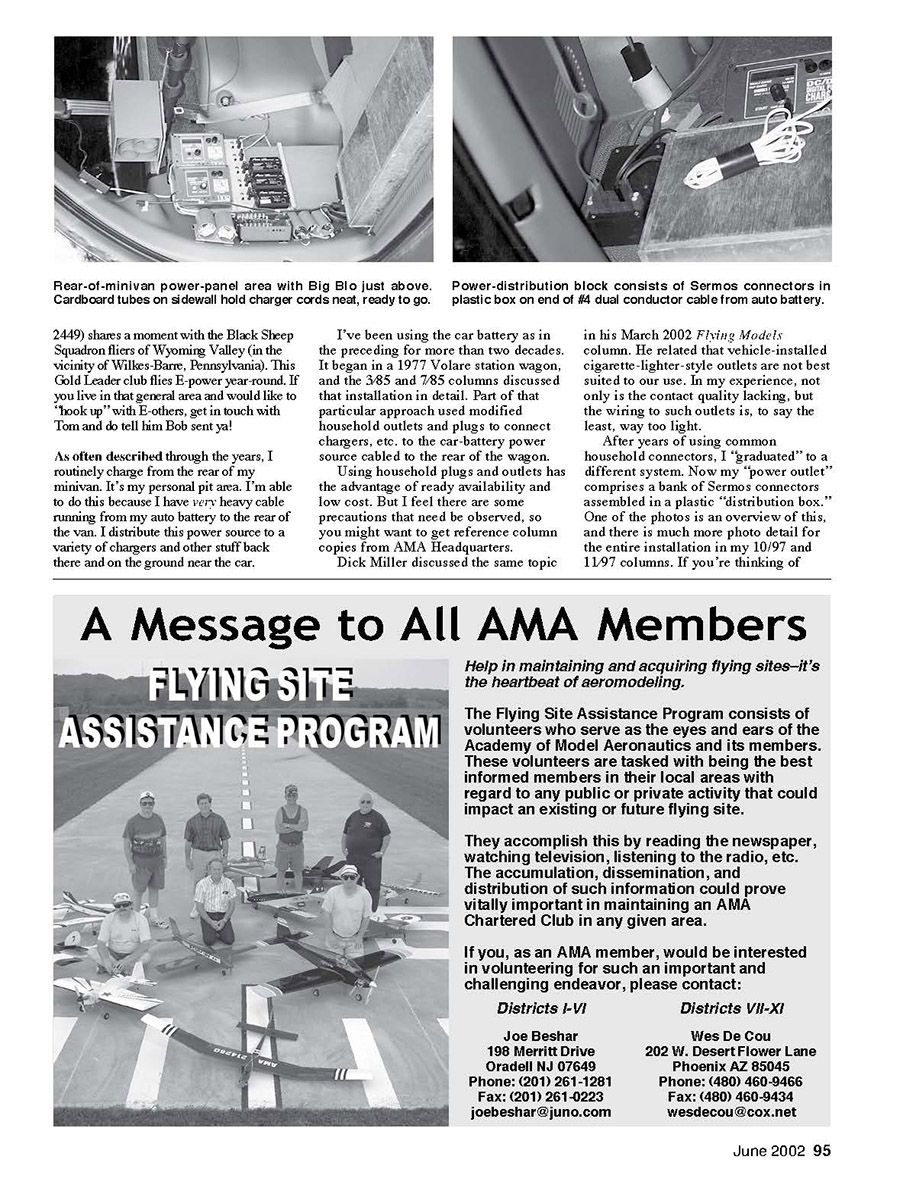
One photo this month shows what I mean. Tom Hizny (<REDACTED>) shares a moment with the Black Sheep Squadron fliers of Wyoming Valley (in the vicinity of Wilkes-Barre, Pennsylvania). This Gold Leader club flies E-power year-round. If you live in that general area and would like to "hook up" with E-others, get in touch with Tom and do tell him Bob sent ya!
As often described through the years, I routinely charge from the rear of my minivan. It's my personal rat area. I'm able to do this because I have very heavy cable running from my auto battery to the rear of the van. I distribute this power source to a variety of chargers and other stuff back there and on the ground near the car.
I've been using the car battery as in the preceding for more than two decades. It began in a 1977 Volare station wagon, and the 3/85 and 7/85 columns discussed that installation in detail. Part of that particular approach used modified household outlets and plugs to connect chargers, etc. to the car-battery power source cabled to the rear of the wagon.
Using household plugs and outlets has the advantage of ready availability and low cost. But I feel there are some precautions that need be observed, so you might want to get reference column copies from AMA Headquarters.
Dick Miller discussed the same topic in his March 2002 Flying Models column. He related that vehicle-installed cigarette-lighter-style outlets are not best suited to our use. In my experience, not only is the contact quality lacking, but the wiring to such outlets is, to say the least, way too light.
After years of using common household connectors, I "graduated" to a different system. Now my "power outlet" comprises a bank of Sermos connectors assembled in a plastic "distribution box." One of the photos is an overview of this, and there is much more photo detail of the entire installation in my 10/97 and 11/97 columns. If you're thinking of doing this sort of thing, I suggest that you get these column copies as well.
One aspect of my contemporary installation that stopped so many passes by at the Northeast Electric Aircraft Technology (NEAT) event was the panel of stuff installed as seen in one photo. Basically, it's my collection of chargers and connection devices mounted on a panel. The panel, which was cut to shape from 1/4" plywood to fit the available space, rests on the floor and is held to the inside side wall with Velcro® straps. It must be readily removable because the jacks it is stored behind an interior section now covered by the power panel.
This "wall" of stuff effectively expands the floor space available. Previously, all that stuff was all over the van floor. The panel liberates that space for more airplanes, transmitters, etc. At first glance it may appear awkward to work with, given that some chargers are positioned "funny," but all works well in practice.
One real convenience is the cardboard tube arrays — similarly attached — that serve to hold wrapped-up charger output leads. This has proven to be extremely convenient, offering rapid deployment and quick storage. (I don't want to waste a second of flying time!) For what it's worth, this evolved system works extremely well for me, and you might find some ideas here for your interest and utility as well.
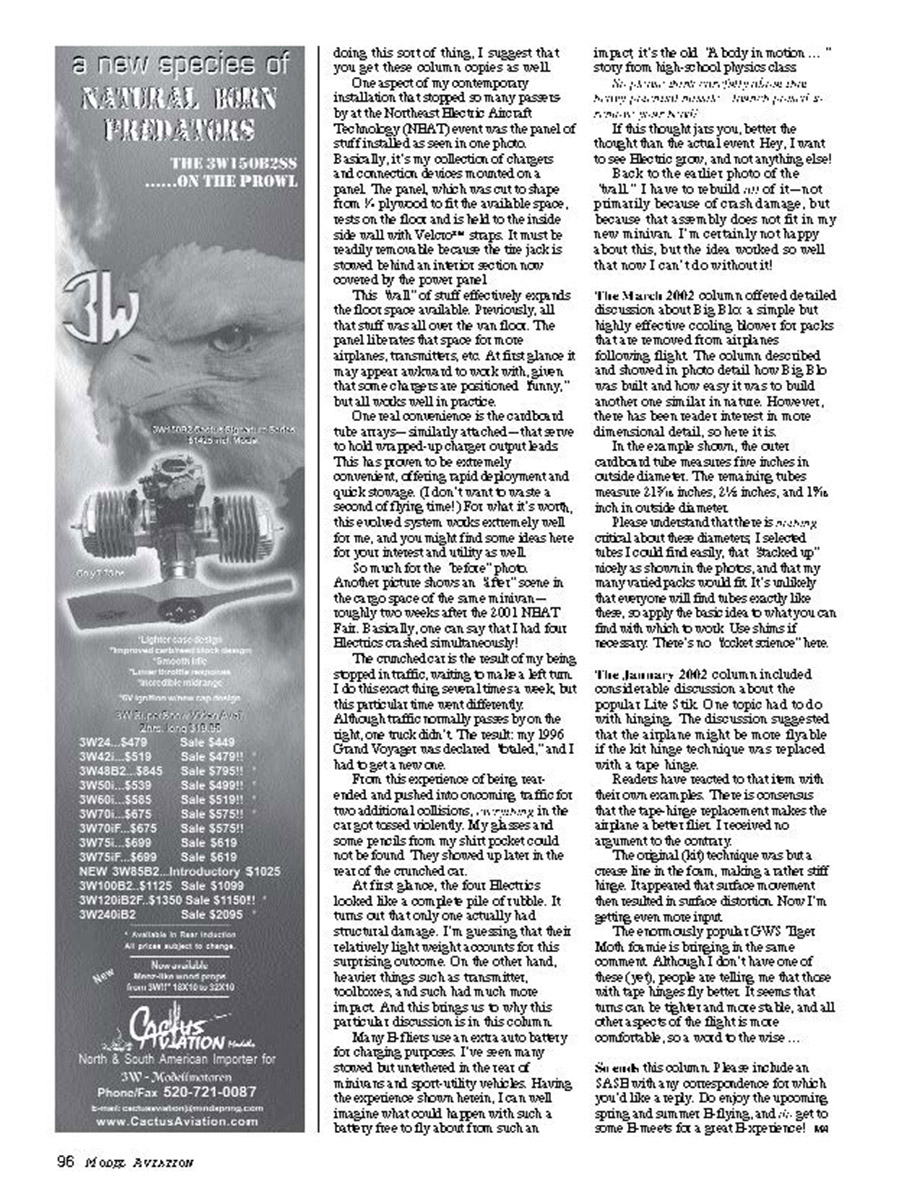
So much for the "before" photo. Another picture shows an "after" scene in the cargo space of the same minivan — roughly two weeks after the 2001 NEAT Fair. Basically, one can say that I had four Electrics crash simultaneously!
The crunched car is the result of my being stopped in traffic, waiting to make a left turn. I do miscast things several times a week, but this particular time went differently. Although traffic normally pauses by the right, one truck didn't. The result: my 1996 Grand Voyager was declared "totaled," and I had to get a new one.
From this experience of being rear-ended and pushed into oncoming traffic for two additional collisions, everything in the car got tossed violently; my glasses and some pencils from my shirt pocket could not be found. They showed up later in the rear of the crunched car.
At first glance, the four Electrics looked like a complete pile of rubble. It turns out that only one actually had structural damage. I'm guessing that their relatively light weight accounts for this surprising outcome. On the other hand, heavier things such as transmitters, toolboxes, and such had much more impact. And this brings us to why this particular discussion is in this column.
Many E-fliers use an extra auto battery for charging purposes. I've seen many stored but unwheeled in the rear of mini-vans and sport-utility vehicles. Had the experience shown herein, I can well imagine what could happen with such a battery free to fly about from such an impact; it's the old "A body in motion ..." story from high-school physics class.
If this thought jars you, better re-think than the actual event. Hey, I want to see Electrics grow, and not anything else!
Back to the detailed photo of the "wall." I have to build it — if not primarily because of crash damage, but because the assembly does fit in my new minivan. I'm certainly not happy about this, but the idea worked so well that now I can't do without it!
The March 2002 column offered detailed discussion about Big B; a simple but highly effective cooling blower for packs that I removed from airplanes following flight. The column described and showed in photo detail how Big B was built and how easy it was to build another one similar in nature. However, there has been reader interest in more dimensional detail, so here it is.
In the example shown, the outer cardboard tube measures five inches in outside diameter. The remaining tubes measure 2 1/4 inches, 2 1/8 inches, and 1 9/16 inch in outside diameter.
Please understand that there is nothing critical about those diameters. I selected tubes I could find easily, that "stacked up" nicely as shown in the photos, and that my many varied packs would fit. It's unlikely that everyone will find tubes exactly like these, so apply the basic idea to what you can find with the least effort. Use shims if necessary. There's no "rocket science" here.
The January 2002 column included considerable discussion about the popular Lite-5 Kit. One topic had to do with hinges. The discussion suggested that the airplane might be more flyable if the kit hinge technique was replaced with a tape hinge.
Readers have reacted to that item with their own examples. There is consensus that the tape-hinge replacement makes the airplane a better flier. I received no argument to the contrary.
The original kit technique was but a crease line in the foam, making a rather stiff hinge. It appeared that surface movement then resulted in surface distortion. Now I'm seeing even more improvement.
The enormously popular GWS Tiger Moth continues to bring in the same comments. Although I don't have one of these (yet), people are telling me that those kits are tightly built and made, and all the big aspects of the flight is more comfortable, so a word to the wise ...
So until this column, please include an SASE with any correspondence for which you'd like a reply. Do enjoy the upcoming spring and summer E-flying, and, get to some E-meets for a great E-experience! KO
Transcribed from original scans by AI. Minor OCR errors may remain.