Micro-Flying
Route 4, Box 369, Farmville VA 23901; E-mail: aplusfarm@hovac.com
GREETINGS, FRIENDS, from a very cold Central Virginia. This has been a nice active period in micro/indoor, and there is plenty to review.
Thanks to all of you who have written in support of this department; it is very encouraging. For those of you who contacted me for the Cox .010 carburetor sketch and had individual questions, I apologize for not answering each letter personally. Frankly, I was swamped.
In answer to the most-often-asked question—whether the carburetor can be scaled to other sizes of Cox engines—the answer is "Sure." It should work fine as long as the throat area of the carburetor matches the original throat area, and the base of the unit will fit into the molded body.
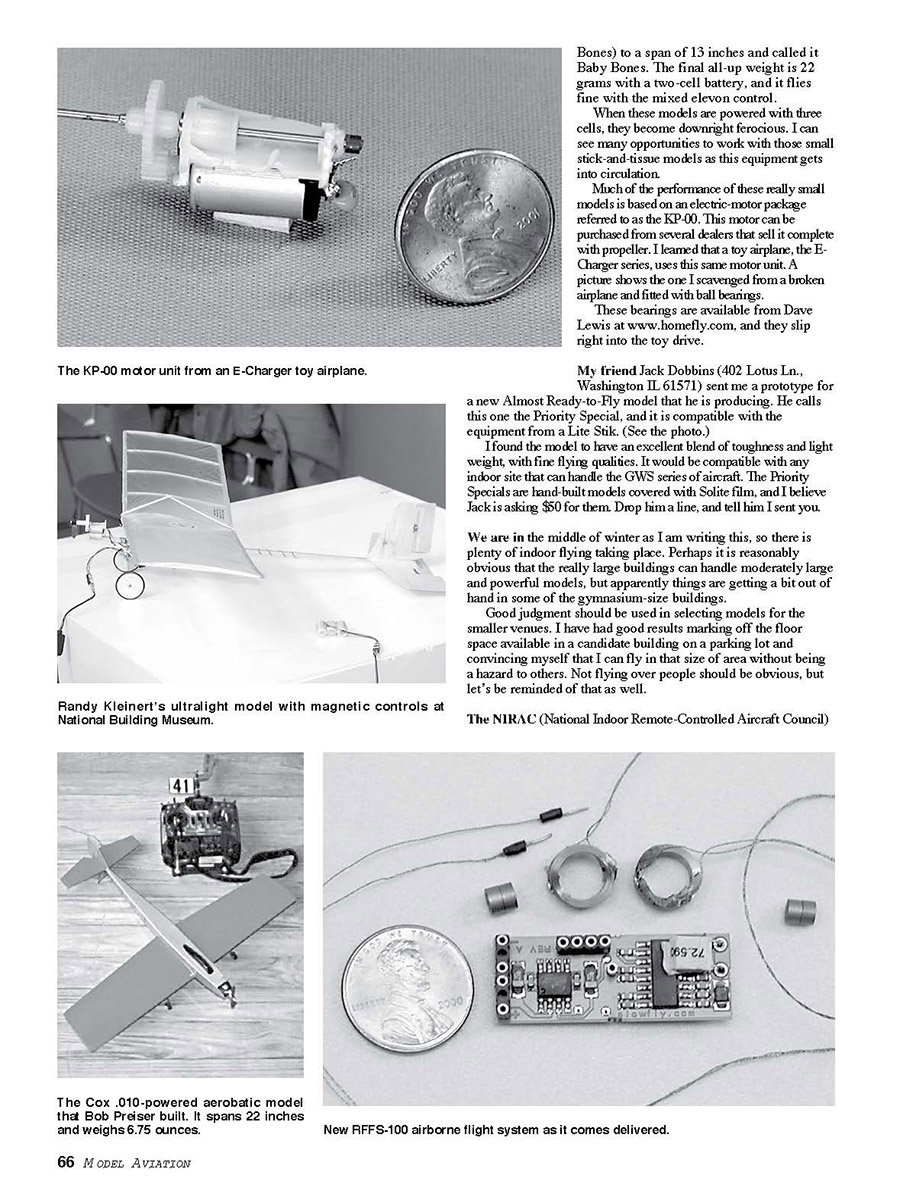
I rarely get excited about new equipment, but this month is different. In following on the Internet, I learned of a new airborne flight system that offers three-channel proportional control at a weight of only 3.75 grams without the battery. And it will operate on as few as two Ni-Cd cells. This system is called the RFFS-100, and it uses proportional magnetic servos to operate the controls.
A photo shows the RFFS-100 system as it comes delivered. Clarence Hurd, the designer, also designed a cute, little all-balsa model — the Skeeter — that is intended for use with this system, and it flies at a weight as low as 7/8 ounce. A set of Skeeter plans comes with each order.
More information is available from Dynamics Unlimited, 2814 Cold Springs Rd., Baldwinsville NY 13027; Web site: www.slowfly.com. Another dealer is American FunFly Co. at Box 2673, Syracuse NY 13220; Web site: www.americanfunfly.com. The list price for this goodie is $129.95.
To meet the deadline for this department, Mr. Hurd was kind enough to interrupt his vacation to send me a system from the first production run. Since it clearly can handle the typical, stable three-channel model, I decided to give the system a bit of a challenge.
As shown, I scaled down one of my designs (a delta — Mr. Bones) to a span of 13 inches and called it Baby Bones. The final all-up weight is 22 grams with a two-cell battery, and it flies fine with the mixed elevon control.
When these models are powered with three cells, they become downright ferocious. I can see many opportunities to work with those small stick-and-tissue models as this equipment gets into circulation.
Much of the performance of these really small models is based on an electric-motor package referred to as the KP-00. This motor can be purchased from several dealers that sell it complete with propeller. I learned that a toy airplane, the E-Charger series, uses this same motor unit. A picture shows the one I scavenged from a broken airplane and fitted with ball bearings.
These bearings are available from Dave Lewis at www.homefly.com, and they slip right into the toy drive.
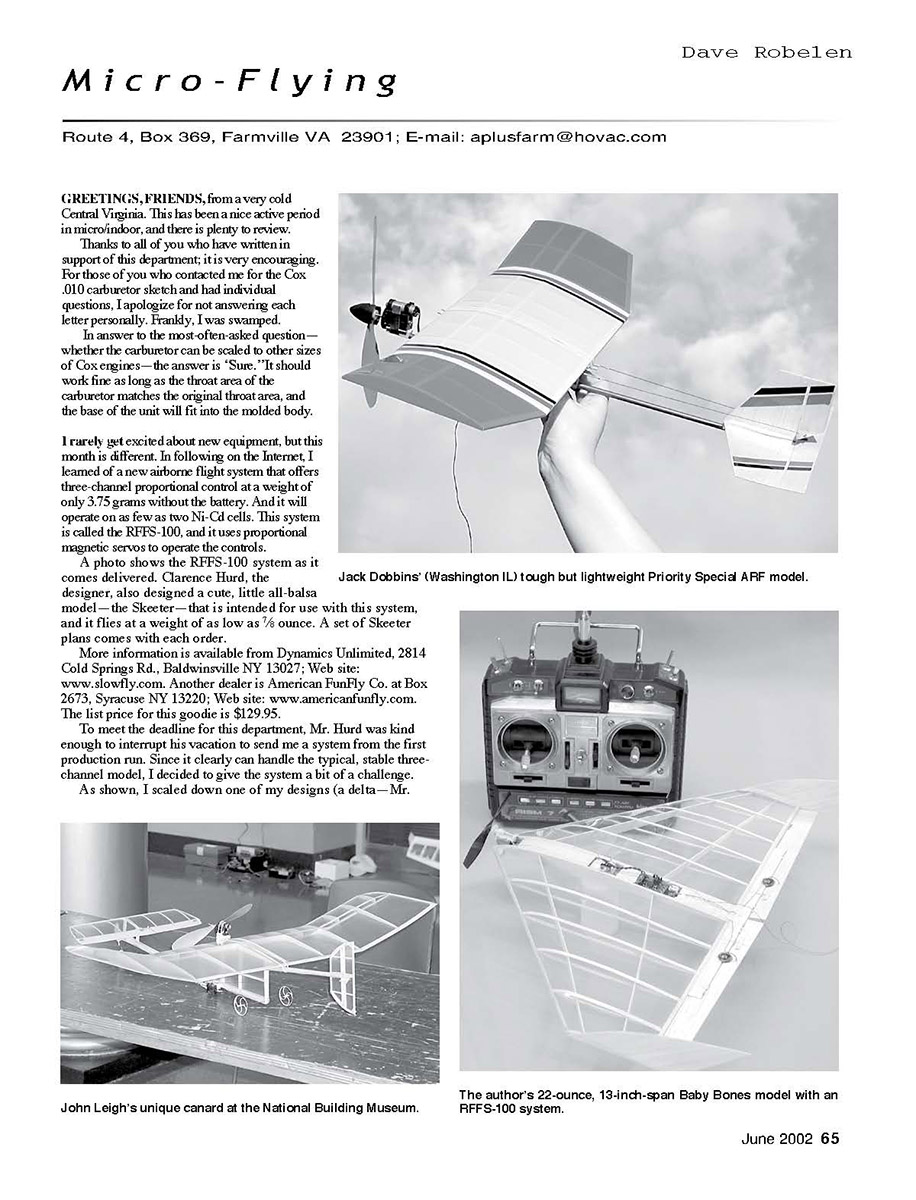
My friend Jack Dobbins (402 Lotus Ln., Washington IL 61571) sent me a prototype for a new Almost Ready-to-Fly model that he is producing. He calls this one the Priority Special, and it is compatible with the equipment from a Lite Stik. (See the photo.)
I found the model to have an excellent blend of toughness and light weight, with fine flying qualities. It would be compatible with any indoor site that can handle the GWS series of aircraft. The Priority Specials are hand-built models covered with Solite film, and I believe Jack is asking $50 for them. Drop him a line, and tell him I sent you.
We are in the middle of winter as I am writing this, so there is plenty of indoor flying taking place. Perhaps it is reasonably obvious that the really large buildings can handle moderately large and powerful models, but apparently things are getting a bit out of hand in some of the gymnasium-size buildings.
Good judgment should be used in selecting models for the smaller venues. I have had good results marking off the floor space available in a candidate building on a parking lot and convincing myself that I can fly in that size of area without being a hazard to others. Not flying over people should be obvious, but let's be reminded of that as well.
The NIRAC (National Indoor Remote-Controlled Aircraft Council) organization is sponsoring the first indoor national RC meet to be held in Muncie IN July 9, 2002. Contact Bob Wilder, NIRAC president, at 1105 Hidden Oaks Ct., Collegeville TX 76084; Tel: (817) 498-6316. This will be a combined competition and fly-in, so please contact Bob for details.
I received a nice letter from Bobbie C. Gamble (708 E. Clay St., Box 73, Bowie TX 76230) that described a very useful tip I am going to quote Bobbie on this one.
I realize we get as much from this hobby by helping others as we do from receiving help and ideas from other modelers, so I would like to pass a little hint on to you. I live 50 miles from the closest hobby shop and frequently recycle items for R/C use — like everyone else.
I have disassembled a butane stove lighter and found the small tubing that moves the butane from the can to the tip is ideal for filling small tanks, and it has a small fitting that fits small tubing as a bonus.
I even cut off the rear portion of the thing, using a Dremel to crack out the inside of a three-inch butt piece, and after heating it with a heat gun and several trips later, I had a snug housing for a .400 electric motor — a couple of air holes to match the motor cooling slots, and the unit was complete. I used a couple of small screws inside the rear to mount it to the plywood firewall. It looks sorta like Rudolph, the red-nosed reindeer, since the lighter had a red handle, but it works.
Thanks for the tip, Bobbie.
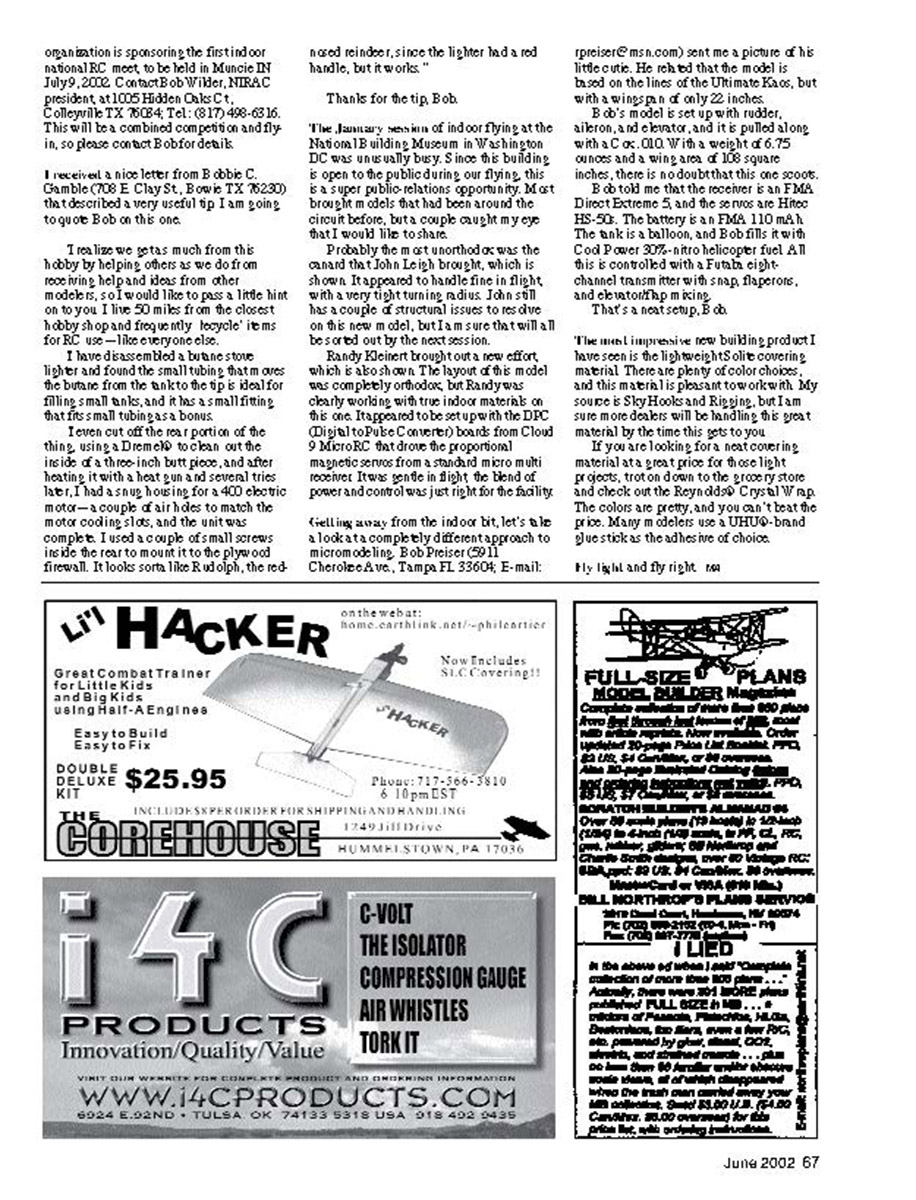
The January season of indoor flying at the National Building Museum in Washington, DC was unusually busy. Since the building is open to the public during our flying, this is a superb public-relations opportunity. Most brought models that had been around the circuit before, but a couple caught my eye that I would like to share.
Probably the most unorthodox was the canard that John Leigh brought, which is shown. It appeared to handle fine in flight, with a very tight turning radius. John still has a couple of structural issues to resolve on his new model, but I am sure that will all be sorted out by the next session.
Randy Kienert brought out a new effort, which is also shown. The layout of this model was completely orthodox, but Randy was clearly working with true indoor materials on this one. He appeared to be set up with the DPC (Digital to Pulse Converter) boards from Cloud 9 MicroRC that drove the proportional magnetic servos from a standard micro multi-receiver. The servo in flight trim and the power and control was just right for the facility.
Getting away from the indoor bit, let's take a look at a completely different approach to micromodeling. Bob Preiser (5911 Cherokee Ave., Tampa FL 33604; E-mail: rpreiser@msn.com) sent me a picture of his little cutie. He noted that the model is based on the lines of the Ultimate Cessna 103, but with a wingspan of only 22 inches.
Bob's model is set up with rudder, aileron, and elevator, and it is pulled along with a Cox .049. With a weight in a wind-tunnel of 6.75 ounces and a wing area of 108 square inches, there is no doubt that this one scoots.
Bob told me that the receiver is an FM8, Direct Extreme 5, and the servos are Hitec HS-50s. The battery is an FMA 110 mAh. The tank is a balloon, and Bob fills it with Cool Power 30% nitro helicopter fuel. And this is controlled with a Futaba eight-channel transmitter with snap, flaperons, and elevator/thp mixing.
That's a neat setup, Bob.
The most impressive new building product I have seen is the lightweight Solite covering material. There are plenty of color choices and this material is pleasant to work with. My source is SkyHooks and Rigging, but I am sure more dealers will be handling this great material by the time this gets to you.
If you are looking for re-covering materials at a great price for those light projects, trot on down to the grocery store and check out the Reynolds® Crystal Wrap. The colors are pretty, and you can't beat the price. Many modelers use a UHU®-brand type glue stick as the adhesive of choice.
Fly light and fly right. RA
Transcribed from original scans by AI. Minor OCR errors may remain.