Flying for Fun
D.B. Mathews 909 N. Maize Rd., Townhouse 734, Wichita KS 67212
A FAIRLY RECENT program on The History Channel related an incident from D-Day (June 6, 1944) involving Brigadier General Donald F. Pratt and his dream of being the first Allied soldier to set foot in France that morning. His was to be the first glider to touch down in the predawn hours at the beginning of the assault.
General Pratt opted to have a specially reinforced floor installed in a WACO CG-4 glider so he could drive a Jeep® straight out the lifted nose onto the field with guns blazing.
In the dark the glider crashed into a hedgerow, ejecting the general from his Jeep® and killing him instantly. So rather than being the first US soldier on the ground, he was the first dead man and highest-ranking officer to be killed during the D-Day invasion.
What price glory?
Twilight Zone: Those of you who have read this column for many years are probably aware of the strange coincidences I often encounter when preparing it.
Following is another.
Among the newsletters so kindly sent to me is one from the Michigan Antique Modelers, edited by Carl Spielmaker. Recently Carl featured photos and text describing a 1/4-scale WACO CG-4 that Tim Sarber of Cedar Springs, Michigan built to be used as a static overhead display in a new Meijer superstore in Greenville, Michigan.
I thought this model-building project would be of interest to readers, and I contacted Carl to borrow the photos. When they arrived, they were digital and of insufficient quality to use in the column. Hoping to locate better-quality pictures, Carl had to become a detective for several months to locate Tim Sarber's address; Tim sent not only photos but a large packet of information.
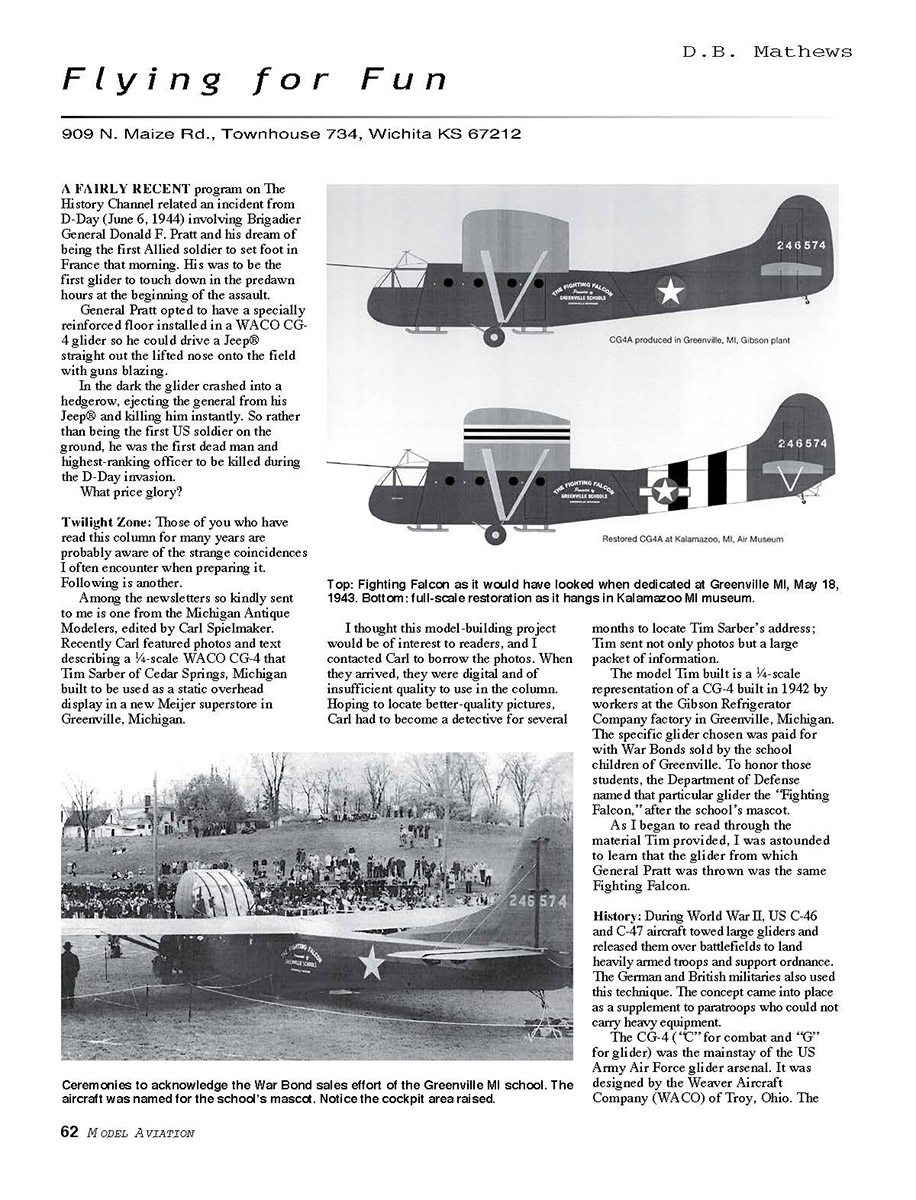
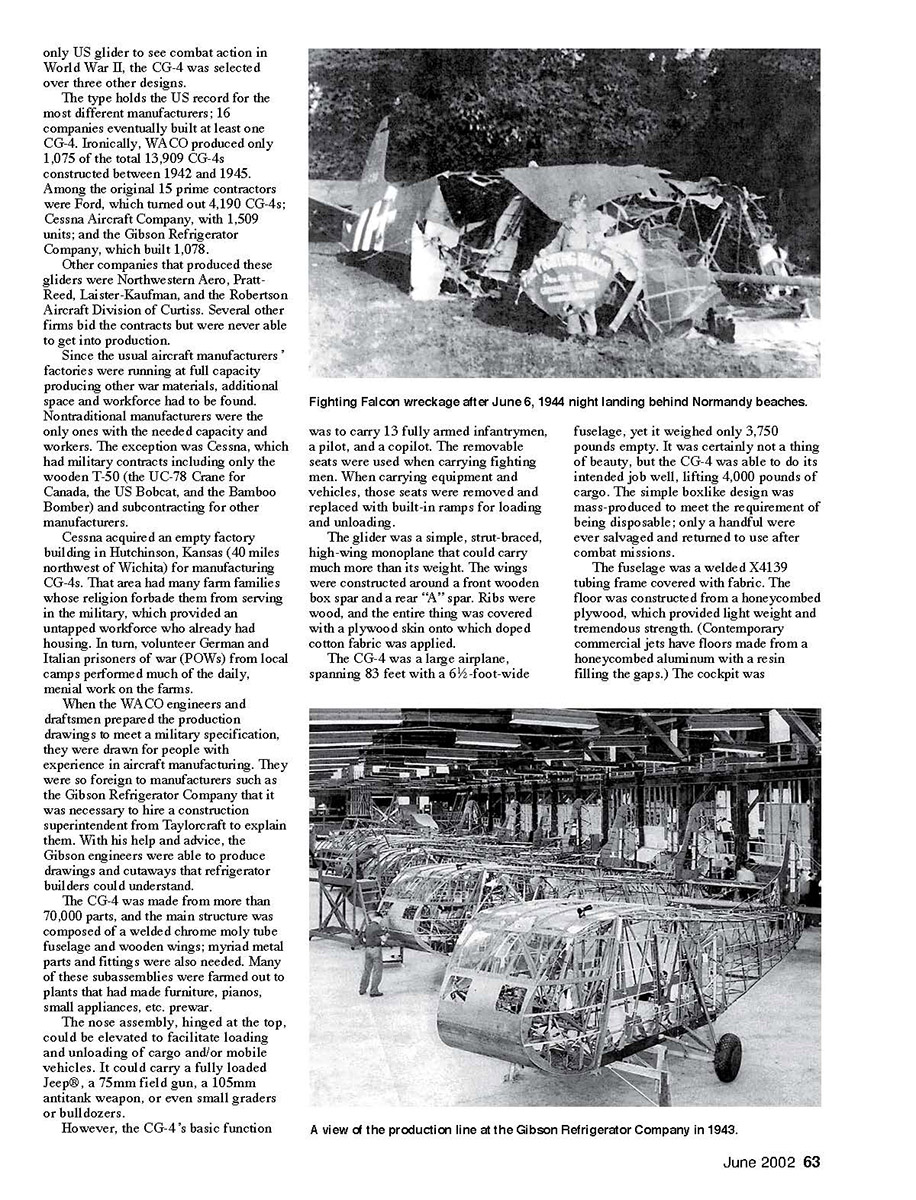
The model Tim built is a 1/4-scale representation of a CG-4 built in 1942 by workers at the Gibson Refrigerator Company factory in Greenville, Michigan. The specific glider chosen was paid for with War Bonds sold by the school children of Greenville. To honor those students, the Department of Defense named that particular glider the "Fighting Falcon," after the school's mascot.
As I began to read through the material Tim provided, I was astounded to learn that the glider from which General Pratt was thrown was the same Fighting Falcon.
History: During World War II, US C-46 and C-47 aircraft towed large gliders and released them over battlefields to land heavily armed troops and support ordnance. The German and British militaries also used this technique. The concept came into place as a supplement to paratroops who could not carry heavy equipment.
The CG-4 ("C" for combat and "G" for glider) was the mainstay of the US Army Air Force glider arsenal. It was designed by the Weaver Aircraft Company (WACO) of Troy, Ohio. The only US glider to see combat action in World War II, the CG-4 was selected over three other designs.
The type holds the US record for the most different manufacturers; 16 companies eventually built at least one CG-4. Ironically, WACO produced only 1,075 of the total 13,909 CG-4s constructed between 1942 and 1945. Among the original 15 prime contractors were Ford, which turned out 4,190 CG-4s; Cessna Aircraft Company, with 1,509 units; and the Gibson Refrigerator Company, which built 1,078.
Other companies that produced these gliders were Northwestern Aero, Pratt-Reed, Laister-Kaufman, and the Robertson Aircraft Division of Curtiss. Several other firms bid the contracts but were never able to get into production.
Since the usual aircraft manufacturers' factories were running at full capacity producing other war materials, additional space and workforce had to be found. Nontraditional manufacturers were the only ones with the needed capacity and workers. The exception was Cessna, which had military contracts including only the wooden T-50 (the UC-78 Crane for Canada, the US Bobcat, and the Bamboo Bomber) and subcontracting for other manufacturers.
Cessna acquired an empty factory building in Hutchinson, Kansas (40 miles northwest of Wichita) for manufacturing CG-4s. That area had many farm families whose religion forbade them from serving in the military, which provided an untapped workforce who already had housing. In turn, volunteer German and Italian prisoners of war (POWs) from local camps performed much of the daily, menial work on the farms.
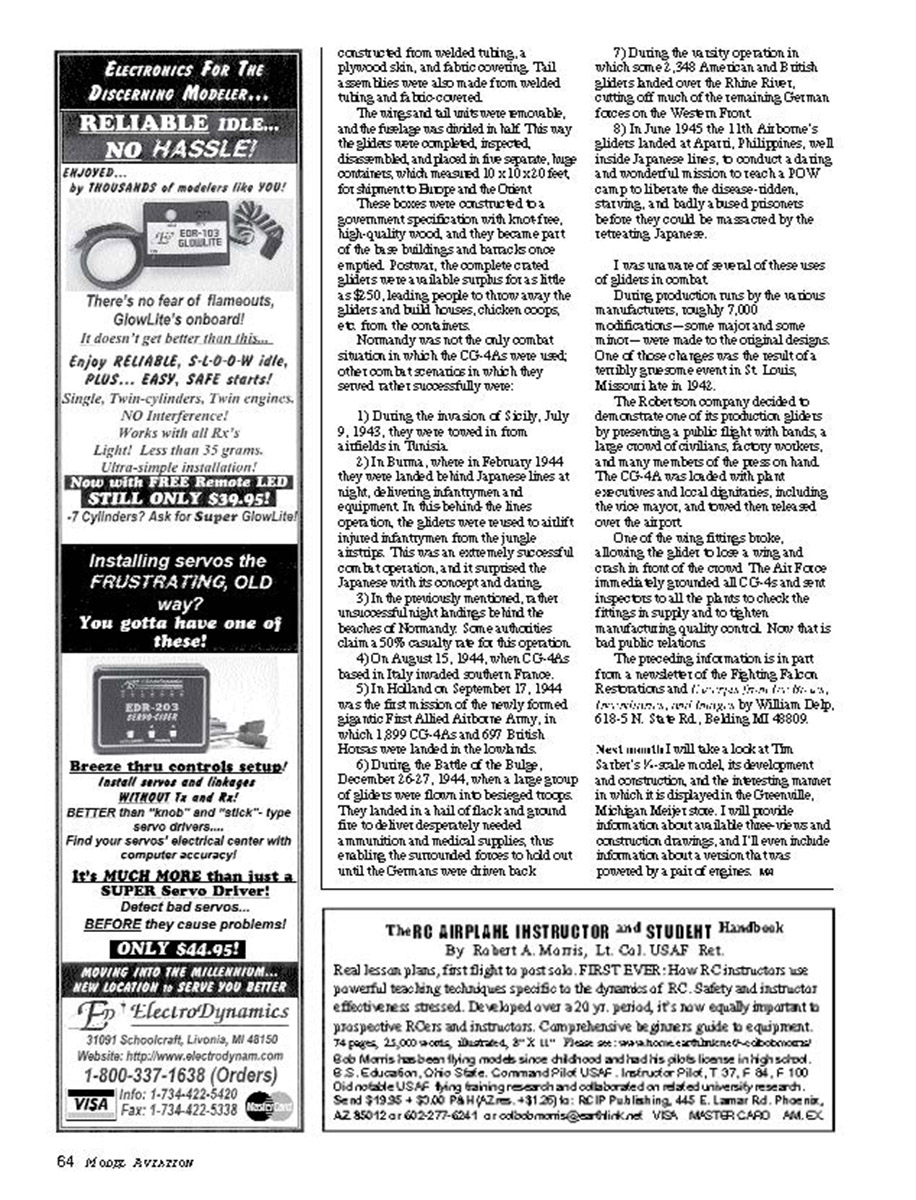
When the WACO engineers and draftsmen prepared the production drawings to meet a military specification, they were drawn for people with experience in aircraft manufacturing. They were so foreign to manufacturers such as the Gibson Refrigerator Company that it was necessary to hire a construction superintendent from Taylorcraft to explain them. With his help and advice, the Gibson engineers were able to produce drawings and cutaways that refrigerator builders could understand.
The CG-4 was made from more than 70,000 parts, and the main structure was composed of a welded chrome moly tube fuselage and wooden wings; myriad metal parts and fittings were also needed. Many of these subassemblies were farmed out to plants that made furniture, pianos, small appliances, etc.
The nose assembly, hinged at the top, could be elevated to facilitate loading and unloading of cargo and/or mobile vehicles. It could carry a fully loaded Jeep®, a 75mm field gun, a 105mm antitank weapon, or even small graders or bulldozers.
However, the CG-4's basic function was to carry 13 fully armed infantrymen, a pilot, and a copilot. The removable seats were used when carrying fighting men. When carrying equipment and vehicles, those seats were removed and replaced with built-in ramps for loading and unloading.
The glider was a simple, strut-braced, high-wing monoplane that could carry much more than its weight. The wings were constructed around a front wooden box spar and a rear "A" spar. Ribs were wood, and the entire thing was covered with a plywood skin onto which doped cotton fabric was applied.
The CG-4 was a large airplane, spanning 83 feet with a 6½-foot-wide fuselage, yet it weighed only 3,750 pounds empty. It was certainly not a thing of beauty, but the CG-4 was able to do its intended job well, lifting 4,000 pounds of cargo. The simple boxlike design was mass-produced to meet the requirement of being disposable; only a handful were ever salvaged and returned to use after combat missions.
The fuselage was a welded X4139 tubing frame covered with fabric. The floor was constructed from a honeycombed plywood, which provided light weight and tremendous strength. (Contemporary commercial jets have floors made from a honeycombed aluminum with a resin filling the gaps.) The cockpit was constructed from welded tubing, a plywood skin, and fabric covering. Tail assemblies were also made from welded tubing and it was fabric-covered.
The wings and tail units were removable, and the fuselage was divided in half. This way the gliders were completed, inspected, disassembled, and placed in five separate, huge containers, which measured 10 x 10 x 20 feet, for shipment to Europe and the Orient.
These boxes were constructed to a government specification, with knot free, high-quality wood, and they became part of the base buildings and barracks once emptied. Postwar, the complete crated gliders were available surplus for as little as $25.50, leading people to throw away the gliders and build houses, chicken coops, etc. from the containers.
Normandy was not the only combat situation in which the CG-4As were used; combat scenarios in which they served rather successfully were:
- During the invasion of Sicily, July 9, 1943, they were towed in from airfields in Tunisia.
- In Burma, where in February 1944 they were landed behind Japanese lines at night, delivering infantrymen and equipment. In this behind-the-lines operation, the gliders were used to airlift injured infantrymen from the jungle airstrips. This was an extremely successful combat operation, and it surprised the Japanese with its concept and daring.
- In the previously mentioned, rather unsuccessful night landings behind the beaches of Normandy. Some authorities claim a 50% casualty rate for this operation.
- On August 15, 1944, when CG-4As based in Italy invaded southern France.
- In Holland on September 17, 1944 was the first mission of the newly formed gigantic First Allied Airborne Army, in which 1,899 CG-4As and 697 British Horsa were landed in the lowlands.
- During the Battle of the Bulge, December 26-27, 1944, when a large group of gliders were flown into besieged troops. They landed in a hail of flak and ground fire to deliver desperately needed ammunition and medical supplies, thus enabling the surrounded forces to hold out until the Germans were driven back.
- During the vastity operation in which some 2,348 American and British gliders landed over the Rhine River, cutting off much of the remaining German forces on the Western Front.
- In June 1945 the 11th Airborne's gliders landed at Aparri, Philippines, well inside Japanese lines, to conduct a daring and wonderful mission to reach a POW camp to liberate the disease-ridden, starving, and badly abused prisoners before they could be massacred by the retreating Japanese.
I was unaware of several of these uses of gliders in combat.
During production runs by the various manufacturers, roughly 7,000 modifications—some major and some minor—were made to the original designs. One of those changes was the result of a terribly gruesome event in St. Louis, Missouri late in 1944.
The Robertson company decided to demonstrate one of its production gliders by presenting a public flight with bands, a large crowd of civilians, factory workers, and many members of the press on hand. The CG-4A was loaded with plant executives and local dignitaries, including the vice mayor, and towed then released over the airport.
One of the wing fittings broke, allowing the glider to lose a wing and crash in front of the crowd. The Air Force immediately grounded all CG-4As and sent inspectors to all the plants to check the fittings in supply and to tighten manufacturing quality control. Now that is bad public relations.
The preceding information is in part from a newsletter of the Fighting Falcon Restorations and from personal correspondence with the late William Deh, 618 S. N. State Rd., Belding MI 48809.
Transcribed from original scans by AI. Minor OCR errors may remain.