FREE FLIGHT DURATION
Louis Joyner, 6 Saturday Rd., Mt. Pleasant SC 29464
SUPER MAX
It's not a cartoon superhero, but part of the new rules changes for the larger Fédération Aéronautique Internationale (FAI) events F1A Towline Glider, F1B Wakefield Rubber, and F1C Power. Simply stated, the rules permit a longer-than-normal maximum flight time, called a super max, for the first round and possibly during other rounds of the contest. But the full flight time only counts if you make the traditional three-minute max on all seven rounds.
In a way, it is a provisional first flyoff round done at the beginning of the contest. It only counts if you max all the regular rounds. The time in excess of three minutes is only used to break a tie. (FAI rules can be viewed and downloaded from the FAI Web site at www.fai.org/aeromodelling.)
The first-round super max for F1A is four minutes; for F1B and F1C, it is five minutes. (As with any other maximum during any FAI Free Flight contest, the length of the super max can be changed prior to the start of the round because of exceptional meteorological conditions or model-recovery problems. Most of us are familiar with maxes being cut from three minutes to two minutes when wind speed increases and causes a larger number of models to go off the field.)
In the past, the first-round maximum has been slightly longer than the three minutes specified for rounds two through seven. Under the old system of scoring, your entire time on the first round counted, even if you dropped below the three-minute maximum on any flights in rounds two through seven.
Under the new system, you have to make a minimum of three minutes on each round for the first-round time in excess of three minutes to count. In a way, it is like making the flyoff; you can't do it if you don't max every round.
Following is one example, of flying F1C with a five-minute first round followed by six three-minute rounds. Flier A makes the five-minute first round but drops 12 seconds on his seventh-round flight. Since he didn't make the three-minute minimum on all his flights, only 180 seconds of his first-round score would be counted. Flier A ends up with a total of 1,248 seconds.
Flier B drops 12 seconds in the first round but makes the three-minute max on all his other flights. Therefore, he does get to count his full time in the first round. Flier B ends up with a score of 1,368.
Flier C drops 20 seconds in the first round then maxes the remaining rounds. Flier D drops 30 seconds in the first round then maxes the rest. Counting just the three-minute basic maximum, both fliers would be tied at 1,260. Since there is a tie, the times in excess of three minutes in the first-round super max is counted to resolve the tie. Flier C ends up with a total score of 1,360, and Flier D gets a total of 1,350 seconds.
Fliers E and F make the five-minute first-round max, and they max in all subsequent rounds. They end up tied at 1,380. They would fly a five-minute flyoff to determine the winner. If they both made that, they would go for seven minutes, then nine minutes, etc. (The new rules do not affect the flyoff procedure—only who gets to be in it.)
The rules state that the new duration of flight rules apply to world and continental championships. They are also to be used for other international events unless different durations have been announced in advance and approved by CIAM (International Aeromodelling Commission) for specific rounds. (In the United States, the only international events are the two World Cup contests: the Sierra Cup in the fall and the Max Men in February.)
Also, the rule allows additional super maximums to be added during the contest in anticipation of bad weather or other problems later in the contest. It allows the jury to increase the maximum for any round—even flyoffs. (The jury already had the option to reduce maximums.) The duration of the maximum must be announced before the start of the round affected.
The new rules require consistency and reward performance. The super-maximum times are set high enough that you need a well-adjusted, well-flown model to make them, yet they are not unrealistically high.
For the flier, the new rules mean that you must pay attention to announcements from the contest organizers and be ready to quickly set your model's timer for the stated max. (If you drop below the three-minute basic max on any flight, you are not eligible for additional time by flying a super max. You can just keep plugging away flying threes.)
For the timer, you need to know what the maximum is for each round and record the total flight time if it is less than a super max. Depending on how the flier does in subsequent rounds, it may or may not be counted.
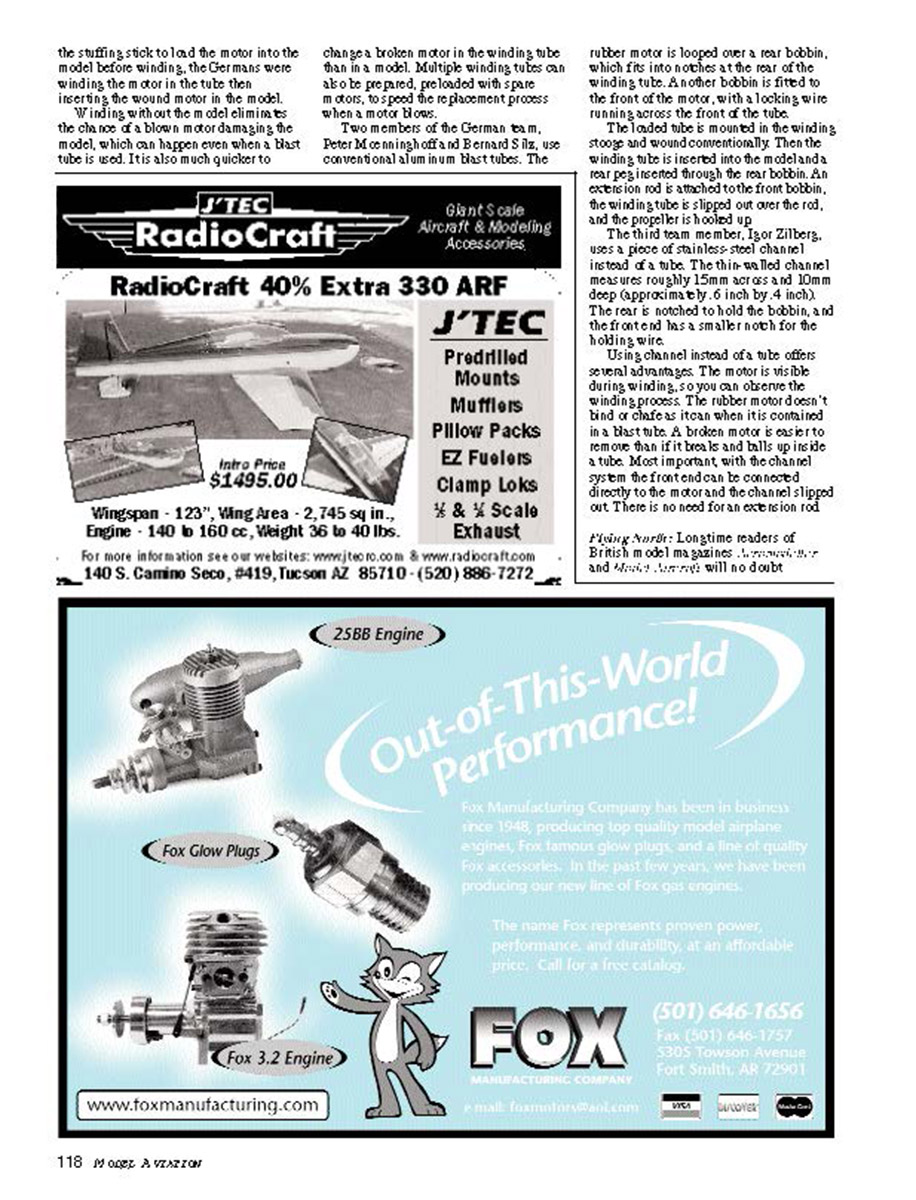
For the contest organizer, a bit more record-keeping is required. On the scoreboard you will need one line for the contestant's flight score, a second line for the running total of his or her basic time (e.g., 180 seconds for the first round), and a third line to show his or her extra time accumulation from the super-max rounds (e.g., 120 seconds for maxing a five-minute super-max round).
In the excellent discussion of the new rules in the February 2002 Free Flight News (FFN), Ian Kaynes and the CIAM FF Subcommittee suggest a simpler, color-coded system that only requires two lines for each flier on the scoreboard.
The suggestion is to use red to denote
Free Flight News
Since 1969 FFN has provided a monthly look at all aspects of the FAI Free Flight classes, including Indoor. Ian Kaynes' excellent plans and airfoil plots (done on his KPS software) are a regular feature, as are reports on all World Cup contests. Also included are an occasional Open Rubber plan and text articles about aerodynamics, thermal finding, model retrieval, and a variety of other items of interest to Free Flighters. FFN is a must-read for the serious FAI Free Flight modeler.
To subscribe, write to Ian at Free Flight News, 7 Ashley Rd., Farnborough, Hants, GU14 7EZ, England, or visit the Web site at http://ourworld.compuserve.com/homepage/kaynes/. A year's subscription is $38.
Winding Outside
At the last World Championships I visited with the three members of the German F1B team and watched their cartridge-loading system in operation. It is basically a variation of the familiar winding tube (also called a blast tube) that many Rubber modelers use to protect their motors from motors that break during winding (See July 2001 column for more about winding tubes).
But instead of using the winding tube as the stuffing stick to load the motor into the model before winding, the Germans were winding the motor in the tube then inserting the wound motor in the model.
Winding without the model eliminates the chance of a blown motor damaging the model, which can happen even when a blast tube is used. It is also much quicker to change a broken motor in the winding tube than in a model. Multiple winding tubes can also be prepared, preloaded with spare motors, to speed the replacement process when a motor blows.
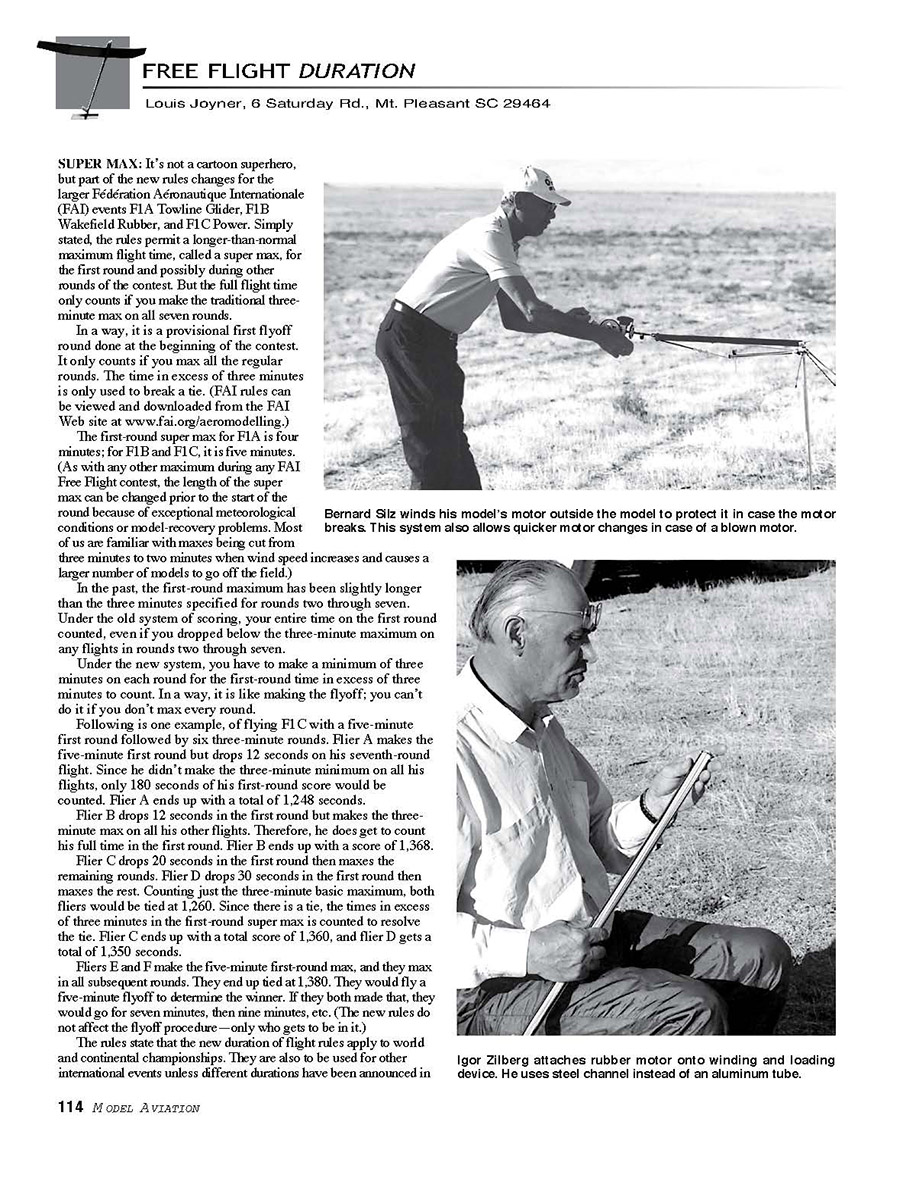
Two members of the German team, Peter Menninghoff and Bernard Siis, use conventional aluminum blast tubes. The rubber motor is looped over a rear bobbin, which fits into notches at the rear of the winding tube. Another bobbin is fitted to the front of the motor, with a locking wire running across the front of the tube.
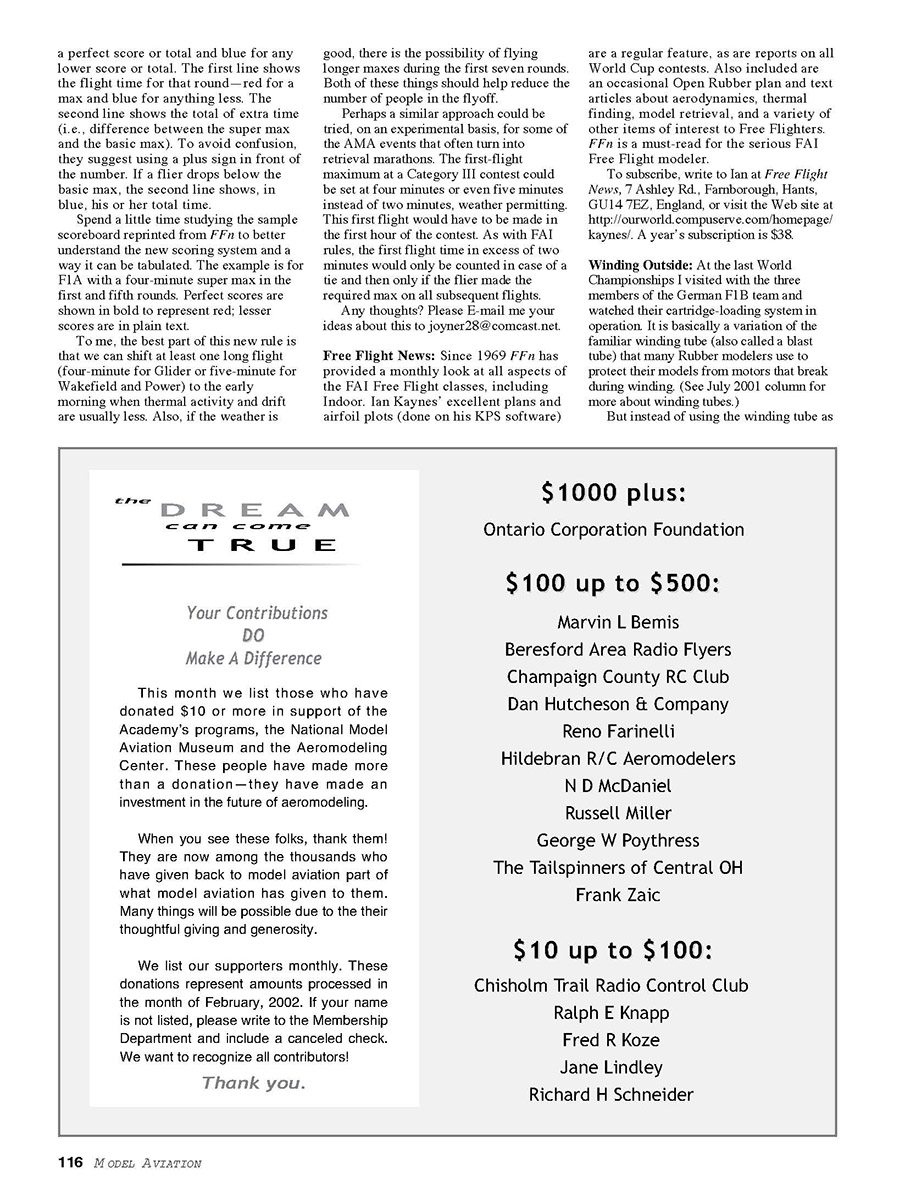
The loaded tube is mounted in the winding stage and wound conventionally. Then the winding tube is inserted into the model and a rear peg inserted through the rear bobbin. An extension rod is attached to the front bobbin, the winding tube is slipped out over the rod, and the propeller is hooked up.
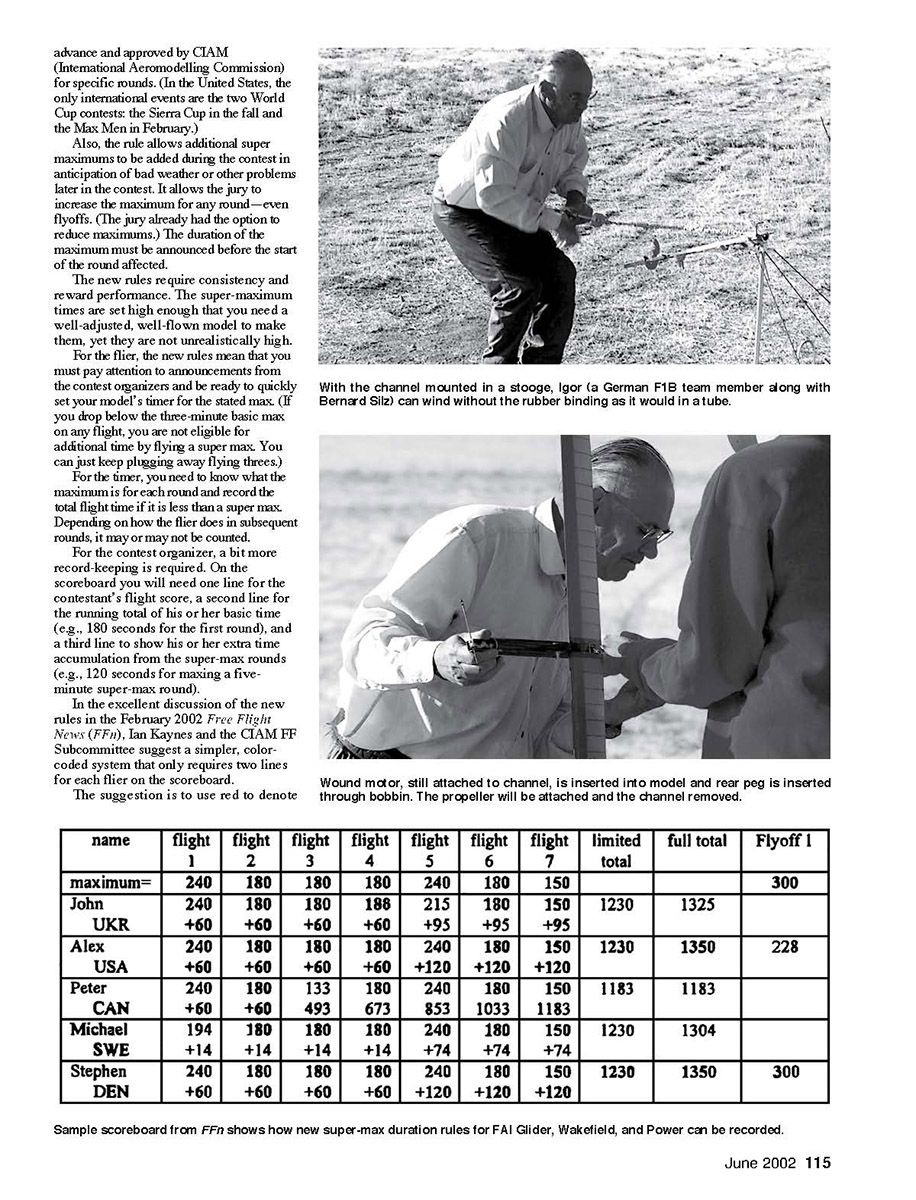
The third team member, Igor Zilberg, uses a piece of stainless-steel channel instead of a tube. The thin-walled channel measures roughly 15 mm across and 10 mm deep (approximately .6 inch by .4 inch). The rear is notched to hold the bobbin, and the front end has a smaller notch for the holding wire.
Using channel instead of a tube offers several advantages. The motor is visible during winding, so you can observe the winding process. The rubber motor doesn't bind or chafe as it can when it is confined in a blast tube. A broken motor is easier to remove than if it breaks and balls up inside a tube. Most important, with the channel system the front end can be connected directly to the motor and the channel slipped out. There is no need for an extension rod.
He was awarded the FAI's Antonov Diploma—the Federation's highest award for technical achievement. Among his contributions were pioneer work on rubber testing, the "Croydon method" of tube winding, and a variety of approaches to thermal detection.
He shared all of these ideas and more with readers of British modelling magazines and subscribers to FF. Although his published designs may not be familiar to American readers, they include a number of Rubber models, Power models, and Gliders of all sizes. These and a number of previously unpublished models are reproduced in the book.
One design, Jack's 1956 Lightweight, looks like it would be a good design for the new Nostalgia Rubber event. The 40-inch-span model features sliced wing and stabilizer ribs and weighs in at only three ounces.
Professionally, Jack was an internationally known expert on high-speed aerodynamics and wind-tunnel techniques. His work with Schlieren photography of shock-wave–induced boundary layers was significant in the development of supersonic flight. This work led to many honors, including the DuPont Medal awarded by the Society of Motion Picture and Television Engineers.
Luckily, Jack kept notes, sketches, and photographs that date from the 1930s through the 1980s. These "show the way he worked via testing, measurements, innovation, simplification, and more testing, all carefully noted."
However, my favorite part of the book are the many reminiscences by Jack North's friends. Martin Dilly tells of his teen-age experiences riding to contests in the early 1950s on the back of Jack's Triumph motorcycle.
Martin goes on to tell of their longtime friendship and the typical way that Jack provided help. "If you were serious in wanting help or advice," wrote Martin, "I know of nobody who was more helpful. Even if people casually mentioned something that was puzzling them, a few days later, without fail, an envelope would arrive with carefully researched and annotated explanation or perhaps various solutions."
Peter King wrote, "I remember him as a great modeler, a great thinker, and a brilliant, if rather frightening man. He did not suffer fools gladly and could be scathing to anyone who he felt was wasting his time. In spite of his intimidating manner, you only had to ask Jack's advice and he would take time out to help you."
You can order a copy of Flying North from Martin Dilly, 20 Links Rd., West Wickham, Kent BR4 0XQ, UK. The cost is 21 pounds sterling (approximately $31). Checks should be payable to "BMFA F/F Team Support Fund," be in pounds sterling only, and drawn on a bank with a branch in Great Britain. An easier way to order is to use your credit card. Fax Martin at +44 (0)208-777-5533 with your credit-card information and mailing address. MA
Transcribed from original scans by AI. Minor OCR errors may remain.