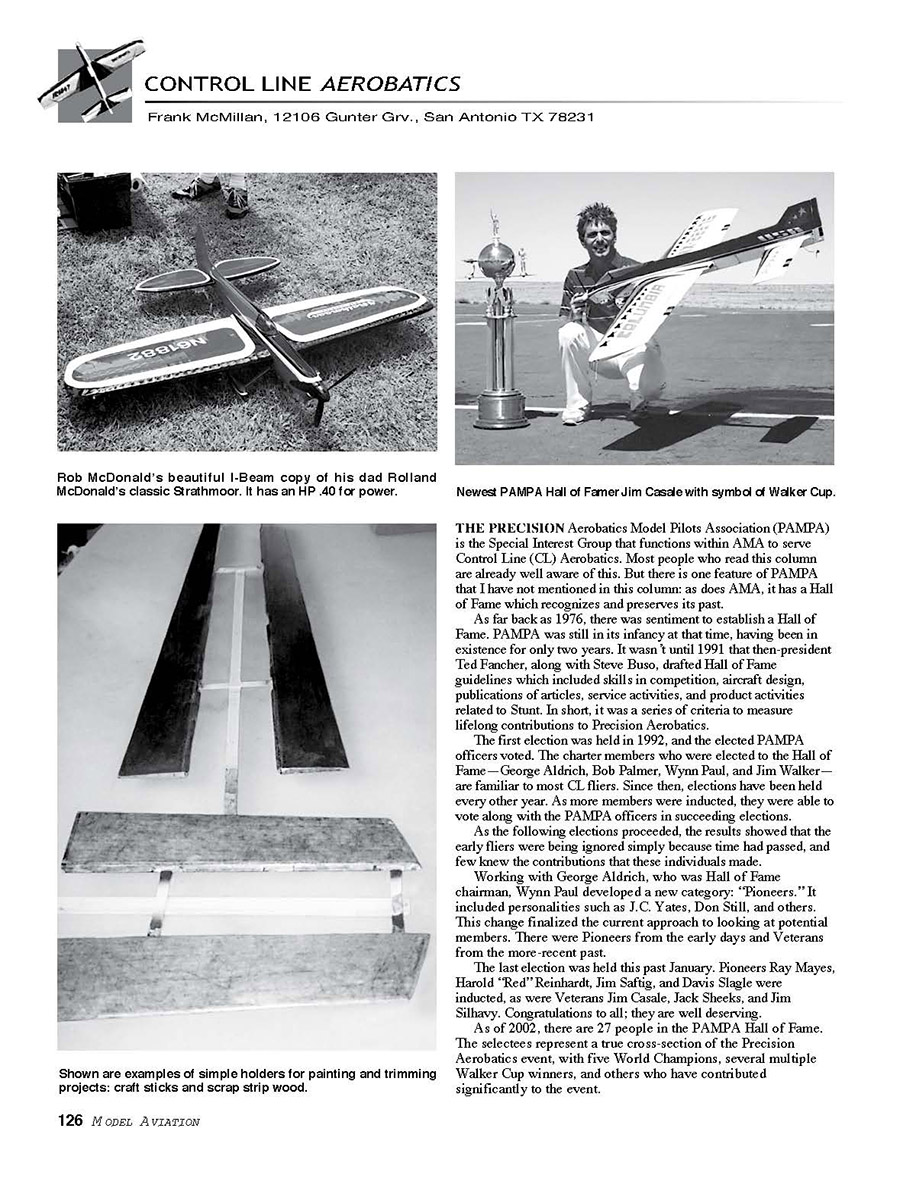
CL Aerobatics
THE PRECISION Aerobatics Model Pilots Association (PAMPA) is the Special Interest Group that functions within AMA to serve Control Line (CL) Aerobatics. Most people who read this column are already well aware of this. But there is one feature of PAMPA that I have not mentioned in this column: as does AMA, it has a Hall of Fame which recognizes and preserves its past.
As far back as 1976, there was sentiment to establish a Hall of Fame. PAMPA was still in its infancy at that time, having been in existence for only two years. It wasn't until 1991 that then-president Ted Fancher, along with Steve Buso, drafted Hall of Fame guidelines which included skills in competition, aircraft design, publications of articles, service activities, and product activities related to Stunt. In short, it was a series of criteria to measure lifelong contributions to Precision Aerobatics.
The first election was held in 1992, and the elected PAMPA officers voted. The charter members who were elected to the Hall of Fame—George Aldrich, Bob Palmer, Wynn Paul, and Jim Walker—are familiar to most CL fliers. Since then, elections have been held every other year. As more members were inducted, they were able to vote along with the PAMPA officers in succeeding elections.
As the following elections proceeded, the results showed that the early fliers were being ignored simply because time had passed, and few knew the contributions that these individuals made.
Working with George Aldrich, who was Hall of Fame chairman, Wynn Paul developed a new category, "Pioneers." It included personalities such as J. C. Yates, Don Still, and others. This change finalized the current approach to looking at potential members. There were Pioneers from the early days and Veterans from the more-recent past.
The last election was held this past January. Pioneers Ray Mayes, Harold "Red" Reinhardt, Jim Saftig, and Davis Slagle were inducted, as were Veterans Jim Casale, Jack Sheeks, and Jim Silhavy. Congratulations to all; they are well deserving.
As of 2002, there are 27 people in the PAMPA Hall of Fame. The selectees represent a true cross-section of the Precision Aerobatics event, with five World Champions, several multiple Walker Cup winners, and others who have contributed significantly to the event.
When I look back on more than 50 years of building Stunters, I marvel at the progress in the many technical areas. There are so many excellent products available that were developed specifically for Stunt. We use them and enjoy them. We even have sophisticated full competition models available, ready to fly—at a price.
As can be seen in other events, the trend is to allow commercially built models in open competition. Certainly, those with contacts who can develop and supply quality models favor this because there is money to be made. On the demand side, the lack of time and/or skill by many would probably fuel the market if the price was right.
My thoughts on the subject can rationalize the arguments. However, I am ever the traditionalist who still favors the requirement to build the model you fly. That is part of the event that I hope does not change. There is simply too much pleasure in feeling your last creation fly well.
While I reflected on my many years of building, the amazing thing was that I got the airplanes assembled. Typically, I was in such a rush to finish that I had to go back and correct something or install a part I forgot.
I'd read every article many times, but the most informative set of instructions was supplied in the old Veco Chief kit. The illustrations in the plans provided a logical sequence for assembling a good-flying model. The two that I built, 10 days start to fly, were my first successful Stunters. Even today, there is an original Chief kit sitting on my cabinet shelf waiting.
On the subject of the sequence of assembly, many approaches have been developed throughout the years. Each evolved to serve how the builder visualized that the construction should come together.
That is certainly a key point: the construction sequence can be a very personal thing. You must be comfortable with the methods you use if you are to be successful. This may seem a bit abstract, but developing fixtures or assembly sequences depends on your capabilities, and even the space in your workshop.
To take this further, no matter what model you build, you shouldn't just begin. This will lead to many potential errors or an attitude of "that's good enough." Whether a kit, from plans, or an original, you need to look at the design carefully. Do any areas pose potential problems in alignment or structure? You need to ask yourself, "Where do I start?" and "How will I do major alignments (wing, fuselage, final assembly, etc.)?" Those are critical points.
Recently I looked at an Old-Time design page provided by my friend Keith Troske. The design is graceful—a double-row wing with dihedral. As I considered how to construct the wing, looking at the rather flimsy construction I thought that I would have a difficult time without some type of fixture.
My philosophy when attacking each project is to do everything I can to ensure an accurate assembly and a good-flying airplane to that end. As Keith did, I'm going to cut-form alignment fixtures to build the wing. The fuselage is another story. I'm still thinking about a good approach. That's enough to get you going on the subject of looking at some of the components.
One point I've mentioned many times is building philosophy. Please consider that even the most basic CL Stunters are more than one-day, one-weekend, or one-week projects. You can have a much more successful project if you spend time up front planning your way through from start to finish.
Break the project down into items that can be accomplished separately. Assign some approximate times. This will give you an idea of what you can do within the time available each day.
As you complete pieces, bag them if possible, and have a storage place that is out of the way. A variety of plastic storage bags are great tools for storing all your completed parts. I use them for ribs, control-system components, hatches, and other pieces, such as bolts, that might have special lengths.
Many times I will work on several projects at a time, for convenience and to keep things going. By doing this, I also get to visualize the bits and pieces required and plan to acquire the parts I don't have. When I need them, I have them.
Transcribed from original scans by AI. Minor OCR errors may remain.