Small-Field Flying
Paul Bradley
32238 Spinnaker Run, Magnolia TX 77354; E-mail: bradleyp@ix.netcom.com
CELEBRATING THE Wright Brothers:
We are just around the corner from celebrating the 100th anniversary of the Wright brothers' first successful powered flight. A lot of water has passed under the aviation bridge since that momentous event.
If you have even the slightest interest in full-scale aviation, I'm sure you have read and/or heard about projects underway to commemorate the epic achievement of Orville and Wilbur Wright. The modeling community is no exception. Several members of this wonderful community have designed and built successful models of the various versions of the early Wright aircraft.
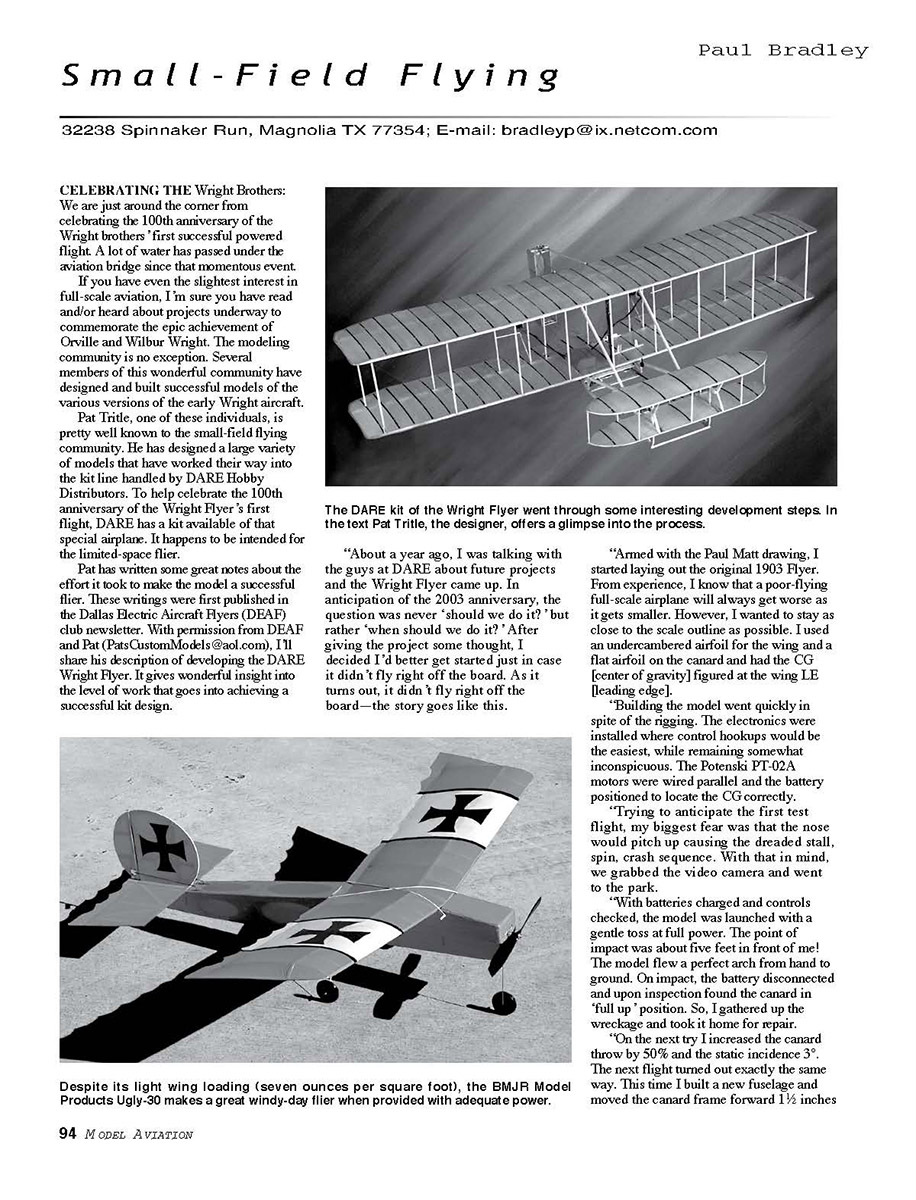
Pat Tritle, one of these individuals, is pretty well known to the small-field-flying community. He has designed a large variety of models that have worked their way into the kit line handled by DARE Hobby Distributors. To help celebrate the 100th anniversary of the Wright Flyer's first flight, DARE has a kit available of that special airplane. It happens to be intended for the limited-space flier.
Pat has written some great notes about the effort it took to make the model a successful flier. These writings were first published in the Dallas Electric Aircraft Flyers (DEAF) club newsletter. With permission from DEAF and Pat (PatsCustomModels@aol.com), I'll share his description of developing the DARE Wright Flyer. It gives wonderful insight into the level of work that goes into achieving a successful kit design.
"About a year ago, I was talking with the guys at DARE about future projects and the Wright Flyer came up. In anticipation of the 2003 anniversary, the question was never 'should we do it?' but rather 'when should we do it?' After giving the project some thought, I decided I'd better get started just in case it didn't fly right off the board. As it turns out, it didn't fly right off the board—the story goes like this.
"Armed with the Paul Matt drawing, I started laying out the original 1903 Flyer. From experience, I know that a poor-flying full-scale airplane will always get worse as it gets smaller. However, I wanted to stay as close to the scale outline as possible. I used an undercambered airfoil for the wing and a flat airfoil on the canard and had the CG [center of gravity] figured at the wing LE [leading edge].
"Building the model went quickly in spite of the rigging. The electronics were installed where control hookups would be the easiest, while remaining somewhat inconspicuous. The Potenski PT-02A motors were wired parallel and the battery positioned to locate the CG correctly.
"Trying to anticipate the first test flight, my biggest fear was that the nose would pitch up causing the dreaded stall, spin, crash sequence. With that in mind, we grabbed the video camera and went to the park.
"With batteries charged and controls checked, the model was launched with a gentle toss at half power. The point of impact was about five feet in front of me! The model flew a perfect arch from hand to ground. On impact, the battery disconnected and upon inspection found the canard in 'full up' position. So, I gathered up the wreckage and took it home for repair.
"On the next try I increased the canard throw by 50% and the static incidence 3°. The next flight turned out exactly the same way. This time I built a new fuselage and moved the canard frame forward 1½ inches in hopes of eliminating ineffectiveness of pitch control. This time the nose pitched up just long enough to get sufficient altitude to really tear things up on impact.
“This time I decided to review the video in slow motion. It turns out the nose wasn’t dropping, but the wing would actually rise up over the nose causing the arching flight path. Boy was I surprised! I know undercambered airfoils are speed sensitive, so I fixed the model again which was really getting ratty by now and rewired the motors to series in hopes of eliminating the problem.
“The first flight almost worked. The model sort of flailed its way to the ground in its first undamaged flight. So I increased the canard incidence to 6° and tried it again. This time it almost flew, but once again stalled and tucked, causing minor damage. I moved the CG back ¼ inch and tried it again. This time the nose pitched up, stalled, and fell sideways from 10 feet onto the wingtip and canard. The damage was so severe that fixing it was out of the question this time.
“By now it was obvious that the basic design was flawed, so I decided to go with a flat-bottom wing and undercambered canard. The second P-type was built, motors wired in series, and the rest of the setup the same as the first attempts.
“Meanwhile, something about the design still bothered me, but I just didn’t know what it was. So, I put it aside for what turned out to be about a month to think it over. Finally, I decided to build a 1/3-scale model of the model and see what happened. I built the glider using the same setup as the RC (Radio Control) model.
“During the trimming process I didn’t get three good glides in over 50 tosses. The model was completely unpredictable and hypersensitive to any change in trim or CG. The most interesting part was that all the problems occurred only in the pitch axis. In roll it was dead stable (hmmm).
“After all that, the model proved itself virtually unflyable. So, I decided to try enlarging the canard 25%. After a fair amount of diddling with the CG (until it was back up to the LE), all of the instability was gone! By now the glider actually flew great. So, I built a new canard, installed it on the RC model, moved the CG back up to the LE, and set the canard to 2° positive.
“The first launch proved the canard to be effective with good stability, but the model didn’t have enough power to maintain altitude. Just to be sure, I tried it again with the same results. Basically it was 60 feet from launch to touch down—twice! So, I rewired the motors back to parallel and tried it again.
“At this point, the model was basically flyable, but out of pitch trim. Through a series of short flights, the canard neutral trim was reduced to ½° positive. By now, the model was not only flyable, but actually flew very well.
“After 15 or so flights, I’ve got the launching sequence figured out and am really beginning to feel comfortable with the model. I also discovered that due to prop torque the Flyer turns much better right than left. Knowing about its quirks and avoiding those things, the Flyer really is fun to fly.
“In retrospect, this project has been the most challenging and rewarding one yet. There was a time when I wasn’t sure it was even doable, but as they say, ‘all’s well that ends well.’
“Meanwhile, while all that was going on, I got to thinking about the Wright brothers and all the head-scratching required to design and build a machine to do something that had never been done, using a machine that had previously never existed—and then having to teach themselves to fly the untested machine while they were testing it to prove it would work.
"And we think our lives are tough! You can't help but respect the ingenuity and tenacity of those two guys and what they accomplished almost 100 years ago."
Many thanks to Pat for sharing his Wright Flyer development process with us.
Windy-Weather Flying:
The DARE Wright Flyer represents one of the favored types of small-field models: those that are lightly loaded and fly slow. A common problem for this kind of model is flying when the wind starts to blow. When wind speeds get much higher than five miles per hour, the slow-flying models tend to get grounded. I don't know about the area where you live, but when I want to fly one of my models the wind is usually a bit stronger than five miles per hour.
Fortunately, models suitable for flying in smaller spaces can be pretty good windy-weather models. Even though they are lightly loaded and usually on the smaller side, it is possible to operate them in wind conditions not only exceeding five miles per hour, but even as high as 15 miles per hour.
That may seem to be a bold statement, so let's explore the characteristics of some small-field flyers that can handle windy conditions.
What are some factors that distinguish a model as a suitable windy-weather flier? I don't claim to know all the answers, but in discussing the subject with experienced modelers the following factors seem most important:
- Available power
- Control response
- Wing loading
This list seems straightforward and is relatively easy to evaluate for a candidate model. It is hard to put the items in a particular order of priority; as they are shown, you get an idea of my sense of relative importance. Pilot skill is not listed but is an important overall factor. Windy weather flying is usually best left to pilots who have mastered the basics of flying and can react by instinct to rapidly changing situations.
Let's look at three models I have found to be excellent windy-weather fliers. These airplanes represent a good range of the types of models most commonly used for small-field flying.
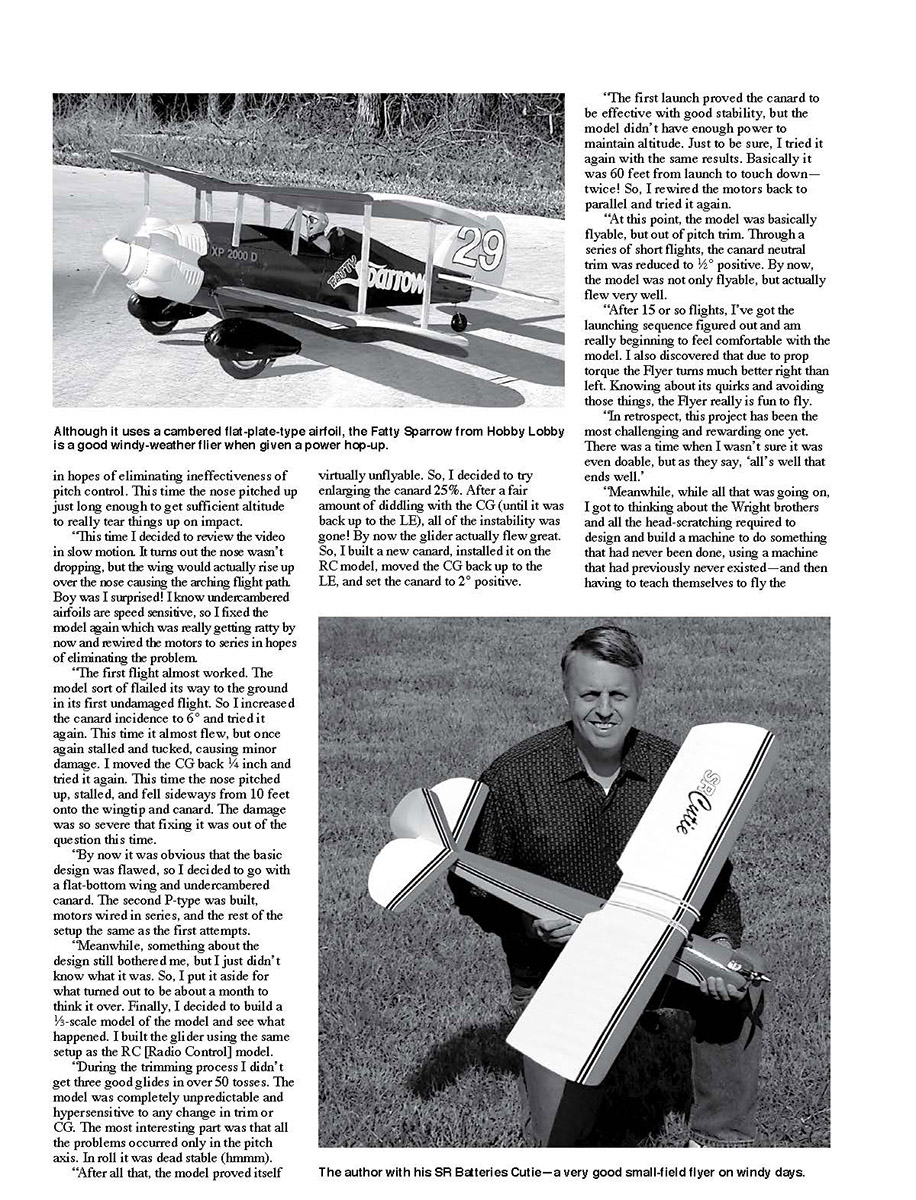
First is the BMR Model Products Ugly 30, which is a built-up balsa model with roots as a rubber-powered Free Flight aircraft. It is electric powered and has a relatively light wing loading (seven ounces per square foot). On the surface, you might not think it would not do well in the wind. The key to making this type of model a good windy-day flier is available power. When given adequate power, the Ugly-30 can be flown in winds higher than 15 miles per hour.
The model in the photo is powered with a Dick Miller MC-1 motor, which is a geared motor package that can turn a seven inch propeller with authority. As a result, it is a blast to fly on a windy day. The MC-1 motor and gear set is available from Penn Valley Hobby Center.
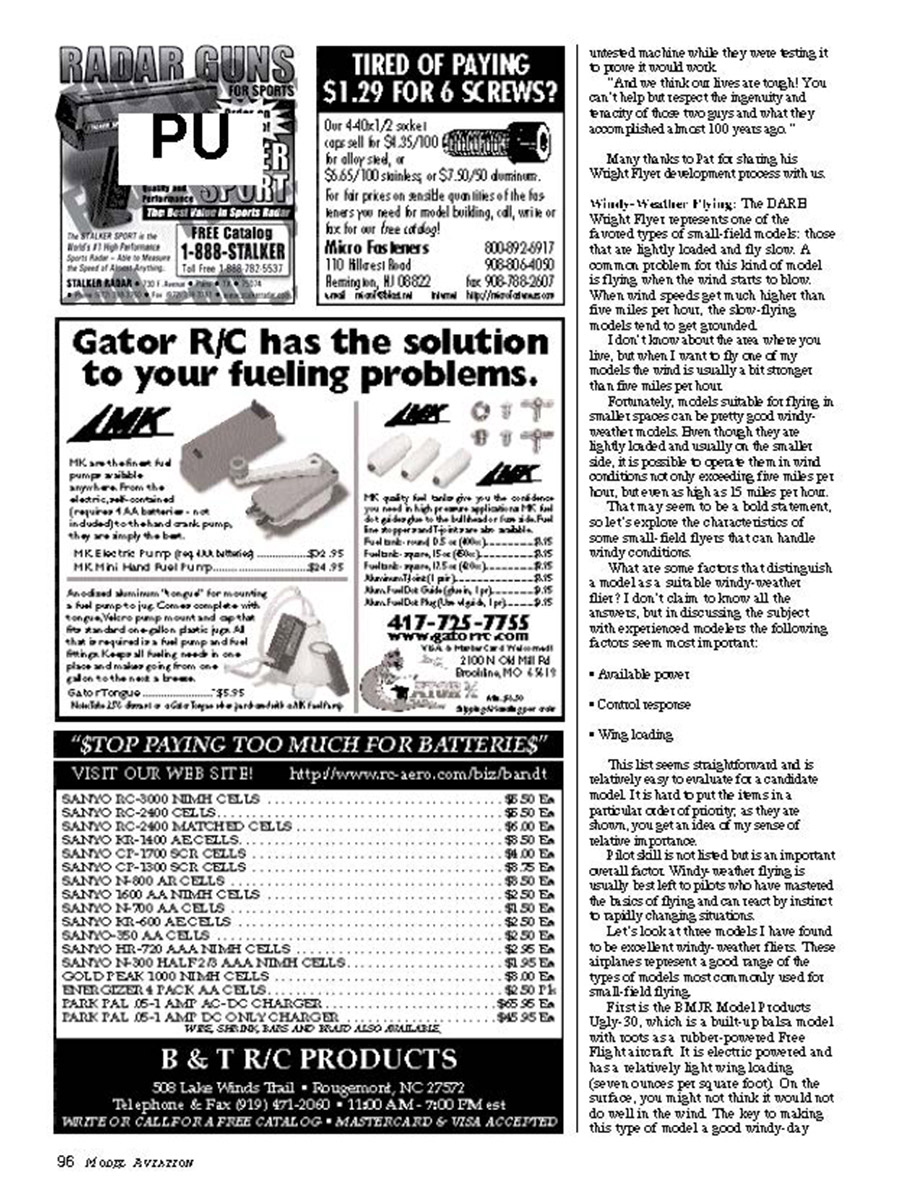
Foam-based models are very popular for small-field flying, and many excellent airplanes are available from which to choose. Some do well in the wind, and some are better suited for flying on calm days, but a common characteristic of many foam small-field flyers is the use of a cambered flatplate-type airfoil for the wing. This approach certainly lends itself nicely to flying slow but can be a problem when the wind starts to blow.
Again, if we have enough power available we can enjoy some great windy-weather flying with this kind of model.
A good example of a foam-based model that uses a cambered flat-plate wing is the Fatty Sparrow. It is available from Hobby Lobby and is an excellent flier in the wind. And you need a power-plant up in the form of a Speed 300 and a 5:1 gear drive. Even when fitted with a seven-cell 600 mAh battery pack, the model has a wing loading of less than seven ounces per square foot.
This means that when flying in calm conditions, you can throttle back and fly around nice and slow. When the wind picks up, just give the model a little more power and it will handle fairly strong winds quite nicely.
What about a model that is slightly larger in size and wing loading? Models of this type generally fly a little faster and on require a little more pilot effort when flown in small-field venues. Throw in some wind, and you can end up with an unhappy flying experience.
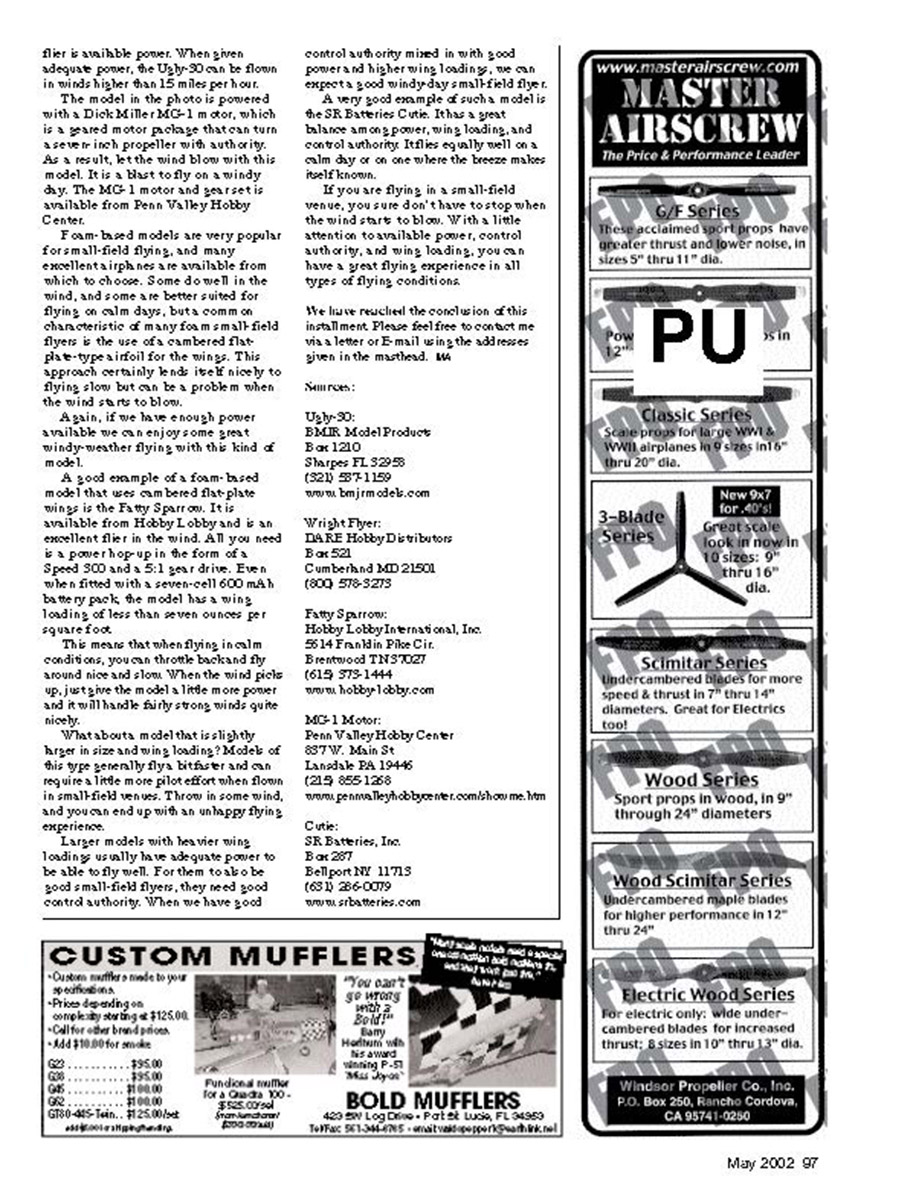
Larger models with heavier wing loading usually have adequate power to be able to fly well. For them to also be good small-field flyers, they need good control authority. When we have good control authority mixed in with good power and higher wing loading, we can expect a good windy-day small-field flyer.
A very good example of such a model is the SR Batteries Cutie. It has a great balance among power, wing loading, and control authority. It flies equally well on a calm day or on one where the breeze makes itself known.
If you are flying in a small-field venue, you sure don't have to stop when the wind starts to blow. With a little attention to available power, control authority, and wing loading, you can have a great flying experience in all types of flying conditions.
We have reached the conclusion of this installment. Please feel free to contact me via a letter or E-mail using the addresses given in the masthead.
Sources:
Ugly-30: BMR Model Products Box 1210 Sharps, FL 32958 (321) 567-1159 www.bmjmodelsk.com
Wright Flyer: DARE Hobby Distributors Box 521 Cumberland MD 21501 (800) 578-3273
Fatty Sparrow: Hobby Lobby International, Inc. 5814 Franklin Pike Cir. Brentwood TN 37027 (615) 373-1444 www.hobby-lobby.com
MC-1 Motor: Penn Valley Hobby Center 837 W. Main St Lansdale PA 19446 (215) 855-1268 www.pennvalleyhobbycenter.com
Cutie: SR Batteries, Inc. Box 287 Bellport NY 11713 (631) 286-0079 www.srbatteries.com
Transcribed from original scans by AI. Minor OCR errors may remain.