Safety Comes First
Box 461, Lovell WY 82431; E-mail: fly_safe@worldnet.att.net
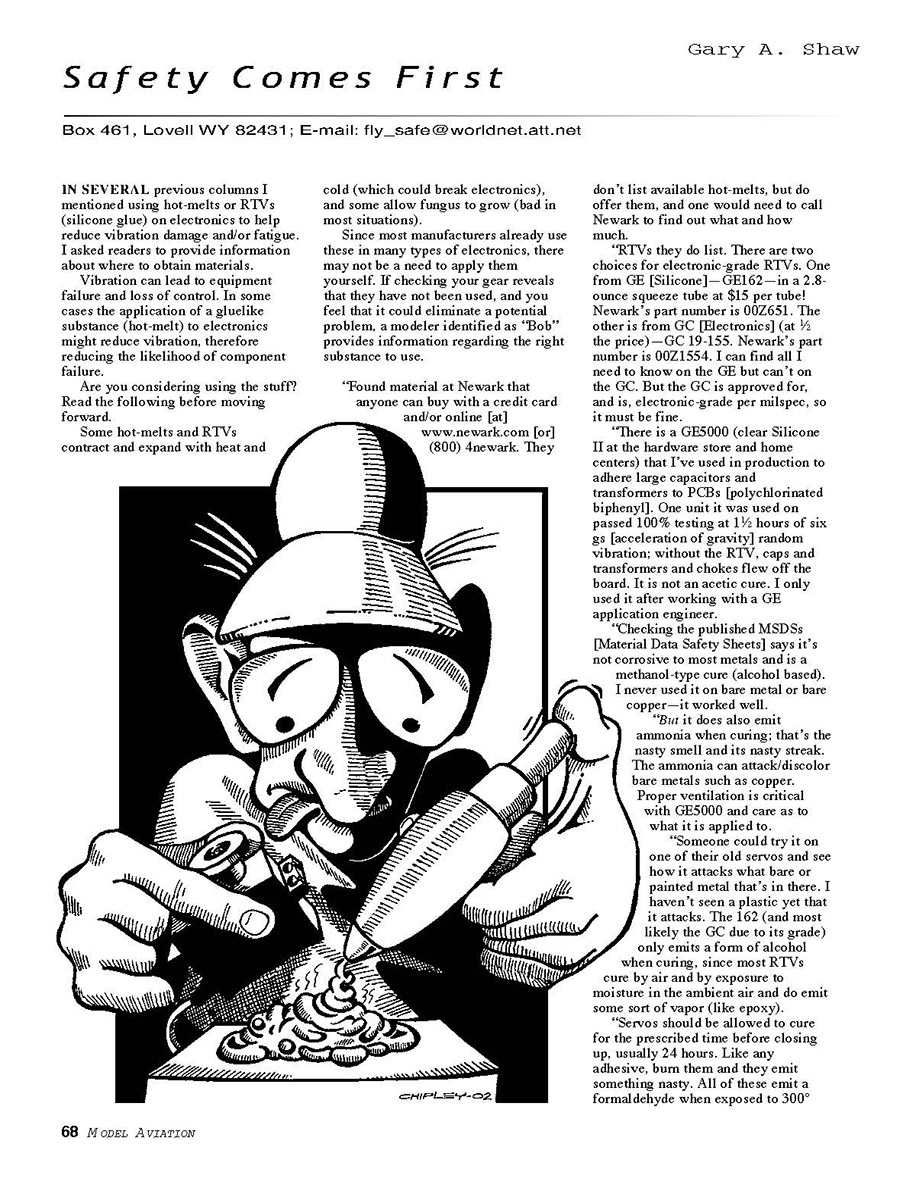
IN SEVERAL previous columns I mentioned using hot-melts or RTVs (silicone glue) on electronics to help reduce vibration damage and/or fatigue. I asked readers to provide information about where to obtain materials.
Vibration can lead to equipment failure and loss of control. In some cases the application of a gluelike substance (hot-melt) to electronics might reduce vibration, therefore reducing the likelihood of component failure.
Are you considering using the stuff? Read the following before moving forward.
Some hot-melts and RTVs contract and expand with heat and cold (which could break electronics), and some allow fungus to grow (bad in most situations).
Since most manufacturers already use these in many types of electronics, there may not be a need to apply them yourself. If checking your gear reveals that they have not been used, and you feel that it could eliminate a potential problem, a modeler identified as “Bob” provides information regarding the right substance to use.
“Found material at Newark that anyone can buy with a credit card and/or online [at] www.newark.com [or] (800) 4newark. They don’t list available hot-melts, but do offer them, and one would need to call Newark to find out what and how much.
“RTVs they do list. There are two choices for electronic-grade RTVs. One from GE [Silicone]—GE162—in a 2.8-ounce squeeze tube at $15 per tube! Newark’s part number is 00Z651. The other is from GC [Electronics] (at ½ the price)—GC 19-155. Newark’s part number is 00Z1554. I can find all I need to know on the GE but can’t on the GC. But the GC is approved for, and is, electronic-grade per milspec, so it must be fine.
“There is a GE5000 (clear Silicone II at the hardware store and home centers) that I’ve used in production to adhere large capacitors and transformers to PCBs [printed circuit board]. One unit it was used on passed 100% testing at 1½ hours of six gs [acceleration of gravity] random vibration; without the RTV, caps and transformers and chokes flew off the board. It is not an acetic cure. I only used it after working with a GE application engineer.
“Checking the published MSDSs [Material Data Safety Sheets] says it’s not corrosive to most metals and is a methanol-type cure (alcohol based). I never used it on bare metal or bare copper—it worked well.
“But it does also emit ammonia when curing; that’s the nasty smell and its nasty streak. The ammonia can attack/discolor bare metals such as copper. Proper ventilation is critical with GE5000 and care as to what it is applied to.
“Someone could try it on one of their old servos and see how it attacks what bare or painted metal that’s in there. I haven’t seen a plastic yet that it attacks. The 162 (and most likely the GC due to its grade) only emits a form of alcohol when curing, since most RTVs cure by air and by exposure to moisture in the ambient air and do emit some sort of vapor (like epoxy).
“Servos should be allowed to cure for the prescribed time before closing up, usually 24 hours. Like any adhesive, burn them and they emit something nasty. All of these emit a formaldehyde when exposed to 300° F or more."
Another modeler recently wrote me and asked that I pass along the methods he uses to find and prevent problems related to harmonics.
"Please pass on to the fellow with the large servo problem this concept.
I also have a Giant Stinger that has well over 300 flights. It has a very similar setup. I'm running a Quadra Q-52S swinging a 20 x 8-10 prop. Not the smoothest engine made! Vibration has been a constant problem. Early soft mounts disintegrated. Screws have come out unless either safety wire (carburetor stack, muffler, engine bolts) or nylon locks/lock nuts are used.
"I am using ancient World (yes, World) giant servos that are probably 20 years old for the rudder and ailerons. I say probably because I don't really know. They were bought at flea markets by a friend.
"Standard servos are used for the elevators (two in the tail) and one for throttle. I've never had either kind fail, even in the high-vibration environment I have. These old servos have a large, discrete parts count (in the days before sophisticated ICs [integrated circuits] and surface-mounted technology) and are not conformal-coated (epoxied) like most military electronics.
"I have worked for the Air Force in electronic warfare and have much experience in these areas, plus I've been a Ham [radio operator] for almost 40 years. I really dig into the electronics.
"I think this fellow's particular problem might be more related to the specific location of his rudder servo and perhaps the linkage used. As we all know, harmonics can set up within a particular airframe and they vary with engine rpm.
"We've all heard that pushrods vibrate at a specific rpm, usually not full throttle. I'm suggesting that certain rpm settings, or even a specific rpm during transitions from high to low throttle, might be doing the damage. The servo might be located on a spot that amplifies this tendency. We all know about how vibration can have peaks and null spots. The servo might be located on a peak vibration spot.
"I suggest he try relocating the servo to a different place. I also suggest he use pull-pull cables on the rudder. This helps reduce the delivered vibrations/shocks to the servo, especially since the tail wheel is tied to the rudder and the shocks from it can be enormous (grass-field flying can really add to this).
"He might be experiencing some mild flutter he can't hear but is losing the linkage nonetheless. Place the servo in the radio compartment. The closer it is to this spot, the less likely sympathetic harmonics will be set up since it is closer to the engine rather than way out on the tail, and it will require long control-cable lengths that will help eliminate the shock delivered.
"It will all have to be accomplished via experimentation. No way to predict or experiment without a great deal of time being invested."
What to Fly? While visiting family during the holidays I had the opportunity to meet an individual just getting started in the hobby. It was fun seeing his enthusiasm and learning what types of models he was interested in.
As these types of conversations often seem to go, his first model was going to be a biplane (very complex), and he wanted to tackle it from scratch. Understanding that this would be his first building project, I did my best to guide him toward a stable, high-wing kit that offered economy, good looks, and stability.
For starters, I recommended a high-wing Almost Ready to Fly (ARF) with nice colors, easy building characteristics, and forgiving tendencies, then I suggested that he move to more-advanced craft as his confidence grew.
As many of you have learned, it's better to take a slow, conservative, noncomplex approach to model building and flying than it is to jump into the complexities of high performance from day one. I've lost numerous models throughout the years because I lacked essential building and flying-experience skills.
Was that a bad or unsafe thing? Not really, but if I'd had a modeling mentor when I started out, I would have made better choices and saved a little bit of cash.
Through the years I've received several comments regarding models that beginners should start with. A recent letter from Jeff Raskin touches on what clubs should encourage and/or initially allow. Should we be concerned?
"After reading your column (February 2002) and the president's discussion about another accident, I find myself wondering why clubs don't require beginners to fly smaller, slower, and safer models. We all know the novice who wants to start off with a 3/4-scale B-58 with four turbines, working rocket-powered ejection seats, and custom retracts—and we all know to advise him or her to learn on a trainer.
"We make it clear that we expect them to step up to other models when they are ready and praise their choice of goals (whatever it might be; even if it is unrealistic, they'll learn that on their own once they know how to build and fly). After all, we don't want to discourage them. But, more importantly, we don't want anybody to get hurt.
"At our club, we recommend one of the many excellent-performing models that are easy to build and fly and which are particularly safe. They are commonly called 'backyard' or 'park flyers.'
"The Wingo is a sterling example, as its simple Styrofoam™ construction, ability to handle a bit of wind, and superb handling make it easy to build and a joy to fly (even if it is an ugly duckling). Its pusher configuration and very blunt, soft nose make it unlikely to cause injury or property damage. There are many other fine-flying models in this class, many of which cost under $50, including the motor and prop!
"Some backyard flyers have ailerons; if you feel that it's better for beginners to start off with them, Electrics are preferred, as the beginner can concentrate on flying, not dealing with an engine. Later, they can add the delights of fuel systems, breaking in an engine, changing glow plugs, cleaning up the goo, and the like.
"Any backyard or park flyer will teach the beginner how the controls operate, to make coordinated turns, distinguish left from right turns at a distance, judge a landing on the runway, and learn the fundamentals.
"I know that every club has a caveman or two who will pooh-pooh any flying object that weighs less than five pounds and will tell you that they started out with a fire-breathing .60-powered model back when 'men wuz men,' and that anything less will make a wimp out of a pilot.
"I suggest, in the manner of Swift's Modest Proposal, that we all be required to stand alongside the runway as beginners land their preferred trainers. The issue is not what kind of model is best, as this is a hobby. There is no 'best,' or rather best is what you like to fly. But when it comes to not hurting others, clubs would be wise to require beginners to learn on safe models.
"Once the beginner can solo and land in one piece on the runway, and with the clean slate up more often than not, it is time for them to move to the big iron if that's what they want to do."
Enough said! Keep the dirty side down! MA
Transcribed from original scans by AI. Minor OCR errors may remain.