Royal Palm Scale Contest
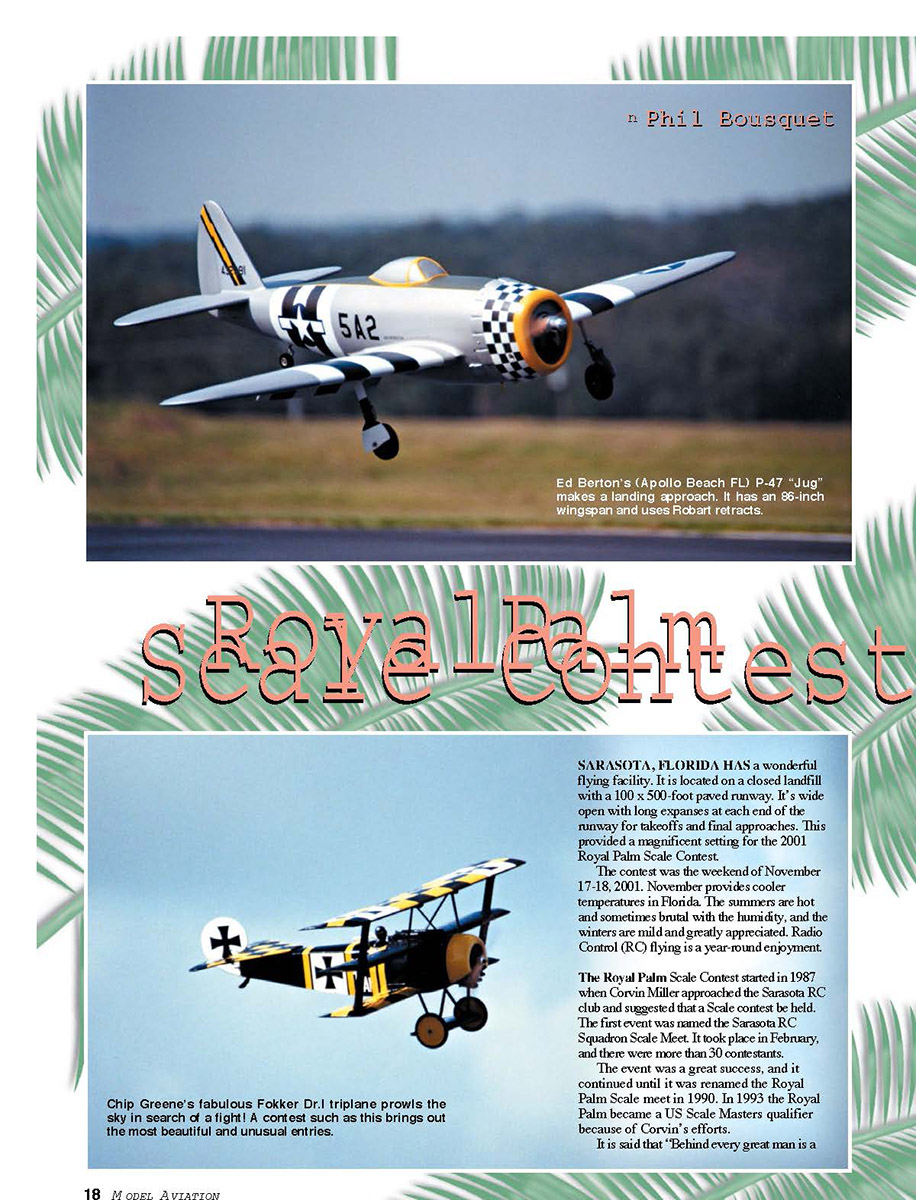
SARASOTA, FLORIDA HAS a wonderful flying facility. It is located on a closed landfill with a 100 x 500-foot paved runway. It's wide open with long expanses at each end of the runway for takeoffs and final approaches. This provided a magnificent setting for the 2001 Royal Palm Scale Contest.
The contest was the weekend of November 17-18, 2001. November provides cooler temperatures in Florida. The summers are hot and sometimes brutal with the humidity, and the winters are mild and greatly appreciated. Radio Control (RC) flying is a year-round enjoyment.
The Royal Palm Scale Contest started in 1987 when Corvin Miller approached the Sarasota RC club and suggested that a Scale contest be held. The first event was named the Sarasota RC Squadron Scale Meet. It took place in February, and there were more than 30 contestants.
The event was a great success, and it continued until it was renamed the Royal Palm Scale meet in 1990. In 1993 the Royal Palm became a US Scale Masters qualifier because of Corvin's efforts.
It is said that "Behind every great man is a great woman," and that is Cherie Miller. Together she and Corvin have inspired club members and modelers to display the spirit of competition. For 11 years they provided their talents and initiative for this yearly contest that many attended. Since then, Mike Winters has taken the helm and continues this fine tradition.
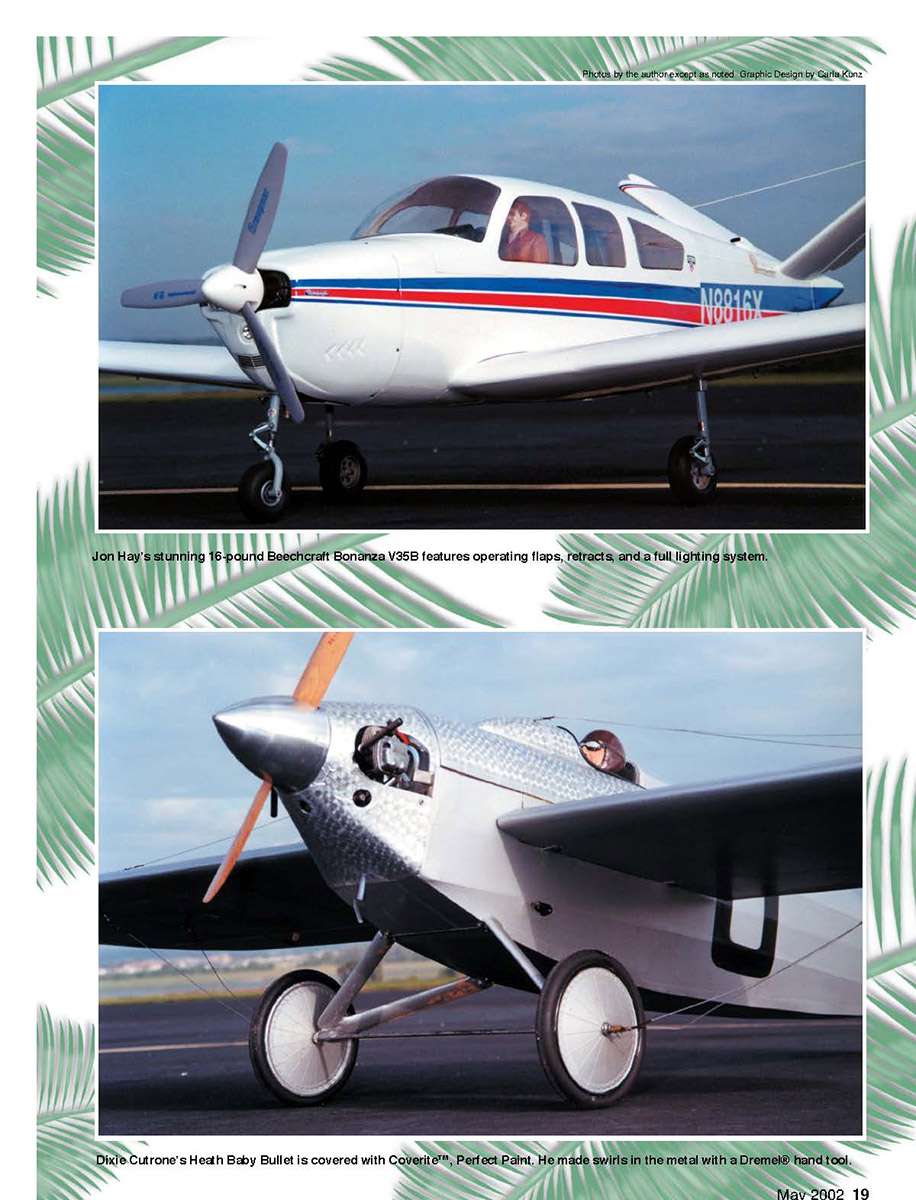
Jon Hay's stunning 16-pound Beechcraft Bonanza V35B features operating flaps, retracts, and a full lighting system.
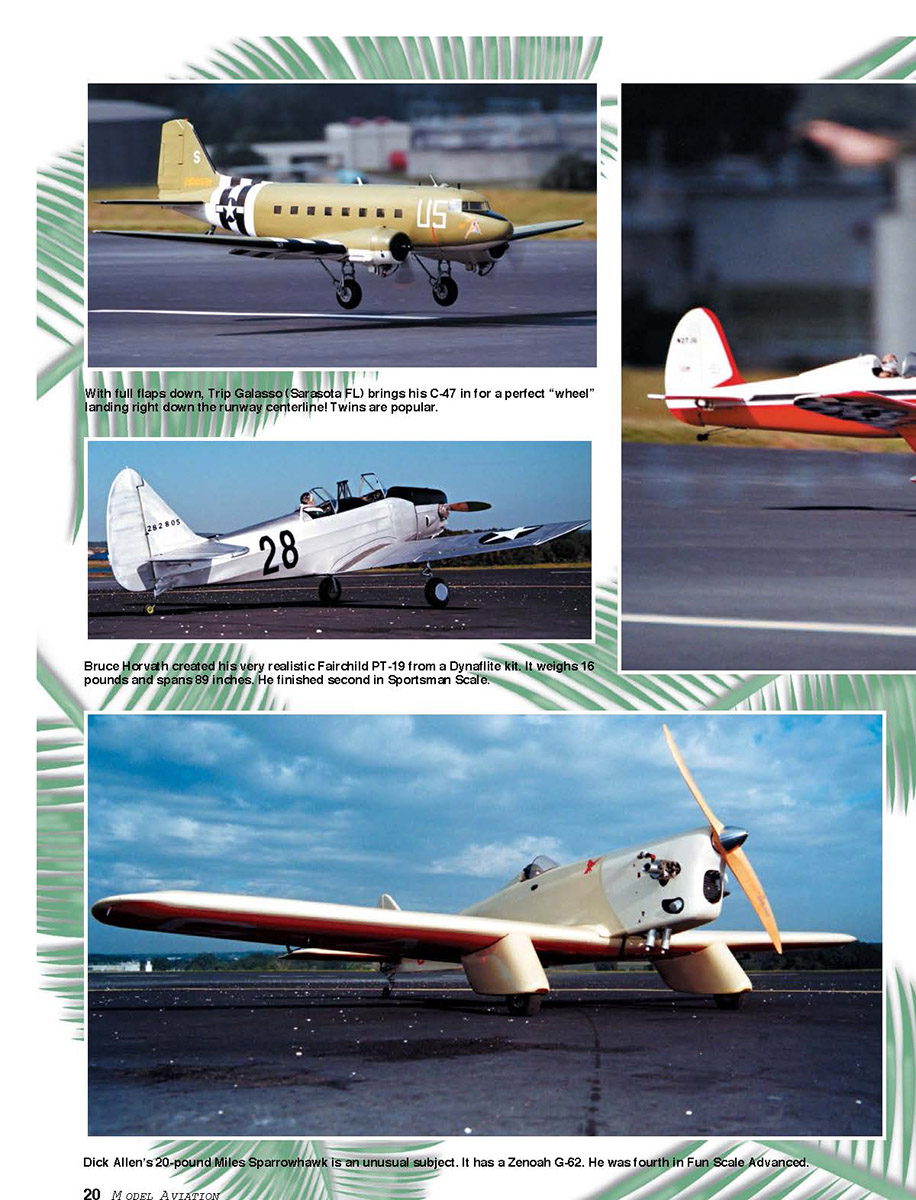
Dixie Cutrone's Heath Baby Bullet is covered with Coverit™, Perfect Paint. He made swirls in the metal with a Dremel® hand tool.
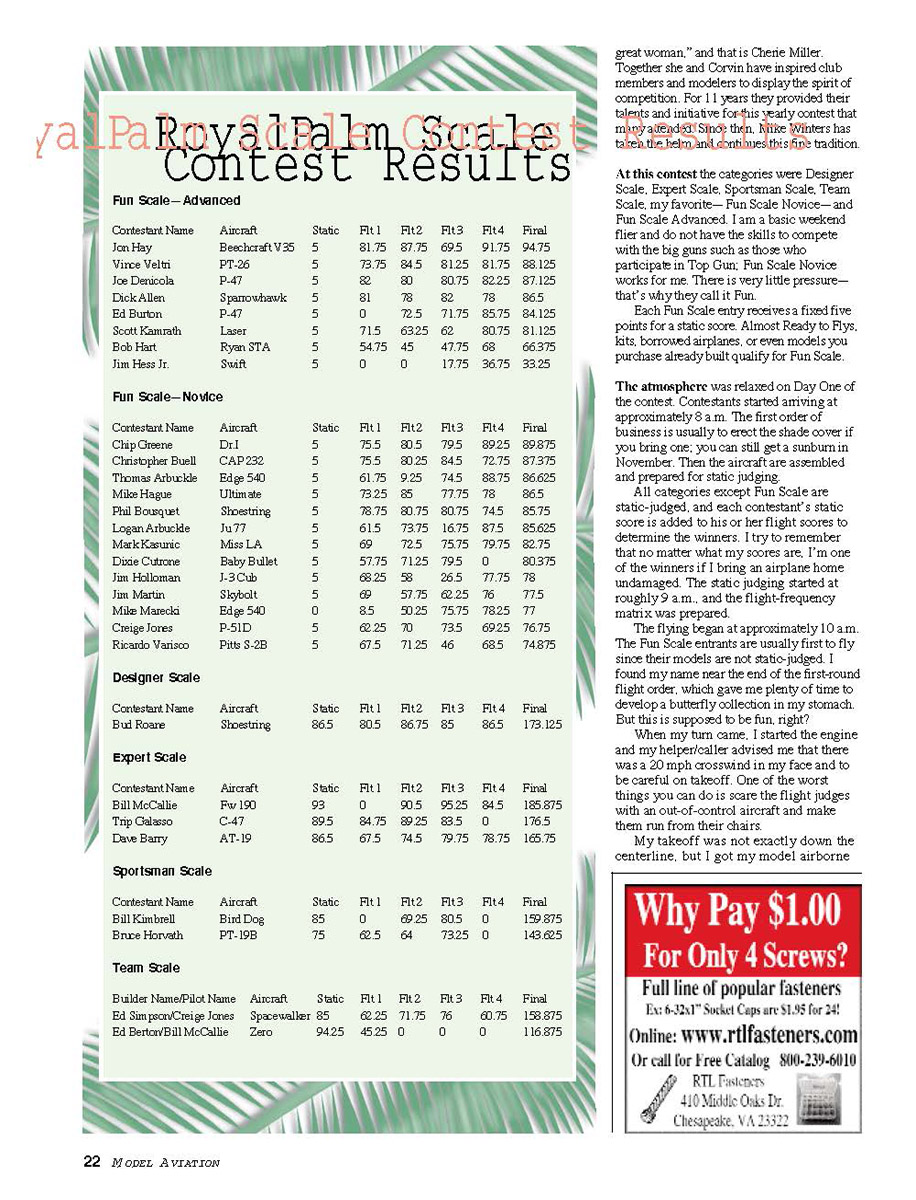
At this contest the categories were Designer Scale, Expert Scale, Sportsman Scale, Team Scale, my favorite — Fun Scale Novice — and Fun Scale Advanced. I am a basic weekend flier and do not have the skills to compete with the big guns such as those who participate in Top Gun. Fun Scale Novice works for me. There is very little pressure—that's why they call it Fun.
Each Fun Scale entry receives a fixed five points for a static score. Almost Ready to Flys, kits, borrowed airplanes, or even models you purchase already built qualify for Fun Scale.
The atmosphere was relaxed on Day One of the contest. Contestants started arriving at approximately 8 a.m. The first order of business is usually to erect the shade cover or if you bring one; you can still get a sunburn in November. Then the aircraft are assembled and prepared for static judging.
All categories except Fun Scale are static-judged, and each contestant's static score is added to his or her flight scores to determine the winners. I try to remember that no matter what my scores are, I'm one of the winners if I bring an airplane home undamaged. The static judging started at roughly 9 a.m., and the flight-frequency matrix was prepared.
The flying began at approximately 10 a.m. The Fun Scale entrants are usually first to fly since their models are not static-judged. I found my name near the end of the first-round flight order, which gave me plenty of time to develop a butterfly of collision in my stomach. But this is supposed to be fun, right?
When my turn came, I started the engine and my helper/caller advised me that there was a 20 mph crosswind in my face and to be careful on takeoff. One of the worst things you can do is scare the flight judges with an out-of-control aircraft and make them run from their chairs.
My takeoff was not exactly down the centerline, but I got my model airborne and did a trim pass. I performed the flight maneuvers I selected and landed without mishap. I returned the radio to the impound and wheeled the aircraft back to the pit area. Then I took a deep breath and tried to relax (I should have done that sooner).
Lunch, which is usually hot dogs and hamburgers, was served, and we got ready to fly again. Most of the butterflies had escaped by this time, and Round Two was much smoother. After each round the contestants gathered around the leader board to see how they were doing in the competition.
The other categories were not as hotly contested Saturday but were sure to warm up as the contest continued.
There was some attrition Saturday. A highly detailed A6M3 Zero built by Ed Berton and flown by Bill McCallie didn't make it back to base; it returned to earth with a thump. That was the only mishap during the contest.
At the end of the first day of competition the contestants headed home or to a hotel to rest. There is usually a social gathering planned for the evening, which is where we share the events of the day, kick back a little bit, and get to know each other.
The second day of competition brought new hope—mostly better flight scores and less crosswind. The crosswinds were gone, so it was time to work on the flight scores. By this time most contestants were aware of what was needed to get into the winner's circle.
The flying began at roughly 9 a.m. and moved along smoothly. Round Three was completed by 11:00, and everyone was treated to the lunchtime show.
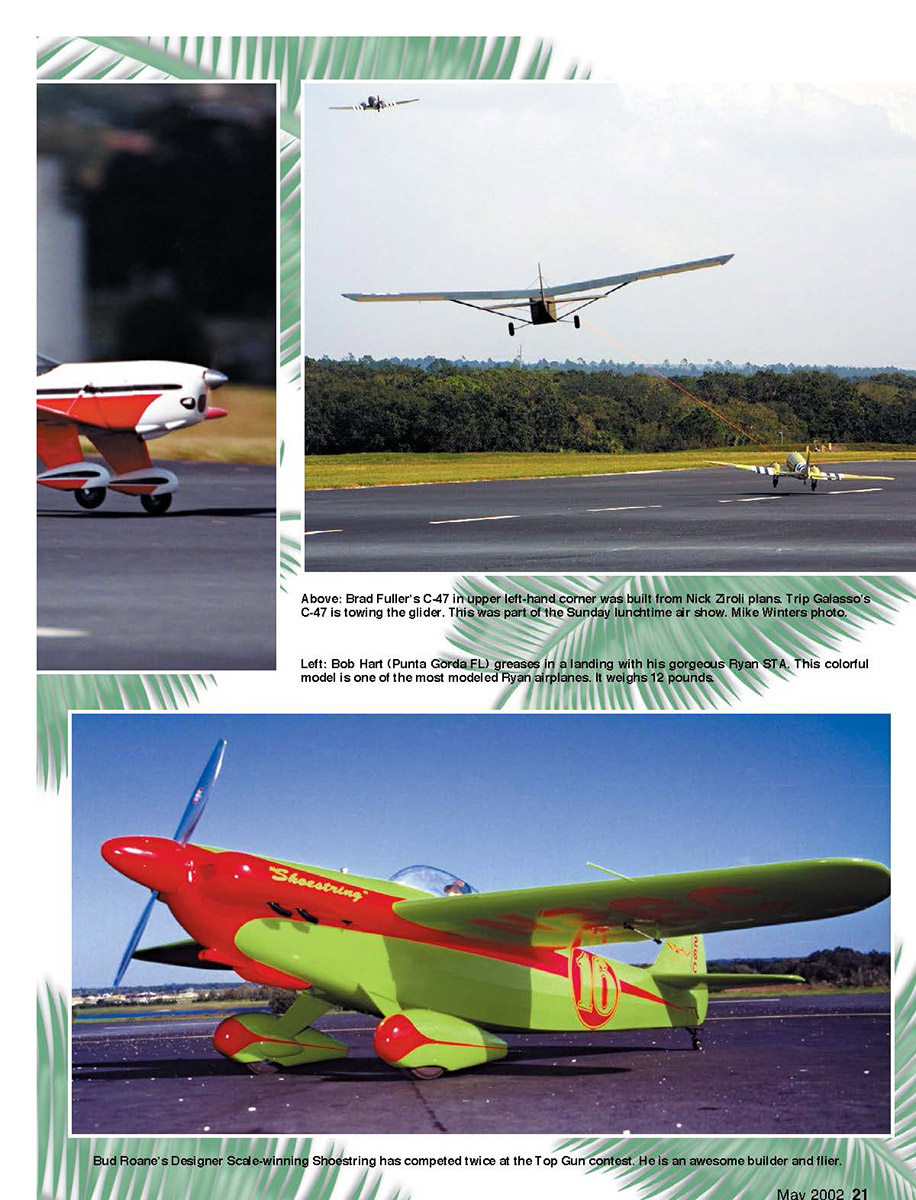
The display included two very large C-47s flying in formation, and one towed a World War II glider into the sky. Brad Fuller piloted the first C-47 to take off, followed by Trip Galasso's towing the glider. The towline was released after a couple of passes, and the glider floated back to base. The C-47s circled in the sky, and Trip released paratroopers that parachuted to the ground.
This entertainment may have been geared toward the spectators, but other contestants and I enjoyed it as well.
Most of the contestants were ready to put in their best flight when the last round began. In the previous three rounds we learned where we made mistakes in our maneuvers, so we were striving to do our best. Round Four was completed by 2 p.m., then the tension began to build as we awaited the final tally.
During the two days of competition I followed myself in the scoring. I found myself in first place after Round One, which surprised me, but the other pilots hadn't even warmed up yet. I had dropped to second place after Round Two—still in the running. The end of Round Three put me in third place. I was beginning
After Round Four, when the final day was about to is, I straightened my hat, tucked in my shirt, and waited for the announcement. Bud Rancine finished in first place in Designer Scale with his scratch-built Shoestring. He had a final score of 173.125. He was the only entry in Designer Scale, but he compared his flight scores with other contestants to see how he was doing.
Ed Simpson and Creige Jones were the winners in Team Scale with their X-scale Spacewalker. Their final score was 158.875.
Bill McCallie took first place in Expert Scale with his highly detailed Focke-Wulf Fw 190. His static score was 93, and his final score was 185.875.
Bill Kimbrell finished first in Sportsman Scale with his Bird Dog and a final score of 150.875. He had quite a bit of detail in this aircraft, down to the multiple antennas and wires.
Jon Hay finished first in Fun Scale
with a tight entry turn to begin this maneuver. The flight judges advised me to begin the maneuver with a gentle sweeping turn, and I agree with them; it looks better and receives a higher flight score. I always keep my mind open for improvement.
There are many forms of competition within our hobby, and Scale is just one of them. I was shy about entering a contest, fearing that I would make a fool of myself. I found the opposite to be true. There are so many of us willing to help in any way we can; indeed, we are one big family.
If you have been thinking about competing in a contest, give it a try; you might be surprised by how much fun it is. Most RC clubs have members who enter contests on a regular basis. Entering a fun-fly started it for me. I asked a few questions and found a great deal of help. The answers removed some of the mystery and hesitation about competing. Now I look forward to competing, and I practice my flight maneuvers for the events.
I would be missing out on the fun of competition without the help of others, so thanks to Bud Rancine for his guidance and for lending his Scale aircraft to me to enter in the contest. I also thank Mike Winters, the Contest Director of the event, for making me feel at home and like part of the family.
Transcribed from original scans by AI. Minor OCR errors may remain.