RADIO CONTROL HELICOPTERS
Eric Hawkinson, 319 Yellowstone Ave., Billings MT 59101; E-mail: eric@heliproz.com
IT'S ANOTHER great month to be enjoying Radio Control (RC) helicopters! With all the new products recently announced or just now shipping, it will be an interesting season out at the flying field.
The first product is not new at all, but it is finally becoming more or less readily available. I've finally been able to give Miniature Aircraft's Fury 60 Expert a thorough going-over, and it's a very nice helicopter.
It started shipping sporadically last spring, but most people who tried to buy one or look at one in a hobby shop were not able to find it because the supply was very constrained. Miniature finally seems to have gotten out of the back-order situation on it, so you should have a much easier time finding one at any serious helicopter shop. It is certainly worth looking at.
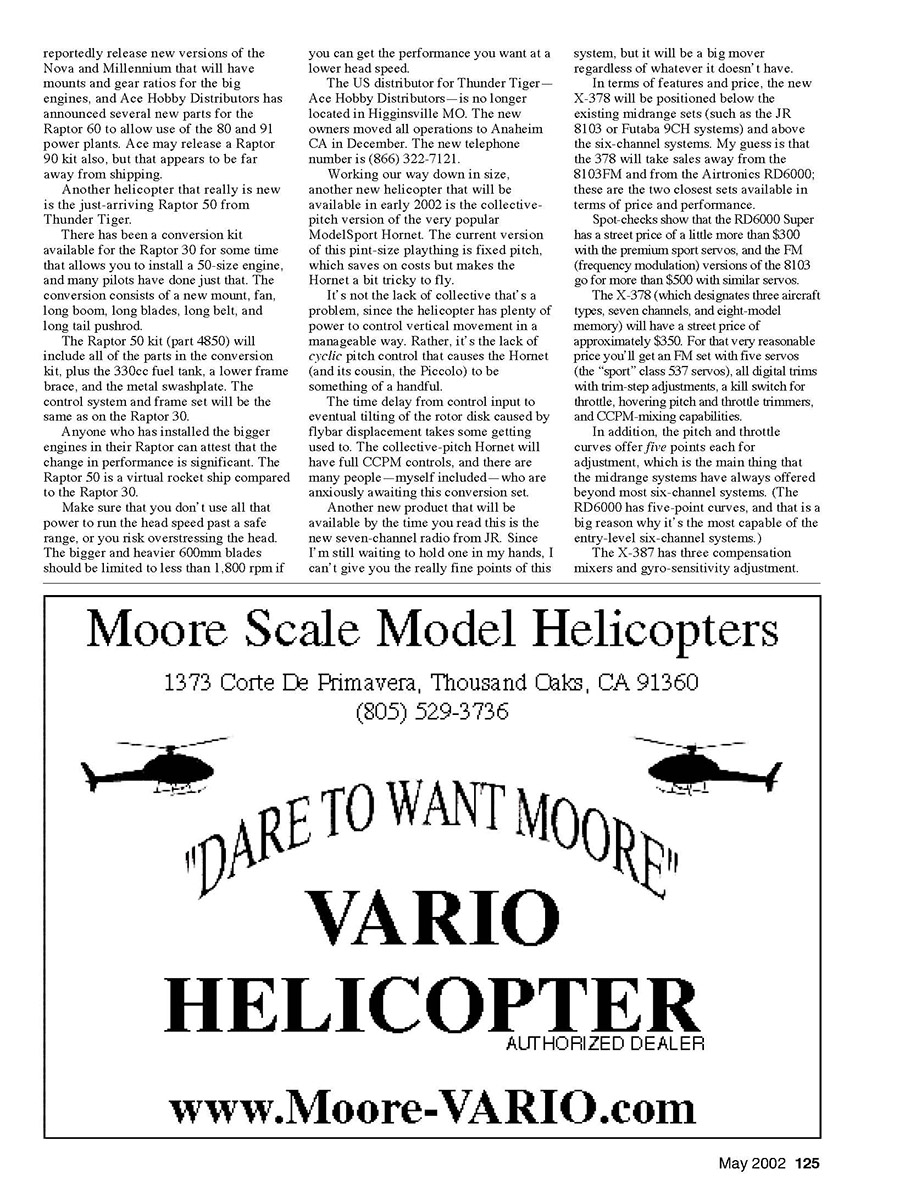
The Fury is different from earlier Miniature Aircraft designs. The two most obvious areas of change from the traditional X-Cell models are the frames and the control system.
The frames will remind you more of a Vigor than an X-Cell; it's a narrow set with G10 frame halves and a bottom frame brace. There's quite a bit of work done for you on the frames, with threaded fasteners installed in a multitude of locations. Gear mesh is factory-set on these, saving you some time and fiddling. There's no doubt that this is the easiest-building helicopter that Miniature has designed.
The control system is a nicely implemented CCPM (Collective and Cyclic Pitch Mixing) setup, complete with composite bearing-equipped servo braces and full ball bearings.
The tail servo drives a long intermediate lever that allows for less deviation from linear output, even when using moderately high amounts of travel on the tail servo. (The higher servo travel improves resolution.)
If you decide to add the optional Pro-Style tail setup, you'll have an excellent tail system for any kind of flying you want to do, and the CCPM primary controls will be more than suitable whether you are a sport flier or a 3-D (three-dimensional) maniac. It is a very smooth system that can be made quite hot on cyclic response, and there is more than enough collective range to make you happy.
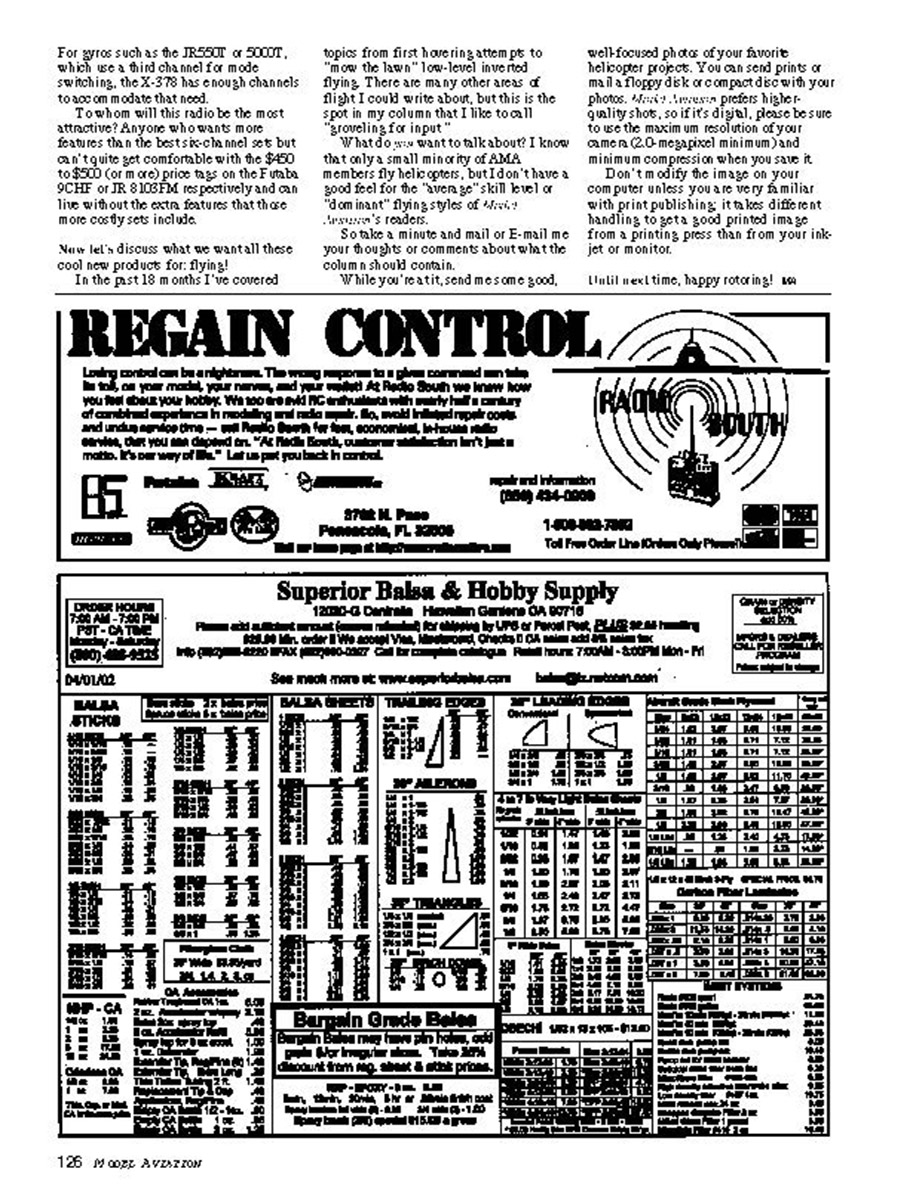
My flying pal Kurt Kreiger has several flights on his model, and he's extremely happy with the control feel. At approximately $700 with a nicely made gel-coated fiberglass canopy, the Fury 60 Expert is a pretty good value.
At press time Miniature has just started shipping some options for the 60 Furys, including carbon-fiberglass frame sets and several different gear ratio kits that will allow use of the YS 80 or O.S. 91. The company expects to have new kit versions in the late spring that will include all of the 80-90 engine specification parts, so all you'll need to add is your engine and exhaust.
Speaking of the bigger engines, Miniature Aircraft is not the only one working to release versions of helicopters that can accommodate the new powerhouses. Robbe Schlüter will reportedly release new versions of the Nova and Millennium that will have mounts and gear ratios for the big engines, and Ace Hobby Distributors has announced several new parts for the Raptor 60 to allow use of the 80 and 91 power plants. Ace may release a Raptor 90 kit also, but that appears to be far away from shipping.
RC Helicopters
Another helicopter that really is new is the just-arriving Raptor 50 from Thunder Tiger.
There has been a conversion kit available for the Raptor 30 for some time that allows you to install a 50-size engine, and many pilots have done just that. The conversion consists of a new mount, fan, long boom, long blades, long belt, and long tail pushrod.
The Raptor 50 kit (part 4850) will include all of the parts in the conversion kit, plus the 330cc fuel tank, a lower frame brace, and the metal swashplate. The control system and frame set will be the same as on the Raptor 30.
Anyone who has installed the bigger engines in their Raptor can attest that the change in performance is significant. The Raptor 50 is a virtual rocket ship compared to the Raptor 30.
Make sure that you don't use all that power to run the head speed past a safe range, or you risk overstressing the head. The bigger and heavier 600mm blades should be limited to less than 1,800 rpm if you can get the performance you want at a lower head speed.
The US distributor for Thunder Tiger—Ace Hobby Distributors—is no longer located in Higginsville MO. The new owners moved all operations to Anaheim CA in December. The new telephone number is (866) 322-7121.
Working our way down in size, another new helicopter that will be available in early 2002 is the collective-pitch version of the very popular ModelSport Hornet. The current version of this pint-size plaything is fixed pitch, which saves on costs but makes the Hornet a bit tricky to fly.
It's not the lack of collective that's a problem, since the helicopter has plenty of power to control vertical movement in a manageable way. Rather, it's the lack of cyclic pitch control that causes the Hornet to be something of a handful.
The time delay from control input to eventual tilting of the rotor disk caused by flybar displacement takes some getting used to. The collective-pitch Hornet will have full CCPM controls, and there are many people—myself included—who are anxiously awaiting this conversion set.
Another new product that will be available by the time you read this is the new seven-channel radio from JR. Since I'm still waiting to hold one in my hands, I can't give you the really fine points of the system, but it will be a big mover regardless of whatever it doesn't have.
In terms of features and price, the new X-378 will be positioned below the existing midrange sets (such as the JR 8103 or Futaba 9CH systems) and above the six-channel systems. My guess is that the 378 will take sales away from the 8103FM and from the Airtronics RD6000; these are the two closest sets available in terms of price and performance.
Spot-checks show that the RD6000 Super has a street price of a little more than $300 with the premium sport servos, and the FM (frequency modulation) versions of the 8103 go for more than $500 with similar servos.
The X-378 (which designates three aircraft types, seven channels, and eight-model memory) will have a street price of approximately $350. For that very reasonable price you'll get an FM set with five servos (the "sport" class servos), all digital trims with trim-step adjustments, a kill switch for throttle, hovering pitch and throttle trimmers, and CCPM-mixing capabilities.
In addition, the pitch and throttle trims (or five points each) are adjustable, which is the main thing that the midrange systems have always offered beyond most six-channel systems. The RD6000 has five-point curves, and that is a big reason why it's the most capable of the entry-level six-channel systems.
The X-387 has three compensation mixers and gyro-sensitivity adjustment. For gyros such as the JR550II or 5000T, which use a third channel for mode switching, the X-378 has enough channels to accommodate that need.
To whom will this radio be the most attractive? Anyone who wants more features than the best six-channel set but can't quite get comfortable with the $450 to $500 (or more) price tags on the Futaba 9CHF or JR 8103FM respectively and can live without the extra features that the more costly sets include.
Now let's discuss what we want all these cool new products for: flying!
In the past 18 months I've covered topics from first hovering attempts to "mow the lawn" low-level inverted flying. There are many other areas of flight I could write about, but this is the spot in my column that I like to call "groveling for input."
What do you want to talk about? I know that only a small minority of AMA members fly helicopters, but I don't have a good feel for the "average" skill level or dominant flying styles of MAW's readers.
So take a minute and mail or E-mail me your thoughts or comments about what the column should contain.
While you're at it, send me some good, well-focused photos of your favorite helicopter projects. You can send prints or mail a floppy disk or compact disc with your photos. Image resolution prefers higher-quality shots, so if it's digital, please be sure to use the maximum resolution of your camera (2.0-megapixel minimum) and a minimum compression when you save it.
Don't modify the image on your computer unless you are very familiar with print publishing; it takes different handling to get a good printed image from a printing press than from your ink-jet or monitor.
Until next time, happy rotorings! Lee
Transcribed from original scans by AI. Minor OCR errors may remain.