RC Electrics
Bob Kopski, 25 West End Dr., Lansdale PA 19446
THIS COLUMN will announce two meets, share some experiences with the Fundango, and discuss more reader query and comment on slow-charging.
Joe Beshar (198 Merritt Dr., Oradell NJ 07649; Tel.: (201) 261-1281; Fax: (201) 261-0223) has announced the sixth Eagles All Electric Fly-In scheduled for May 18, 2002 (rain date May 19) in Hope NJ. The Old Time Eagles model airplane club is hosting this meet, and you do need AMA membership to participate.
I've been to the last two of these gatherings and am anxious for this one. The only complaint I have is that it's only one day! This meet is described as "A Fun Fly for the promotion of all types of Electric powered models ... You can fly Radio Control (RC), Free Flight, modern, vintage, or whatever. There is open flying all day from 9 a.m. to 4 p.m., and there is one event scheduled for competitive types: Elexaco.
Elexaco is an Electric version of the popular Society of Antique Modelers Texaco wet event, and Joe came up with this variant several years ago. (Texaco is described as the most popular Old-Timer [OT] event.) As does Texaco, Elexaco has simple rules and requirements for the power system and airplane. And as in Texaco, time in the air is the judgement criteria.
With current Elexaco rules (revised from earlier versions as of 06/02/01), you are free to use any power system you want as long as it's the Dymond Max 4 Speed 400 motor and the associated Dymond plastic propeller! That is the only motive system allowed, which makes it easy for you and conceptually like the wet-power Texaco version of the event.
You must also use a seven-cell Sanyo pack of 270 (now obsolete) or 350 mAh Ni-Cd cells with an RC motor shut down at two minutes max. NiMH is not allowed (though this does not make sense to me).
At the discretion of the contest director, the airplane can be any design (not necessarily of OT origin), as long as the aspect ratio does not exceed eight (another point I don't understand). The rules are easy enough, and that's an event theme: simple. It's low in cost too!
Flights are timed from launch to landing with a target of 15 A perfect score is 900 points.
There are a few other minor rules and regulations, but this is the essence of the event. You can get more details and directions to the field from Contest Director Joe.
The Burlington County RC Club (NJ) has announced plans for its 2002 Electric meet scheduled for Saturday, May 11 at the club field. You can get all the details from Bob Afflerback, 123 Harrington Cir., Willingboro NJ 08046; Tel.: (609) 871-8777.
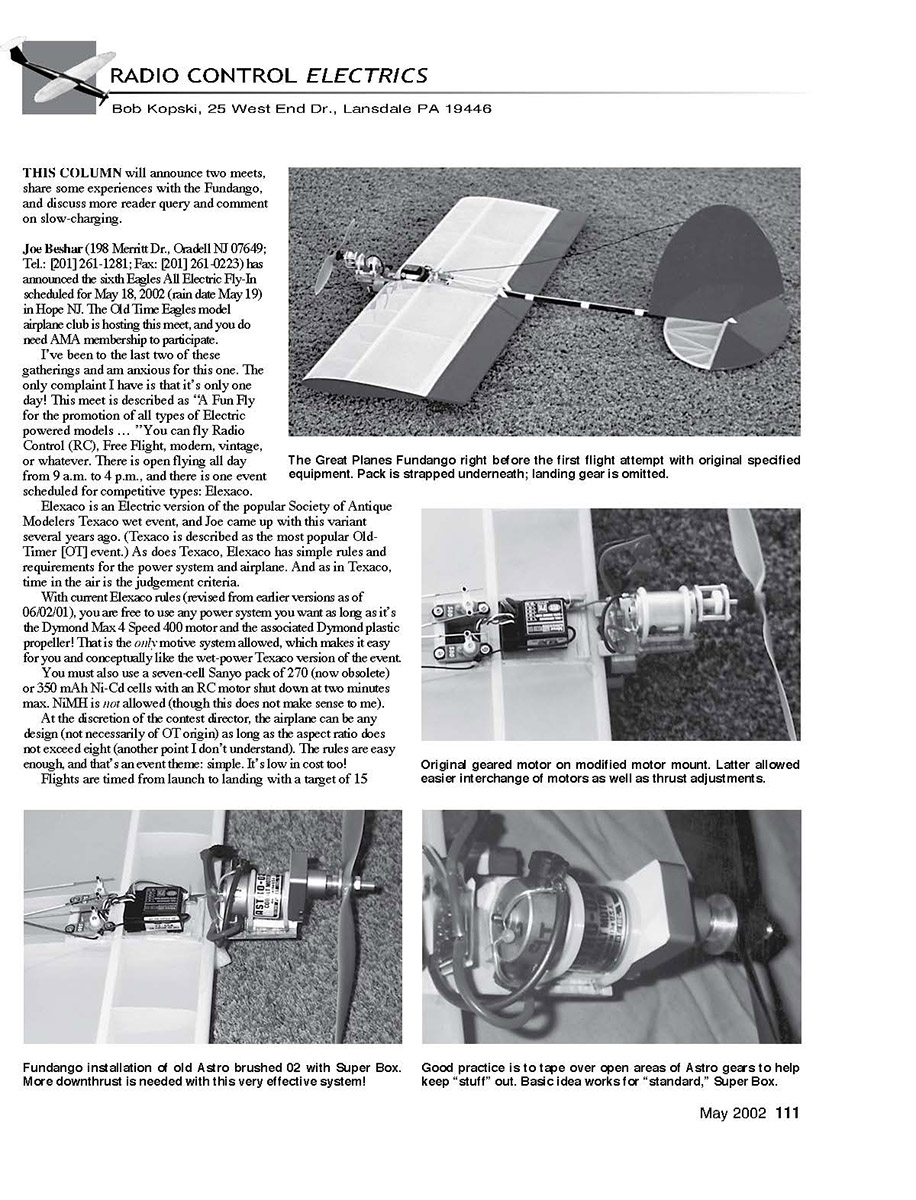
The Great Planes Fundango "fun-fly" design appealed to me in the first ad I saw for it. I was quick to order the model and all the recommended stuff for it.
This is a very nice kit with good wood selection and crisp, clean die-cutting — something more rare in this era of laser-cut parts. The manual was excellent and in the established tradition of this company. Everything went together very nicely, and I was quite pleased with this aspect.
One part of the assembly—cutting a slot in the fiberglass fuselage tube for the fin to fit in—pretty much requires the use of a Dremel® tool with a cutoff wheel. Any other approach to this task would likely be quite difficult.
Except as in the following, the only thing I'd change in assembly would be to add some balsa on the fin and stabilizer structures where these surfaces join the fuselage. Widen (approximately double) the leading-edge and trailing-edge woodwork of each in that immediate area. You'll see what I mean when you check out the plans.
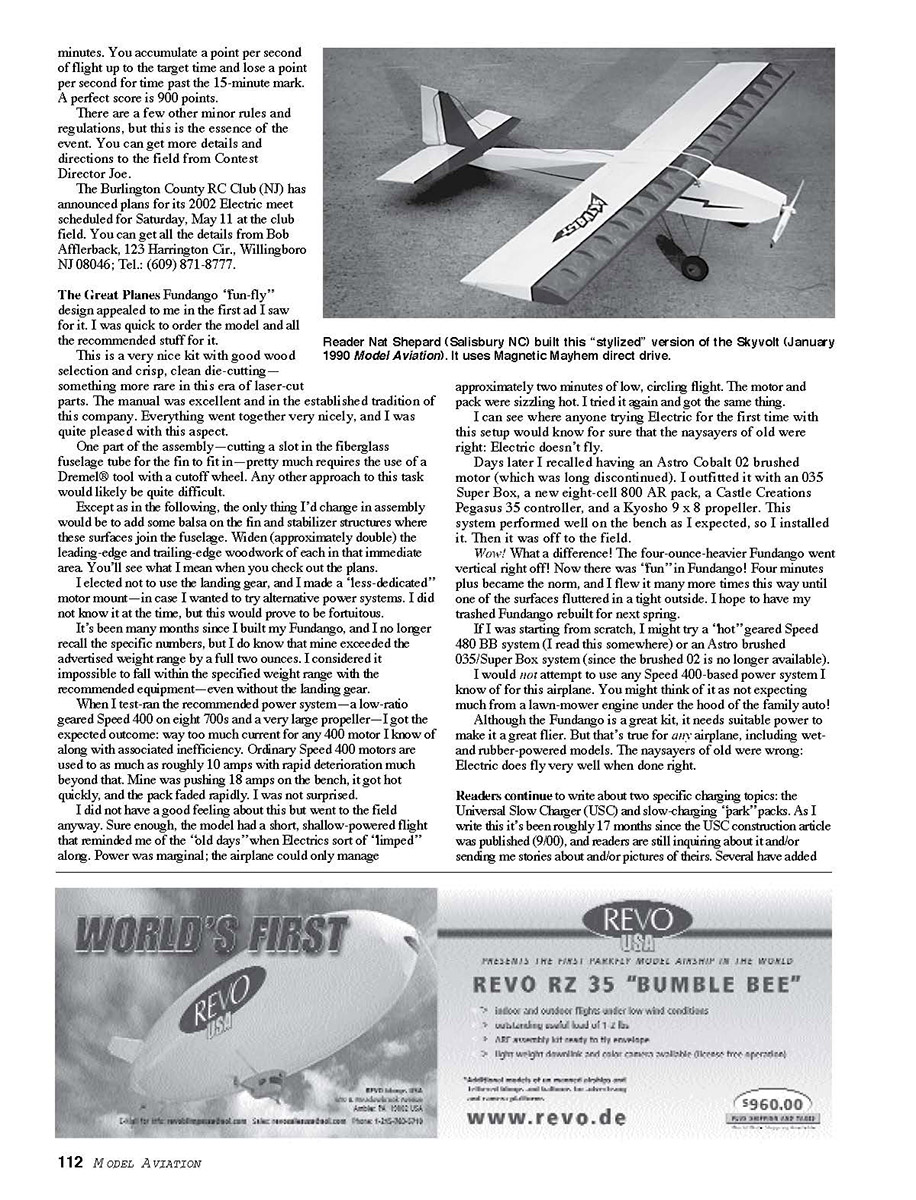
I elected not to use the landing gear, and I made a "less-dedicated" motor mount—in case I wanted to try alternative power systems. I did not know it at the time, but this would prove to be fortuitous.
It's been many months since I built my Fundango, and I no longer recall the specific numbers, but I do know that mine exceeded the advertised weight range by a full two ounces. I considered it impossible to fall within the specified weight range with the recommended equipment—even without the landing gear.
When I set the recommended power system—a low-ratio geared Speed 400 on eight 700s and a very large propeller—I got the expected outcome: way too much current for any 400 motor I know of along with associated inefficiency. Ordinary Speed 400 motors are used to as much as roughly 10 amps with rapid deterioration much beyond that. Mine was pushing 18 amps on the bench, it got hot quickly, and the pack faded rapidly. I was not surprised.
I did not have a good feeling about this but went to the field anyway. Sure enough, the model had a short, shallow-powered flight that reminded me of the "old days" when Electrics sort of "limped" along. Power was marginal; the airplane could only manage approximately two minutes of low, circling flight. The motor and pack were sizzling hot. I tried it again and got the same thing.
I can see where anyone trying Electric for the first time with this setup would know for sure that the naysayers of old were right: Electric doesn't fly.
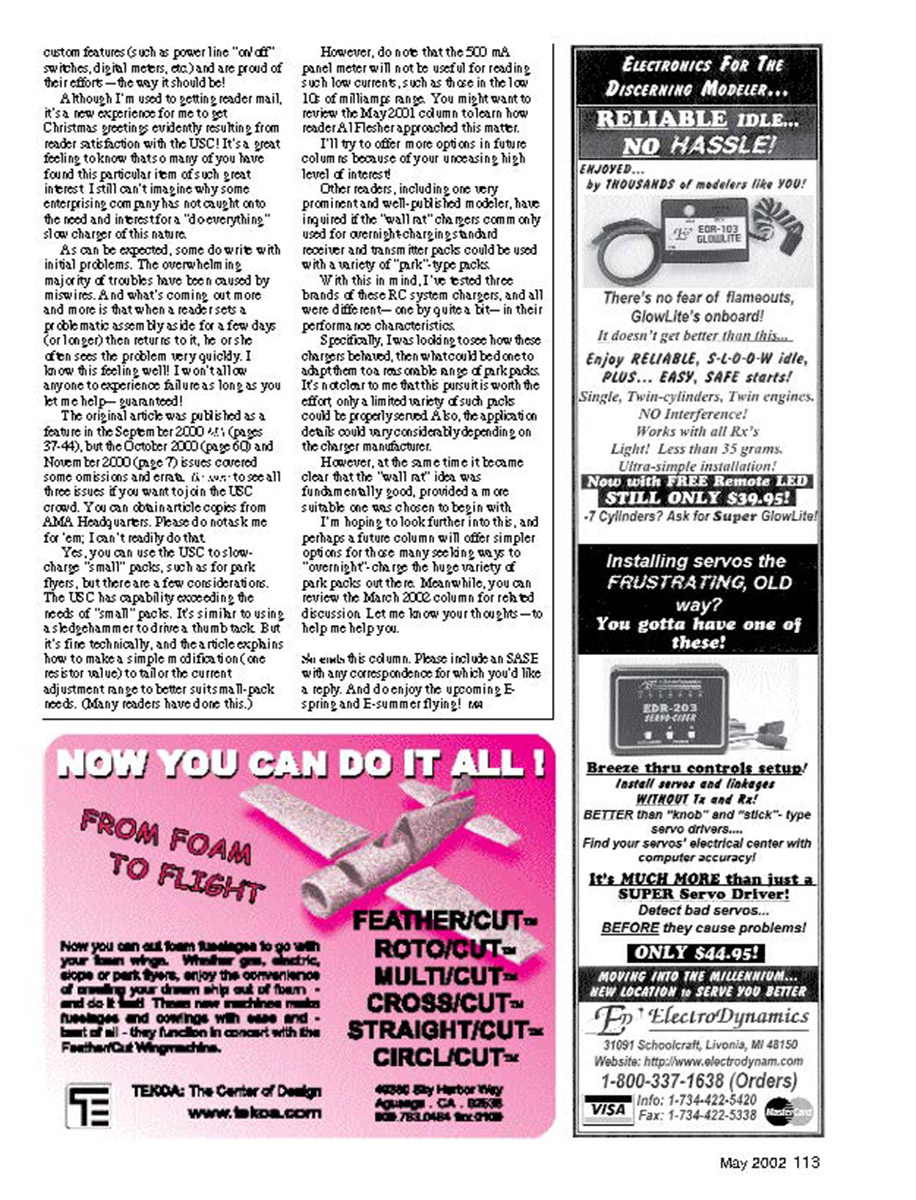
Days later I recalled having an Astro Cobalt 02 brushed motor (which was long discontinued). I outfitted it with an 035 Super Box, a new eight-cell 800 AR pack, a Castle Creations Pegasus 35 controller, and a Kyosho 9 x 8 propeller. This system performed well on the bench as I expected, so I installed it. Then it was off to the field.
Wow! What a difference! The four-ounce-heavier Fundango went vertical right off! Now there was "fun" in Fundango! Four minutes plus became the norm, and I flew it many more times this way until one of the surfaces fluttered in a tight outside. I hope to have my trashed Fundango rebuilt for next spring.
If I was starting from scratch, I might try a "hot" geared Speed 480 BB system (I read this somewhere) or an Astro brushed 035/Super Box system (since the brushed 02 is no longer available).
I would not attempt to use any Speed 400-based power system I know of for this airplane. You might think of it as not expecting much from a lawn-mower engine under the hood of the family auto!
Although the Fundango is a great kit, it needs suitable power to make it a great flier. But that's true for any airplane, including water- and rubber-powered models. The naysayers of old were wrong: Electrics does fly very well when done right.
Readers continue to write about two specific charging topics: the Universal Slow Charger (USC) and slow-charging "park" packs. As I write this it's been roughly 17 months since the USC construction article was published (9/00), and readers are still inquiring about it and/or sending me stories about and/or pictures of theirs. Several have added custom features (such as power line "on/off" switches, digital meters, etc.) and are proud of their efforts — the way it should be!
Although I'm used to getting reader mail, it's a new experience for me to get Christmas greetings evidently resulting from reader satisfaction with the USC! It's a great feeling to know that so many of you have found this particular item of such great interest. I still can't imagine why some enterprising company has not caught onto the need and interest for a "do everything" slow charger of this nature.
As can be expected, some do write with initial problems. The overwhelming majority of troubles have been caused by mis-wires. And what's coming out more and more is that when a reader sets a problematic assembly aside for a few days (or longer) then returns to it, he or she then sees the problem very quickly. I know this feeling well! I won't allow anyone to experience failures as long as you let me help — guaranteed!
Yes, you can use the USC to slow‑charge "small" packs, such as for park flyers, but there are a few considerations. The USC has capability exceeding the needs of "small" packs. It's similar to using a sled‑gear motor to drive a thumb tacker. But it's fine technically, and the article explains how to make a simple modification (one resistor value) to tailor the current adjustment range to better suit small‑pack needs. (Many readers have done this.)
However, do note that the 500 mA panel meter will not be useful for reading such low currents, such as those in the low 10s of milliamps range. You might want to review the May 2001 column to learn how reader Al Fletcher approached this matter.
I'll try to offer more options in future columns because of your increasing high level of interest!
Other readers, including one very prominent and well‑published modeler, have inquired if the "wall wart" chargers commonly used for overnight charging standard receiver and transmitter packs could be used with a variety of "park"-type packs.
With this in mind, I've tested three brands of these RC system chargers, and all were different — once by quite a bit — in their performance characteristics.
Specifically, I was looking to see how these chargers behaved, then what could be done to adapt them to also enable safe charging of park packs. It's not clear to me that this pursuit is worth the effort only a limited variety of such packs could be properly served. Also, the application detail could vary considerably depending on the charger manufacturer.
However, at the same time it became clear that the "wall wart" idea was not fundamentally good, provided a more suitable one was chosen to begin with.
I'm hoping to look further into this, and perhaps a future column will offer simpler options for the many seeking ways to "overnight"-charge the huge variety of park packs out there. Meanwhile, you can review the March 2002 column for related discussion. Let me know your thoughts — to help me help you.
Send in this column. Please include an SASE with any correspondence for which you'd like a reply. And enjoy the upcoming E‑spring and E‑summer flying! Leo
Transcribed from original scans by AI. Minor OCR errors may remain.