RADIO CONTROL AEROBATICS
Eric Henderson, <REDACTED>
MY LOCAL INTERNET provider has been "absorbed." As a result, I no longer have "@home" as a mailing tag; now it is "@comcast." If you have sent me mail and I have not at least acknowledged it, you can assume that it did not reach me. I always reply to my column mail, so "no response" means I did not get your note.
One of the best aspects of writing a column is column-related mail. Most of it is complimentary with a "little" request or two built in. Some mail is not so complimentary but still has that "little" request built in. In either case, it is good to get the feedback.
As a rugby player, my coaches gave me regular feedback. Most of the words they threw at me were corrective in nature. No matter how digestible the message was, it certainly made me a better player—when I listened!
A recent lengthy E-mail got my attention in the same way. The writer pointed out that I had not presented a balanced picture of the realities of soft mounts and had a not-so-"little" request for me to put that right.
Antivibration soft mounts were highlighted in the Pattern column approximately three months ago. To be honest, I had never intended to do a balanced review of soft mounts; the original intent was to try to get people interested in their use because they are, in my opinion, the most significant way to reduce noise.
Note that I used the words "the most significant way"—not "the only way." We only have so much column word space to work with, and it really is difficult to decide how much to write about any given subject.
I have three places where I can write about Precision Aerobatics: this column, the National Society of Radio Controlled Aerobatics (NSRCA) newsletter—the KFactor, published by Brian Clemmons—and the NSRCA online discussion list.
Overlap and "redundant" inevitably occurs. I try not to scoop or repeat myself in all three; it is all too easy to think I have covered something appropriately in all of them. To preserve my sanity and perhaps protect yours, I have compartmentalized my writing into three types—one for each communications vehicle.
In Model Aviation the goal is to bring news and innovation to the AMA membership and beyond. In the K-Factor I write the president's column and tend to focus on the technologies in more depth for those who are already well into the sport (read: hooked!). In the online discussion list (accessed by going to NSRCA.org), it is more of a free-for-all and free-to-all question-and-answer environment. The good news is that the latter often stimulates content ideas for this column.
Back to soft-mount pros and cons. It would be possible to write a whole column about this subject alone. In the latest letter I was taken to task for not addressing the negatives of engine isolation and for not mentioning the many other ways to reduce sound in an airplane.
The perceived negatives of soft mounts are that they rob the engine of power, increase plug-element wear, can hurt the throttle servo, and can shake off mufflers. I would add the possible loss of thrustline vectors.
It was also pointed out that the servos come with isolation-mount grommets and that they did not need the engine to be "isomounted." Although I could agree in some part with the first few items, I could not agree with the isolation argument about the servos.
That is because even though the servo is "soft-mounted," the servo arm is directly connected to the control rod that is connected to the control surface that is connected to the airplane that is connected to the engine! Therefore, the servo is still "hard-coupled" to the control surface. The control surfaces are subjected to some pretty tough engine vibration.
I have performed many tests in this area. I have seen the smallest loads on individual servos make large jumps when the engine is run. Typically a servo measured with the engine off, supporting an aileron, showed a 50 mA draw. This was without the servo being operated (i.e.) at servo idle but supporting the weight of the control surface. This same servo jumped to well more than 400 mA when the engine was running on a hard mount.
Fitting a soft mount gave a reading of 70 mA at servo idle with the engine running.
Merle Hyde has done extensive testing in this area and had much more impressive data.
It was also clear that the vibration-induced loads on the servos were zonal. The left wing was much better than the right wing. I have had several snapped control horns on the right wing panel of a Pattern airplane. There is a lot of vibration happening in that area. After fitting soft mounts there were no more breaks. (This was after many hundreds of flights.)
Personal experience with the same brand and model number of servos that were flown in sport models and Pattern airplanes showed clear differences in servo-gear wear and servo-pot wear. I have Pattern models with 500-plus flights on them with the same servos!
In the glow-plug and engine-power department there may be a loss of longevity and a few hundred rpm respectively. In the case of my YS 1.40 brigade, they sure continue to deliver the "ponies" on a soft mount!
Other sound-reduction methods I had "deliberately" ignored were muffler design, propeller choices, carburetor, and mufflers. The original mention of soft mounts was aimed at all fliers, not just Pattern fliers, because it is a very uncomplicated way to get a big result!
When you get into the options of fitting much larger propellers to sport engines to reduce the noise, there can be many problems. Bigger propellers can cause ill effects. Big propellers make the engines run slower, hence quieter. However, they could easily overload the engines and cause overheating and subsequent damage to them.
Pattern fliers were driven to reduce noise by some pretty tough Fédération Aéronautique Internationale (FAI) and AMA contest standards. The Pattern fraternity went through many years of trial and error. It was clear that the engines were producing noise because of the high (15,000-17,000) rpm of the day.
Larger propellers were employed, but it was soon learned that the mufflers had to change to support the lower rpm tuning needs. This resulted in somewhat-harder-to-operate new designs of tuned pipes and engines. Four-strokes came onto the scene and were friendly to noise-reduction experiments and eventual off-the-shelf aftermarket devices.
I have several sport models fitted with a Hyde soft mount for .32- and .50-size engines. They are fitted to an O.S. .32, an O.S. .46, and an O.S. .50. These two-stroke engines run much quieter than the same engines run by my clubmates who are using regular mounts.
The stock mufflers are the same on soft- and hard-mounted engines. For the most part, the propellers used are the same. The soft mounts seem to keep the edge off the noise that comes from the airframe.
I hope this information balances the original data provided on soft mounts. I still conclude that the most effective and easiest way to quiet things down is to fit a soft mount. There are other techniques, but they are harder to master and give smaller returns on your investment.
Two Two-Stroke Engines for 2002
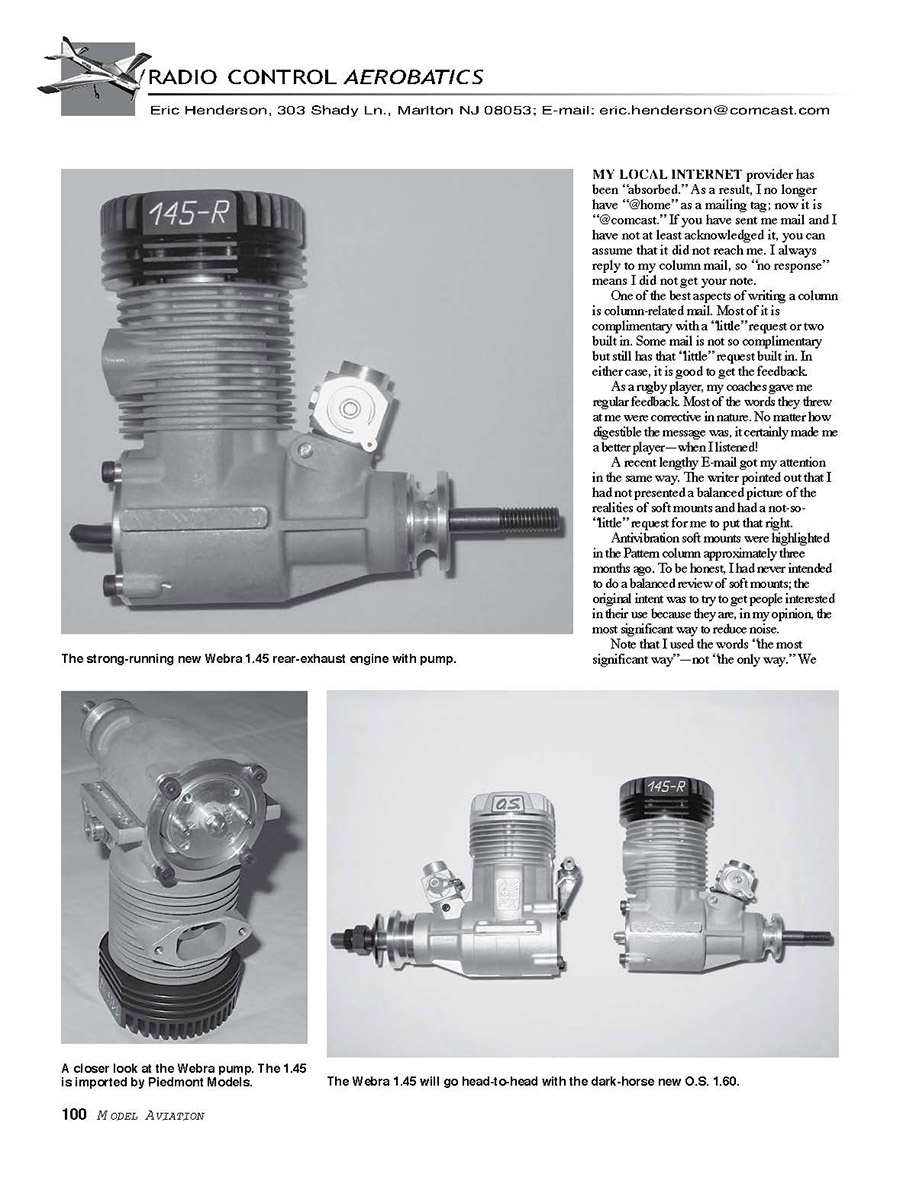
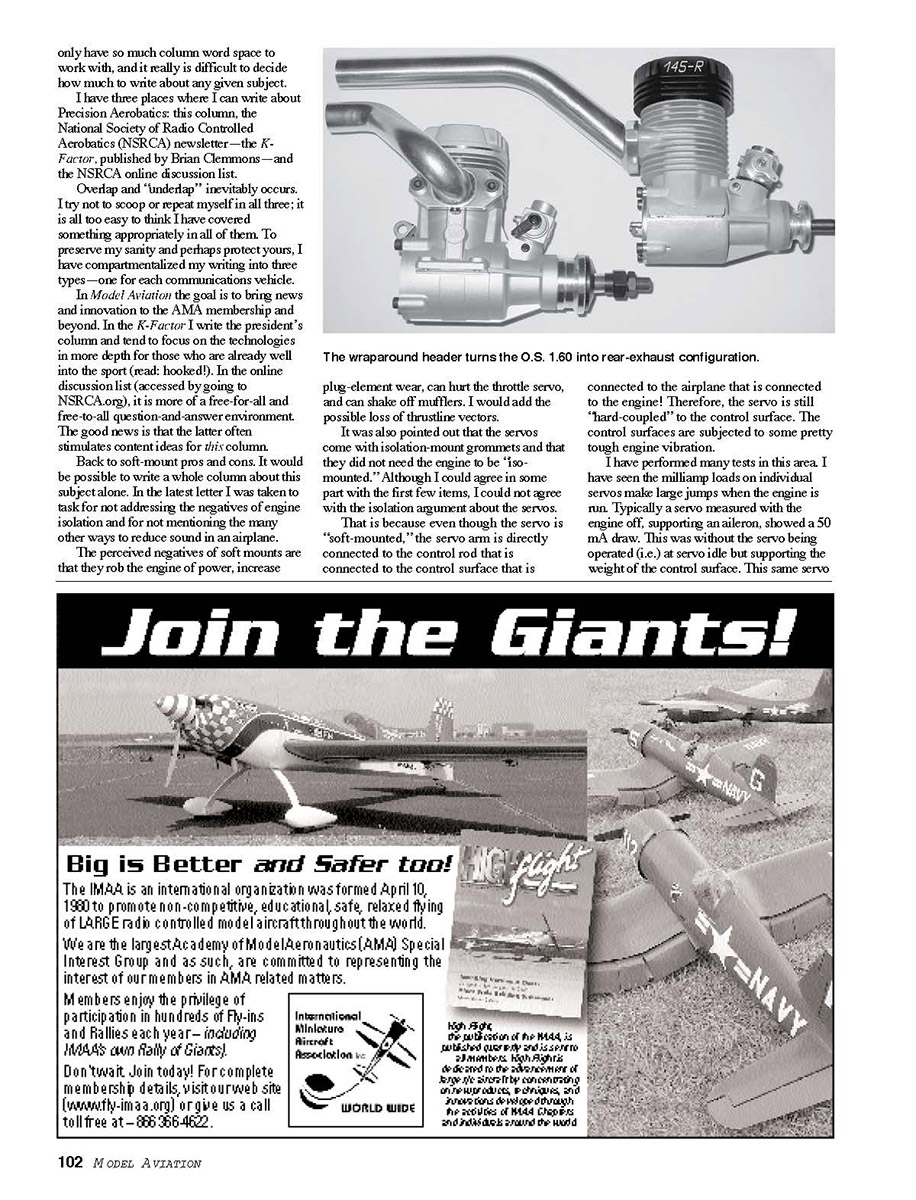
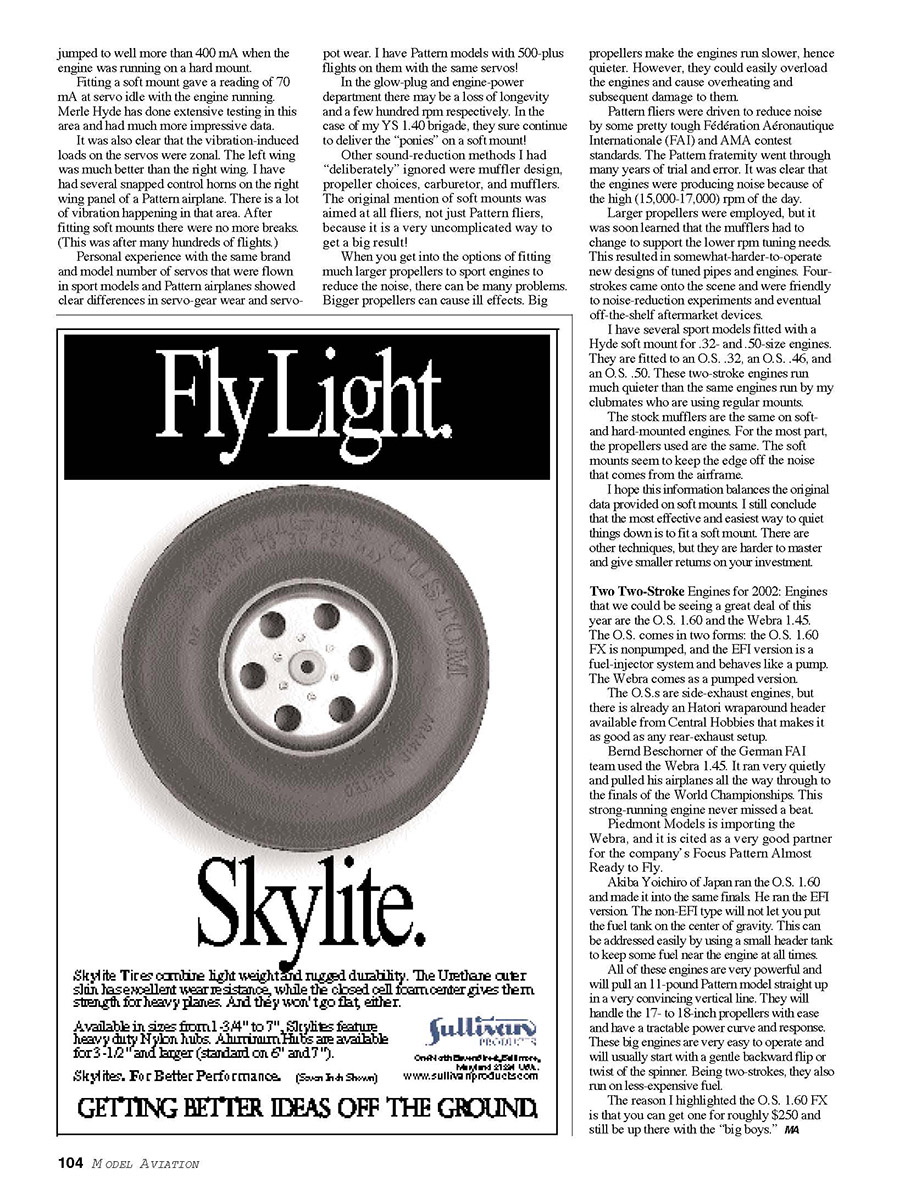
Engines that we could be seeing a great deal of this year are the O.S. 1.60 and the Webra 1.45. The O.S. comes in two forms: the O.S. 1.60 FX is nonpumped, and the EFI version is a fuel-injector system and behaves like a pump. The Webra comes as a pumped version.
The O.S.s are side-exhaust engines, but there is already an Hatron wraparound header available from Central Hobbies that makes it as good as any rear-exhaust setup.
Bernd Beschorner of the German FAI team used the Webra 1.45. It ran very quietly and pulled his airplanes all the way through to the finals of the World Championships. This strong-running engine never missed a beat. Piedmont Models is importing the Webra, and it is cited as a very good partner for the company's Focus Pattern Almost Ready to Fly.
Akiba Yoichiro of Japan ran the O.S. 1.60 and made it into the same finals he ran the EFI version. The non-EFI type will not let you put the fuel tank on the center of gravity. This can be addressed easily by using a smaller header tank to keep some fuel near the engine at all times.
All of these engines are very powerful and will pull an 11-pound Pattern model straight up in a very convincing vertical line. They will handle the 17- to 18-inch propellers with ease and have a tractable power curve and response. These big engines are very easy to operate and will usually start with a gentle backward flip or twist of the spinner. Being two-strokes, they also run on less-expensive fuel.
The reason I highlighted the O.S. 1.60 FX is that you can get one for roughly $250 and still be up there with the "big boys." MA
Transcribed from original scans by AI. Minor OCR errors may remain.