Great Planes Shoestring
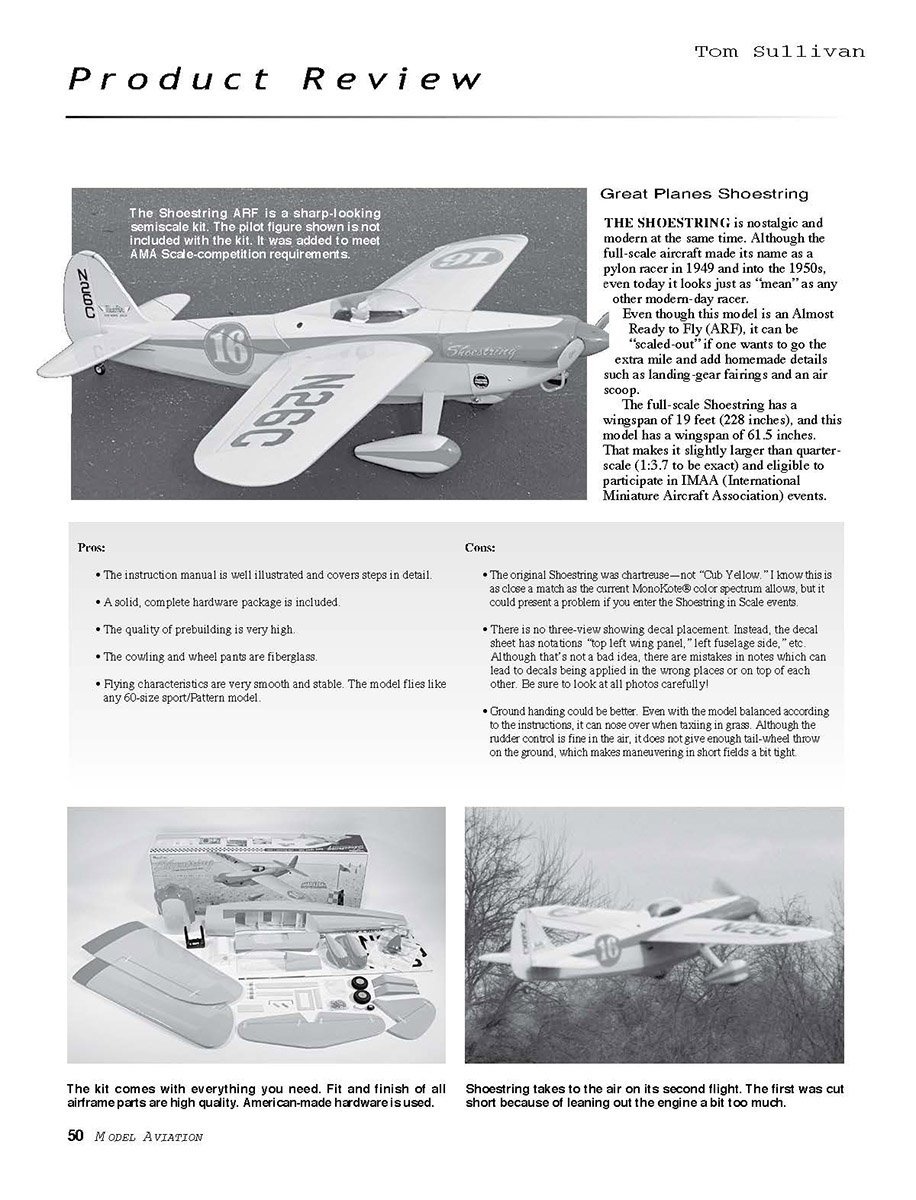
THE SHOESTRING is nostalgic and modern at the same time. Although the full-scale aircraft made its name as a pylon racer in 1949 and into the 1950s, even today it looks just as "mean" as any other modern-day racer.
Even though this model is an Almost Ready to Fly (ARF), it can be "scaled-out" if one wants to go the extra mile and add homemade details such as landing-gear fairings and an air scoop.
The full-scale Shoestring has a wingspan of 19 feet (228 inches), and this model has a wingspan of 61.5 inches. That makes it slightly larger than quarter-scale (1:3.7 to be exact) and eligible to participate in IMAA (International Miniature Aircraft Association) events.
Pros:
- The instruction manual is well illustrated and covers steps in detail.
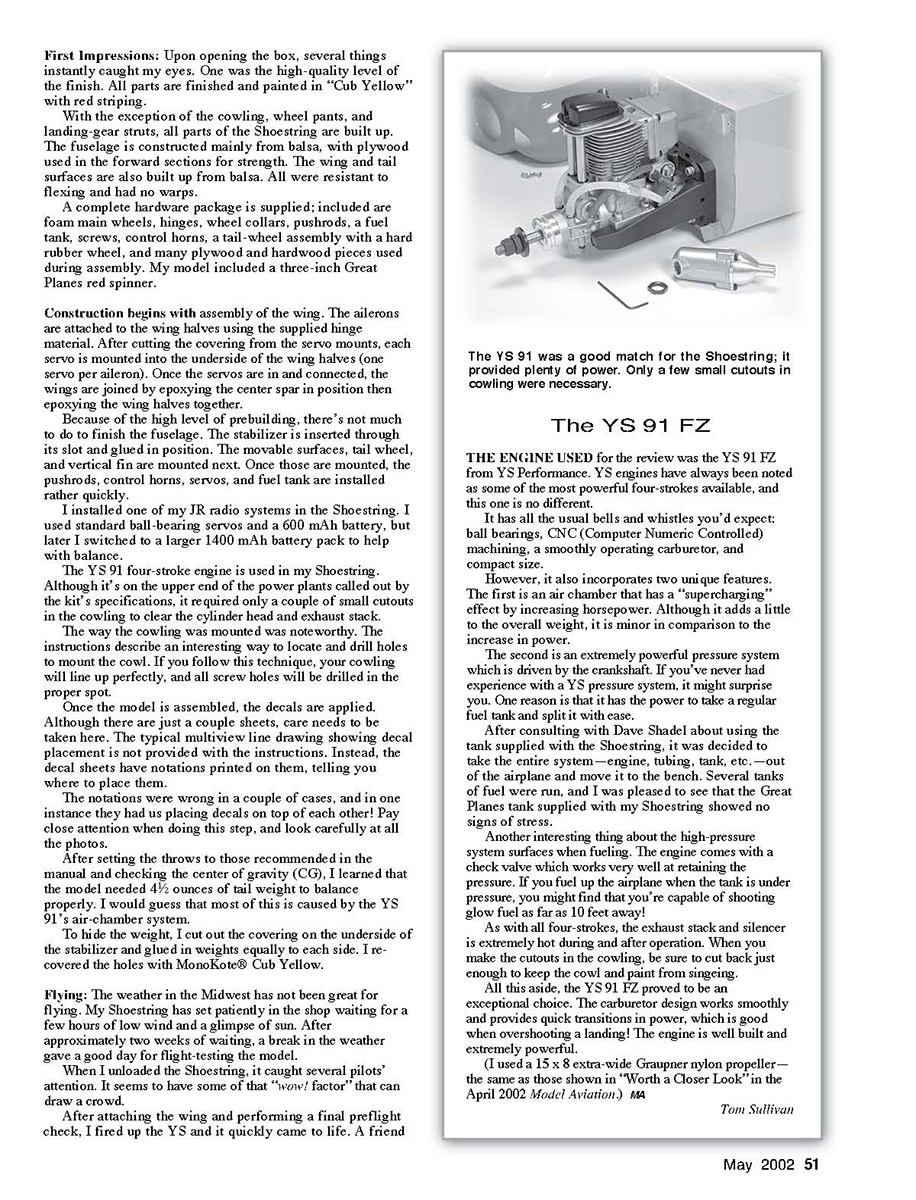
- A solid, complete hardware package is included.
- The quality of prebuilding is very high.
- The cowling and wheel pants are fiberglass.
- Flying characteristics are very smooth and stable. The model flies like any 60-size sport/Pattern model.
Cons:
- The original Shoestring was chartreuse—not "Cub Yellow." I know this is as close a match as the current MonoKote® color spectrum allows, but it could present a problem if you enter the Shoestring in Scale events.
- There is no three-view showing decal placement. Instead, the decal sheet has notations "top left wing panel," "left fuselage side," etc. Although that's not a bad idea, there are mistakes in notes which can lead to decals being applied in the wrong places or on top of each other. Be sure to look at all photos carefully!
- Ground handling could be better. Even with the model balanced according to the instructions, it can nose over when taxiing in grass. Although the rudder control is fine in the air, it does not give enough tail-wheel throw on the ground, which makes maneuvering in short fields a bit tight.
Construction begins with assembly of the wing. The ailerons are attached to the wing halves using the supplied hinge material. After cutting the covering from the servo mounts, each servo is mounted into the underside of the wing halves (one servo per aileron). Once the servos are in and connected, the wings are joined by epoxying the center spar in position then epoxying the wing halves together.
Because of the high level of prebuilding, there's not much to do to finish the fuselage. The stabilizer is inserted through its slot and glued in position. The movable surfaces, tail wheel, and vertical fin are mounted next. Once those are mounted, the pushrods, control horns, servos, and fuel tank are installed rather quickly.
I installed one of my JR radio systems in the Shoestring. I used standard ball-bearing servos and a 600 mAh battery, but later I switched to a larger 1400 mAh battery pack to help with balance.
The YS 91 four-stroke engine is used in my Shoestring. Although it's on the upper end of the power plants called out by the kit's specifications, it required only a couple of small cutouts in the cowling to clear the cylinder head and exhaust stack.
The way the cowling was mounted was noteworthy. The instructions describe an interesting way to locate and drill holes to mount the cowl. If you follow this technique, your cowling will line up perfectly, and all screw holes will be drilled in the proper spot.
Once the model is assembled, the decals are applied. Although there are just a couple sheets, care needs to be taken here. The typical multiview line drawing showing decal placement is not provided with the instructions. Instead, the decal sheets have notations printed on them, telling you where to place them.
The notations were wrong in a couple of cases, and in one instance they had us placing decals on top of each other! Pay close attention when doing this step, and look carefully at all the photos.
After setting the throws to those recommended in the manual and checking the center of gravity (CG), I learned that the model needed 4½ ounces of tail weight to balance properly. I would guess that most of this is caused by the YS 91's air-chamber system.
To hide the weight, I cut out the covering on the underside of the stabilizer and glued in weights equally to each side. I recovered the holes with MonoKote® Cub Yellow.
Flying: The weather in the Midwest has not been great for flying. My Shoestring has sat patiently in the shop waiting for a few hours of low wind and a glimpse of sun. After approximately two weeks of waiting, a break in the weather gave a good day for flight-testing the model.
When I unloaded the Shoestring, it caught several pilots' attention. It seems to have some of that "wow!" factor that can draw a crowd.
After attaching the wing and performing a final preflight check, I fired up the YS and it quickly came to life. A friend
The YS 91 FZ
THE ENGINE USED for the review was the YS 91 FZ from YS Performance. YS engines have always been noted as some of the most powerful four-strokes available, and this one is no different.
It has all the usual bells and whistles you'd expect: ball bearings, CNC (Computer Numeric Controlled) machining, a smoothly operating carburetor, and compact size.
However, it also incorporates two unique features. The first is an air chamber that has a "supercharging" effect by increasing horsepower. Although it adds a little to the overall weight, it is minor in comparison to the increase in power.
The second is an extremely powerful pressure system which is driven by the crankshaft. If you've never had experience with a YS pressure system, it might surprise you. One reason is that it has the power to take a regular fuel tank and split it with ease.
After consulting with Dave Shadel about using the tank supplied with the Shoestring, it was decided to take the entire system—engine, tubing, tank, etc.—out of the airplane and move it to the bench. Several tanks of fuel were run, and I was pleased to see that the Great Planes tank supplied with my Shoestring showed no signs of stress.
Another interesting thing about the high-pressure system surfaces when fueling. The engine comes with a check valve which works very well at retaining the pressure. If you fuel up the airplane when the tank is under pressure, you might find that you're capable of shooting glow fuel as far as 10 feet away!
As with all four-strokes, the exhaust stack and silencer is extremely hot during and after operation. When you make the cutouts in the cowling, be sure to cut just enough to keep the cowl and paint from singeing.
All this aside, the YS 91 FZ proved to be an exceptional choice. The carburetor design works smoothly and provides quick transitions in power, which is good when overshooting a landing! The engine is well built and extremely powerful.
I used a 15 x 8 extra-wide Graupner nylon propeller—the same as those shown in "Worth a Closer Look" in the April 2002 Model Aviation.
Tom Sullivan, who helped me during the flights, commented that the engine pulled quite a bit more than he expected.
Taxiing out to the field showed a couple of problems. When taxiing through the grass parts of our field, the model had a tendency to nose forward and strike the propeller. Although it was balanced according to the instructions, the landing gear performed as you close to the CG.
Also, the steering on the ground was not quite as tight as I would like, even after switching to high rates on rudder.
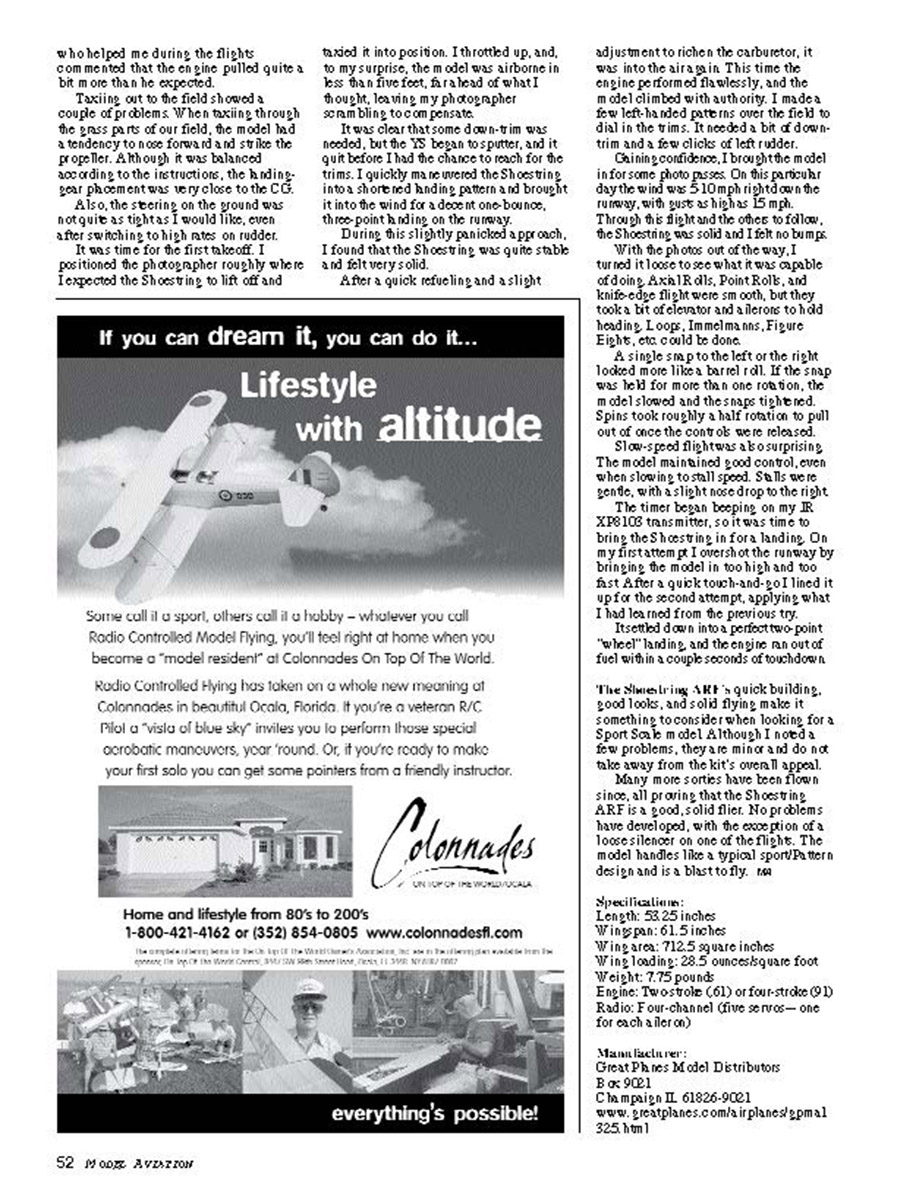
It was time for the first takeoff. I positioned the photographer roughly where I expected the Shoestring to lift off and taxied it into position. I throttled up, and, to my surprise, the model was airborne in less than five feet, far ahead of what I thought, leaving my photographer scrambling to compensate.
It was clear that some down-trim was needed, but the YS began to sputter, and it quit before I had the chance to reach for the trims. I quickly maneuvered the Shoestring into a short end-over-end pattern and brought it into the wind for a decent one-bounce, tree-point landing on the runway.
During this slightly panicked approach, I found that the Shoestring was quite stable and felt very solid.
After a quick refueling and a slight adjustment to richen the carburetor, it was into the air again. This time the engine performed flawlessly, and the model climbed with authority. I made a few left-hand patterns over the field to dial in the trims. It needed a bit of down-trim and a few clicks of left rudder.
Climbing confidence, I brought the model in for some photo passes. On this particular day the wind was 5-10 mph right down the runway, with gusts as high as 15 mph. Through this flight and the others to follow, the Shoestring was solid and I felt no bumps.
With the photos out of the way, I turned it loose to see what it was capable of doing. Axial Rolls, Point Rolls, and knife-edge flight were smooth, but they took a bit of elevator and ailerons to hold heading. Loops, Immelmanns, Figure Eights, etc. could be done.
A single snap to the left or the right looked more like a barrel roll. If the snap was held for more than one rotation, the model slowed and the snaps tightened. Spins took roughly a half rotation to pull out once the controls were released.
Slow-speed flight was also surprising. The model maintained good control, even when slowed to stall speed. Stalls were gentle, with a slight nose drop to the right.
The timer began beeping on my JR XP8103 transmitter, so it was time to bring the Shoestring in for a landing. On my first attempt I overshot the runway by bringing the model in too high and too fast. After a quick touch-and-go I lined it up for the second attempt, applying what I had learned from the previous try.
I settled down into a perfect two-point "wheel" landing, and the engine ran out of fuel within a couple seconds of touchdown.
The Shoestring ARF's quick building, good looks, and solid flying make it something to consider when looking for a Sport Scale model. Although I noted a few problems, they are minor and do not take away from the kit's overall appeal.
Many more sorties have been flown since, all proving that the Shoestring ARF is a good, solid flier. No problems have developed, with the exception of a loose silencer on one of the flights. The model handles like a typical sport/pattern design and is a blast to fly.
Transcribed from original scans by AI. Minor OCR errors may remain.