Focal Point
Model Aviation, 5161 E. Memorial Dr., Muncie IN 47302
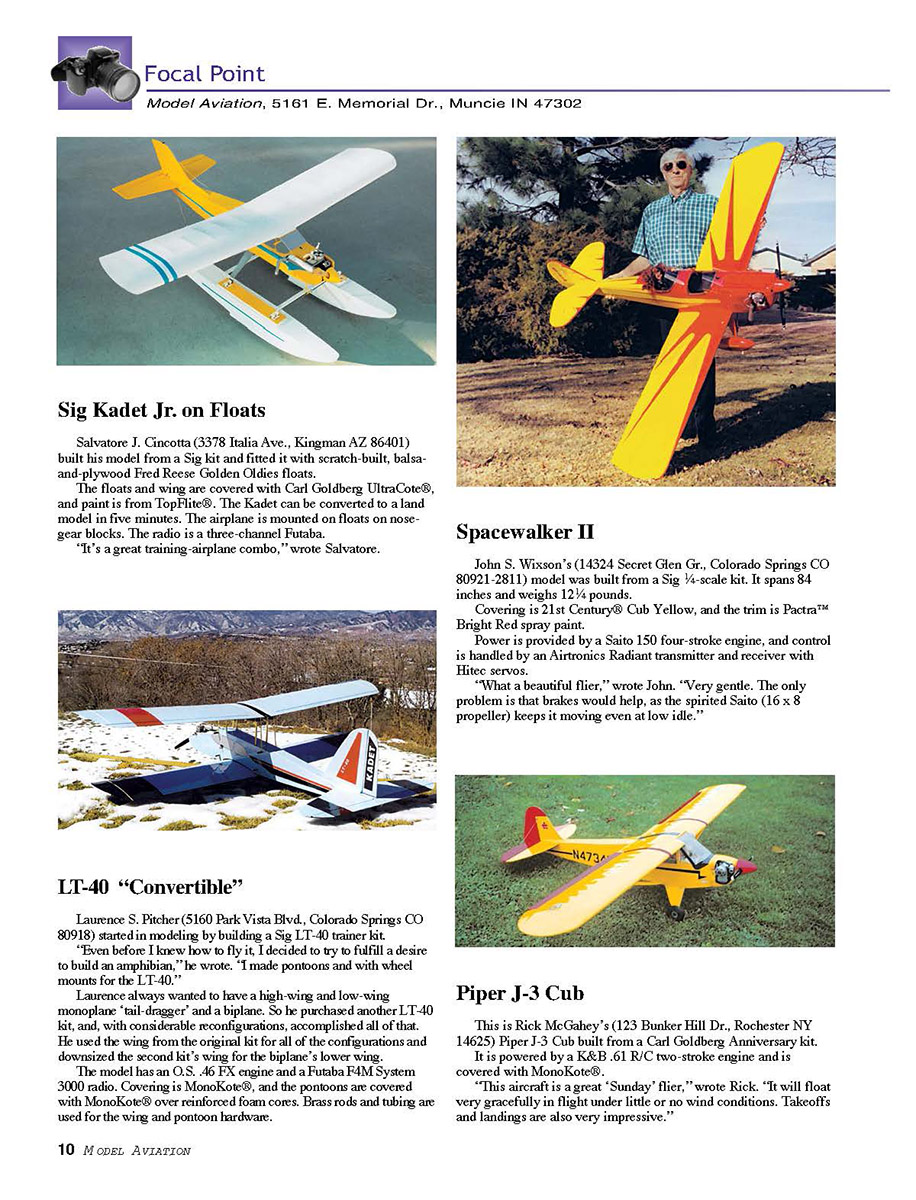
Sig Kadet Jr. on Floats
Salvatore J. Cincotta (3378 Italia Ave., Kingman AZ 86401) built his model from a Sig kit and fitted it with scratch-built, balsa-and-plywood Fred Reese Golden Oldies floats.
The floats and wing are covered with Carl Goldberg UltraCote®, and paint is from TopFlite®. The Kadet can be converted to a land model in five minutes. The airplane is mounted on floats on nose-gear blocks. The radio is a three-channel Futaba.
"It's a great training-airplane combo," wrote Salvatore.
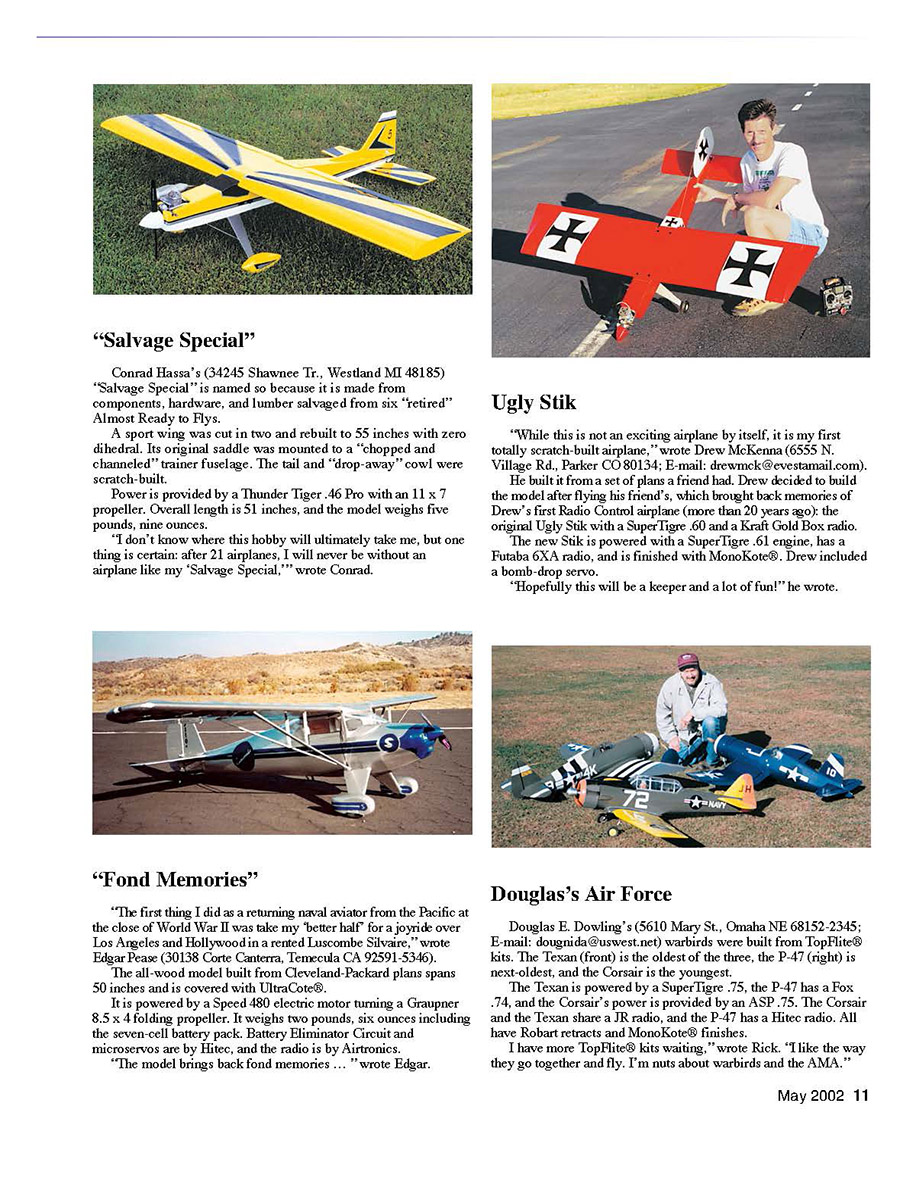
Spacewalker II
John S. Wixson's (14324 Secret Glen Gr., Colorado Springs CO 80921-2811) model was built from a Sig 1/4-scale kit. It spans 84 inches and weighs 12 1/4 pounds.
Covering is 21st Century® Cub Yellow, and the trim is Pactra™ Bright Red spray paint.
Power is provided by a Saito 150 four-stroke engine, and control is handled by an Airtronics Radiant transmitter and receiver with Hitec servos.
"What a beautiful flier," wrote John. "Very gentle. The only problem is that brakes would help, as the spirited Saito (16 x 8 propeller) keeps it moving even at low idle."
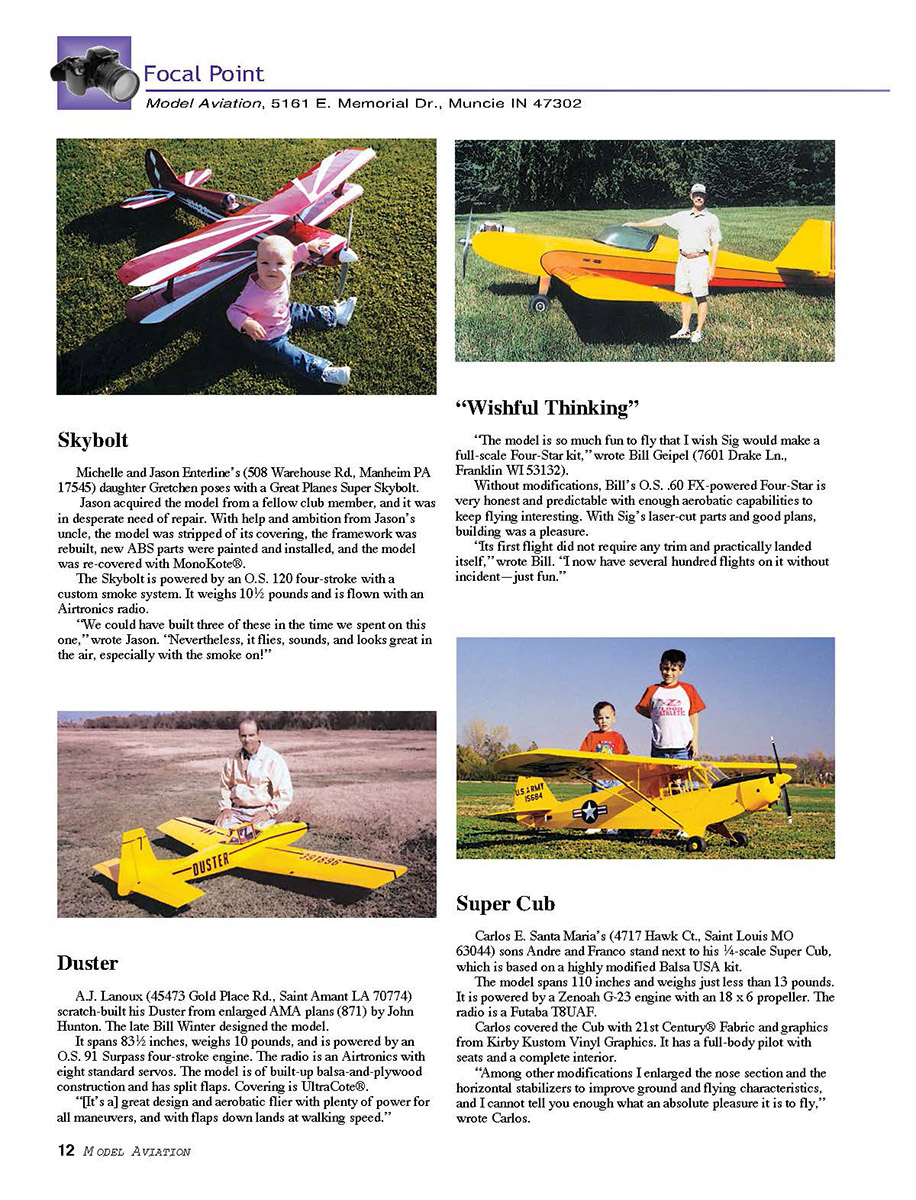
LT-40 "Convertible"
Laurence S. Pitcher (5160 Park Vista Blvd., Colorado Springs CO 80918) started in modeling by building a Sig LT-40 trainer kit.
"Even before I knew how to fly it, I decided to try to fulfill a desire to build an amphibian," he wrote. "I made pontoons and wheel mounts for the LT-40."
Laurence always wanted to have a high-wing and low-wing monoplane 'tail-dragger' and a biplane. So he purchased another LT-40 kit, and, with considerable reconfigurations, accomplished all of that. He used the wing from the original kit for all of the configurations and downsized the second kit's wing for the biplane's lower wing.
The model has an O.S. .46 FX engine and a Futaba F4M System 3000 radio. Covering is MonoKote®, and the pontoons are covered with MonoKote® over reinforced foam cores. Brass rods and tubing are used for the wing and pontoon hardware.
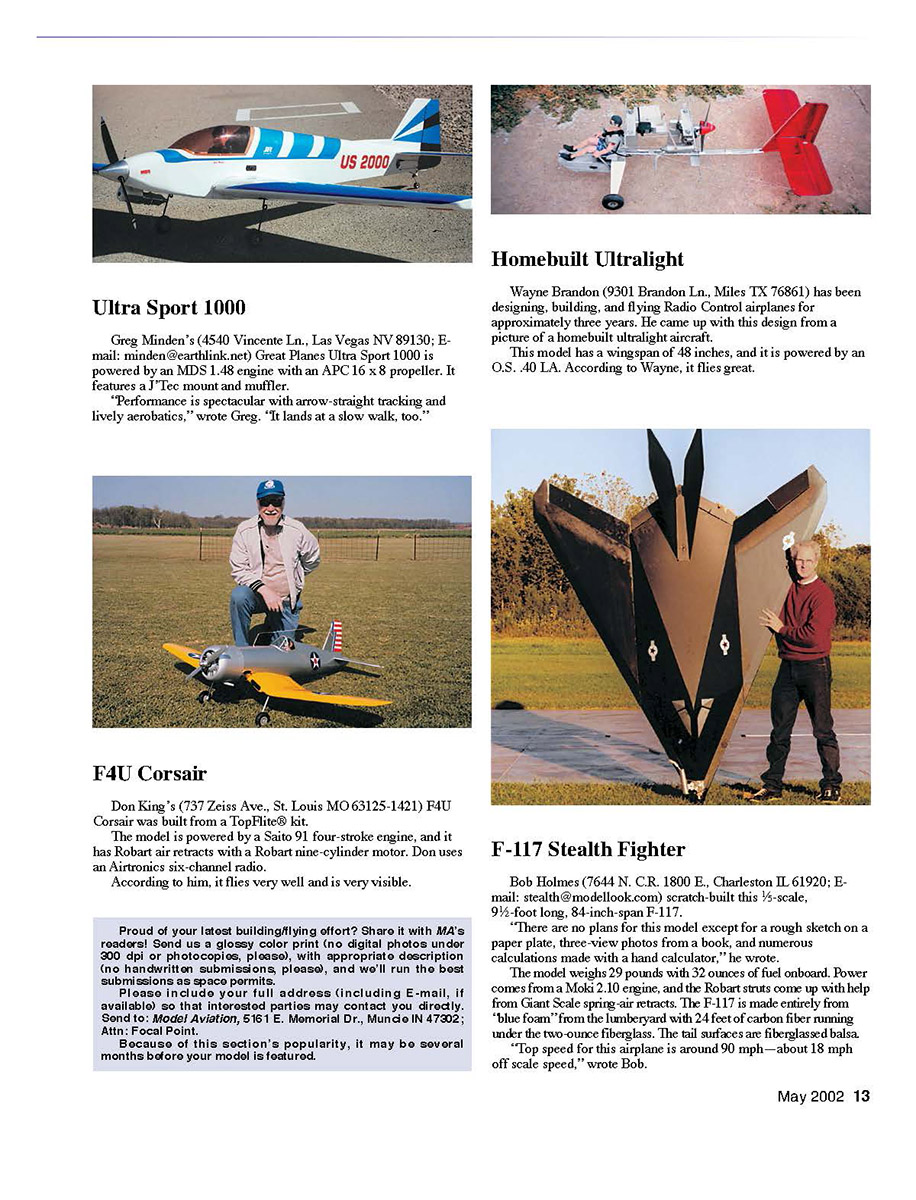
Piper J-3 Cub
This is Rick McGahey's (123 Bunker Hill Dr., Rochester NY 14625) Piper J-3 Cub built from a Carl Goldberg Anniversary kit.
It is powered by a K&B .61 R/C two-stroke engine and is covered with MonoKote®.
"This aircraft is a great 'Sunday' flier," wrote Rick. "It will float very gracefully in flight under little or no wind conditions. Takeoffs and landings are also very impressive."
"Salvage Special"
Conrad Hassa's (34245 Shawnee Tr., Westland MI 48185) "Salvage Special" is named so because it is made from components, hardware, and lumber salvaged from six "retired" Almost Ready to Flys.
A sport wing was cut in two and rebuilt to 55 inches with zero dihedral. Its original saddle was mounted to a "chopped and channeled" trainer fuselage. The tail and "drop-away" cowl were scratch-built.
Power is provided by a Thunder Tiger .46 Pro with an 11 x 7 propeller. Overall length is 51 inches, and the model weighs five pounds, nine ounces.
"I don't know where this hobby will ultimately take me, but one thing is certain: after 21 airplanes, I will never be without an airplane like my 'Salvage Special,'" wrote Conrad.
Ugly Stik
"While this is not an exciting airplane by itself, it is my first totally scratch-built airplane," wrote Drew McKenna (6555 N. Village Rd., Parker CO 80134; E-mail: drewmck@evestamail.com).
He built it from a set of plans a friend had. Drew decided to build the model after flying his friend's, which brought back memories of Drew's first Radio Control airplane (more than 20 years ago): the original Ugly Stik with a SuperTigre .60 and a Kraft Gold Box radio.
The new Stik is powered with a SuperTigre .61 engine, has a Futaba 6XA radio, and is finished with MonoKote®. Drew included a bomb-drop servo.
"Hopefully this will be a keeper and a lot of fun!" he wrote.
"Fond Memories"
"The first thing I did as a returning naval aviator from the Pacific at the close of World War II was take my 'better half' for a joyride over Los Angeles and Hollywood in a rented Luscombe Silvaire," wrote Edgar Pease (30138 Corte Cantura, Temecula CA 92591-5346).
The all-wood model built from Cleveland-Packard plans spans 50 inches and is covered with UltraCote®.
It is powered by a Speed 480 electric motor turning a Graupner 8.5 x 4 folding propeller. It weighs two pounds, six ounces including the seven-cell battery pack. Battery Eliminator Circuit and microservos are by Hitec, and the radio is by Airtronics.
"The model brings back fond memories ..." wrote Edgar.
Douglas's Air Force
Douglas E. Dowling's (5610 Mary St., Omaha NE 68152-2345; E-mail: dougdna@uswest.net) warbirds were built from TopFlite® kits. The Texan (front) is the oldest of the three, the P-47 (right) is next-oldest, and the Corsair is the youngest.
The Texan is powered by a SuperTigre .75, the P-47 has a Fox .74, and the Corsair's power is provided by an ASP .75. The Corsair and the Texan share a JR radio, and the P-47 has a Hitec radio. All have Robart retracts and MonoKote® finishes.
"I have more TopFlite® kits waiting," wrote Rick. "I like the way they go together and fly. I'm nuts about warbirds and the AMA."
Skybolt
Michelle and Jason Enterline's (508 Warehouse Rd., Manheim PA 17545) daughter Gretchen poses with a Great Planes Super Skybolt.
Jason acquired the model from a fellow club member, and it was in desperate need of repair. With help and ambition from Jason's uncle, the model was stripped of its covering, the framework was rebuilt, new ABS parts were repaired and installed, and the model was re-covered with MonoKote®.
The Skybolt is powered by an O.S. 120 four-stroke with a custom smoke system. It weighs 10½ pounds and is flown with an Airtronics radio.
"We could have built three of these in the time we spent on this one," wrote Jason. "Nevertheless, it flies, sounds, and looks great in the air, especially with the smoke on!"
"Wishful Thinking"
"The model is so much fun to fly that I wish Sig would make a full-scale Four-Star kit," wrote Bill Geipel (7601 Drake Ln., Franklin WI 53132).
Without modifications, Bill's O.S. .60 FX-powered Four-Star is very honest and predictable with enough aerobatic capabilities to keep flying interesting. With Sig's laser-cut parts and good plans, building was a pleasure.
"Its first flight did not require any trim and practically landed itself," wrote Bill. "I now have several hundred flights on it without incident—just fun."
Duster
A.J. Lanoux (45473 Gold Place Rd., Saint Amant LA 70774) scratch-built his Duster from enlarged AMA plans (871) by John Hunton. The late Bill Winter designed the model.
It spans 83½ inches, weighs 10 pounds, and is powered by an O.S. .91 Surpass four-stroke engine. The radio is an Airtronics with eight standard servos. The model is of built-up balsa-and-plywood construction and has split flaps. Covering is UltraCote®.
"[It's] a great design and aerobatic flier with plenty of power for maneuvers, and with flaps down lands at walking speed."
Super Cub
Carlos E. Santa Maria's (4717 Hawk Ct., Saint Louis MO 63044) sons Andre and Franco stand next to his 1/4-scale Super Cub, which is based on a highly modified Balsa USA kit.
The model spans 110 inches and weighs just less than 13 pounds. It is powered by a Zenoah G-23 engine with an 18 x 6 propeller. The radio is a Futaba T8UAF.
Carlos covered the Cub with 21st Century® fabric and graphics from Kirby Kustom Vinyl Graphics. It has a full-body pilot with seats and a complete interior.
"Among other modifications I enlarged the nose section and the horizontal stabilizers to improve ground and flying characteristics, and I cannot tell you enough what an absolute pleasure it is to fly," wrote Carlos.
Ultra Sport 1000
Greg Minden's (4540 Vincente Ln., Las Vegas NV 89130; E-mail: minden@earthlink.net) Great Planes Ultra Sport 1000 is powered by an MDS 1.48 engine with an APC 16 x 8 propeller. It features a J'Tec mount and muffler.
"Performance is spectacular with arrow-straight tracking and lively aerobatics," wrote Greg. "It lands at a slow walk, too."
Homebuilt Ultralight
Wayne Brandon (9301 Brandon Ln., Miles TX 76861) has been designing, building, and flying Radio Control airplanes for approximately three years. He came up with this design from a picture of a homebuilt ultralight aircraft.
This model has a wingspan of 48 inches, and it is powered by an O.S. .40 LA. According to Wayne, it flies great.
F4U Corsair
Don King's (737 Zeiss Ave., St. Louis MO 63125-1421) F4U Corsair was built from a TopFlite® kit.
The model is powered by a Saito 91 four-stroke engine, and it has Robart air retracts with a Robart nine-cylinder motor. Don uses an Airtronics six-channel radio.
According to him, it flies very well and is very visible.
Proud of your latest building/flying effort? Share it with MA's readers! Send us a glossy color print (no digital photos under 300 dpi or photocopies, please), with appropriate description (no handwritten submissions, please), and we'll run the best submissions as space permits.
Please include your full address (including E-mail, if available) so that interested parties may contact you directly. Send to: Model Aviation, 5161 E. Memorial Dr., Muncie IN 47302; Attn: Focal Point.
Because of this section's popularity, it may be several months before your model is featured.
F-117 Stealth Fighter
Bob Holmes (7644 N. C.R. 1800 E., Charleston IL 61920; E-mail: stealth@modellook.com) scratch-built this 1/5-scale, 9½-foot long, 84-inch-span F-117.
"There are no plans for this model except for a rough sketch on a paper plate, three-view photos from a book, and numerous calculations made with a hand calculator," he wrote.
The model weighs 29 pounds with 32 ounces of fuel onboard. Power comes from a Moki 2.10 engine, and the Robart struts came up with help from Giant Scale spring-axle retracts. The F-117 is made entirely from "blue foam" from the lumberyard with 24 feet of carbon fiber running under the two-ounce fiberglass. The tail surfaces are fiberglassed balsa.
"Top speed for this airplane is around 90 mph—about 18 mph off scale speed," wrote Bob.
Transcribed from original scans by AI. Minor OCR errors may remain.