Flying for Fun
909 N. Maize Rd., Townhouse 734, Wichita KS 67212
By the time this column reaches you, several other columnists may have already had their comments on the FMA Direct Co-Pilot™ published. I presume they have tested and reported on the Co-Pilot™ trainer-type models, for which it is wonderfully well suited.
I have long advocated the use of inherently stable model designs with light wing loadings, such as Old-Timers and powered gliders, as first trainers for novice pilots. These model types have the ability to return to level flight when the sticks are allowed to center. If the pilot becomes disoriented or panicked, he or she can "let go of the sticks," and the model will correct itself to a straight and level attitude.
With the Co-Pilot™ installed, any model—be it trainer, helicopter, flying wing, or, as I will detail, unstable aerobatic or Scale—can benefit from this ability to return to level flight once the sticks are released.
This unit can enable a rank beginner to fly a model successfully with minimum training time. It can also smooth out an average pilot's flying and make him or her look like an expert.
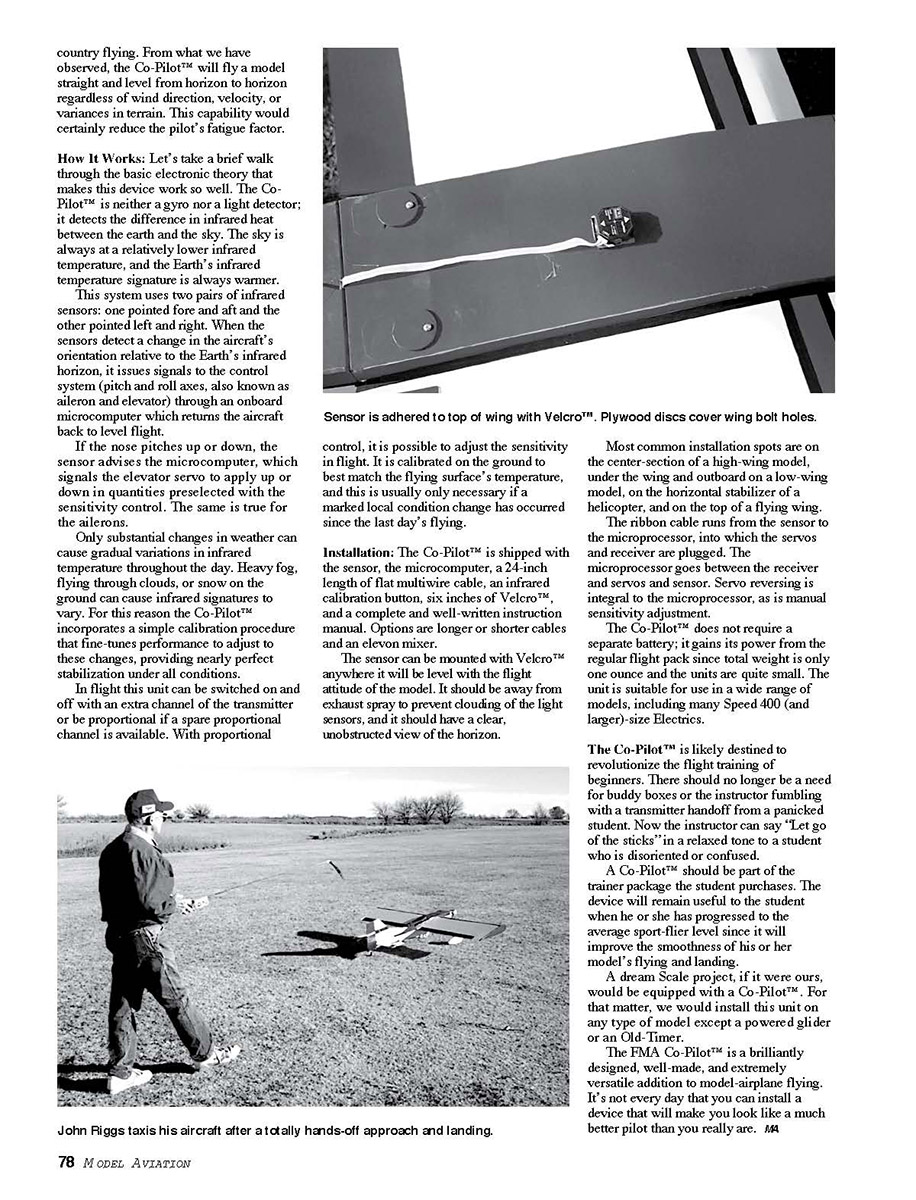
Test: In the name of being different (or contrary), I asked flying buddy John Riggs to install the sample Co-Pilot™ in his Quadra 42-powered, fully aerobatic—but unstable—model to test. It is obvious that the system will greatly shorten the learning time on a trainer, but, as we learned, it will also greatly improve the flying qualities of a fully aerobatic model.
We installed the test unit on a model that was apparently improperly balanced or suffered from incorrect surface deflections. With the Co-Pilot™ turned on and set for the upper end of the sensitivity scale, this model will correct for wind gusts and fly straight and level as if it was on rails.
It is possible to execute landings using only the throttle control; the model will fly level without correction and descend as the power is reduced. Loops don't tend to wander off to one side or the other; this unit keeps the wings level in spite of how severely the pilot messes up. Rolls recover to level and straight ahead by merely allowing the sticks to center.
Although the manufacturer does not recommend it, the model will fly level and straight inverted with a quick return to level, upright flight once rolled out.
With the Co-Pilot™ turned on, this particular model is fun to fly; with the system off, it is a nasty flier that requires constant correction and inputs. We flew the airplane for a few minutes with the Co-Pilot™ turned on, then we asked that it be shut off. In an instant, a model that had been rather well behaved and enjoyable to fly became what we consider an exceptionally nasty beast that had to be flown every minute and was all over the sky.
We immediately turned the Co-Pilot™ back on, and we refuse to fly the model without it in the future. If this device works that well on a beast, it should be wonderful on a more stable aerobatic model and irreplaceable for a student trainer.
With the aid of the Co-Pilot™ the model's wing remained level to the ground, it held its headings beautifully with no tendency for unwanted climbs and dives (porpoising), and it made lovely, well-controlled turns.
Pulled up into a brisk stall, one can release the sticks and the model will return itself to level flight. If a spin is initiated, the model will return to level flight on its own. We deliberately tossed the model into all sorts of attitudes, from which it recovered instantly once the sticks were released.
It seems that the Co-Pilot™ will be an indispensable device for learning fundamental aerobatics later in the training cycle.
Though we have no first-hand knowledge of the Co-Pilot™ in helicopter use, we have been told about several rank beginners who used it to learn to hover in one or two flights.
Another use that occurred to us is cross-country flying. From what we have observed, the Co-Pilot™ will fly a model straight and level from horizon to horizon regardless of wind direction, velocity, or variances in terrain. This capability would certainly reduce the pilot's fatigue factor.
How It Works: Let's take a brief walk through the basic electronic theory that makes this device work so well. The Co-Pilot™ is neither a gyro nor a light detector; it detects the difference in infrared heat between the earth and the sky. The sky is always at a relatively lower infrared temperature, and the Earth's infrared temperature signature is always warmer.
This system uses two pairs of infrared sensors: one pointed fore and aft and the other pointed left and right. When the sensors detect a change in the aircraft's orientation relative to the Earth's infrared horizon, it issues signals to the control system (pitch and roll axes, also known as aileron and elevator) through an onboard microcomputer which returns the aircraft back to level flight.
If the nose pitches up or down, the sensor advises the microcomputer, which signals the elevator servo to apply up or down in quantities preselected with the sensitivity control. The same is true for the ailerons.
Only substantial changes in weather can cause gradual variations in infrared temperature throughout the day. Heavy fog, flying through clouds, or snow on the ground can cause infrared signatures to vary. For this reason the Co-Pilot™ incorporates a simple calibration procedure that fine-tunes performance to adjust to these changes, providing nearly perfect stabilization under all conditions.
In flight this unit can be switched on and off with an extra channel of the transmitter or be proportional if a spare proportional channel is available. With proportional control, it is possible to adjust the sensitivity in flight. It is calibrated on the ground to best match the flying surface's temperature, and this is usually only necessary if a marked local condition change has occurred since the last day's flying.
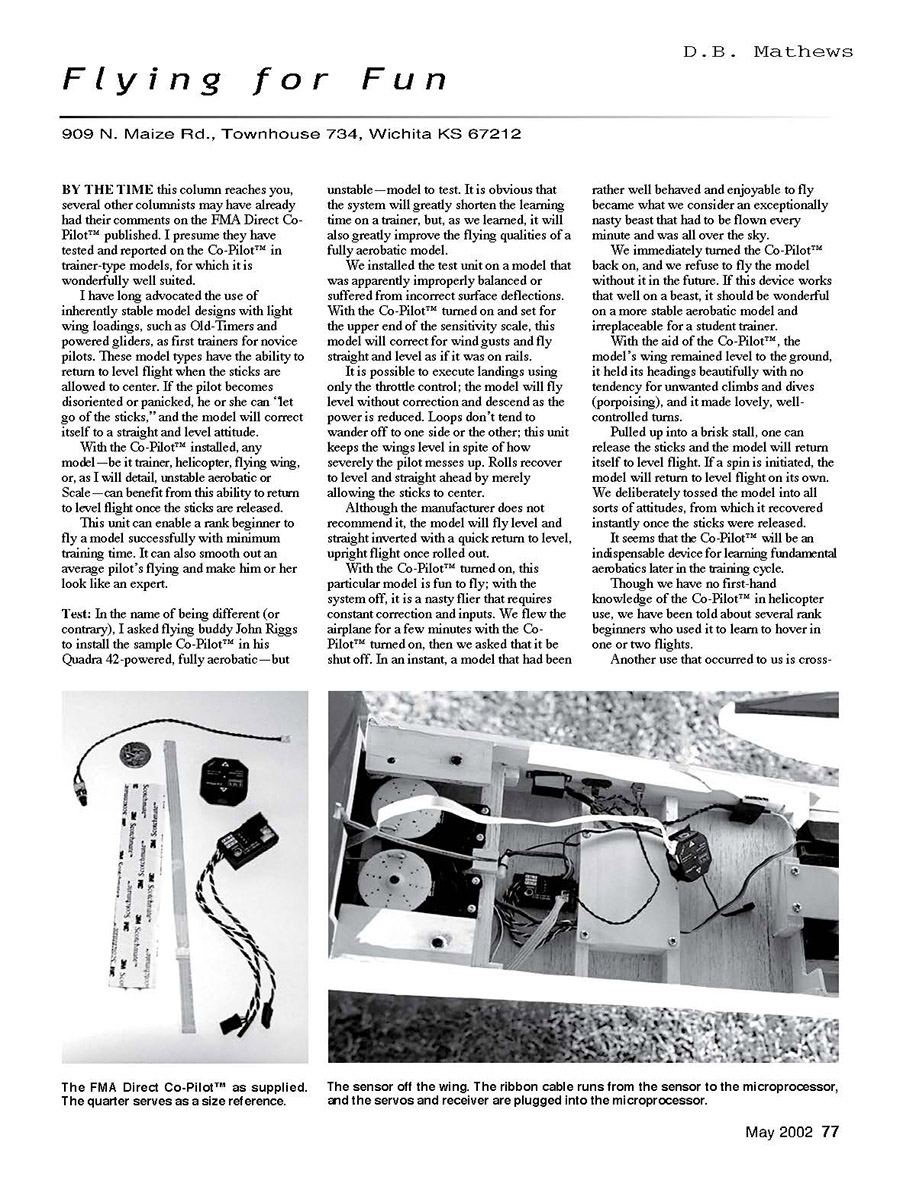
Installation: The Co-Pilot™ is shipped with the sensor, the microcomputer, a 24-inch length of flat multiwire cable, an infrared calibration button, six inches of Velcro™, and a complete and well-written instruction manual. Options are longer or shorter cables and an elevator mixer.
The sensor can be mounted with Velcro™ anywhere it will be level with the flight attitude of the model. It should be away from exhaust spray to prevent clouding of the light sensors, and it should have a clear, unobstructed view of the horizon.
Most common installation spots are on the center-section of a high-wing model, under the wing and outboard on a low-wing model, on the horizontal stabilizer of a helicopter, and on the top of a flying wing.
The ribbon cable runs from the sensor to the microprocessor, into which the servos and receiver are plugged. The microprocessor goes between the receiver and servos and sensor. Servo reversing is integral to the microprocessor, as is manual sensitivity adjustment.
The Co-Pilot™ does not require a separate battery; it gains its power from the regular flight pack since total weight is only one ounce and the units are quite small. The unit is suitable for use in a wide range of models, including many Speed 400 (and larger)-size Electrics.
The Co-Pilot™ is likely destined to revolutionize the flight training of beginners. There should no longer be a need for buddy boxes or the instructor fumbling with a transmitter handoff from a panicked student. Now the instructor can say "Let go of the sticks" in a relaxed tone to a student who is disoriented or confused.
A Co-Pilot™ should be part of the trainer package the student purchases. The device will remain useful to the student when he or she has progressed to the average sport-flyer level since it will improve the smoothness of his or her model's flying and landing.
A dream Scale project, if it were ours, would be equipped with a Co-Pilot™. For that matter, we would install this unit on any type of model except a powered glider or an Old-Timer.
The FMA Co-Pilot™ is a brilliantly designed, well-made, and extremely versatile addition to model-airplane flying. It's not every day that you can install a device that will make you look like a much better pilot than you really are. J.A.
Transcribed from original scans by AI. Minor OCR errors may remain.