FF Indoor
JUNIOR F1D TEAM
Thanks to Vernon Hacker, we have profiles of two members of the first US Junior F1D Team. The following is a short biography that Ben Saks wrote. He relates his experience and progress in the field of Indoor model airplanes from 1998 to 2001, from beginner to Junior team member.
"My adventures in Indoor started with Science Olympiad [SO]. I first joined it in fifth grade, and loved every minute of it. In the middle school I was assigned to the Propeller Propulsion event. I knew nothing about airplanes, or how to build them. I started out with a heavy shoebox ROG [rise-off-ground] that consistently did five seconds diving to the floor. I was in desperate need of help.
"In February of my fifth-grade year, at the Solon Middle School Invitational, I met a man named Dr. Vernon Hacker who later I got to know as Hack. I went from doing five seconds to 30 seconds after an afternoon of trimming lessons, and was instantly hooked. I started building different designs and refined my building skills enough to break the two-minute mark.
"At Andrews School, I met some other very helpful Indoor aficionados: Don and Chuck Slusarczyk, Larry Loucka, Larry Mizik, and John Kagan, to name a few. Later that year my SO team made it to States and I had the opportunity to compete against many different schools.
"I had been flying two years and had accumulated a lot of equipment by then. I was now a freshman in high school, and was one of the core members of a strong SO team. My eight-gram biplane was doing over four minutes in practice flights at States.
"My airplane hung up on an official flight, and I got it down, but a spectator grabbed the airplane by the wings and destroyed it. I didn't have a backup, but I learned my lesson. At the State SO competition in my 10th-grade year, I won five medals, including fourth in Wright Stuff.
"By the third year of Indoor, I was flying Easy B, Limited PP [Pennyplane], PP, No-Cal, and others. My SO airplane was doing ok, but I started to get bored with all of the three-minute flight. John Kagan recommended building an F1D. I thought I might as well, and eventually built an unbraced airplane from Darryl Stevens' design. It weighed 1.9 grams and was doing 15 minutes in a Cat III site, so I was happy.
"I ordered more wood, and got different designs, and eventually came up with a mixture of Hunt's and Stevens' airplanes. I accomplished my goal of 20 minutes at USIC, and got a 21:58 high time. Getting a 19:11 and a 21:35 with F1D at USIC (US Indoor championships) put me on the team selection with a solid 91.87 points.
"After summer was over, and trials were around the corner, I swung into high gear. I refined my design, built stronger and lighter airplanes, and practiced. Getting a spot on the team was a thrill to end all, and more than I could have dreamed I could have done.
"Indoor is very rewarding, but it comes second to school. When I'm not flying, you can find me in the science lab at school working on an SO project, in the auditorium rehearsing for a play, or at a German Club meeting. Extracurricular activities are fun, but to me grades are more important, and so each new semester takes up a lot of my time.
"My other passion is fishing, which sometimes overlaps flying: I fly-fish and spin-fish for steelhead, bass, trout, and pike. Fishing and flying are very similar—add infinite variables and a goal, and you have a challenge, which is the main reason I do both."
Vern furnished the following biography of 15-year-old Doug Schaefer. It tells the story of a very determined person. However, it fails to mention how much Doug learned from Internet sources and the personal contacts that are mentioned on the three on his report cards.
"Doug had the longest flights of the Junior team members, and is also the youngest. His model aircraft experience started while he was involved in a science-fair project in sixth grade. That project was to try to learn the efficiency of seven different wings.
"Doug won first place in the science fair, this led to an invitation to join the middle school SO (Science Olympiad) team. Doug's curiosity, intelligence, perseverance during the next three years paid off. He now holds or has held the following Junior records: Cat I F1D, Cat II F1D, Easy B, and Cat I F1D.
"The best way to show his devotion to F1D is that between USIC in June and the flyoff, Doug built and flew nine different F1Ds and learned to build and adjust variable-pitch props. His exemplary flying at the Air Dock got him flights of 29:48 and 27:15—first place among the seven younger men.
"I don't wish to make Doug sound like a one-sided person; although he is only 15 he has interests besides model aviation. Some of these interests include playing saxophone in marching bands at the Northmont Middle School and fishing in Canada and their farm pond. At age 13 he is a Life Member of Boy Scouts.
"His activities with an SO team included second place in Mystery Architecture and Write It Do It at the state level. Doug has lots of home support from his sisters and his parents, Mark and Sandy.
"This report would be incomplete without mentioning the way he has learned Indoor modeling. First was help from schoolmate Matt Moline. Then there came the Internet; this was followed by help from many Indoor modelers. Walt VanGorder leads the list, followed by John Kagan, Don Slusarczyk, Fred Tellier, Larry Loucka, Tim Goldstein, Bruce McCrory, Vlad Linardic, Bucky Sweeites, Joe Mechina, and Gary Underwood.
"It started with a science project and Science Olympiad; now Doug is leading the team to Romania."
Steering Wrap
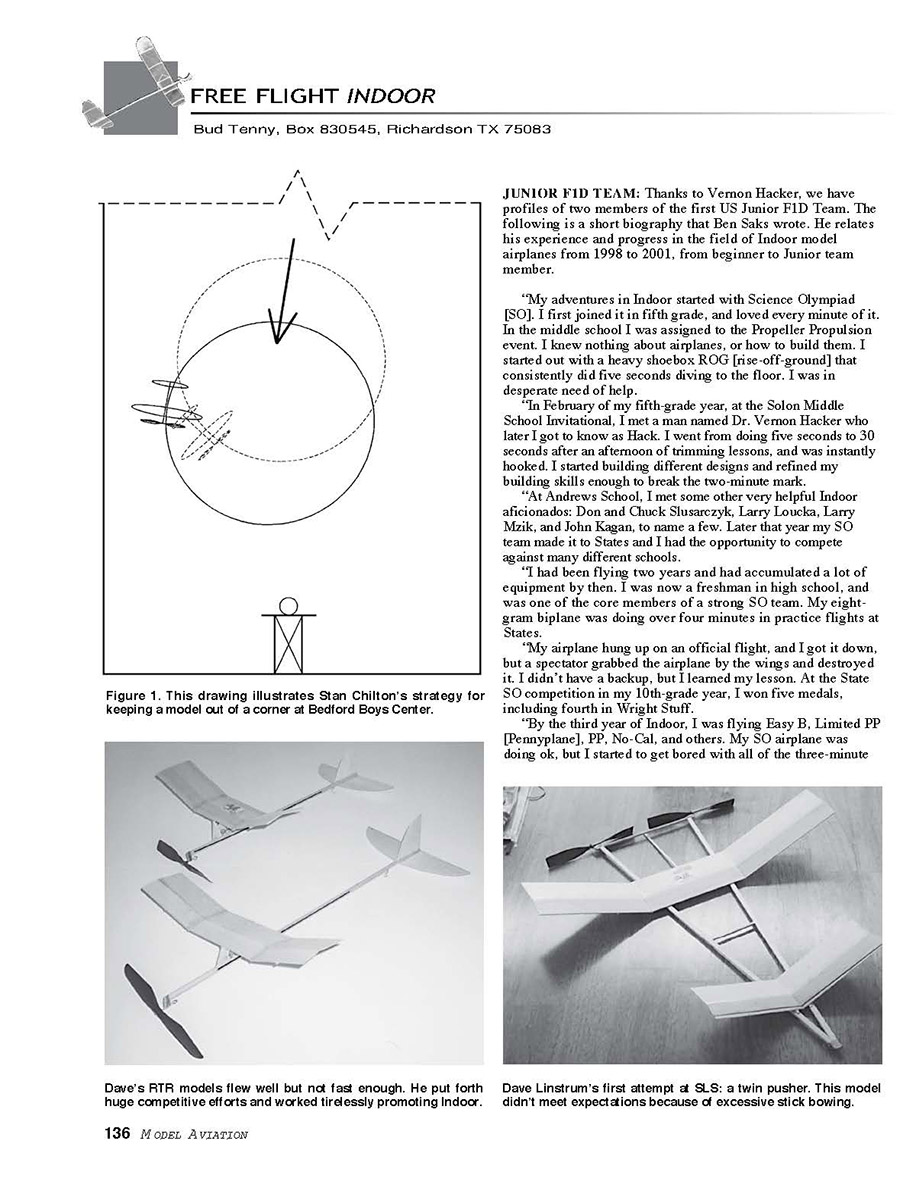
Figure 1 shows how Stan Chilton kept a 90-centimeter F1D model from drifting into a corner at the Bedford Boys Center.
The drift was slow and steady along the vector shown. On each circle Stan caught the model (solid outline) and cranked it just to the left—almost a full roll. The model's power was tuned perfectly, so the climb peaked just below the ceiling, and each circle took approximately one minute.
The flight lasted longer than 30 minutes. That's not bad for a Cat I site!
Intensive Effort
Longtime MIAMA (Miami Indoor Aircraft Modelers Association) member Dave Linstrum is a prolific builder. Besides his strong devotion to scale models, he has devoted a tremendous effort to the unofficial events at the US Indoor Championships.
RTR (Race To Roost) is simple: the model with the shortest time from launch to the shutters in the top of the dome wins. Dave also flew SLS (Straight Line Speed) in 2001.
Transcribed from original scans by AI. Minor OCR errors may remain.