FF DURATION
ELECTRONIC TIMERS for Free Flight have been around for more than a quarter century. The latest iteration of electronic timers for F1A Towline Gliders uses servo-operated linkage to the flying surfaces, allowing preset stabilizer positions for straight tow, circle tow, zoom, bunt, fast glide, and slow glide, as well as dethermalizer (DT).
Settings for different weather conditions can be stored on a laptop or palm-size computer and downloaded as needed. For F1C Power, electronic timers control the engine cutoff, auto rudder, auto stab, and often a wing wiggler.
But all this comes at a price. In addition to being expensive ($100 to $300 for the timer, plus another couple hundred for the computer), electronic timers are heavy; many weigh more than one ounce. Even the lightest, designed for F1B Wakefield Rubber models, are approximately 20 grams—five or six grams heavier than comparable mechanical timers.
For those of us flying many of the AMA events, especially the smaller Rubber classes, electronic timers made no sense. The auto-surface functions were simply not needed for locked-up, non-auto models. Although more accurate than a fuse, electronic timers were much heavier—an important consideration in events such as P-30 and Moffett.
Timers based on the wind-up Tomy toys and the viscous fluid mechanisms like the button timers do manage to get the weight down into the five- to six-gram range, but the accuracy, although better than a fuse, was not as precise as an electronic timer.
For small, lightly loaded models, an accurate DT is actually more important than on larger, more heavily loaded models. A model such as a P-30 has a slow rate of sink when DT'd. A long fuse will allow the model to gain extra height in a thermal, often putting the model well downwind and off the field. Cut the fuse short, and you can spoil the flight—and your chances for a trophy—with premature DT.
Until now the combination of accuracy and low weight simply was not available in electronic timers. Part of the reason is the weight of the battery needed to run the timer. Another reason was the way electronic timers work. Most use a servo to operate a pull-pull cable or a pushrod to move the stabilizer (F1A and F1H), or a servo or step motor to release lines back to the tail (F1C, F1B, F1G, and F1J). A few systems have used a timer-actuated electromagnet to release lines.
Shortly before his death in 1993, Tom McLaughlin was working on an electronic timer fitted with nichrome wire hooks. Rubber bands attached to the hooks held the various control lines in place. On the timer's command, an electric current was sent through the nichrome wire, which burned through the rubber band, releasing the towline or stabilizer. The concept worked, but the battery size required was still large enough to make the timer heavy.
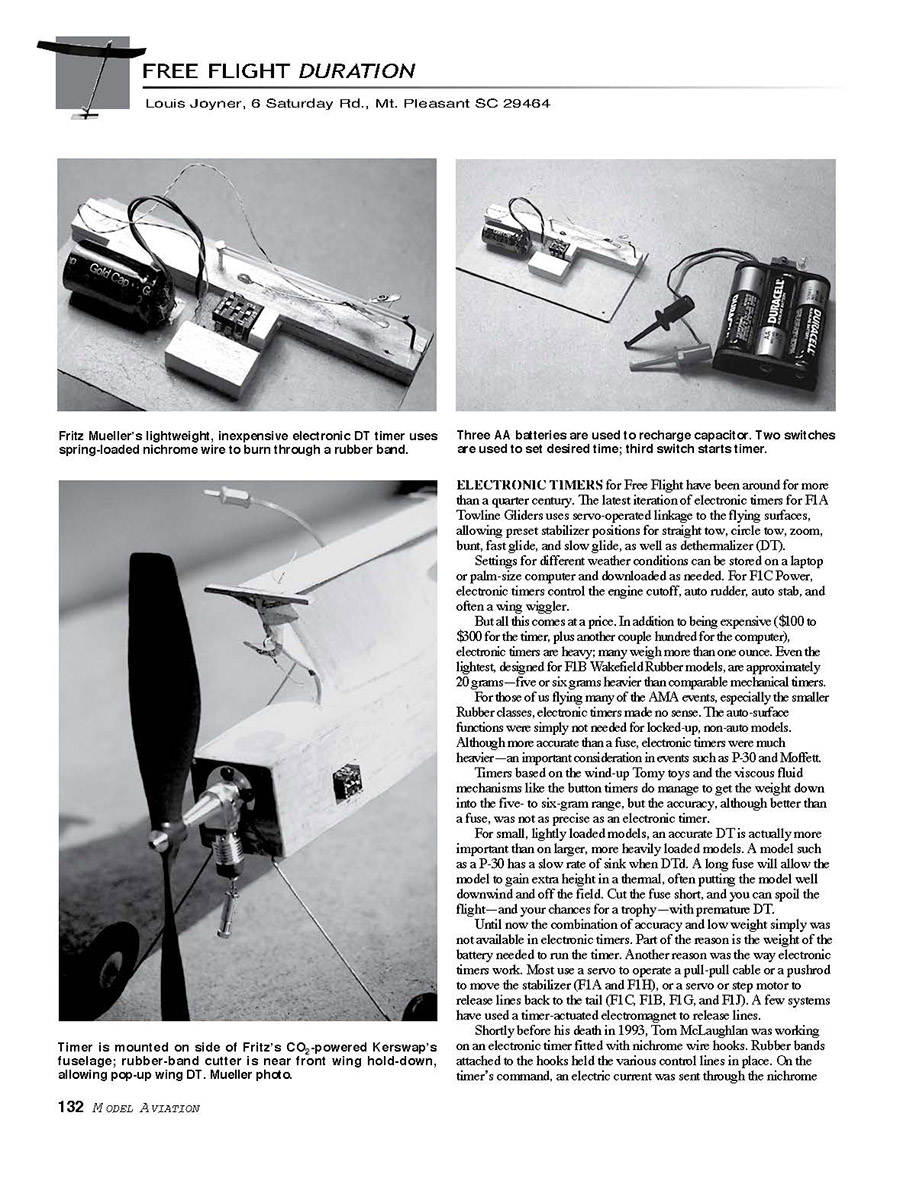
Fritz Mueller's solution to the battery problem is simple: use a capacitor — a small electrolytic capacitor — charged by three AA-size cells. When discharged through the nichrome, it delivers a short, high-current burst, enough to heat and burn the rubber band quickly. The battery only needs to charge the capacitor slowly and can be light.
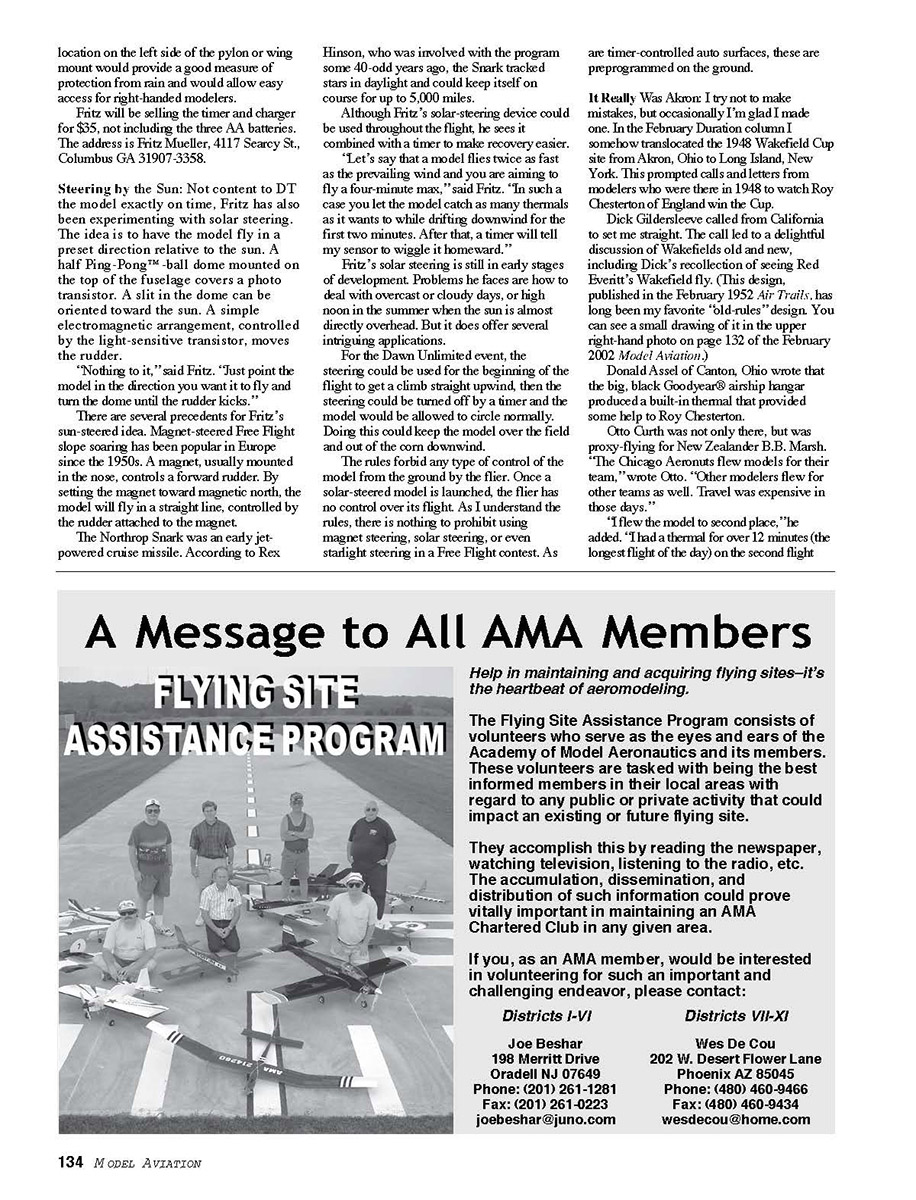
Mueller's timer uses two pushbutton switches to set the desired time and a third to start the timing cycle. A spring-loaded nichrome cutter is mounted so that when the band burns through, the spring snaps the cutter away, preventing the hot wire from sticking to the band. The entire timer, including battery pack, switch, capacitor, and nichrome assembly, weighs under an ounce and fits on the small wooden planking common on duration models.
In flight tests the timer proved reliable and accurate to within a second or two over a wide range of settings. For those who want the features of modern timers without the weight penalty, Mueller's design is an attractive alternative. two switches are used to set the DT times. Four settings are available: one minute, two minutes, three minutes, and four minutes. The third switch is to start. There is a three-second delay after tripping this switch, allowing time to launch the model.
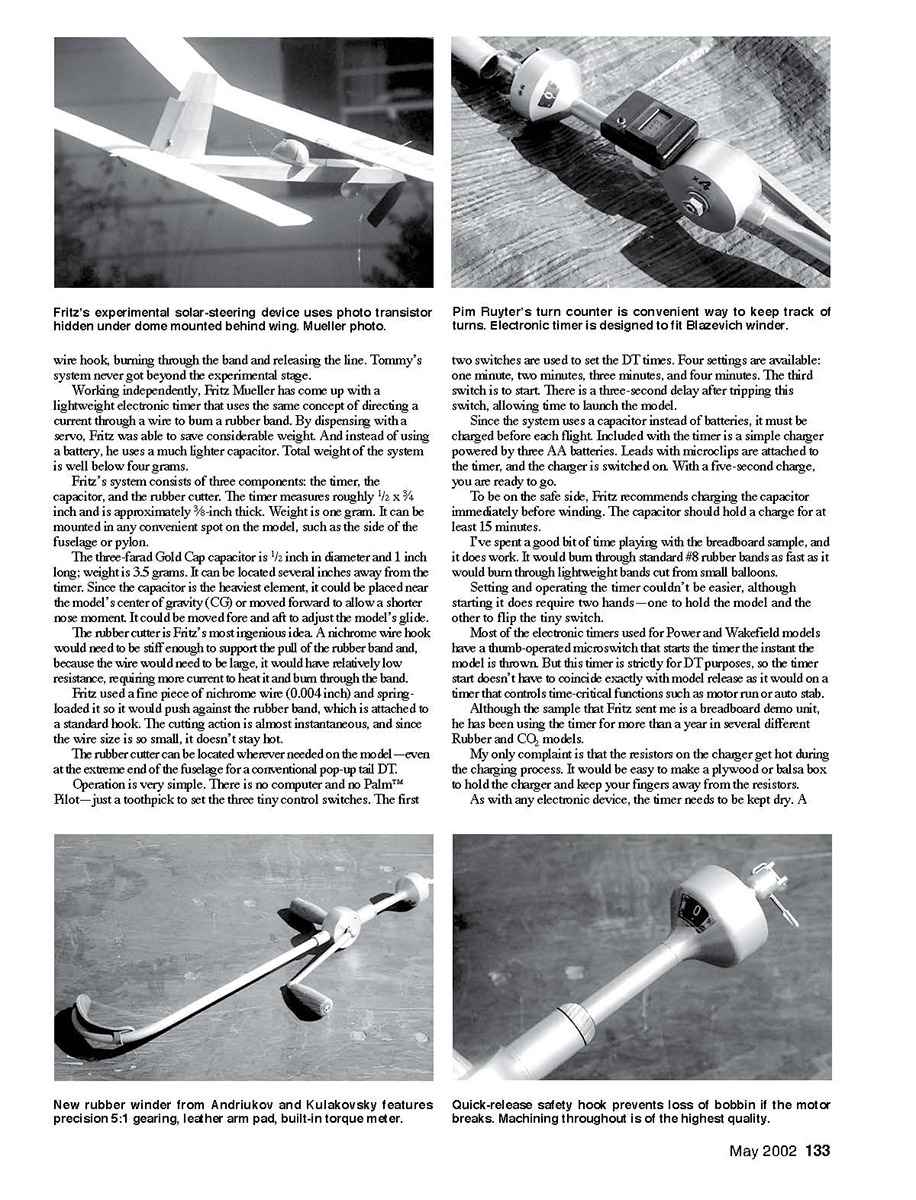
Since the system uses a capacitor instead of batteries, it must be charged before each flight. Included with the timer is a simple charger powered by three AA batteries. Leads with microclips are attached to the timer, and the charger is switched on. With a five-second charge, you are ready to go.
To be on the safe side, Fritz recommends charging the capacitor immediately before winding. The capacitor should hold a charge for at least 15 minutes.
I’ve spent a good bit of time playing with the breadboard sample, and it does work. It would burn through standard #8 rubber bands as fast as it would burn through lightweight bands cut from small balloons.
Setting and operating the timer couldn’t be easier, although starting it does require two hands—one to hold the model and the other to flip the tiny switch.
Most of the electronic timers used for Power and Wakefield models have a thumb-operated microswitch that starts the timer the instant the model is thrown. But this timer is strictly for DT purposes, so the timer start doesn’t have to coincide exactly with model release as it would on a timer that controls time-critical functions such as motor run or auto stab.
Although the sample that Fritz sent me is a breadboard demo unit, he has been using the timer for more than a year in several different Rubber and CO2 models.
My only complaint is that the resistors on the charger get hot during the charging process. It would be easy to make a plywood or balsa box to hold the charger and keep your fingers away from the resistors.
As with any electronic device, the timer needs to be kept dry. A location on the left side of the pylon or wing mount would provide a good measure of protection from rain and would allow easy access for right-handed modelers.
Fritz will be selling the timer and charger for $35, not including the three AA batteries. The address is Fritz Mueller, 4117 Searcy St., Columbus GA 31907-3358.
Steering by the Sun: Not content to DT the model exactly on time, Fritz has also been experimenting with solar steering. The idea is to have the model fly in a preset direction relative to the sun. A half Ping-Pong–ball dome mounted on the top of the fuselage covers a photo transistor. A slit in the dome can be oriented toward the sun. A simple electromagnetic arrangement, controlled by the light-sensitive transistor, moves the rudder.
"Nothing to it," said Fritz. "Just point the model in the direction you want it to fly and turn the dome until the rudder kicks."
There are several precedents for Fritz's sun-steered idea. Magnet-steered Free Flight slope soaring has been popular in Europe since the 1950s. A magnet, usually mounted in the nose, controls a forward rudder. By setting the magnet toward magnetic north, the model will fly in a straight line, controlled by the rudder attached to the magnet.
The Northrop Snark was an early jet-powered cruise missile. According to Rex Hinson, who was involved with the program some 40-odd years ago, the Snark tracked stars in daylight and could keep itself on course for up to 5,000 miles.
Although Fritz's solar-steering device could be used throughout the flight, he sees it combined with a timer to make recovery easier.
"Let's say that a model flies twice as fast as the prevailing wind and you are aiming to fly for a four-minute max," said Fritz. "In such a case you let the model catch as many thermals as it wants to while drifting downwind for the first two minutes. After that, a timer will tell my sensor to wiggle it homeward."
Fritz's solar steering is still in early stages of development. Problems he faces are how to deal with overcast or cloudy days, or high noon in the summer when the sun is almost directly overhead. But it does offer several intriguing applications.
For the Dawn Unlimited event, the steering could be used for the beginning of the flight to get a climb straight upwind, then the steering could be turned off by a timer and the model would be allowed to circle normally. Doing this could keep the model over the field and out of the corn downwind.
The rules forbid any type of control of the model from the ground by the flier. Once a solar-steered model is launched, the flier has no control over its flight. As I understand the rules, there is nothing to prohibit using magnetic steering, solar steering, or even starlight steering in a Free Flight contest. As are timer-controlled auto surfaces, these are preprogrammed on the ground.
It Really Was Akron: I try not to make mistakes, but occasionally I'm glad I made one. In the February Duration column I somehow translocated the 1948 Wakefield Cup site from Akron, Ohio to Long Island, New York. This prompted calls and letters from modelers who flew there in 1948 to watch Roy Chesterton of England win the Cup.
Dick Gildersleeve called from California to set me straight. The call led to a delightful discussion of Wakefields old and new, including Dick's recollection of seeing Red Everitt's Wakefield fly. (This design, published in the February 1952 Air Trails, has long been my favorite "old-rules" design. You can see a small drawing of it in the upper right-hand photo on page 132 of the February 2002 Model Aviation.)
Donald Assel of Canton, Ohio wrote that the big, black Goodyear airship hangar produced a built-in thermal that provided some help to Roy Chesterton.
Otto Curth was not only there, but was proxy-flying for New Zealander B.R. Marsh. "The Chicago Aerosmiths flew models for their team," wrote Otto. "Other modelers flew for other teams as well. Travel was expensive in those days."
"I flew the model to second place," he added. "I had a thermal for over 12 minutes (the longest flight of the day) on the second flight" and a downer for the third. A thermal for a couple of minutes would have changed the outcome. The next year the maximum introduced to eliminate a lucky flight winning.
"Dick Kordh flew for 48 minutes in 1939 and every kid who built the ship hoped to do the same thing," wrote Otto. "This may be part of the Junior and Free Flight problem — there are lucky flights that may occur!"
"I only played a part for Chesterton too," Otto added. "On one flight his model zoomed to a power stall, did a tail stall almost hit the ground, but recovered to post a good flight."
After 1948 the rules were changed to impose a five-minute maximum on each flight, and three flight rules were made. No one made the five until the 1952 Wakefield Cup, when Joe Foster of the United States, Hugh O'Donald of Great Britain, and Eliseo Scott of Argentina tied. Joe won with a flyoff attempt of 445 seconds. George Reich, also of the United States, dropped one second to miss the flyoff and finish fourth. (He won the Cup in 1951.)
In 1956 the rules were changed to five flights with a three-minute maximum. This was changed again in 1969 to the present seven-round format. In 1975 the single unlimited flyoff was changed to a series of progressively longer flights.
The Jaguar: Like the automobile and the animal, Roy Chesterton's Jaguar was a graceful design—certainly among the most effective models to win the Wakefield Cup. And since it was designed and published during the 1944-1948 period, it is eligible for the new Nostalgia Wakefield event.
Designed by noted British modeler Ted Evans, the Jaguar featured a diamond fuselage, gracefully tapered V-dihedral wings, and a most distinctive underbelly which hung more than four inches below the bottom fuselage longeron.
Necessary to meet the required minimum fuselage cross-section, the underbelly allowed a slimmer fuselage and eliminated the need for a pylon to increase cross-sectional area. This allowed a midwing configuration with the two-piece wing plugging into plywood wing braces. The propeller is a two-blade freewheeler.
Full-size plans for the Jaguar are available from Aero Dyne, 5154 Falcon St., Pomona CA 91767. The Web address is www.freedflightmodels.com.
Counting the Turns: No matter what kind of Rubber model you fly, it helps to know exactly how many turns you put on the motor for each flight. You can count the number of cranks then multiply by the gear ratio of the winder. This may work at the practice field, but the distractions and pressures of contest flying often make you lose count.
A mechanical counter has long been available for the popular Simplex Sidewinder. Various homemade electronic counters have been seen using a bicycle computer or an inexpensive calculator.
The first purpose-made electronic turn counter I've seen is the very nice unit that Dutch F1B flier Pim Ruijter made. It's a simple black plastic box measuring 1¾ x 2 inches. A window displays the turns, and a red button resets the counter to zero. The counter is designed to fit the popular "umbrella-style" winders made by Yuri Bzrevich and distributed in the United States by EAI Model Supply.
Installation is simple. A plastic ring on the underside of the counter slips over the winder just in front of the gearcase and is secured with a setscrew. A second plastic ring slips over the output shaft and is fastened with a setscrew. A magnet in the second ring triggers the counter every time the output shaft turns. This device counts actual turns; there is no need to multiply by the gear ratio.
I E-mailed Pim last summer and made arrangements to pick mine up at the World Championships at Lost Hills CA. Price, including the adapters, was $50.
Since the Bzrevich winders come with three shaft sizes, you'll need to know the size adapter needed before ordering. The sizes are 13.9 mm, 15.0 mm and 15.9 mm, measured at the rear of the machined aluminum shaft just in front of the gearbar.
For more information about ordering, E-mail Pim at PRUITER@triple-p.nl.
The Ultimate Winder: If you need a new winder, consider the top-of-the-line model available from Andriukov and Kulakovsky Aeromodelling Products. This 5:1 winder comes standard with a torque meter; a turn counter is optional. The umbrella handle features a leather arm pad, and the entire handle can be quickly disconnected for storage.
Special attention has been paid to the smoothness of the gears to allow better feedback of the rubber condition while winding.
The price for the standard winder is $209; for the model with turn counter, it's $259. This is definitely not a converted hand drill.
As are all the other products from Alexander Andriukov and Oleg Kulakovsky, the winder is beautifully designed and made—just what you would expect from two modelers who, between them, have been World Champion five times, European Champion five times, and World Cup winner five times.
You can order direct from Alexander at 2766 Currier Ave., Simi Valley CA 93065. E-mail: andriukov@pacbell.net For more information about the winders and their other products, visit the Website at http://home.pacbell.net/andriukov/.
If you do visit, be sure to read the simple instructions for cleaning a mechanical timer.
John Chappat FAA Model Supply also stocks the winder and other parts and kits. That address is Box 566, Sayre PA 18840-0566. Website: www.faamodelsupply.com.
Transcribed from original scans by AI. Minor OCR errors may remain.