The Engine Shop
Joe Wagner
927 Pine Ave., Ozark AL 36360
NEW MODEL engines in a wide range of sizes and types come out all the time. That's nothing unusual; it's been happening continually since the 1930s. Unfortunately there's no practical way for me to keep fully up to date with all these new products and developments. When readers write in asking about (e.g.) the latest Nelson, Jett, or YS engines, I feel embarrassed about not being able to answer all of their questions.
If you own a computer, sometimes you can learn a lot about newly released model engines by accessing the manufacturer's Internet Web site. Most of those sites include E-mail addresses you can use to make direct inquiries. However, I don't advise E-mailing engine-makers or dealers out of idle curiosity. Some that I know have stopped responding to E-mail questions because they've received so many and don't have time to answer all the questions.
It's also difficult for me to keep informed about all the "major breakthroughs" in model engines. Most are quite specialized—and quite expensive.
I'm in no position to properly evaluate the new G-K (GalbreathKeck) Hummer: a gear-drive Free Flight (FF) competition engine which has a crankshaft rpm exceeding 36,000. Nor do I know anything yet about O.S.'s recently announced four-stroker: the FS91S II FII that features fuel injection and an electronic microprocessor module to control that.
That's why I don't ordinarily write about "gee whiz" model engines in this column.
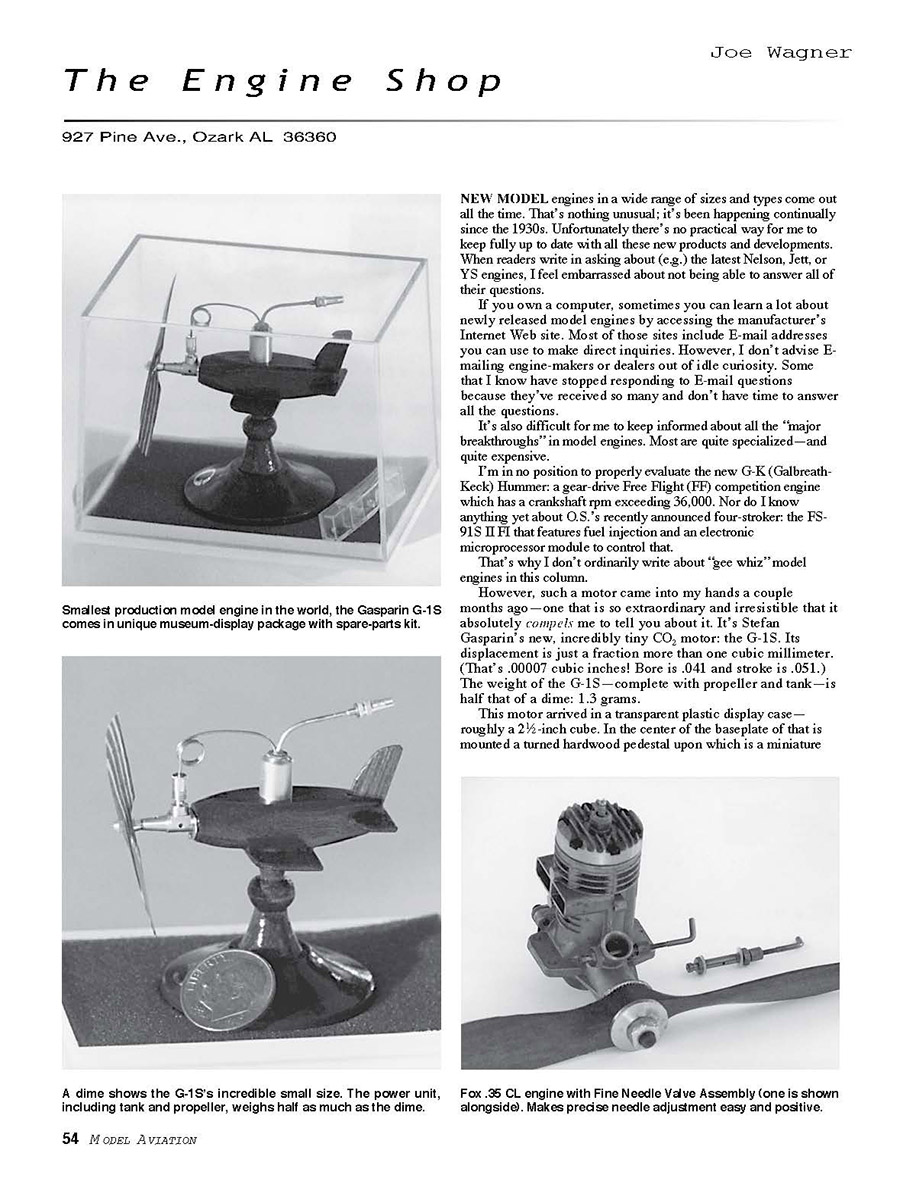
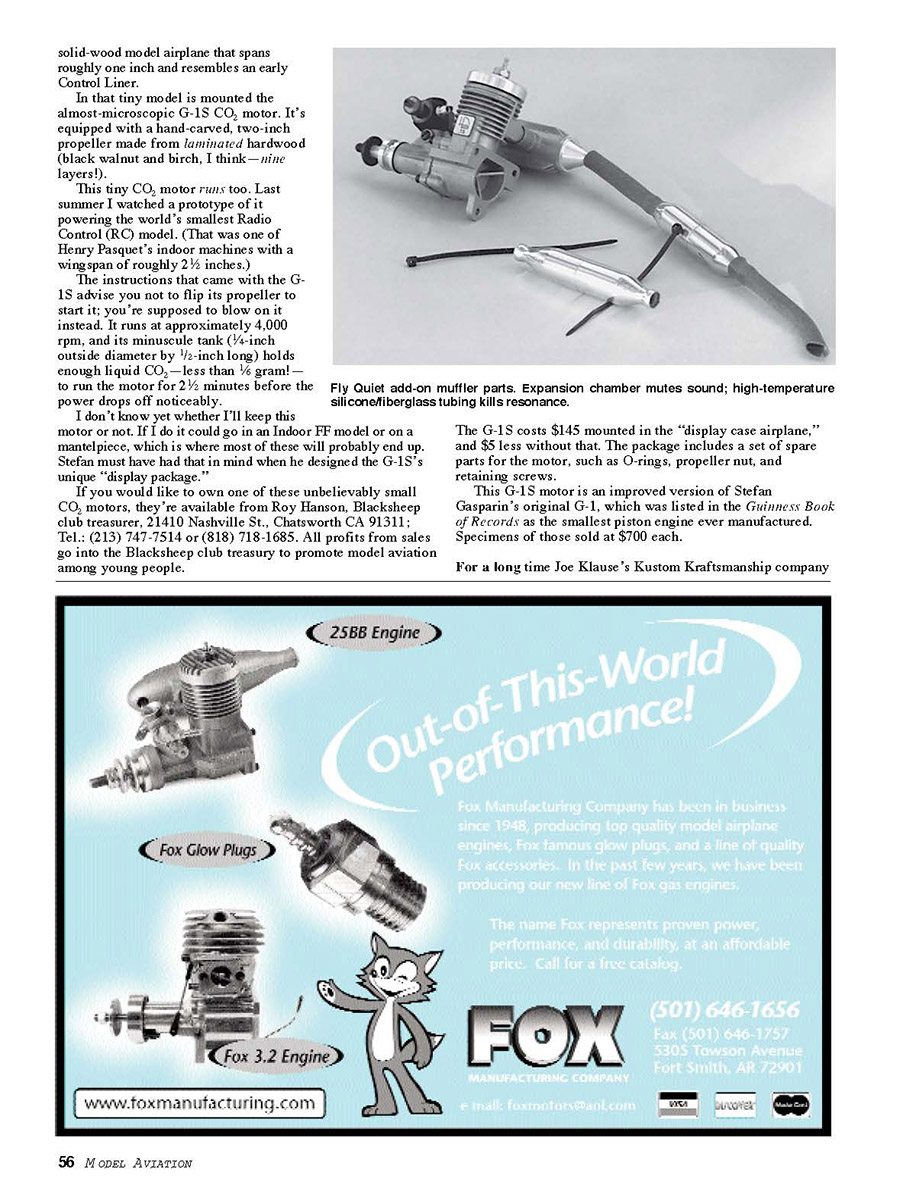
However, such a motor came into my hands a couple months ago—one that is so extraordinary and irresistable that it absolutely compels me to tell you about it. It's Stefan Gasparin's new, incredibly tiny CO2 motor: the G-1S. Its displacement is just a fraction more than one cubic millimeter. (That's .00007 cubic inches; bore is .041 and stroke is .051.) The weight of the G-1S—complete with propeller and tank—is half that of a dime: 1.3 grams.
This motor arrived in a transparent plastic display case—roughly a 2½-inch cube. In the center of the baseplate of that is mounted a turned hardwood pedestal upon which is a miniature solid-wood model airplane that spans roughly one inch and resembles an early Control Liner.
In that tiny model is mounted the almost-microscopic G-1S CO2 motor. It's equipped with a hand-carved, two-inch propeller made from laminated hardwood (black walnut and birch, I think—nine layers!).
This tiny CO2 motor runs too. Last summer I watched a prototype of it powering the world's smallest Radio Control (RC) model. (That was one of Henry Pasquet's indoor machines with a wingspan of roughly 2½ inches.)
The instructions that came with the G-1S advise you not to flip its propeller to start it; you're supposed to blow on it instead. It runs at approximately 4,000 rpm, and its minuscule tank (¼-inch outside diameter by ½-inch long) holds enough liquid CO2—less than ½ gram!—to run the motor for 2½ minutes before the power drops off noticeably.
I don't know yet whether I'll keep this motor or not. If I do it could go in an Indoor FF model or on a mantelpiece, which is where most of these will probably end up. Stefan must have had that in mind when he designed the G-1S's unique "display package."
If you would like to own one of these unbelievably small CO2 motors, they're available from Roy Hanson, Blacksheep club treasurer, 21410 Nashville St., Chatsworth CA 91311; Tel.: (213) 747-7514 or (818) 718-1685. All profits from sales go into the Blacksheep club treasury to promote model aviation among young people.
Fly Quiet add-on muffler parts. Expansion chamber mutes sound; high-temperature silicone/fiberglass tubing kills resonance.
The G-1S costs $145 mounted in the "display case airplane," and $5 less without that. The package includes a set of spare parts for the motor, such as O-rings, propeller nut, and retaining screws.
This G-1S motor is an improved version of Stefan Gasparin's original G-1, which was listed in the Guinness Book of Records as the smallest piston engine ever manufactured. Specimens of those sold at $700 each.
For a long time Joe Klause's Kustom Kraftsmanship company supplied model fliers with performance-enhancing model-engine parts and accessories. Health problems recently caused Joe to turn K-K over to Competition Model Airplane Parts and Accessories, Box 4622 18, Escondido CA 92046; Tel.: (760) 746-3164; Fax: (760) 745-4584.
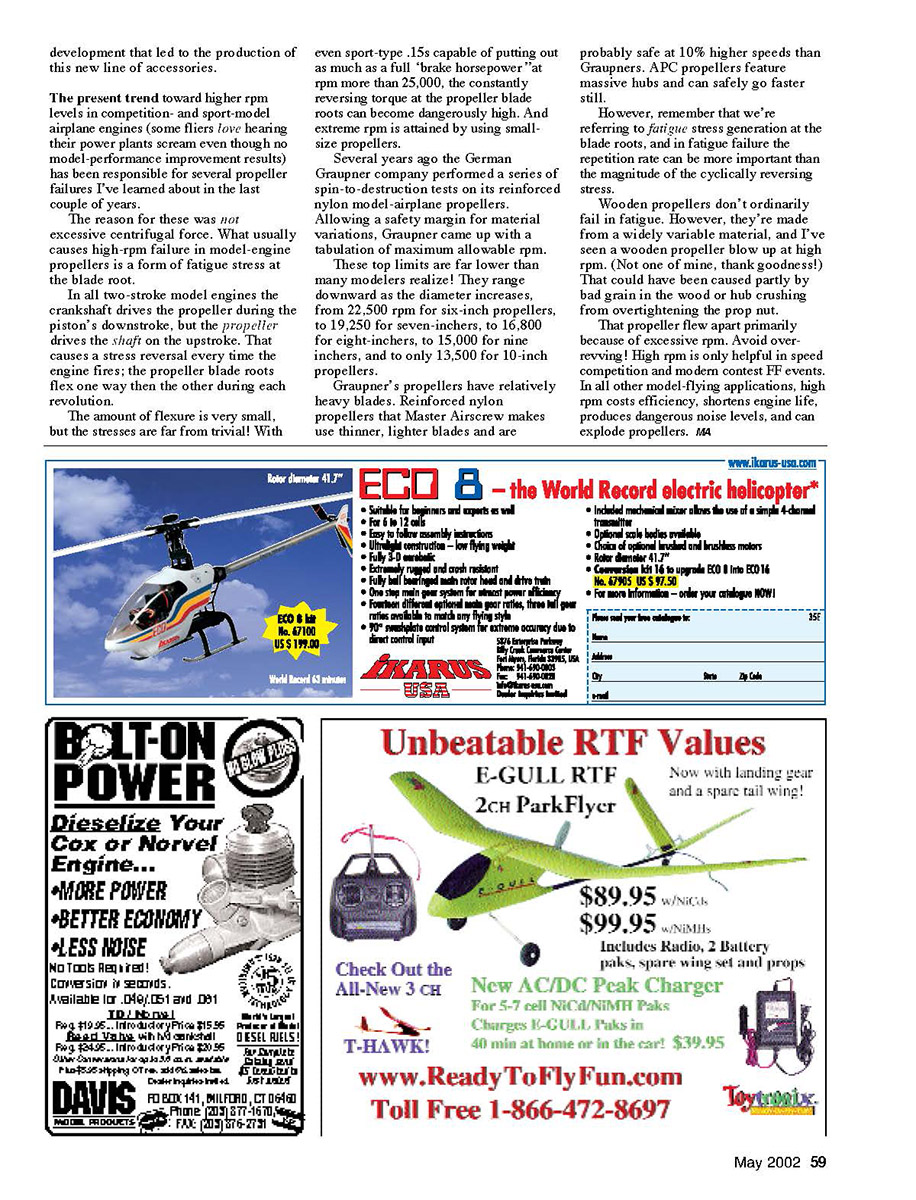
The K-K product line, well known by competitors, includes a most useful Control Line (CL) engine accessory: the Fine Needle Valve Assembly. It fits most ".19-.35 size" model engines and provides a more precise setting than most stock needle valves. The threaded end of the spraybar uses a colletlike design that ensures vibration-proof settings and effectively eliminates air leakage down the threads of the needle.
With the addition of a suitable "venturi insert," the Fine Needle Valve Assembly makes it easy to convert RC engines for CL use.
At one time CL was the world's most popular model-airplane activity, with flying sites in or near every town in America. However, too many people were annoyed by the monotonous wow-wow-wow-wow sound (the Doppler effect) that CL models generate in flight. In spite of the use of mufflers, noise complaints closed down most of the CL flying areas in local parks and school yards.
Now Fly Quiet, an aptly named new company, has introduced a line of what I'd call "downstream mufflers." These are add-on units that bring model-engine-exhaust noise levels to new lows without affecting power output.
You can learn all about Fly Quiet's mufflers and tuned pipes at the Web site: www.flyquiet.com. It also contains a most interesting and educational narrative by Fly Quiet's Ron Marvel that describes in readable—and even entertaining—detail the principles, performance tests, and materials
The Engine Shop
development that led to the production of this new line of accessories.
The present trend toward higher rpm levels in competition- and sport-model airplane engines (some fliers love hearing their power plants scream even though no model-performance improvement results) has been responsible for several propeller failures I've learned about in the last couple of years.
The reason for these was not excessive centrifugal force. What usually causes high-rpm failure in model-engine propellers is a form of fatigue stress at the blade root.
In all two-stroke model engines the crankshaft drives the propeller during the piston's downstroke, but the propeller drives the shaft on the upstroke. That causes a stress reversal every time the engine fires; the propeller blade roots flex one way then the other during each revolution.
The amount of flexure is very small, but the stresses are far from trivial! With even sport-type .15s capable of putting out as much as a full "brake horsepower" at rpm more than 25,000, the constantly reversing torque at the propeller blade roots can become dangerously high. And extreme rpm is attained by using small-size propellers.
Several years ago the German Graupner company performed a series of spin-to-destruction tests on its reinforced nylon model-airplane propellers.
Allowing a safety margin for material variations, Graupner came up with a tabulation of maximum allowable rpm.
These top limits are far lower than many modelers realize! They range downward as the diameter increases, from 22,500 rpm for six-inch propellers, to 19,250 for seven-inchers, to 16,800 for eight-inchers, to 15,000 for nine-inchers, and to only 13,500 for 10-inch propellers.
Graupner's propellers have relatively heavy blades. Reinforced nylon propellers that Master Airscrew makes use thinner, lighter blades and are probably safe at 10% higher speeds than Graupners. APC propellers feature massive hubs and can safely go faster still.
However, remember that we're referring to fatigue stress generation at the blade roots, and in fatigue failure the repetition rate can be more important than the magnitude of the cyclically reversing stress.
Wooden propellers don't ordinarily fail in fatigue. However, they're made from a widely variable material, and I've seen a wooden propeller blow up at high rpm. (Not one of mine, thank goodness!) That could have been caused partly by bad grain in the wood or hub crushing from overtightening the prop nut.
That propeller flew apart primarily because of excessive rmp. Avoid over-revving! High rpm is only helpful in speed competition and modern contest FF events. In all other model-flying applications, high rpm costs efficiency, shortens engine life, produces dangerous noise levels, and can explode propellers. MA
Transcribed from original scans by AI. Minor OCR errors may remain.