Electronics
2626 W. Northwood, Santa Ana CA 92704
WHAT WAS YOUR first Radio Control (RC) system? I forget what my first receiver was, but my first transmitter was a Mac II. It started with a two-volt, 30-ampere wet cell that powered a vibrator-type power supply, which provided 135 volts for the two large vacuum tubes that ultimately produced some five watts of power. It sat on the ground with a 10-foot antenna sticking up and a long cable with a push button that, when activated, caused the rudder to move. Sometimes!
Multichannel equipment was a dream, and proportional control such as we enjoy now had not yet been thought of. The first equipment I had that I did not build was an F&M reed set, which never worked as well as my homemade stuff. But the real breakthrough came in 1967 when I purchased an Orbit 7-14 for $700—seven channels of real proportional control.
Since then we have seen many changes. Not only is our equipment smaller and lighter, but the features and reliability are almost beyond belief. And, although not everyone will agree, RC equipment today is inexpensive—as long as you buy it to match your abilities and not to impress your friends, but that is another story.
What about the radio equipment of tomorrow? That is, in part, up to you RCers—even those of you who started your RC careers last weekend. You are the customer; you are the one who lays down your dollars, and you are the one radio-equipment manufacturers have to please.
Don't shrug it off with an "Aw, nobody is going to listen to me"! I can name more than one equipment update that came about as a result of a suggestion or improvement that I made and wrote about. The important point is not that I have access to magazine space; it's that I communicated through it with the manufacturers.
You can do the same, and even faster: you can use the postal service, faxes, and E-mail. Tell your favorite radio company what you want to see in your 2003 and subsequent radio equipment. I will share my thoughts with you—and with the manufacturers—here. Agree or disagree, but use them as a guide to communicate your desires with the equipment makers.
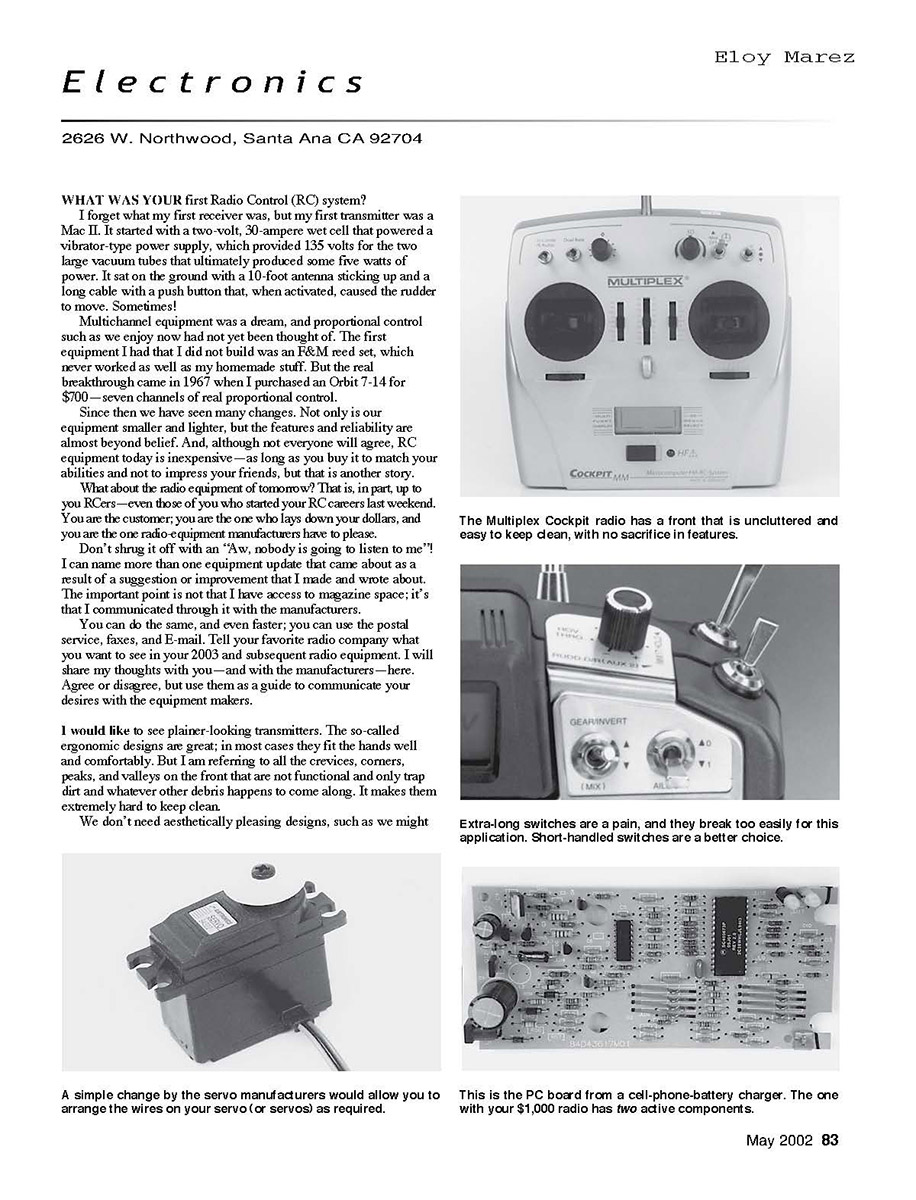
I would like to see plainer-looking transmitters. The so-called ergonomic designs are great; in most cases they fit the hands well and comfortably. But I am referring to all the crevices, corners, peaks, and valleys on the front that are not functional and only trap dirt and whatever other debris happens to come along. It makes them extremely hard to keep clean.
We don't need aesthetically pleasing designs, such as we might look for in a piece of jewelry; we need something we can maintain in a clean, professional manner.
Multiplex is one manufacturer that has made an effort in that direction. Its Cockpit radio might not be as impressive in the showcase as others, but you will appreciate its clean, simple, unadorned design once you have had it out at the field several times.
Aiming toward a less-cluttered front, all those push buttons required for programming computer radios could be eliminated in a number of ways. The Cockpit has taken a step in that direction; it uses one programming control! A multiposition switch walks you through the menus, and pushing down on the same knob effects changes within that menu.
Another approach, using similar programming, could be to use membrane switches or sealed keypads—neither of which have knobs or openings that make them hard to keep clean. There is also a new type of piezo switch that is completely sealed externally and might have an application here.
The touch pads on the screen used on some transmitters is a step in the right direction, but that is not usable on less-complex equipment since it requires a large screen.
To achieve a cleaner transmitter front, I could even live with an external plug-in programmer that would be disconnected once the required programming was done. After all, I never make input changes while flying. Do you?
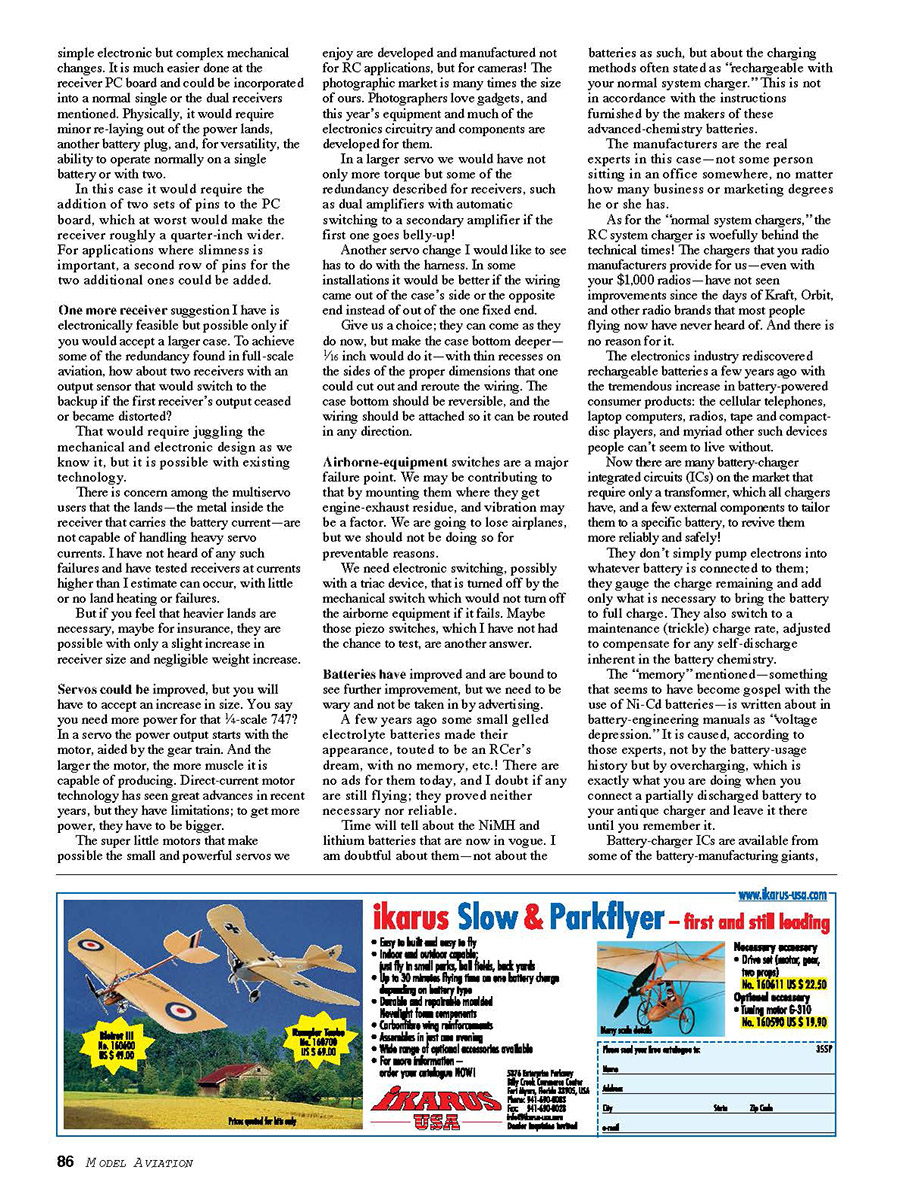
Let us no longer accept those 35-cent switches on $1,000 radios which have levers that break if you even look at them hard. If you look around your flying field, you will see very few of those porcupine-looking transmitters with all their switch levers intact. In many cases, they are cheap and the levers are hollow (not solid throughout).
There are thousands of similar electrical and mechanical—but more rugged—switches that will not break under normal use or even if you accidentally knock the transmitter over when reaching for it. The extra-long switch handles generally make them even more vulnerable to damage.
There is a need for the difference in length so one can identify the switches without looking, but why not go shorter instead of longer? The benefits would be the same. Off-the-shelf switches are available with handles as short as 1/4 inch; even if they are not as easy to operate, they would work fine for seldom-used controls. And they wouldn't break off!
Another transmitter improvement many of us can use is more volume on the "beeper" that signals elapsed time, low battery, etc. The average age of R/Cers is up there where the hearing starts to go, and the next generation—with ears pounded by loud rock and rap music—will have an even greater problem.
The airborne systems should, and definitely could, be improved in more than one area, but first you—the RCer—will have to reconsider your needs.
Stop being impressed by small and light! Look around you, and consider how much difference in performance the average noncompetition airplane, which is by far the majority, would suffer with the addition of four or five ounces of weight—very little, actually. As for the size, even a .40-powered airplane has room to spare, which could be used to carry some insurance and reliability in our electronics.
The dual airborne system, which I first flew with and wrote about in 1983, are in common use today in many medium and large airplanes. It uses two separate receiver, battery, and switch-harness systems. One flies the left side of the airplane, and the other flies the right side. If one system fails, even with servo input the other system keeps your model under control and able to land on one piece.
It would be easy to mate two receivers in a single case—either two units in production or two on a single printed circuit (PC) board. Two sets of battery and servo connectors would have to be provided, but with a slight change to the antenna-coupling circuit a common antenna would serve both for both receivers.
Separate receiver and servo batteries might be of interest to you. This requires simple electronic but complex mechanical changes. It is much easier done at the receiver PC board and could be incorporated into a normal single or the dual receivers mentioned. Physically, it would require minor re-laying out of the power lands, another battery plug, and, for versatility, the ability to operate normally on a single battery or with two.
In this case it would require the addition of two sets of pins to the PC board, which at worst would make the receiver roughly a quarter-inch wider. For applications where slimness is important, a second row of pins for the two additional ones could be added.
One more receiver suggestion I have is electronically feasible but possible only if you would accept a larger case. To achieve some of the redundancy found in full-scale aviation, how about two receivers with an output sensor that would switch to the backup if the first receiver's output ceased or became distorted?
That would require juggling the mechanical and electronic design as we know it, but it is possible with existing technology.
There is concern among the multiservo users that the lands—the metal inside the receiver that carries the battery current—are not capable of handling heavy servo currents. I have not heard of any such failures and have tested receivers at currents higher than I estimate can occur, with little or no land heating or failures.
But if you feel that heavier lands are necessary, maybe for insurance, they are possible with only a slight increase in receiver size and negligible weight increase.
Servos could be improved, but you will have to accept an increase in size. You say you need more power for that 's-scale 747? In a servo the power output starts with the motor, aided by the gear train. And the larger the motor, the more muscle it is capable of producing. Direct-current motor technology has seen great advances in recent years, but they have limitations; to get more power, they have to be bigger.
The super little motors that make possible the small and powerful servos we enjoy are developed and manufactured not for RC applications, but for cameras! The photographic market is many times the size of ours. Photographers love gadgets, and this year's equipment and much of the electronics circuitry and components are developed for them.
In a larger servo we would have not only more torque but some of the redundancy described for receivers, such as dual amplifiers with automatic switching to a secondary amplifier if the first one goes belly-up!
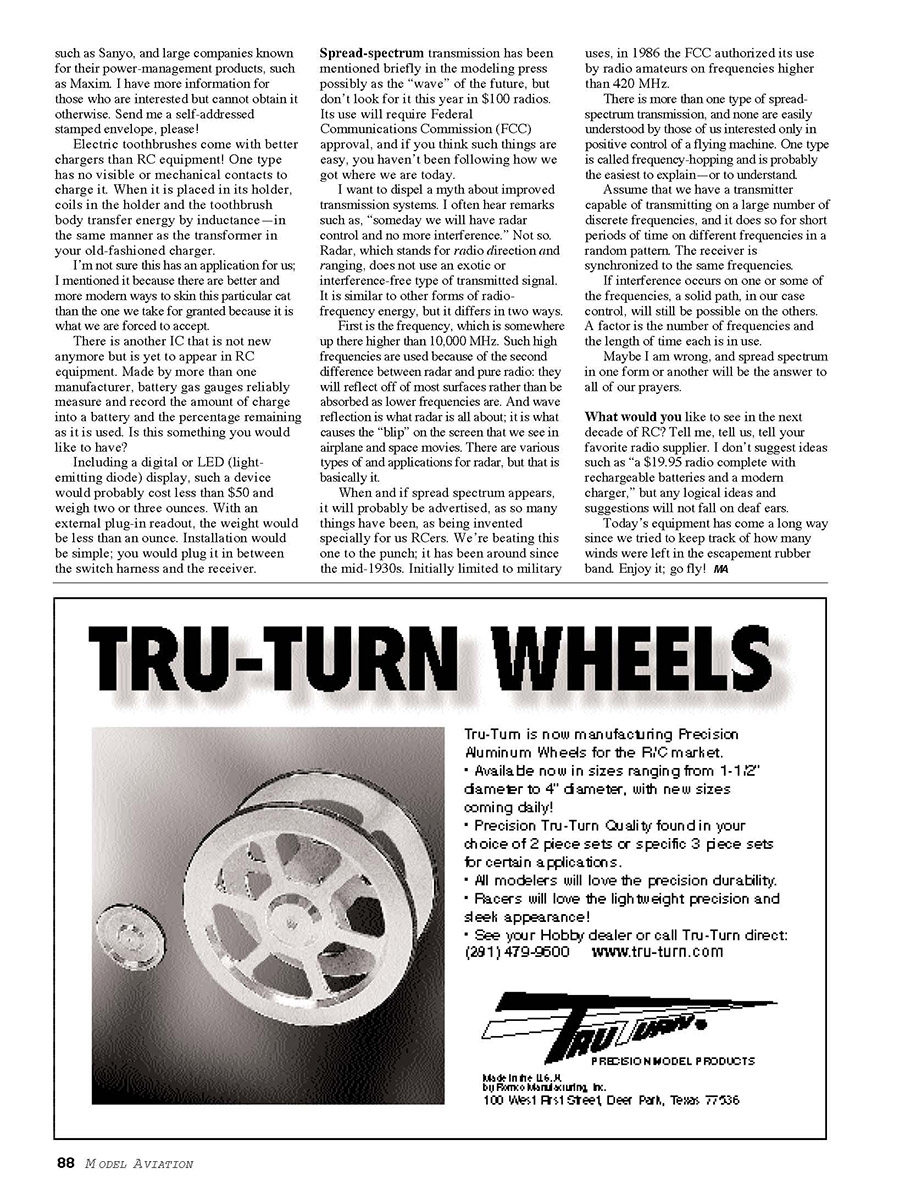
Another servo change I would like to see has to do with the harness. In some installations it would be better if the wiring came out of the case's side or the opposite end instead of out of the one fixed end.
Give us a choice; they can come as they do now, but make the case bottom deeper—1/16 inch would do it—with thin recesses on the sides of the proper dimensions that one could cut out and reroute the wiring. The case bottom should be reversible, and the wiring should be attached so it can be routed in any direction.
Airborne-equipment switches are a major failure point. We may be contributing to that by mounting them where they get engine-exhaust residue, and vibration may be a factor. We are going to lose airplanes, but we should not be doing so for preventable reasons.
We need electronic switching, possibly a triac device, that is turned off by the mechanical switch which would not turn off the airborne equipment if it fails. Maybe those piezo switches, which I have not had the chance to test, are another answer.
Batteries have improved and are bound to see further improvement, but we need to be wary and not be taken in by advertising.
A few years ago some small gelled-electrolyte batteries made their appearance, touted to be an RCer's dream, with no memory, etc.! There are no ads for them today, and I doubt if any are still flying; they proved neither necessary nor reliable.
Time will tell about the NiMH and lithium batteries that are now in vogue. I am doubtful about them—not about the batteries as such, but about the charging methods often stated as "rechargeable with your normal system charger." This is not in accordance with the instructions furnished by the makers of these advanced-chemistry batteries.
The manufacturers are the real experts in this case—not some person sitting in an office somewhere, no matter how many business or marketing degrees he or she has.
As for the "normal system chargers," the RC system charger is woefully behind the technical times! The chargers that you radio manufacturers provide for us—even with your $1,000 radios—have not seen improvements since the days of Kraft, Orbit, and other radio brands that most people flying now have never heard of. And there is no reason for it.
The electronics industry rediscovered rechargeable batteries a few years ago with the tremendous increase in battery-powered consumer products: the cellular telephones, laptop computers, radios, tape and compact-disc players, and myriad such devices people can't seem to live without.
Now there are many battery-charger integrated circuits (ICs) on the market that require only a transformer, which all chargers have, and a few external components to tailor them to a specific battery, to revive them more reliably and safely!
They don't simply pump electrons into whatever battery is connected to them; they sense the charge remaining and add only what is necessary to bring the battery to full charge. They also switch to a maintenance (trickle) charge rate, adjusted to compensate for any self-discharge inherent in the battery chemistry.
The "memory" mentioned—something that seems to have become gospel with the use of Ni-Cd batteries—is written about in battery-engineering manuals as "voltage depression." It is caused, according to those experts, not by the battery-usage history but by overcharging, which is exactly what you are doing when you connect a partially discharged battery to your antique charger and leave it there until you remember it.
Battery-charger ICs are available from some of the battery-manufacturing giants, such as Sanyo, and large companies known for their power-management products, such as Maxim. I have more information for those who are interested but cannot obtain it otherwise. Send me a self-addressed stamped envelope, please!
Electric toothbrushes come with better chargers than RC equipment! One type has no visible or mechanical contacts to charge it. When it is placed in its holder, coils in the holder and the toothbrush body transfer energy by inductance—in the same manner as the transformer in your old-fashioned charger.
I'm not sure this has an application for us; I mentioned it because there are better and more modern ways to skin this particular cat than the one we take for granted because it is what we are forced to accept.
There is another IC that is not new anymore but is yet to appear in RC equipment. Made by more than one manufacturer, battery gas gauges reliably measure and record the amount of charge into a battery and the percentage remaining as it is used. Is this something you would like to have?
Including a digital or LED (light-emitting diode) display, such a device would probably cost less than $50 and weigh two or three ounces. With an external plug-in readout, the weight would be less than an ounce. Installation would be simple; you would plug it in between the switch harness and the receiver.
Spread-spectrum transmission has been mentioned briefly in the modeling press possibly as the "wave" of the future, but don't look for it this year in $100 radios. Its use will require Federal Communications Commission (FCC) approval, and if you think such things are easy, you haven't been following how we got where we are today.
I want to dispel a myth about improved transmission systems. I often hear remarks such as, "someday we will have radar control and no more interference." Not so. Radar, which stands for radio direction and ranging, does not use an exotic or interference-free type of transmitted signal. It is similar to other forms of radio-frequency energy, but it differs in two ways.
First is the frequency, which is somewhere up there higher than 10,000 MHz. Such high frequencies are used because of the second difference between radar and pure radio: they will reflect off of most surfaces rather than be absorbed as lower frequencies. And wave reflection is what radar is all about; it is what causes the "blip" on the screen that we see in airplane and space movies. There are various types of and applications for radar, but that is basically it.
When and if spread spectrum appears, it will probably be advertised, as so many things have been, as being invented specially for us RCers. We're beating this one to the punch; it has been around since the mid-1930s. Initially limited to military uses, in 1986 the FCC authorized its use by radio amateurs on frequencies higher than 420 MHz.
There is more than one type of spread-spectrum transmission, and none are easily understood by those of us interested only in positive control of a flying machine. One type is called frequency-hopping and is probably the easiest to explain—or to understand.
Assume that we have a transmitter capable of transmitting on a large number of discrete frequencies, and it does so for short periods of time on different frequencies in a random pattern. The receiver is synchronized to the same frequencies.
If interference occurs on one or some of the frequencies, a solid path, in our case control, will still be possible on the others. A factor is the number of frequencies and the length of time each is in use.
Maybe I am wrong, and spread spectrum in one form or another will be the answer to all of our prayers.
What would you like to see in the next decade of RC? Tell me, tell us, tell your favorite radio supplier. I don't suggest ideas such as "a $19.95 radio complete with rechargeable batteries and a modern charger," but any logical ideas and suggestions will not fall on deaf ears.
Today's equipment has come a long way since we tried to keep track of how many winds were left in the escapement rubber band. Enjoy it; go fly! MA
Transcribed from original scans by AI. Minor OCR errors may remain.