CL Scale
Bill Boss, 77-06 269th St., New Hyde Park NY 11040
ELECTRONIC AND battery-operated servo systems for use in Control Line (CL) Scale models have been explored in this column in the past several years. I have written about converted radio systems, encoder-decoder systems, direct battery-operated servos (servos in which the electronics have been removed), and the combination of the standard three-line bellcrank and electronics for controlling the operating features of Scale models.
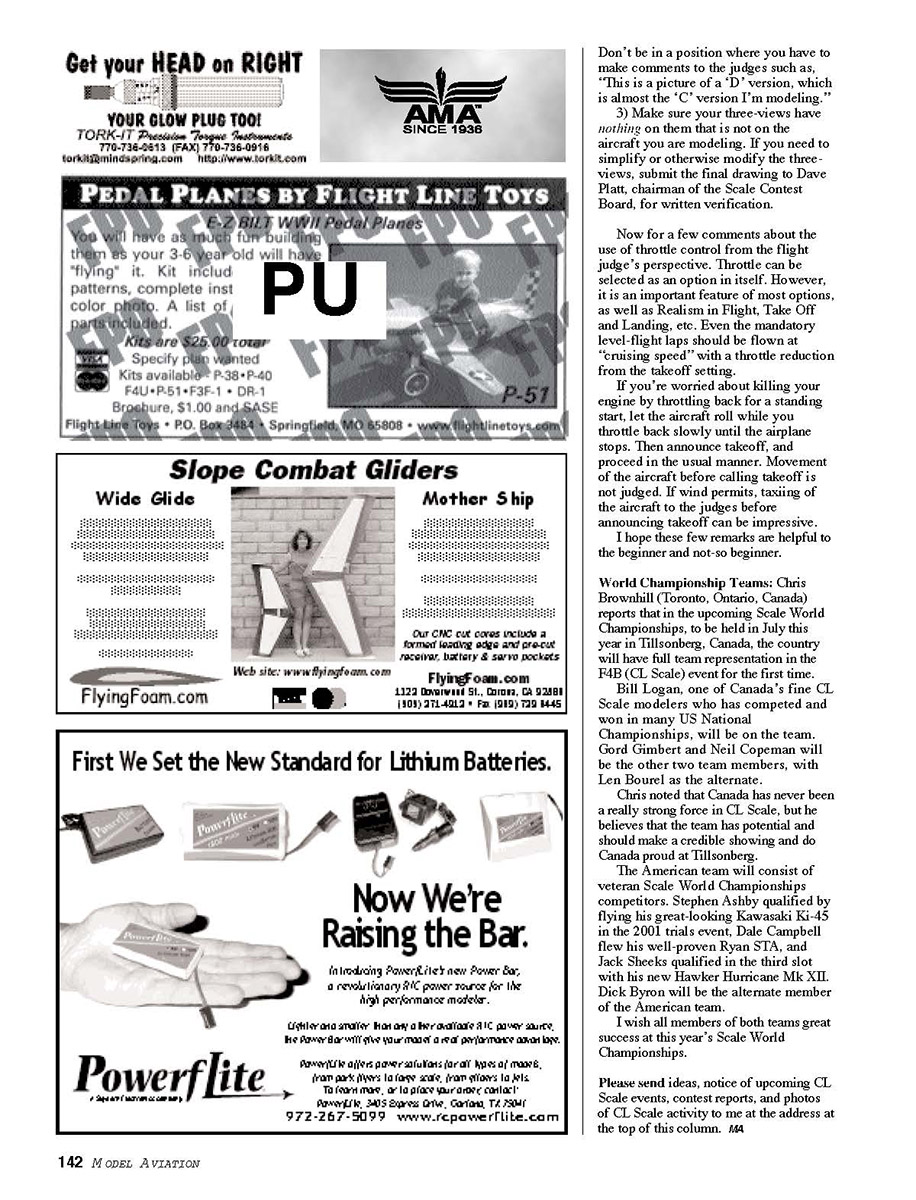
I have also mentioned Bill Young (Flagstaff AZ) and the work he has done in connection with the development of control handles that contain all the electronics needed for three- and five-channel systems. I asked Bill to provide some background and comment on the development of his systems. He was kind enough to provide the following.
"Over the years, I have designed, built, used, and sold many electronic devices for use in models. These include FF (Free Flight) timers, mixers, speed controls, light sequencers, servo testers, glitch recorders, and many more.
"During the last few years, there has been much written about electronic Control Line systems. In fact, there are many being used by many modelers all over the world. They vary from the simplest units operating one servo or speed control, all the way up to systems capable of operating eight or more servos.
"Fred Cronenwett and Grant Heistand are the people I have had the most contact with about these systems. At the 1994 IMS (International Modeler Show, now the AMA Convention) show in Pasadena CA, I discussed the possibilities for a self-contained, custom unit, built for the purpose, with Grant.
"As a result of that discussion I began the design of such a unit and was made available to give both Fred and Grant my first version for field testing. It was a microprocessor-based unit of three channels. Several other fliers saw this unit and wanted one. This resulted in my first revision to a prototype design, and I built six of these units.
"As time went on, and with much feedback from owners, I ended up with the current five-channel version 3.0, self-contained unit. The features I was trying to integrate into the system were:
- Self-contained. No wires over the shoulder;
- Lightweight and compact. No tired arms holding it up;
- Dynamic throttle control. No stumbling around to find the correct throttle setting; and
- Trim and hold functions for the throttle. Makes starting a fuel engine easy.
"I have received many requests for a less-expensive and simpler system, and have spent a lot of time thinking about how to accomplish"
The result is a handle that can be operated like the servo-driven types, without a decoder in the airplane or by adding a decoder in the airplane, an additional two channels can be implemented.
The throttle channel is controlled with a trigger and has an idle trim and a preset associated with it. The preset allows starting a fuel engine without holding the trigger partly open. The two auxiliary channels can be configured as toggling, or as proportional action.
Even further, I have made this design available as a do-it-yourself project. This version is limited to two channels to avoid the use of a microprocessor in the airborne decoder unit. Construction requires woodworking skills, as well as electronics ability.
“If all goes well, this version will be published in this magazine [with...],” (answering) this year following an article by Fred Cronenberg about CL throttle systems and getting started in CL scale modeling.
In addition to the handle and the decoder unit (if used), the system requires several other items. First are the insulated control lines. These are made from standard stainless-steel cables, just like you see used to, except these have a nylon coating to insulate them from each other. They are alternate fishing leaders in real life. The control lines are made up just like any other lines and then a set of connecting cables are attached at each end to plug into the handle and the airplane.
Next are the servos and/or electronic throttle control, along with associated battery pack, switch harness, and charger. In the case of an electric-powered airplane, the electronic throttle can also provide the power for the system through a battery eliminator circuit (BEC), included in the unit.
Other than making the necessary connections between the servos and what they control, that is, except for how easy it is to operate Control Line models with these electronic systems. You have full electronic control without line tension. Thus, the throttle can be shut down in an emergency, as well as be used before the airplane has begun to roll.
“Finally, we older fliers can stop a flight whenever we need to.”
The accompanying photo is Bill’s three-channel system showing the handle and the airplane components of servo, receiver, battery, and on-off switch with a battery charging connector. The insulating lines would be inserted at the “A” connection.
For further information about the cost and availability of the handles, write to Bill Young Designs, 4035 E. Rustic Knolls Ln., Flagstaff AZ 86004. Tel.: (520) 522-0158.
Don't be in a position where you have to make comments to the judges such as, "This is a picture of a 'D' version, which is almost the 'C' version I'm modeling." Make sure your three-views have nothing on them that is not on the aircraft you are modeling. If you need to simplify or otherwise modify the three-views, submit the final drawing to Dave Platt, chairman of the Scale Contest Board, for written verification.
Now for a few comments about the use of throttle control from the flight judge's perspective. Throttle can be selected as an option in itself. However, it is an important feature of most options, as well as Realism in Flight, Take Off and Landing, etc. Even the mandatory level-flight laps should be flown at "cruising speed" with a throttle reduction from the takeoff setting.
If you're worried about killing your engine by throttling back for a standing start, let the aircraft roll while you throttle back slowly until the airplane stops. Then announce takeoff, and proceed in the usual manner. Movement of the aircraft before calling takeoff is not judged. If wind permits, taxiing of the aircraft to the judges before announcing takeoff can be impressive.
I hope these few remarks are helpful to the beginner and not-so beginner.
World Championship Teams: Chris Brownhill (Toronto, Ontario, Canada) reports that in the upcoming Scale World Championships, to be held in July this year in Tillsonberg, Canada, the country will have full team representation in the F4B (CL Scale) event for the first time.
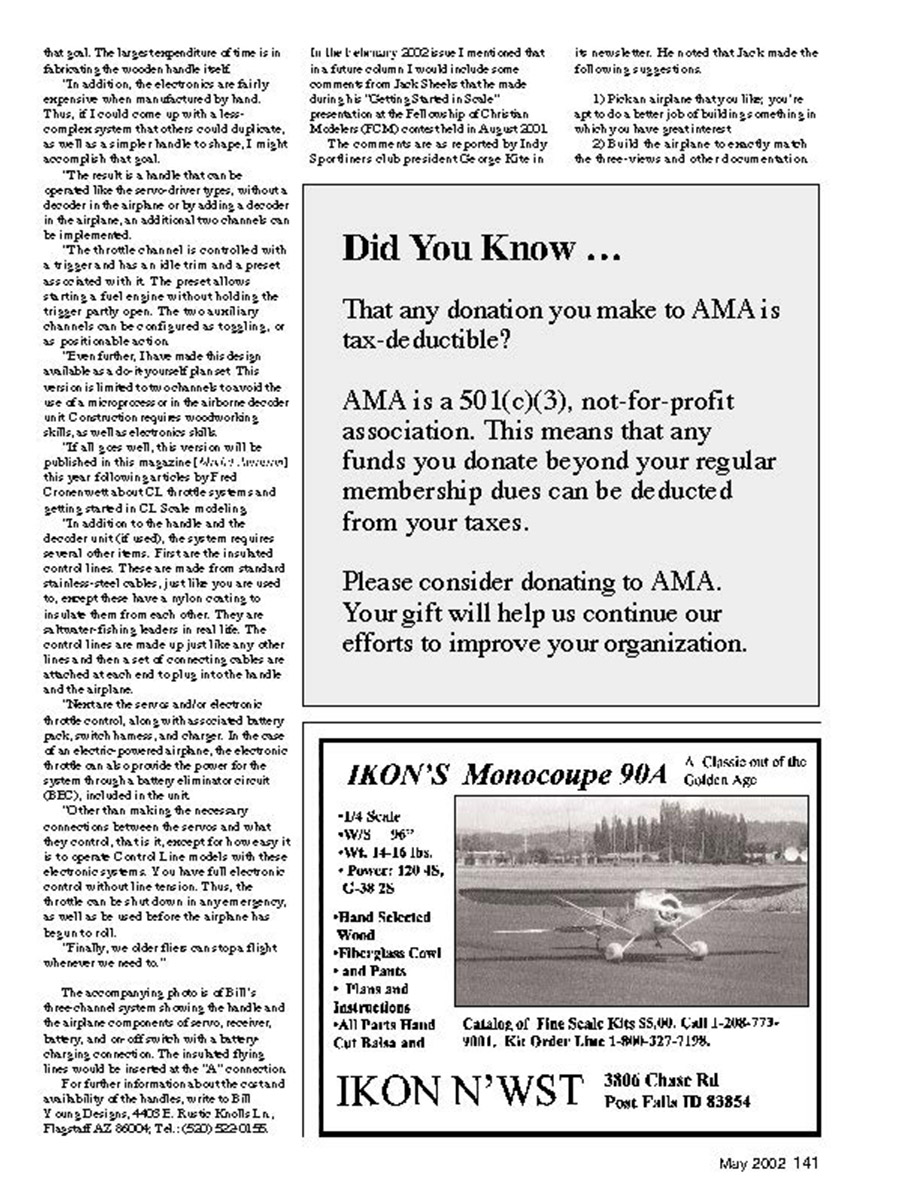
Bill Logan, one of Canada's fine CL Scale modelers who has competed and won in many US National Championships, will be on the team. Gord Gimbert and Neil Copeman will be the other two team members, with Len Bourel as the alternate.
Chris noted that Canada has never been a really strong force in CL Scale, but he believes that the team has potential and should make a credible showing and do Canada proud at Tillsonberg.
The American team will consist of veteran Scale World Championships competitors. Stephen Ashby qualified by flying his great-looking Kawasaki Ki-45 in the 2001 trials event, Dale Campbell flew his well-proven Ryan STA, and Jack Sheets qualified in the third slot with his new Hawker Hurricane Mk XII. Dick Byron will be the alternate member of the American team.
I wish all members of both teams great success at this year's Scale World Championships.
Please send ideas, notice of upcoming CL Scale events, contest reports, and photos of CL Scale activity to me at the address at the top of this column. MA
Transcribed from original scans by AI. Minor OCR errors may remain.