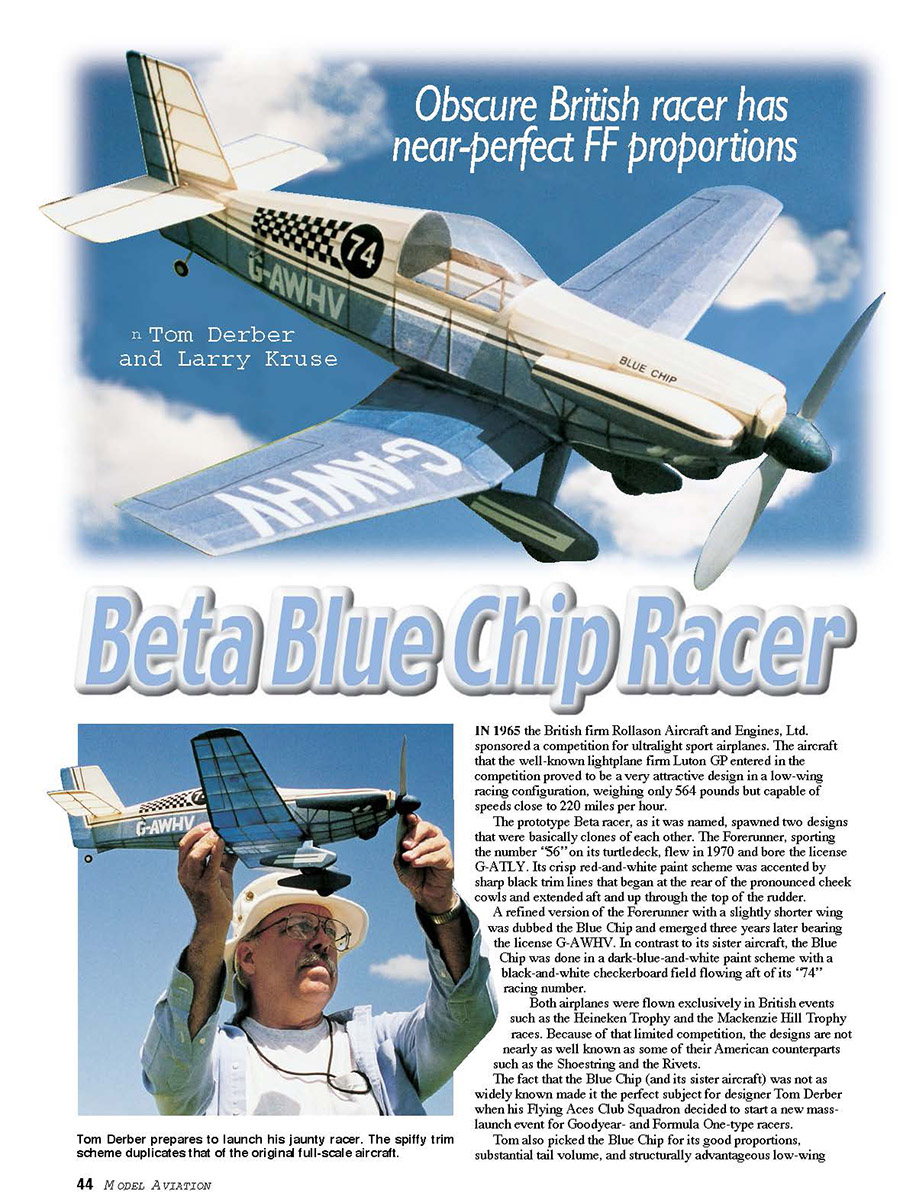
Beta Blue Chip Racer
In 1965 the British firm Rollason Aircraft and Engines, Ltd. sponsored a competition for ultralight sport airplanes. The aircraft that the well-known lightplane firm Luton GP entered in the competition proved to be a very attractive design in a low-wing racing configuration, weighing only 564 pounds but capable of speeds close to 220 miles per hour.
The prototype Beta racer, as it was named, spawned two designs that were basically clones of each other. The Forerunner, sporting the number “56” on its turtledeck, flew in 1970 and bore the license G-ATLY. Its crisp red-and-white paint scheme was accented by sharp black trim lines that began at the rear of the pronounced cheek cowls and extended aft and up through the top of the rudder.
A refined version of the Forerunner with a slightly shorter wing was dubbed the Blue Chip and emerged three years later bearing the license G-AWHV. In contrast to its sister aircraft, the Blue Chip was done in a dark-blue-and-white paint scheme with a black-and-white checkerboard field flowing aft of its “74” racing number.
Both airplanes were flown exclusively in British events such as the Heineken Trophy and the Mackenzie Hill Trophy races. Because of that limited competition, the designs are not nearly as well known as some of their American counterparts such as the Shoestring and the Rivets.
The fact that the Blue Chip (and its sister aircraft) was not as widely known made it the perfect subject for designer Tom Derber when his Flying Aces Club Squadron decided to start a new mass-launch event for Goodyear- and Formula One-type racers.
Tom also picked the Blue Chip for its good proportions, substantial tail volume, and structurally advantageous low-wing
Transcribed from original scans by AI. Minor OCR errors may remain.